
A lane of red torii gates, set close together, throws a reddish light on the stone underfoot. Past them come a pond, a hillside planted with azaleas and a long wall with lattice windows.
Nezu Shrine stands in Bunkyo ward, among Tokyo neighborhoods of low houses and old temples, and walking in costs nothing. The visit is a slow wander through a Shinto shrine and its gardens, best for travelers who like details of wood, lacquer and stone.
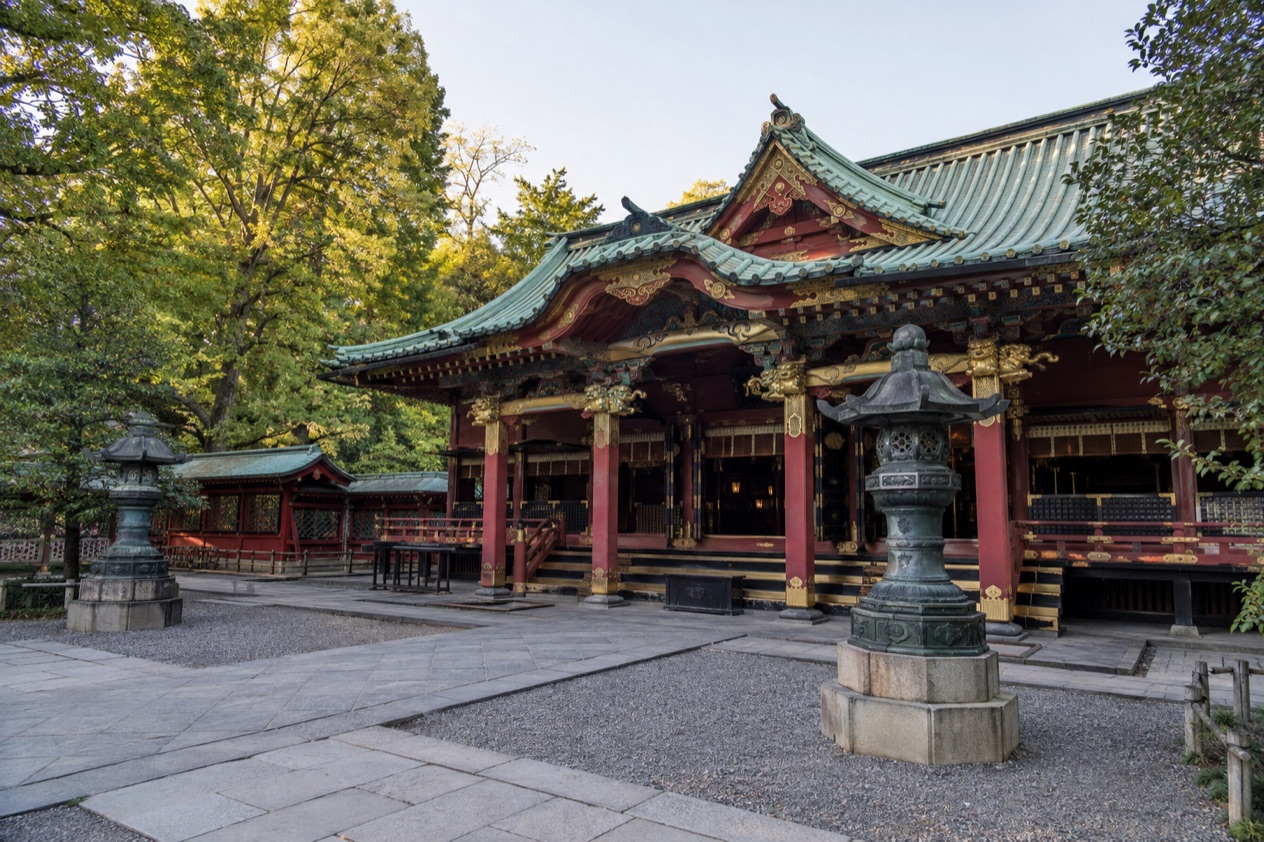
Is visiting Nezu Shrine worth it?
Yes, especially if you like a shrine you take in by wandering rather than by ticking it off a list. Nezu Shrine asks no entry fee and sits near streets of old houses and temples. Its grounds reward slow looking: a long lattice-windowed wall, a tunnel of red gates, a pond with its bridges and, in spring, a hillside of azaleas.
Next to Tokyo’s bigger shrine names, Nezu Shrine works differently. Meiji Jingu is set inside a forest, and Senso-ji is reached through a shopping street. Here the point is the cluster of old buildings, each with its own carved details, and the garden around them. Three of those buildings are designated Important Cultural Properties, so the architecture alone justifies the trip.
It suits architecture lovers, gardeners, photographers and anyone building a day around the old neighborhoods of Yanaka and Sendagi. It is less about one grand view than a string of small ones, and that is its charm. If you want blockbuster spectacle, other places do it louder. If you want a place with texture and a sense of the city beyond the skyscrapers, this is a good choice.
The calendar adds another reason. When the Azalea Festival comes in spring, the hillside turns into a patchwork of pinks, magentas and whites, and the shrine takes on a festive air. Outside that season the visit is quieter in feel but no less rewarding, because the buildings and the wall do not depend on the flowers.
What to see at Nezu Shrine
The grounds hold several distinct parts, and the pleasure lies in how they follow one another as you walk. Begin with the main buildings, then follow the wall, and leave time for the torii path and the azalea hill.
The honden, haiden and heiden
The core of Nezu Shrine is a line of three connected buildings: the honden, where the enshrined deity is housed, the haiden, the hall of worship in front of it, and the heiden, the hall that links them. Each is designated an Important Cultural Property. Susanoo-no-Mikoto is among the deities enshrined here, a figure from Japanese myth.
What you notice is the richness of the surface: lacquered beams, carved details, gilded fittings and heavy tiled roofs. The shrine was established in 1705 and carries the stamp of the Edo period, when the Tokugawa shoguns had the power to commission buildings of this kind. Stand before the haiden, as worshippers do, and look at how the three structures read as one composition.
The Sukibei wall
The Sukibei is a long wall with lattice windows that surrounds the honden. It is the kind of detail that makes the shrine different from a plain walled compound: you can look through the wooden lattice and glimpse the sacred buildings beyond, framed like a picture. The pattern of the openings changes your view with every few steps.
Walk along the outside and notice how the plaster, the tiles and the timber lattice play against the greenery above. Photographers tend to like this stretch because the repeated openings make strong lines, and in spring the azaleas add color along the edges. It is an easy thing to pass without noticing, so give it real attention.
The torii tunnel of Otome Inari
Within the grounds stands a small Inari shrine, Otome Inari, marked by a path of vermilion torii gates set close together. Inari shrines are associated with foxes and with rice and prosperity, and the stone foxes that guard such places often wear little red bibs. The red against the green foliage is one of the most photographed scenes at Nezu.
The gates are donated by worshippers, which is why each one carries inscriptions in black on its posts. It is smaller in scale but has a similar atmosphere of passing through a corridor of color.
The azalea hill and the pond
Behind the main buildings, the grounds rise into a hillside planted thickly with azaleas, and a pond with a bridge lies below. In the Azalea Festival season the slopes burst into bloom and the paths fill with people photographing the flowers against the old buildings. Out of season, the shape of the garden still shows: clipped shrubs, stone lanterns and the green water reflecting the trees.
A pond like this is a classic feature of Edo-period gardens, designed to be seen from several points as you walk around it. Look for the koi rising near the surface, and for the way the roofs of the shrine appear through the branches. Bring patience: the garden is composed to be discovered gradually, not taken in with one glance.
Hours, tickets and rules
Entering the Nezu Shrine precincts is free, and that applies to the whole walk through the grounds: the main buildings, the wall, the torii path and the garden. There is no ticket to buy and no gate where you pay, which makes it easy to fit into a day of wandering. You might spend a few minutes or much longer, depending on how much you like to linger.
The Azalea Festival, known in Japanese as Tsutsuji Matsuri, runs from early April until early May. The honden, haiden and heiden are each designated Important Cultural Properties, which is why the buildings are treated with such care and why visitors tend to keep a respectful distance from the sacred halls.
As at any Shinto shrine, the habits are simple: a slight bow at the torii, a rinse of the hands at the water basin, a coin as an offering at the haiden, and a bow, a pair of claps and another bow when praying. These are customs that visitors can follow or simply observe. Watching worshippers go through them is part of the experience.
How to get to Nezu Shrine
The shrine is reached by subway, from three stations in the surrounding neighborhoods. Two are on the Tokyo Metro Chiyoda Line and one is on the Tokyo Metro Namboku Line, so the choice depends on where in the city you are coming from.
| Station | Line | Walk to the shrine (minutes) |
|---|---|---|
| Nezu | Tokyo Metro Chiyoda Line | 5 |
| Todaimae | Tokyo Metro Namboku Line | 6 |
| Sendagi | Tokyo Metro Chiyoda Line | 9 |
Nezu Station is the nearest, and the shrine entrances are a walk of just a few minutes from it. Todaimae Station, whose name means in front of the university, sits on the Namboku Line and is another good option. Sendagi Station takes a little longer on foot but puts you into the lanes of the neighborhood first, which some travelers prefer because it turns the approach into part of the visit.
If you are arriving in Tokyo from abroad, you will land at Haneda Airport, officially Tokyo International Airport, or at Narita Airport, Japan’s largest international airport. From either, you can make your way into the city and then to one of the stations above. Tokyo is on Tokyo Bay, in the Kanto region on Honshu, and the shrine is in the Bunkyo ward within the city itself.
Visitors approach Nezu from other well-known districts. Ginza and Nihonbashi, for instance, are in Tokyo too, the first an upscale area of luxury shops and restaurants and the second known for its heritage and its role as Japan’s main financial district. Roppongi and Akasaka are also in the city, and the Chiyoda Line stops at Nogizaka Station there, which links to the Chiyoda Line stations near the shrine.
When to visit Nezu Shrine
If you want the shrine at its most colorful, that is the window to aim for. The exact moment of full bloom shifts from one spring to the next, so the festival period is a better guide than a single date.
Outside those weeks, the shrine is still worth a visit. The buildings, the wall and the torii path do not depend on flowers. In autumn the garden has a muted palette, and in winter the bare branches make the architecture stand out more clearly. Each season gives a different reading of the same grounds.
| Month | Average high (°F) | Average low (°F) | Days with rain or more |
|---|---|---|---|
| January | 49.6 | 34.2 | 4.5 |
| April | 66.9 | 49.6 | 9.5 |
| July | 85.8 | 72.3 | 10.5 |
| October | 71.6 | 58.6 | 10.5 |
April brings mild afternoons and cool mornings, and rain falls on roughly one day in three, so a folding umbrella earns its place in the bag. July is hot and humid, the kind of weather that makes you slow down and look for shade under the trees.
It is a comfortable month for walking the grounds, even though the azaleas are not in bloom. The mild air makes it pleasant to stroll the neighborhood lanes before and after you visit the shrine.
Tips for your visit
Treat Nezu Shrine as one stop in a neighborhood day, not an outing on its own. The streets around it are lined with old houses, small temples and local shops, and they are part of the same experience. Yanaka and Sendagi are the neighborhoods that travelers combine with the shrine, and wandering through them before or after gives the visit more context.
Bring comfortable shoes for paths and steps, a camera for the wall and the torii path, and a few coins if you want to make an offering at the haiden. In the rainy months, an umbrella is useful, and the wet stone and lacquer look especially rich in a gray light. In hot weather, a hat and a bottle of water are sensible companions.
For families, the pond with its koi and the red torii path tend to catch children’s attention, and the grounds give room to wander. Because the visit does not involve a ticket or a set route, you can adjust it to the mood of the group. Anyone with limited mobility may want to look at the layout of the grounds on arrival, since the garden includes a hillside and steps.
If you come in the festival season, plan to spend more time in the garden and expect the paths to be busy with other visitors photographing the flowers. Slow down and let people pass. Outside that season, spend the extra time on details: the carving on the haiden, the pattern of the lattice, the inscriptions on the torii. They reward the traveler who looks closely.
Good to know before you go
Entry to the grounds is free, but it is a habit at a Shinto shrine to carry a few coins for the offering box in front of the haiden, and to keep a little change for a fortune slip or a wooden votive plaque if you want one. Visitors tend to speak softly in the precincts and to step aside from the main path when they stop to take photographs, out of respect for people who have come to pray. Showers are frequent in the wetter months, so a light rain jacket is worth having on a Tokyo trip, and the wet season gives the stone and moss a deeper green.
Sources
- Wikipedia, Nezu Shrine (https://en.wikipedia.org/wiki/Nezu_Shrine), checked October 11, 2026
- Japan National Tourism Organization, Tokyo (https://www.japan.travel/en/destinations/kanto/tokyo/), checked October 11, 2026
- Japan Meteorological Agency (JMA), Normal values 1991-2020, monthly (https://www.data.jma.go.jp/stats/etrn/view/nml_sfc_ym.php?prec_no=44&block_no=47662), station Tokyo, elevation 25 m, checked October 11, 2026
To plan your stay
- Best Time to Visit Japan: Cherry Blossoms, Autumn Colors, Weather and Festivals
- Where to Stay in Japan: Ryokan, Temple Stays, Capsule Hotels and the Best Cities to Base In
- Sending Luggage from the Airport in Japan: Hands-Free Travel, Hotel Delivery and Coin Lockers
- Know Before You Go to Japan: Entry, Money, Etiquette and Getting Around