
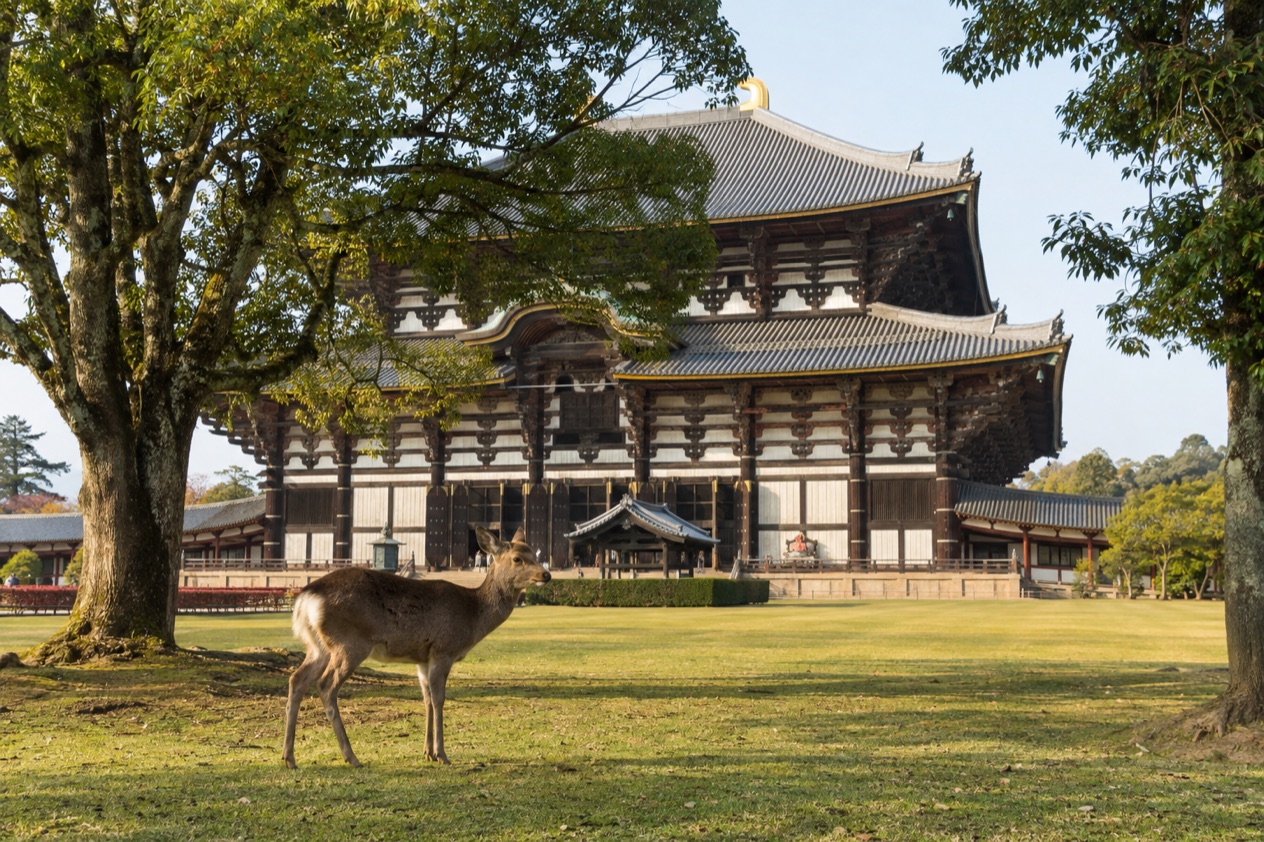
A deer steps out from under the trees of Nara Park, bows its head for a rice cracker, and wanders on toward the great wooden halls of Todaiji. A few streets away, the lanes of Naramachi hold old townhouses with latticed fronts, and the evening belongs to people heading home from the stations. Choosing where to sleep in Nara means choosing which of these Naras you wake up in, the park, the old merchant quarter, the station districts or the countryside around Horyuji.
What is the best area to stay in Nara?
For a first visit, the streets around Kintetsu Nara Station and Nara Park are the best place to base yourself, while travelers who arrive by JR, who want a wider choice of rooms near a train line, or who plan to see Horyuji and Heijo Palace will find the JR Nara Station side and the western districts more useful.
If sightseeing is the whole point, the park side of town puts you next to the deer, the Great Buddha at Todaiji and Kasugataisha Shrine, with its lantern-lined approach. You step out of the lobby and you are already on the way to the main sights. Mornings and evenings in the park belong to you rather than to a day trip from Kyoto or Osaka, and that is a real pleasure.
If you love old streets and want a lodging with some character, Naramachi is the answer. Both stations lead to it, and it sits within reach of the park. It is a district of former merchant houses, small shops, cafes and craft stores, and it suits travelers who like to wander without a fixed plan and come back to a room that feels like part of the town.
Budget travelers and those who travel by rail will often look near JR Nara Station, because that is where the JR Yamatoji rapid train from Osaka and the JR Miyakoji rapid service from Kyoto arrive. The station area works as a transport hub, and from there the park is reached on foot or by bus. For a night or two, with sightseeing planned by train, it is a sensible base.
Families usually care about two things, how far the children must walk and how easy it is to get back for a rest. A room on the park side keeps the deer, the open lawns and the temple grounds close at hand. The deer are tame and can be approached and fed with crackers sold along the roadside, which children tend to remember long after the temples have blurred together.
Nightlife is not why people come to Nara, and it is better to say so plainly. Evenings here suit a long dinner, a walk under lit paths in the park or the old town, and an early night. Travelers who want bars and late dining will find more choice if they stay in Osaka or Kyoto and take the train in for the day, since Nara is easily reached from both.
The areas differ in what surrounds you more than in how they are reached. The park side gives you deer, temples and lawns outside the door. Naramachi gives you old lanes and small shops. The JR station district gives you trains and buses, and the western districts toward Ikaruga and Heijo Palace give you ancient sites that most day visitors skip. Pick the one that matches the evening you picture, not only the day.
One more consideration is your own rhythm. A traveler who likes to be out at the first sign of morning will enjoy the park side, where the walk to the major sights begins at the hotel door. A traveler who prefers to pick a restaurant, wander through shopping lanes and then ride on to the next city will be happy near the stations. Either choice works, because Nara rewards both ways of traveling.
The best areas to stay in Nara
Around Kintetsu Nara Station and Nara Park
This is the part of Nara that most first-time visitors picture. Nara Park lies at the foot of Mount Wakakusa, and the deer move freely across its lawns, paths and the edges of the temple grounds. Todaiji, with its giant Buddha statue and the Nandaimon Gate, stands within the park, and so does Kasugataisha Shrine, known for its brass lanterns and for wisteria that blooms in May.
Staying here suits couples, families and anyone who wants to be among the sights at the quiet edges of the day rather than arriving with a tour. The Kintetsu line brings you in from Kyoto in just over half an hour and from Osaka-Namba by limited express in about the same, so the area also works as a base for rail travelers. A hotel near the station or a ryokan closer to the park both make sense here.
Getting around is mostly on foot, since the park, the main temples and the shrine are all in this part of the city. Buses from Nara Kotsu cover what is farther out. One practical tip: bring a small bag of your own for the walk to dinner, because deer in the park have a way of approaching anyone carrying paper or snacks.
Around JR Nara Station
JR Nara Station is one of the city’s two main stations, and the district around it is where the railway plays the biggest role. The JR Yamatoji rapid train from Osaka and the JR Miyakoji rapid service from Kyoto both arrive here directly. For travelers who have planned a loop through Kansai by JR, this is the neighborhood where arriving, checking in and heading out the next morning all feel straightforward.
The lodging here leans toward the practical. Business-style hotels and simple rooms are the sort of stay that suits a one-night or two-night visit, and a guesthouse can make sense for solo travelers who want a base and little more. The park is a walk of twenty minutes from the station, or a bus ride, so you are not cut off from the main sights.
Getting around from here relies on the Gurutto buses in Nara City, as well as the train network run by JR West. If your trip is built around the rail line and you plan to visit places farther out, this district keeps your options open.
Naramachi
Naramachi is the old town of Nara, a district of narrow streets and former merchant houses that has been turned into a place of small shops, cafes and galleries. It can be reached from both Nara Station and Kintetsu Nara Station, which gives you a choice depending on the train you arrive on. Staying here means dinner in the old lanes and a morning that starts on streets rather than in a lobby.
It suits travelers who prefer atmosphere to convenience, and couples who want something with a sense of place. For lodging, this is where the idea of a traditional inn feels most natural. A ryokan typically offers tatami floors, futons, a yukata to wear, a kaiseki dinner and a traditional Japanese breakfast, and some have private baths. A guesthouse or a small boutique-style inn also fits the setting.
From Naramachi you reach the park and its temples on foot or by bus, and you can return to your room between visits. A tip for the evening: after dinner, walk the lanes once more. The shop fronts are closed, the old wooden facades stand out, and the town feels much like it did to the people who lived and traded here.
Nishinokyo, Ikaruga and the western districts
West of the center, the landscape opens up toward ancient sites. Heijo Palace marks Heijokyo, Japan’s first capital, which dates back 1300 years to the Nara Period. The Ikaruga district is home to Horyuji Temple, described as the world’s oldest wooden building. A bus will take visitors to Heijo Palace and Horyuji, and the Nara 1-Day Pass covers the Nara Park and Nishinokyo areas.
This area suits travelers who have already seen the deer and the Great Buddha, or who are returning to Nara and want to spend time on its history. Lodging here is a matter of looking for a place near a bus stop or a station on the Kintetsu or JR lines, both of which operate rail service throughout Nara. The setting is more about the sites around you than about restaurants and shops.
Getting around depends on the bus and the train. Nara Kotsu runs an extensive bus network, including to places that the rail lines do not serve. Its sightseeing bus tours cover Nara Park, Horyuji and Nishinokyo, with audio guides in English and Chinese. A tip: pick your base here only if the ancient sites are your main reason for coming.
Staying in Kyoto or Osaka and visiting Nara
Nara lies east of Osaka and south of Kyoto, and both cities are linked to it by train. From Kyoto Station, Kintetsu Nara Station is reachable in just over half an hour. From Osaka-Namba Station, the Kintetsu limited express reaches Kintetsu Nara Station in 35 minutes, and the regular express takes five minutes longer. The JR rapid trains from both cities arrive at JR Nara Station.
For some trips this is the right call. If your plans are built around the nightlife, shopping or temples of one of the two larger cities, keeping your hotel there and visiting Nara for the day keeps things simple. The cost is that you leave Nara when the day trippers do, and you miss the park in the hours when you can have it more to yourself.
Spending at least one night in Nara changes the visit. You can walk in the park after the day’s trains have left, eat in the old town, and wake up with the deer and the temples as your neighbors.
Nara areas compared
| Area | Best for | Feel | Getting around |
|---|---|---|---|
| Kintetsu Nara Station and Nara Park | First visit, sightseeing, families | Deer, lawns, temples and shrines at the doorstep | 5-minute walk from Kintetsu Nara Station to Nara Park |
| JR Nara Station | Rail travelers, short stays | A station district with trains and buses | 20-minute walk from JR Nara Station to Nara Park, Gurutto buses in the city |
| Naramachi | Old streets, ryokan, couples | Former merchant quarter of small lanes | Reached from both Nara Station and Kintetsu Nara Station |
| Nishinokyo and Ikaruga | Return visitors, history | Ancient sites, Heijo Palace and Horyuji | Buses to Heijo Palace and Horyuji, Nara Kotsu network |
| Kyoto or Osaka as a base | Nightlife, city sightseeing | A day trip into Nara | Kintetsu and JR trains into Nara |
The main trade-off is between being near a station and being near the sights. A room by a station gives you an easy start and finish to the day, with trains, buses and the luggage you carry all handled in one place. A room near the park or in the old town asks for a little more effort to arrive, and in return gives you the setting of Nara itself, with the deer and the old lanes around you.
The second trade-off is the old town against the new. Naramachi and the park keep the atmosphere of the old capital, with its wooden houses, temples and shrines. The station districts are where the modern city lives and moves, and they suit those who prefer straightforward arrival and departure to atmosphere. Neither choice is wrong, and travelers split a two-night stay, one night in each.
The third is how far you plan to go. If your days are spent mostly in Nara Park, with its temples, shrine and lawns, the park side is the natural base.
If you intend to reach Horyuji, Heijo Palace or the ancient towns along the Yamanobe-no-Michi route, which Kintetsu trains serve, a place near a bus stop or a station gives you a better start. The mountain pilgrimage trails toward the Wakayama border are also reached by that line.
A last point is the length of your stay. For one night, being close to your arrival station often matters most. For two or three nights, the character of the neighborhood starts to count for more, and Naramachi or the park side repay the extra attention. Nara is also the starting point of one of the World Heritage Kumano Trails, which suits travelers who plan to continue beyond the city.
How to choose your hotel in Nara
A ryokan is the choice if you want to sleep the way Japan has traditionally welcomed travelers. These inns are believed to have emerged in the 8th century, and they typically feature tatami floors, futons, a yukata to wear around the house, a kaiseki dinner and a traditional Japanese breakfast. Some have private baths, sometimes outdoors. In a city of temples like Nara, a night in a ryokan fits the surroundings well.
Heritage Stays go a step further. At these properties, visitors can take part in cultural activities such as tea ceremony, calligraphy and wearing traditional Japanese clothing. Reservations are required and can often be made through the property’s website or by phone. They suit travelers who want the stay itself to be part of the trip, rather than only a place to sleep between sights.
It keeps arrival and departure easy, and it leaves the evening open for dinner in town. A guesthouse suits those who like a smaller scale and a more personal welcome. For solo travelers and rail-focused trips, either can be a good base, especially close to JR Nara Station or Kintetsu Nara Station.
Distance from the station deserves a thought. Nara Park is a 5-minute walk from Kintetsu Nara Station and a 20-minute walk from JR Nara Station, so the side you stay on changes the shape of your first morning. If you arrive by Kintetsu from Kyoto or Osaka, a park-side hotel keeps things close. If you arrive by JR, a room near JR Nara Station fits better.
From the airports, Nara is about one hour and fifteen minutes by bus and train, which makes it reachable on the day you land. Both Osaka International Airport (Itami) and Kansai International Airport serve the region. For a first night after a long flight, a room near the station you arrive at is the plain choice, and the old town and the park can wait for the next morning.
For families, the question is how much walking the day will involve. The park is large, and the deer and wide lawns keep children interested, but a room on the park side lets everyone return for a rest. Nara Kotsu operates buses throughout the area, and its sightseeing tours include audio guides in English and Chinese, which some families find useful when covering Nara Park, Horyuji and Nishinokyo.
For travelers with limited mobility, the choice of area matters more than the type of room. The walk from JR Nara Station to the park is the longer of the two, so a room on the Kintetsu side or a bus ride may suit better. The Gurutto buses and Nara Kotsu network cover much of the city, which gives you options when the distances grow.
Finally, think about the season. Nara Park has its own calendar. The brass lanterns at Kasugataisha Shrine are lit twice a year, in winter and summer, and the shrine’s wisteria blooms in May. If you plan your trip around one of these moments, choose a base close enough to the shrine that you can go in the evening and walk back to your room afterward.
Good to know before you go
Getting to Nara from the airports takes about one hour and fifteen minutes by bus and train, whether you land at Osaka International Airport (Itami) or Kansai International Airport. Once in the city, the Gurutto buses cost 100 yen per trip, and the Nara 1-Day Pass costs 600 yen for adults and 300 yen for children, covering the Nara Park and Nishinokyo areas.
Both Kintetsu and JR West run trains throughout Nara, and Nara Kotsu buses reach remote areas that the rail lines do not. Deer crackers are on sale around the park, and the deer have been regarded since old times as messengers of the gods. Nara has three World Heritage sites, which gives even a short stay a good deal to fill your days.
Sources
- Japan National Tourism Organization, Nara (https://www.japan.travel/en/destinations/kansai/nara/), checked October 11, 2026
- Official Nara Travel Guide, getting around Nara (https://www.visitnara.jp/getting-around-nara/), checked October 11, 2026
- Official Nara Travel Guide, first-time visitors (https://www.visitnara.jp/for-first-time-visitor/), checked October 11, 2026
- Official Nara Travel Guide, Nara Park area (https://www.visitnara.jp/destinations/area/nara-park/), checked October 11, 2026
- Japan National Tourism Organization, ryokan stays, what is included, etiquette (https://www.japan.travel/en/guide/japanese-ryokan/), checked October 11, 2026
- Japan National Tourism Organization, heritage stays (https://www.japan.travel/en/heritage-stays/), checked October 11, 2026