
MIAMI · THE THREE-DAY PLAN · 3 DAYS · 2 CITIES
Three days is the length most people give Miami, and it works once you stop treating the place as one city. The City of Miami counted 442,241 residents at the 2020 census. Miami Beach counted 82,890, and it sits on its own barrier islands with Biscayne Bay in between. Two cities, two governments, one airport. Crossing that water twice is the whole trick of a short stay, and it costs $2.25 a ride rather than a rental car.
Timings matter more than lists when you have 72 hours. A last admission at 4:30 p.m., a museum that stops charging at 5 on Thursdays, a free trolley that quits at 11: those are the hinges a Miami day swings on. Where a number does not exist, we say so, and hotel rooms are the biggest hole of all.
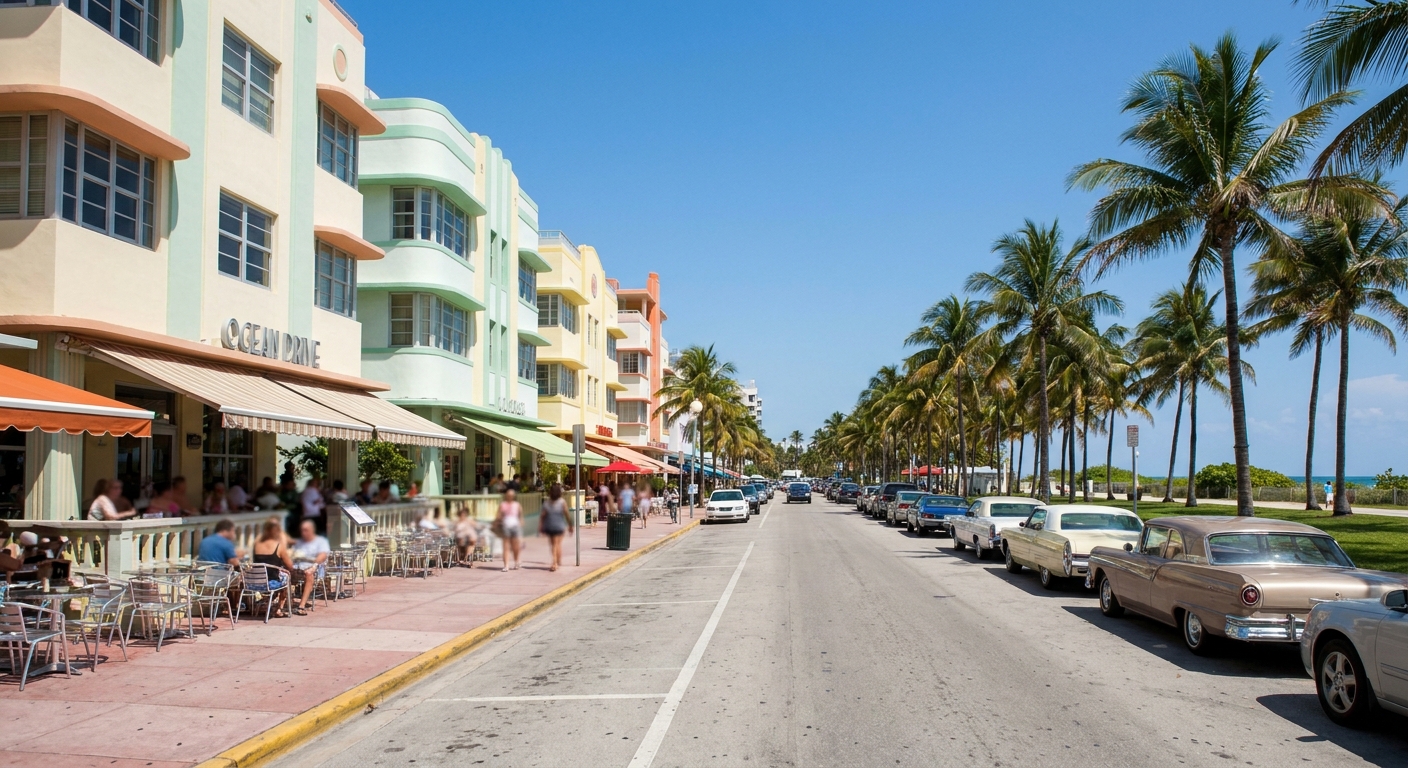
THREE DAYS AT A GLANCE · MIAMI
Three days covers South Beach, then Downtown with Brickell, then one day out to Vizcaya or the Everglades: the Keys need a trip of their own.
3 DAYS · 2 SEPARATE CITIES · TRANSIT FARE $2.25 · DAILY CAP $5.65
Go for: a beach that costs nothing (Lummus Park, free and open 24 hours), a free elevated train around Brickell, and Thursday evenings when the Pérez Art Museum stops charging from 5 to 9 p.m.
Think twice before: driving. For spring break 2026 the four Art Deco District garages went to flat rates of $40 to $100, and non-resident towing in that district runs $548 plus administrative fees.
Fares: Miami-Dade Transit · Hours: vizcaya.org, pamm.org · Normals: NOAA 1991-2020, Miami International Airport gauge · full sources at the end
On this page
- Is three days enough in Miami?Two neighborhoods and one day trip
- Day 1 in South Beach, hour by hourLummus Park, then the Deco blocks
- Downtown and Brickell without a carThe free Metromover, every 90 seconds
- Vizcaya hours or the Everglades feeDay 3, both priced
- Miami or Miami Beach when booking a hotelThree separate cities, one name
- What to do in Miami when it rainsPAMM, the Metromover, Vizcaya’s house
- What three days in Miami costs in tickets$73.90 for two, added up
- Miami in January or in July10h45 of daylight against 13h38
- What to skip in three daysKey West and the second park entrance
The sequence below assumes you land at MIA, about 12 miles from South Beach, and that you have two full days plus two half days of light. For the neighborhood picture and what each one holds, see our Miami guide. For picking the month itself, the best-time verdict does that job.
Is three days enough in Miami?
Three days buys two neighborhoods done properly and one day out. South Beach and the Art Deco streets fill a day without hurrying. Downtown and Brickell fill a second, since the Metromover links them for free and comes every 90 seconds at rush hour. The third day is a single choice rather than a list. What three days will not buy is the Overseas Highway: Key West is a day’s drive each way, and it wants nights.
The format suits a long-weekend traveler flying in from a cold Friday, and it suits anyone happy on a bus. Families with young children will feel day 3 squeeze, because the Everglades entrances and the Flamingo Visitor Center each sit at least an hour’s drive from one another. Event travelers should recount before booking: the 2027 Miami Open runs March 14 to 28 at Hard Rock Stadium in Miami Gardens, and its last three days overlap Ultra at Bayfront Park on March 26, 27 and 28.
Daylight decides the answer more than stamina does. On January 15 the sun rises at 7:07 a.m. and sets at 5:52 p.m., about 10 hours 45 minutes. On July 15 it runs 6:38 a.m. to 8:15 p.m., 13 hours 38 minutes. That gap of nearly three hours is one extra sight per afternoon in summer, if the heat lets you take it.
South Beach and the Art Deco district: day 1 of a Miami itinerary
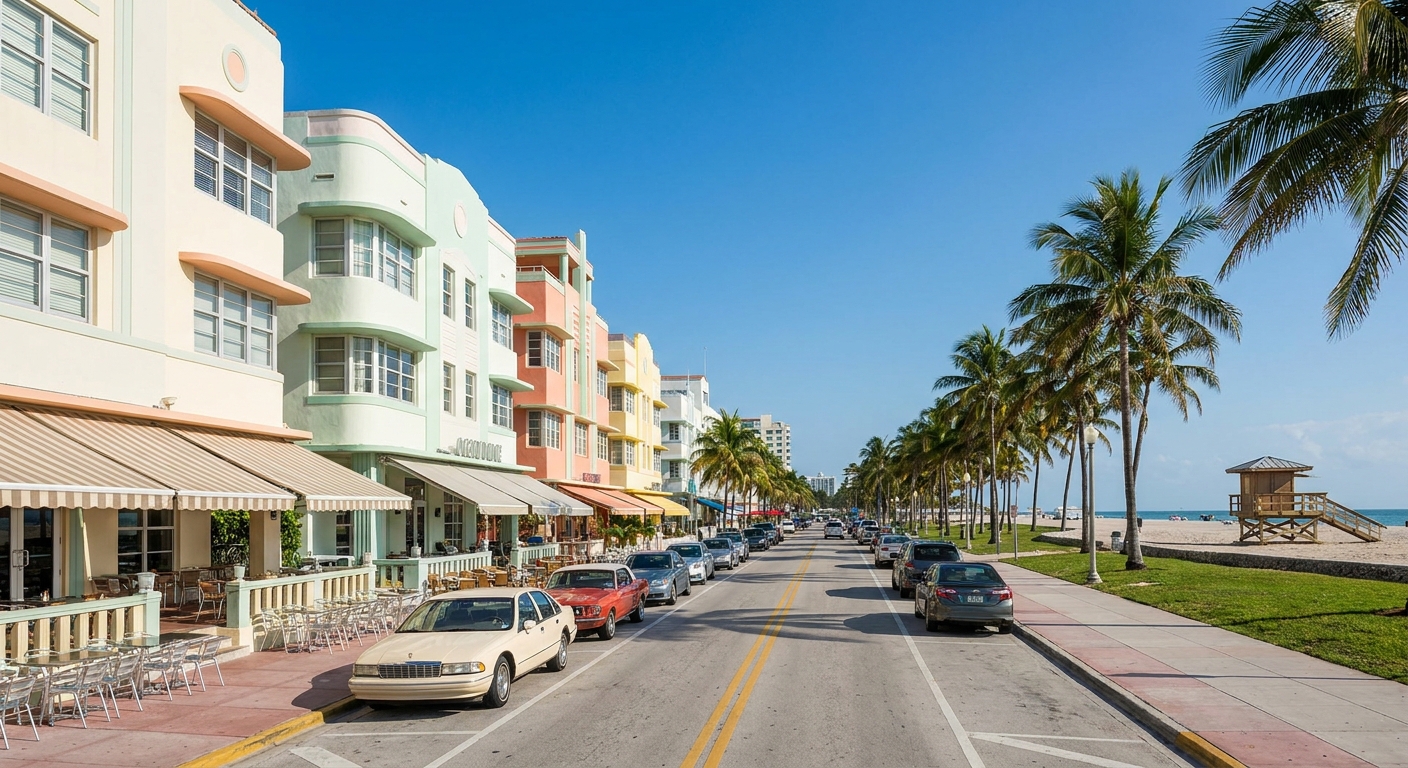
The beach that fronts Ocean Drive is Lummus Park, running between 5th and 15th Streets. Entry is free, it is open 24 hours, and it has lifeguards on duty, public restrooms and picnic tables. Reaching it needs no car. The Miami Beach trolley is free, runs 8 a.m. to 11 p.m. seven days a week and comes about every 20 minutes on five routes, two of them South Beach loops. Straight from the airport, Metrobus 150 crosses the Julia Tuttle Causeway to Mid Beach for $2.25 and carries luggage racks.
Take the sand before nine and keep the Deco streets for later, when the pastel façades hold side light and the terraces open. Walk south after lunch: South Pointe Park is free to enter and puts the cruise-ship channel at your feet. On a spring Thursday, be clear of the South of Fifth and Flamingo Park streets by six. Miami Beach police ran a traffic plan there from 6 p.m. Thursday through Sunday in 2026, with garage and lot closures, restricted beach access and DUI checkpoints among the announced measures.
Driving anyway? Price the ground first. The four Art Deco District garages sit between 5th and 16th Streets, from Washington Avenue to Ocean Drive, and for spring break 2026 they switched to flat rates of $40 to $100. The public lot at South Pointe Park starts at $2 an hour and charges a $20 flat day rate on weekends and public holidays. Towing a non-resident car out of that district costs $548, double the regular rate, plus administrative fees. The city republishes its spring-break plan each winter, so treat the 2026 figures as a warning rather than next year’s quote.
Evening redraws the map. The trolley stops at 11 p.m., and Metrobus 120, the Beach MAX, is the link back over the MacArthur Causeway to the Downtown Bus Terminal for $2.25. Dinner on the island keeps you within walking distance of your bed. Dinner in Little Havana or Wynwood, both mainland neighborhoods inside the City of Miami, means a bay crossing at midnight and a rideshare fare we have no figure for. For 2026 there was no blanket curfew in South Beach and beaches did not close at 6 p.m.: one applies only if the police chief calls for it.
Downtown Miami and Brickell on the free Metromover: day 2 of a Miami itinerary
The Metromover is free, with no ticket and no tap, and it runs elevated loops through Downtown Miami and Brickell. Cars arrive every 90 seconds at rush hour and every three minutes off-peak. Published hours disagree: Miami-Dade gives 5:30 a.m. to 10 p.m. seven days a week, while local sources list 5 a.m. to midnight, so read the last-car notice on the platform. Coming from MIA, the MIA Mover reaches the Miami Intermodal Center, and the Metrorail Orange Line runs Downtown about every 15 minutes for $2.25, with free transfers to Metrobus.
Aim day 2 at a Thursday if the calendar allows. The Pérez Art Museum Miami is free from 5 to 9 p.m. every Thursday, and free all day on the second Saturday of each month, with art-making from 11 a.m. to 3 p.m. A Thursday therefore gives you Brickell in the afternoon and four museum hours at no admission. Bayfront Park sits along the same waterfront walk, and it is the ground Ultra occupies on March 26, 27 and 28, 2027.
Getting back across the bay costs the same $2.25 on route 120. Fare capping rewards a busy Downtown day: Metrorail and Metrobus stop charging once you hit $5.65 in a day, and the Metromover was never counting anyway. Reduced fare is $1.10. Nothing in these three days requires a car, and our Florida transport guide covers the parts of the state that do insist on one.
Vizcaya or the Everglades: day 3 of a Miami itinerary
Day 3 comes down to one call: a bayfront house inside the city, or a national park with a drive at each end. Vizcaya costs a morning. The Everglades takes the whole day. Attempting both means seeing neither properly, since the park’s three entrances and the Flamingo Visitor Center each sit at least an hour apart by road.
Vizcaya Museum and Gardens opens Wednesday to Monday at 9:30 a.m., with last admission at 4:30 p.m., and it closes on Tuesdays. Adult admission is $20 while restoration work is underway, down from the usual $25. Children 6 to 12 pay $5 and under-6s enter free. It stands in north Coconut Grove, inside the City of Miami, looking over Biscayne Bay, and the Vizcaya Metrorail station is a few minutes’ walk away. This is the version of day 3 that still needs no car.
Everglades National Park charges $35.00 per private vehicle, good for seven days. One fee covers a carful, so the park favors four travelers over two. Then add the road: an hour out, an hour back, and another hour if a second entrance tempts you. The dry months concentrate wildlife along the boardwalks, and December to April is when South Florida holds roughly 65°F to 80°F.
Choosing the park costs you the house, the gardens and a Coconut Grove afternoon. Choosing Vizcaya costs you the alligators, and it hands back your evening: on the beach by mid-afternoon instead of on I-95 at dusk. One more line for the ledger, and it can decide things by itself. Vizcaya is shut on Tuesdays, so a Sunday-to-Tuesday trip has already made the choice.
For the flight home, count the ground honestly. MIA is about 12 miles from South Beach, 20 to 45 minutes depending on traffic. FLL is about 25 miles out, 35 to 50 minutes on I-95. On transit the last departure matters more than the mileage: Metrorail and route 150 both run to around midnight, and route 150 comes roughly every 30 minutes. For a morning flight, start moving two hours before the counter rather than one.
Miami itinerary mistakes to avoid
Booking a bed in one city and planning your days in the other is the classic first error. Miami Beach and the City of Miami are separate municipalities with separate governments, and Coral Gables is a third: incorporated on April 29, 1925, with its own police force and zoning. A hotel marketed as Miami can be a causeway and twenty minutes from Ocean Drive. Read the street address before the property name.
Stacking the arrival day is the other. Landing at noon and trying for the beach, Wynwood, Little Havana and a Brickell rooftop before dark ends in an argument in a rideshare. In January the light is gone at 5:52 p.m. Give that first afternoon to one neighborhood, and ride the free Metromover loop on day 2 with fresh legs.
What to do in Miami when it rains
The covered options cluster Downtown. The Pérez Art Museum Miami is the anchor, free from 5 to 9 p.m. on Thursdays and free all day on second Saturdays. The Metromover is a dry elevated circuit of Downtown and Brickell, and riding out a squall on it costs nothing. Vizcaya’s main house shelters you too, though the gardens are half the point, and last admission still lands at 4:30 p.m.
Rain in Miami is a season rather than a forecast. Statewide the wet months run May through October, with summer highs near 90°F, humidity between 85 and 90 percent, and storms that tend to build in the afternoon. At the Miami International Airport gauge, June is the wettest month of the year at 10.51 inches against 1.83 in January (NOAA 1991-2020). Month-level detail lives in the June page and its eleven siblings.
Two things we cannot put a number on: admission for indoor attractions beyond the ones priced here, and how long a given storm parks over your afternoon. One date range is worth holding on to instead. Atlantic hurricane season runs June 1 to November 30 and peaks on September 10.
What three days in Miami costs in tickets and fees
| Line item | Price | Note |
|---|---|---|
| Lummus Park beach | $0 | Free, open 24 hours, lifeguards |
| Miami Beach trolley | $0 | 8 a.m. to 11 p.m., about every 20 min |
| Metromover | $0 | Downtown and Brickell, no ticket |
| Metrobus or Metrorail ride | $2.25 | $1.10 reduced · daily cap $5.65 |
| Vizcaya, adult | $20 | Usually $25 · closed Tuesdays |
| Vizcaya, child 6 to 12 | $5 | Under 6 free |
| Everglades entry | $35.00 | Per private vehicle, 7 days |
| South Pointe Park lot | from $2 an hour | $20 flat on weekends and public holidays |
| Crandon Park parking | $7 weekday · $10 weekend | Key Biscayne |
| Art Deco garages, spring break 2026 | $40 to $100 flat | Non-resident tow in the district: $548 |
Those are the published figures this plan actually touches. Days 1 and 2 carry no admission at all, because the beach, the trolley and the Metromover are free. The two paid entries both fall on day 3, and they do not compare cleanly: Vizcaya charges per person, the Everglades charges per vehicle.
Added up for two adults riding transit, the Vizcaya version is $20 and $20 in admission plus the $5.65 daily cap each, so $51.30 for that day in tickets and fares. The Everglades version is $35.00 for the vehicle, whatever the rental adds on top. Over the full three days, two people hitting the cap every day pay $33.90 in fares, and $73.90 once the two Vizcaya tickets go in.
The bigger half of the bill is missing, and we would rather name the hole than fill it with a guess. We have no hotel rates for Miami Beach, and the nightly resort fee stacked on the room varies too much to quote: published figures run from around $25 on average to $35 or $95 by property. Rental cars, rideshares and restaurant meals are unpriced here as well. Market data puts hotel rates lowest August to October and highest February to April. That is a trend, not an official statistic. Our Florida cost guide takes the wider view.
Best time to visit Miami: January vs July
The same three days rearrange themselves around the light. January 15: sunrise 7:07 a.m., sunset 5:52 p.m., about 10 hours 45 minutes. July 15: sunrise 6:38 a.m., sunset 8:15 p.m., 13 hours 38 minutes. In winter, Vizcaya’s 4:30 p.m. last admission sits close to the end of usable light, so that visit belongs in the morning. In July the identical visit still leaves three hours for the beach afterward. Every climate figure here comes from the NOAA 1991-2020 normals at the Miami International Airport gauge.
Season also moves the hours you build around. January averages a high of 76.2°F and a low of 61.0°F with 1.83 inches of rain and 3.8 days at a tenth of an inch or more. July averages 90.6°F and 77.5°F with 7.36 inches and 11.1 such days, 2.2 of them over a full inch, so an indoor afternoon becomes likely and PAMM’s Thursday 5 to 9 p.m. window turns from an option into the plan. Early December brings Art Basel Miami Beach to the Convention Center in South Beach, and island rooms tighten around it. Published 2026 dates diverge, so confirm before counting on them.
What to skip if you only have three days in Miami
Key West does not fit. Neither does Orlando, and neither does a second Everglades entrance. The bridges run 113 miles down from the mainland, and Key West is a day’s drive each way from South Beach, which leaves you one day of Miami out of three. Crandon Park on Key Biscayne is the tempting near-miss at $7 to park on weekdays and $10 at weekends, and it still spends the afternoon you owed Downtown.
Chasing all of it has a cost beyond tiredness. Each extra hop argues for a car, and the car is what turns free days into paid ones: flat garage rates in the Art Deco District, a $20 weekend day rate at the South Pointe Park lot, $548 if you park wrong there during spring break. The three-day Miami that holds together is the one where the beach, the free trolley and the free Metromover do the carrying and you buy exactly two tickets.
The last word
Settle day 3 before you fly, because Vizcaya shuts on Tuesdays and the Everglades wants a vehicle you may not want to rent. Then let the water settle the rest. The sea off Miami averages about 72°F through the winter, the warmest in the country outside the tropical islands in December, January and February. A January morning on Lummus Park beats whatever indoor plan you had penciled in, and the museum keeps until Thursday at five.
Sources & data for this guide
- Transit fares, $1.10 reduced fare and the $5.65 daily cap · Miami-Dade County, Transit Fares and Parking Fees · checked Sep 10, 2026
- Metromover frequency and the published-hours disagreement (5:30 a.m. to 10 p.m. per Miami-Dade, 5 a.m. to midnight elsewhere) · checked Sep 10, 2026
- Routes 120 Beach MAX and 150 Miami Beach Airport Express · Miami-Dade Transit · checked Sep 10, 2026
- Free trolley routes and 8 a.m. to 11 p.m. hours · City of Miami Beach, Citywide Free Trolley · checked Sep 10, 2026
- Lummus Park (5th to 15th Streets, free, 24 hours) · City of Miami Beach · checked Sep 10, 2026
- Vizcaya hours, 4:30 p.m. last admission, Tuesday closure and the $20 restoration rate · vizcaya.org · checked Sep 10, 2026
- Free Thursday evenings and second Saturdays · pamm.org · checked Sep 10, 2026
- $35.00 vehicle fee and the hour between entrances · National Park Service, Everglades · checked Sep 10, 2026
- January and July normals, June rainfall of 10.51 inches · NOAA NCEI 1991-2020, station USW00012839 (Miami International Airport) · checked Sep 10, 2026
- Sunrise, sunset and daylight length on the 15th · sunrise-sunset.org, converted to America/New_York · checked Sep 10, 2026
- Spring break garage rates, the $548 non-resident tow and the Thursday-to-Sunday traffic plan · City of Miami Beach via NBC 6, CBS News Miami and Time Out · these are the announced 2026 measures and the city republishes them each winter · checked Sep 10, 2026
- Municipal boundaries, 2020 census populations and Coral Gables’ 1925 incorporation · US Census and Miami-Dade County municipal list · checked Sep 10, 2026
- We do not price hotels, resort fees, rental cars, rideshares or restaurants: the published ranges diverge too widely to quote · hours and fees change, so confirm with operators when you book.