
You step out of the station in Nara and the city reveals itself gradually: a street lined with shops, then a gate, then a lawn where deer lie in the grass as if they own it. They do, more or less, and they have been treated that way for a very long time. A few practical things make the visit run smoothly, from the paperwork to the trains, the yen, the weather and the small habits that shape daily life here.
What should you know before visiting Nara?
Four things matter most: the city sits in the Kansai region and is reached by rail from Osaka and Kyoto, it has two separate train stations, the deer in Nara Park are part of the experience, and local etiquette is built around small courtesies such as removing shoes indoors. Get those straight and the rest falls into place.
Nara lies east of Osaka and south of Kyoto, so many travelers treat it as a day trip from either city. The two main stations are JR Nara Station and Kintetsu Nara Station, run by different railway companies, and which one you use depends on the line you arrive on. Nara Park and the old merchant district of Naramachi can both be reached from either one.
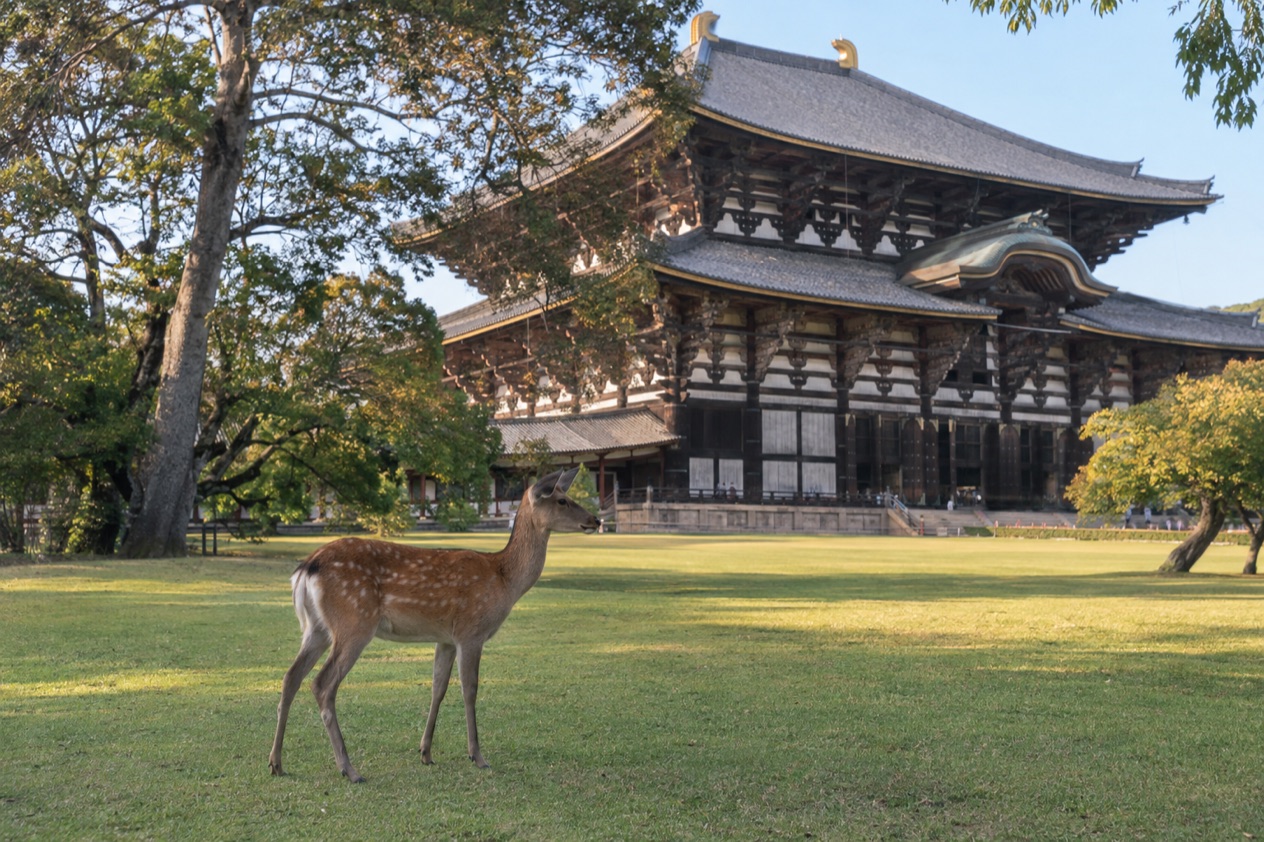
What surprises first-time visitors is how close the old capital feels to everyday life. Todaiji Temple, the Great Buddha and the wild deer of Nara Park are long-established symbols of the city, yet the park is also where residents walk, where schoolchildren pass through and where the roadside stalls sell the crackers that the deer have learned to expect. The deer were once believed to be messengers of the gods, and you can still sense that old regard in the way people treat them, patiently and without fuss.
The other surprise is the history under your feet. Heijokyo, in Nara, was Japan’s first capital, going back to the Nara Period, and the city holds three World Heritage sites that include ancient monuments, sacred mountain trails and some of the country’s oldest temples and shrines.
Entry, customs and paperwork
The U.S. State Department says that U.S. citizens on a tourist or business visa-free stay of up to 90 days need a valid passport and should have proof of a return or onward ticket. The passport must remain valid for the entire time you are in Japan, so check its expiry date against your plans before you book anything else.
A visa-free stay does not include the right to work. According to the same source, you cannot work on the local economy while in Japan on this basis, which matters for anyone mixing a trip with remote or business activity on Japanese soil.
Once you are in the country, the U.S. State Department notes that you must always carry your U.S. passport or a Japanese Residence Card (Zairyu Kado). You may be questioned or detained if you cannot show proof of identity and status, so keep the passport on you rather than leaving it in a hotel safe, even for a day among the deer.
One more point on local law: CBD may be illegal in Japan depending on how much THC it contains. Products that are ordinary at home can fall foul of Japanese rules, so leave them out of your luggage.
Money, cards and tipping
Yen is the currency you will spend in Nara, from a cup of tea in Naramachi to the crackers you buy for the deer. International credit, debit and prepaid cards are generally accepted throughout Japan, which covers most hotels, department stores and larger restaurants in a city this size.
Some shops do not display the symbols of the cards they take, so it is worth asking the seller whether yours can be used. A simple gesture with the card in hand usually settles it. Small stalls and roadside sellers, like the ones near the park, are the kind of place where the question is most worth asking before you pick anything up.
Tipping is not part of everyday habit in Japan. In restaurants, taxis and shops, people pay the amount on the bill and say thank you, and good service is simply expected as normal. If you try to leave extra on a table, a server may well run after you to hand it back, thinking you forgot it.
A gentle ritual often marks the payment itself. Many shops present the bill on a small tray, and you place your money or card on it rather than handing it over directly. It is a small thing, but following it makes the exchange feel like part of a common routine rather than a transaction between strangers.
Getting around and staying connected
Trains are the way most visitors reach Nara, and two railway companies, Kintetsu Railway and West Japan Railway (JR West), operate rail service throughout the area. From Osaka, the JR Yamatoji rapid train serves JR Nara Station directly, and from Kyoto the JR Miyakoji rapid service does the same. Kintetsu Nara Station is also served from Kyoto Station in just over 30 minutes.
From Osaka-Namba Station, the Kintetsu limited express reaches Kintetsu Nara Station in 35 minutes and costs 520 yen more than the regular express, which takes five minutes longer. Flying in, the closest airports are Osaka International Airport (Itami) and Kansai International Airport, both in Osaka Prefecture and about an hour and a quarter from Nara by bus and train.
Within Nara, a bus will take visitors to Heijo Palace and Horyuji Temple. Nara Kotsu runs an extensive bus network across the prefecture, reaching remote areas that the trains do not serve, which is useful if your plans stretch beyond the city center.
| Ticket | Amount | Who it applies to |
|---|---|---|
| Gurutto bus in Nara City, per trip | 100 yen | Per trip |
| Nara 1-Day Pass, one day covering Nara Park and Nishinokyo areas | 600 yen | Adults |
| Nara 1-Day Pass, one day covering Nara Park and Nishinokyo areas | 300 yen | Children |
For phone data, SIM cards, eSIMs and pocket Wi-Fi are the usual options for travelers, and you will want your phone for maps and train timetables. Sort out which one suits you before you land, since the station and the first stretch of walking are where you will reach for it first.
Health, water and the weather
Nara has four distinct seasons, and what you pack depends on the month. January is cold, with highs in the high 40s and lows just above freezing, and it is the one month of those covered here when snow or sleet falls on a good share of the days, though the total amount stays small. Sunshine is limited and the air feels damp, so a warm coat and a hat are worth having.
April is mild, with highs in the upper 60s and lows in the high 40s. Showers come on roughly nine days of the month, and the sun is more present than in winter. It is a month for layers: light enough for a walk through the park at midday, with something warmer for the evening.
July is hot and humid. Highs approach 90 degrees and the nights stay warm, and rain falls on about eleven days, often as heavy downpours, with the air feeling sticky even when the sky is clear. Light clothes, a hat and a bottle of water carried between temples will help you through the day.
October brings comfortable highs in the low 70s and cooler evenings, yet it is also a wet month, with a good amount of rain spread over roughly nine days. A compact umbrella is a sensible companion, and a light jacket covers the shift from afternoon to night.
| Month | Average high (°F) | Average low (°F) | Precipitation (in) | Days with rain | Sunshine (hours) |
|---|---|---|---|---|---|
| January | 47.7 | 33.4 | 2.06 | 6.2 | 118 |
| April | 67.6 | 47.7 | 3.89 | 9.6 | 173 |
| July | 89.1 | 73.4 | 6.83 | 11.2 | 157 |
| October | 72.7 | 56.3 | 5.30 | 9.2 | 149 |
Local customs and etiquette
In Japan it is customary to remove your shoes at the entrance of a building, put on indoor slippers and place your shoes in a shoe box or to the side. You will meet this habit in ryokan, in some restaurants and in certain temple buildings. Wearing socks without holes is a small courtesy that many travelers appreciate once they are asked to step out of their shoes.
Inside a Japanese home or ryokan, it is customary to take off the slippers when walking on tatami mats and again when using the bathroom, where a separate pair of toilet slippers is often provided. Stepping onto the tatami in bare feet or socks keeps the straw mats in good condition, and it is the kind of detail that hosts notice and appreciate.
Around the deer, the habits are gentler than they might look. The animals have learned that visitors carry crackers, and they sometimes bow their heads as if to ask for one, a gesture that delights children and adults alike. People hold the crackers out calmly, hand over the last one, then show their empty palms, which tells the deer that the food has run out.
On trains and buses, people speak softly, keep phones on silent and wait their turn to board, standing in lines painted on the platform. Public trash cans are not always easy to find, so many people carry their wrappers until they reach a bin or return to the hotel. Bowing slightly when thanking someone or greeting a shopkeeper is returned warmly, and a quiet “arigato” goes a long way.
At temples and shrines, people usually lower their voices as they approach the gate and pause before passing through. Photography, offerings and bowing at the main hall follow the lead of those around you, and watching a few minutes before joining in is a perfectly good way to learn.
Good to know before you go
The U.S. State Department rates Japan Level 1: Exercise Normal Precautions.
Showers can arrive in any of the seasons covered here, and October and July are the wettest of the four, so a light rain layer rarely goes to waste. Keep your passport or residence card on you at all times, together with the details of your onward ticket, in case you are asked for proof of status.
One last habit worth adopting: when you sit down to a meal or step inside a temple building, glance around to see whether shoes are lined up at the door. A moment of looking before you step in saves awkward turns, and it is a small way of fitting into a city that has welcomed travelers for centuries.
Sources
- Japan National Tourism Organization, Nara (https://www.japan.travel/en/destinations/kansai/nara/), checked October 11, 2026
- Official Nara Travel Guide, getting around Nara (https://www.visitnara.jp/getting-around-nara/), checked October 11, 2026
- Official Nara Travel Guide, first-time visitors (https://www.visitnara.jp/for-first-time-visitor/), checked October 11, 2026
- U.S. Department of State, Japan travel information, local laws and special circumstances (https://travel.state.gov/content/travel/en/international-travel/International-Travel-Country-Information-Pages/Japan.html), checked October 11, 2026
- Japan National Tourism Organization, manners, etiquette, shoes, bowing, chopsticks, public behavior (https://www.japan.travel/en/guide/understanding-and-mastering-japanese-manners-and-etiquette/), checked October 11, 2026
- Japan National Tourism Organization, credit cards and cash, where cards are accepted (https://www.japan.travel/en/plan/credit-cards/), checked October 11, 2026
- U.S. Department of State, Japan travel advisory (https://travel.state.gov/content/travel/en/international-travel/International-Travel-Country-Information-Pages/Japan.html), checked October 11, 2026
- U.S. Department of State, Japan travel information, entry and exit requirements (https://travel.state.gov/content/travel/en/international-travel/International-Travel-Country-Information-Pages/Japan.html), checked October 11, 2026
- Japan Meteorological Agency (JMA), Normal values 1991-2020, monthly (https://www.data.jma.go.jp/stats/etrn/view/nml_sfc_ym.php?prec_no=64&block_no=47780), station Nara, elevation 102 m, checked October 11, 2026