
A Tokyo morning starts in a station concourse, with bento boxes stacked by the ticket gates and the Tokaido Shinkansen platforms humming under their long white roofs. A few stops down the line, the scenery gives way to Nagoya, a city of miso-glazed pork cutlets, a castle topped with golden dolphins and a shrine that guards one of Japan’s Imperial regalia.
Nagoya makes sense as a day out or as a stop between Tokyo and the cities of the west. The route is one of the best-known in the country, and the choices are simple to follow once you know the three kinds of Shinkansen.
How do you get to Nagoya from Tokyo?
You take the Tokaido Shinkansen, the high-speed line that links Tokyo, Yokohama, Nagoya and Osaka and was the first of Japan’s bullet train lines when it opened in 1964. The line is operated by the Central Japan Railway Company, known as JR Central, which has run it since 1987. Nagoya sits on this line between the capital and the Kansai region, so a ticket to Nagoya is a ticket on the same rails that carry travelers all the way to Osaka.
Three kinds of service share the track. The Nozomi is the super-express, the Hikari is the express and the Kodama stops at every station. What decides your choice is mostly the pass in your pocket.
The Nozomi covers the whole run from Tokyo to Shin-Osaka in two and a half hours, which gives you a sense of how fast the fastest service is. Holders of the Japan Rail Pass can ride the Hikari or the Kodama free of charge, so a pass holder will usually plan around those two names on the departure board.
The line itself is 320 miles (320.3 mi) long between Tokyo and Shin-Osaka, and the trains run at up to 177 mph. Up to 17 trains an hour leave on this line, made up of thirteen Nozomi, two Hikari and two Kodama. That mix tells you what the timetable looks like: the Nozomi dominates, the Hikari appears less often and the Kodama fills in the small stations between.
Other ways exist, built around the same city. Slower trains stop at every station, and travelers arriving from abroad can come in through Chubu Centrair International Airport, which serves Nagoya directly.
Ways to get to Nagoya from Tokyo
The Tokaido Shinkansen
The Shinkansen is the way travelers connect Tokyo and Nagoya. You board at Tokyo, and the train follows the Pacific side of Honshu through Yokohama before reaching Nagoya. It runs on the line JR Central operates, with its three services, Nozomi, Hikari and Kodama. Japanese trains have a reputation for being on time, which lets travelers plan their trips to the minute, so a meeting or a lunch reservation in Nagoya can be set around an arrival time with some confidence.
The three services suit different travelers. The Nozomi is the super-express and the one to look for if you want to arrive as quickly as the line allows. The Hikari, an express, suits Japan Rail Pass holders, since the pass carries them on it free of charge. The Kodama stops everywhere and is the slowest of the three, a choice for those with a pass who do not mind more stops, or who are getting off at a small station on the way.
Inside, the cars are what travelers often remember: wide seats, luggage racks overhead and trolleys of snacks and coffee. A tip for the ride: pick up a bento before you board, since eating a boxed lunch with a view of the countryside sliding by is part of the experience of riding a Japanese train.
Local and rapid trains
Local trains in Japan stop at every station, which makes them ideal for short distances. Rapid trains skip the smaller stations and need no supplement, so they run faster than a local without costing more. In Tokyo, the stations hold a mix of operators, with Japan Railways (JR) trains, Tokyo Metro lines and Toei Subway lines among others, so the first leg of any trip often begins on a city line.
For a trip as long as Tokyo to Nagoya, these slower trains work as a way to see towns the bullet train passes without stopping. They suit travelers who like to change at small stations, watch the landscape change and have time to spare. They are less suited to a trip with a fixed appointment at the other end, since the Shinkansen is the line built for the distance.
By air to Chubu Centrair
Chubu Centrair International Airport is Japan’s third major international gateway, built on an artificial island south of central Nagoya, and it is the place where many arrivals from overseas touch down. Travelers who fly into it come into Nagoya directly, without passing through Tokyo at all. The airport lies thirty minutes south of the city center.
This route suits a traveler whose trip begins in Nagoya, or who plans to explore central Honshu before moving on to Tokyo.
Options compared
| Option | Best for | What to know |
|---|---|---|
| Nozomi (Shinkansen) | Reaching Nagoya as fast as the line allows | Super-express, covers Tokyo to Shin-Osaka in 2 hours 30 minutes |
| Hikari (Shinkansen) | Japan Rail Pass holders | Express service, free of charge with the pass |
| Kodama (Shinkansen) | Pass holders happy to stop often | Stops at every station, free of charge with the pass |
| Local train | Short stretches and small stations | Stops at every station |
| Rapid train | Skipping smaller stops without a supplement | Skips smaller stations, no supplement required |
| Chubu Centrair Airport | Travelers arriving from abroad | On an artificial island, 30 minutes south of central Nagoya |
Laid side by side, the options show a clear pattern. The three Shinkansen services share one set of rails and one operator, so the difference between them is how often they stop and what your pass covers. The slower trains answer a different question, which is how much you want to see between two cities, while the airport serves travelers who start their journey in Nagoya.
If you hold a Japan Rail Pass, the Hikari and the Kodama are the names to watch for on the board. If you do not, the Nozomi is the service with the most departures, with thirteen of the seventeen trains an hour on the line. Either way, you step off in Nagoya with the day still ahead of you.
Making a day of it
Nagoya is a city to eat in as much as to sightsee in. It is the capital of Aichi Prefecture, on the Pacific coast in central Honshu, and the fourth-largest city in Japan, with a metropolitan area of about ten million people.
The food is its own: miso katsu, a pork cutlet under a dark, sweet miso sauce, hitsumabushi, grilled eel over rice served in a wooden tub, tebasaki, peppery fried chicken wings, and kishimen, flat wide noodles in broth. Lunch is a good reason to arrive hungry.
Nagoya Castle
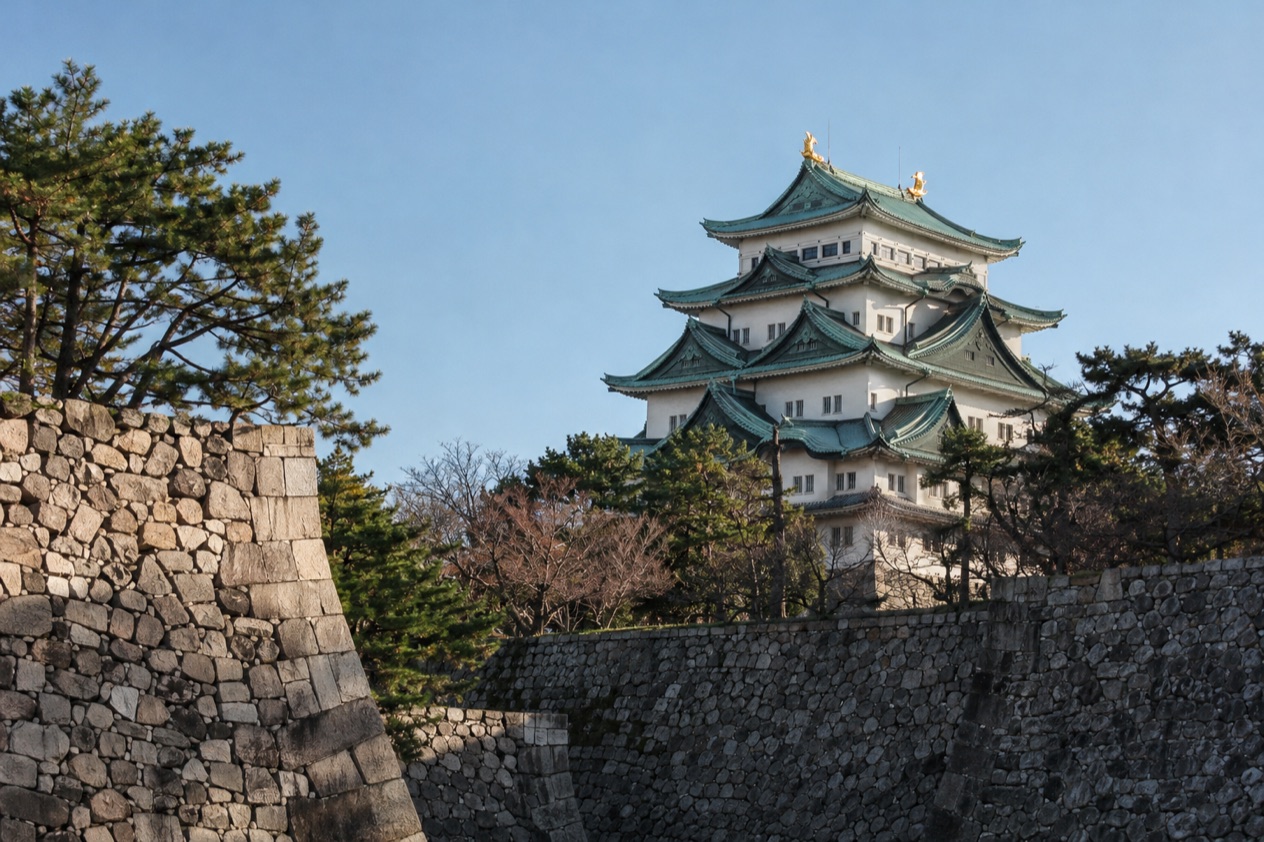
Nagoya Castle is among the landmarks the city is known for, and its keep is topped with a pair of golden shachihoko, the mythical dolphin-headed fish that have come to stand for Nagoya. Walking the grounds, you cross wide stone-walled moats and gates, and the Honmaru Palace inside holds painted rooms with gilded screens.
| Site | Last admission |
|---|---|
| Honmaru Palace, during the Nagoya Castle Autumn Festival | 1 hour before gate closing |
The autumn festival gives the castle a seasonal feel, so a visit in that season carries a little extra. The castle also appears among the highlights of the NAGOYA Sightseeing Pass, which offers a great-value way to enjoy the city’s major attractions, along with Chubu Electric Power MIRAI TOWER, Nagoya Port Aquarium and Higashiyama Zoo and Botanical Gardens.
Atsuta Shrine
Atsuta Shrine is the city’s spiritual landmark, said to date back to around 100 AD. It houses the sacred sword Kusanagi, one of the three Imperial regalia of Japan, although the blade is never shown to the public. What you see instead is the shrine itself, a wooded precinct with large old trees, gravel paths and wooden halls where visitors stop to bow and offer a prayer.
It suits travelers who want a break from the city streets and enjoy the atmosphere of a Shinto shrine. Leave time to wander the grounds without a plan, since the pleasure of the place is in the trees and the quiet corners rather than a single sight.
Zoo, aquarium and tower
For a lighter afternoon, Higashiyama Zoo and Botanical Gardens and the Port of Nagoya Public Aquarium are the two attractions the city is known for beyond its temples. They suit travelers with children, or anyone who wants a change from history. The Chubu Electric Power MIRAI TOWER rounds out the list for those who like to see a city from above.
Bring comfortable shoes, since the castle grounds and the shrine precinct are both places you explore on foot, and pack a light layer for the ride back to Tokyo.
Good to know before you go
Carry some cash and a card for the small restaurants and shrine stalls, and keep your belongings in a bag you can hold on your lap on the train. If your trip falls in the typhoon season, check the forecast before you leave, since a storm can change plans on a day trip as much as on a longer stay. Nagoya’s food, its castle and its shrine are all waiting at the end of a single rail line from Tokyo.
Sources
- Wikipedia, Tōkaidō Shinkansen (https://en.wikipedia.org/wiki/T%C5%8Dkaid%C5%8D_Shinkansen), checked October 11, 2026
- Visit Nagoya, the Nagoya city guide (https://www.nagoya-info.jp/en/), checked October 11, 2026
- Wikipedia, Nagoya (https://en.wikipedia.org/wiki/Nagoya), checked October 11, 2026
- Wikivoyage, Nagoya (https://en.wikivoyage.org/wiki/Nagoya), checked October 11, 2026
- Japan National Tourism Organization, trains and buses (https://www.japan.travel/en/guide/how-to-travel-by-train-and-bus-in-japan/), checked October 11, 2026
- Japan National Tourism Organization, traveling by rail (https://www.japan.travel/en/guide/traveling-by-rail/), checked October 11, 2026
- Japan National Tourism Organization, getting around Japan: trains, subways, buses, taxis (https://www.japan.travel/en/plan/getting-around/), checked October 11, 2026
- Wikipedia, Shinkansen (https://en.wikipedia.org/wiki/Shinkansen), checked October 11, 2026
To plan your stay
- Best Time to Visit Nagoya: Cherry Blossoms, Autumn Leaves, Weather and Festivals
- Things to Do in Nagoya: Castle, Atsuta Shrine, Nagoya-meshi and Day Trips
- Where to Stay in Nagoya: Nagoya Station, Sakae, Osu and the Castle Area
- Know Before You Go to Nagoya: Entry, Money, Getting Around and Local Etiquette