
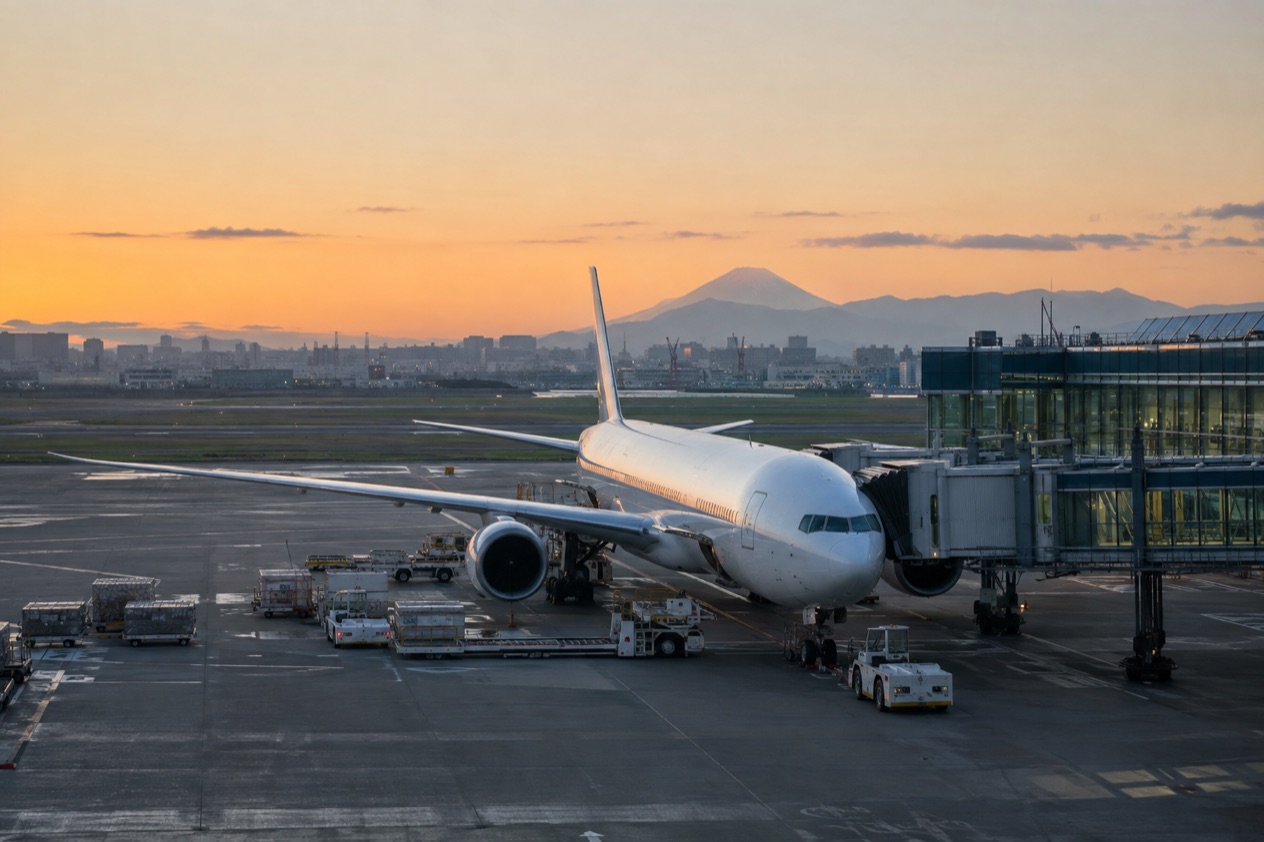
You step out of customs at Centrair and the first thing you see is an airport built like a small town, with a shopping floor open to the public and a Boeing 787 parked on display behind glass. Nagoya sits to the south of the runway’s mainland neighbor, across a long bridge from the artificial island you are standing on.
How do you get from the airport to Nagoya?
The Centrair Limousine bus runs directly to central Nagoya, Sakae and major hotels. A taxi across the Centrair Bridge covers the same crossing for those who want a door-to-door ride.
The airport lies on an island in Ise Bay, about 22 miles from Nagoya, and the city is described as 30 minutes from the airport to its center. What decides your choice is mostly where you sleep.
If your hotel is in central Nagoya or Sakae, or is one of the major hotels the bus serves, the bus matches your destination. If you are headed somewhere the bus does not name, a taxi takes you across the bridge to the mainland and on from there.
Luggage and group size matter too. A single traveler with a suitcase fits easily into a bus seat, while a family with several bags may prefer one car to share.
Arrival time shapes the day as well: after a long flight, travelers simply want to be seated and carried toward the hotel, and a direct bus offers exactly that. A ferry to the port city of Tsu also leaves from the island, but it goes to a different city and is a trip of its own. An IC card in your pocket, the rechargeable kind such as Suica or ICOCA, helps once you are in the city, since these cards work on trains, buses and boats across Japan.
Your options from the airport
Meitetsu trains run from the airport station to Meitetsu Nagoya Station. Each suits a different kind of arrival.
Centrair Limousine bus
Centrair Limousine is the direct bus service between the airport and central Nagoya, with stops that include Sakae and major hotels. It is the option that links the airport to the heart of the city without a transfer, which makes it a natural match for anyone whose hotel sits in one of those areas.
Sakae is a district of department stores, shopping streets and restaurants, so getting off there puts you among the places where visitors spend an evening. The bus suits solo travelers, couples and anyone with a suitcase who would rather not handle stairs and platforms. Fares and timetable are not given here, so confirm them at the airport counters or on the operator’s own materials.
Taxi across the Centrair Bridge
A taxi can take you over the Centrair Bridge, the toll road that links the island to the mainland. It is the way for a group that wants one vehicle, for travelers whose hotel is not on the bus route, or for anyone who prefers to be dropped at the entrance rather than at a stop.
The bridge is a toll road closed to bicycles, so cyclists leaving the airport are directed to a taxi or to a local train. Some taxis in Japan accept IC cards, according to the national guidance on those cards, though that does not tell you whether the one in front of you does. The cost of the ride is not given here.
Ferry to Tsu and the local train to Rinku Tokoname
A ferry connects the airport to the passenger terminal in Tsu, a trip of 40 minutes. Tsu is a different city from Nagoya, so this boat belongs to travelers whose plans lie across the bay, and not to those heading straight into Nagoya.
For cyclists and others on the mainland side, a Meitetsu local train runs one stop from the airport to Rinku Tokoname Station. Check the ferry operator’s accepted payment methods before boarding.
Airport transfer options compared
| Option | Where it goes | Note |
|---|---|---|
| Centrair Limousine bus | Central Nagoya, Sakae and major hotels | Direct service |
| Taxi | Across the Centrair Bridge to the mainland | The only road crossing for people leaving by car, bicycles not allowed on the bridge |
| Ferry | Passenger terminal in Tsu | 40-minute trip |
| Meitetsu local train | Rinku Tokoname Station | One stop from the airport |
The bus is the only entry that names Nagoya itself as its destination, and it does so without a change. The taxi leaves you free to choose any address on the mainland, and it is the route that works for a bicycle-free group needing a vehicle. The ferry and the local train point away from Nagoya, toward Tsu and the first station on the mainland side.
What you trade is freedom against simplicity. The bus asks you to go where it goes, while the taxi goes where you ask. Those who stay in or near Sakae will find the bus lines up with their plans, and those with a hotel outside the major ones it serves will lean toward a car. Whichever you pick, an IC card is useful for the rest of your stay in the city.
Arriving at the airport
Centrair has two terminals. Terminal 1 has gates for both domestic and international flights, and Terminal 2, opened in September 2019, serves budget airlines with international and domestic gates of its own. Which one you land at depends on your airline.
Terminal 1 holds the Sky Town Shopping Center on its fourth floor, open to the general public and home to dozens of shops and restaurants. It is a place to sit down for a first meal in Japan or to browse before heading for the bus or a taxi. Nearby, Flight of Dreams is a Seattle-themed retail complex that opened in 2018, and it shows a prototype Boeing 787 Dreamliner as its centerpiece.
The airport stands on an artificial island in Ise Bay with a single long runway, and it opened in February 2005, taking over almost all commercial flights from the older Nagoya Airport. That history explains why the Nagoya region now uses a bay island as its gateway, described as Japan’s third major international gateway.
From the island, the route to the city passes over the Centrair Bridge, the toll road that bikes may not use. Cyclists must take the Meitetsu local train one stop to Rinku Tokoname Station or a taxi across the bridge. For everyone else, the Centrair Limousine, a taxi or the ferry to Tsu are the choices already described.
Once in town, Nagoya offers Nagoya Castle, Atsuta Shrine, Higashiyama Zoo and Botanical Gardens and the Port of Nagoya Public Aquarium. The NAGOYA Sightseeing Pass is described as a great-value way to enjoy several of the city’s major attractions, including the castle, the Chubu Electric Power MIRAI TOWER, the aquarium and the zoo.
Good to know before you go
Regional cards carry different names and characters, yet they work throughout Japan, so a Suica or an ICOCA bought elsewhere still helps in Nagoya. Nagoya anchors a metropolitan area of about 10 million people, so the city is large, and your hotel’s location is worth settling before you choose between the bus and a taxi.
Sources
- Wikipedia, Chubu Centrair International Airport (https://en.wikipedia.org/wiki/Chubu_Centrair_International_Airport), checked October 11, 2026
- Visit Nagoya, the Nagoya city guide (https://www.nagoya-info.jp/en/), checked October 11, 2026
- Wikipedia, Nagoya (https://en.wikipedia.org/wiki/Nagoya), checked October 11, 2026
- Wikivoyage, Nagoya (https://en.wikivoyage.org/wiki/Nagoya), checked October 11, 2026
- Japan National Tourism Organization, IC cards, Suica, Pasmo, ICOCA, how to use (https://www.japan.travel/en/plan/ic-card/), checked October 11, 2026
To plan your stay
- Best Time to Visit Nagoya: Cherry Blossoms, Autumn Leaves, Weather and Festivals
- Things to Do in Nagoya: Castle, Atsuta Shrine, Nagoya-meshi and Day Trips
- Where to Stay in Nagoya: Nagoya Station, Sakae, Osu and the Castle Area
- Know Before You Go to Nagoya: Entry, Money, Getting Around and Local Etiquette