
A tram rattles around a corner, its bell rings once, and a few streets later you are standing in a park where schoolchildren fold paper cranes and leave them beside a statue. Nagasaki carries its history in plain sight, from the Portuguese and Dutch traders who once worked here to the day in August 1945 that the city still marks every year. It is a port city at the western edge of Kyushu, made for travelers who like to learn as they walk, eat well and ride the trams.
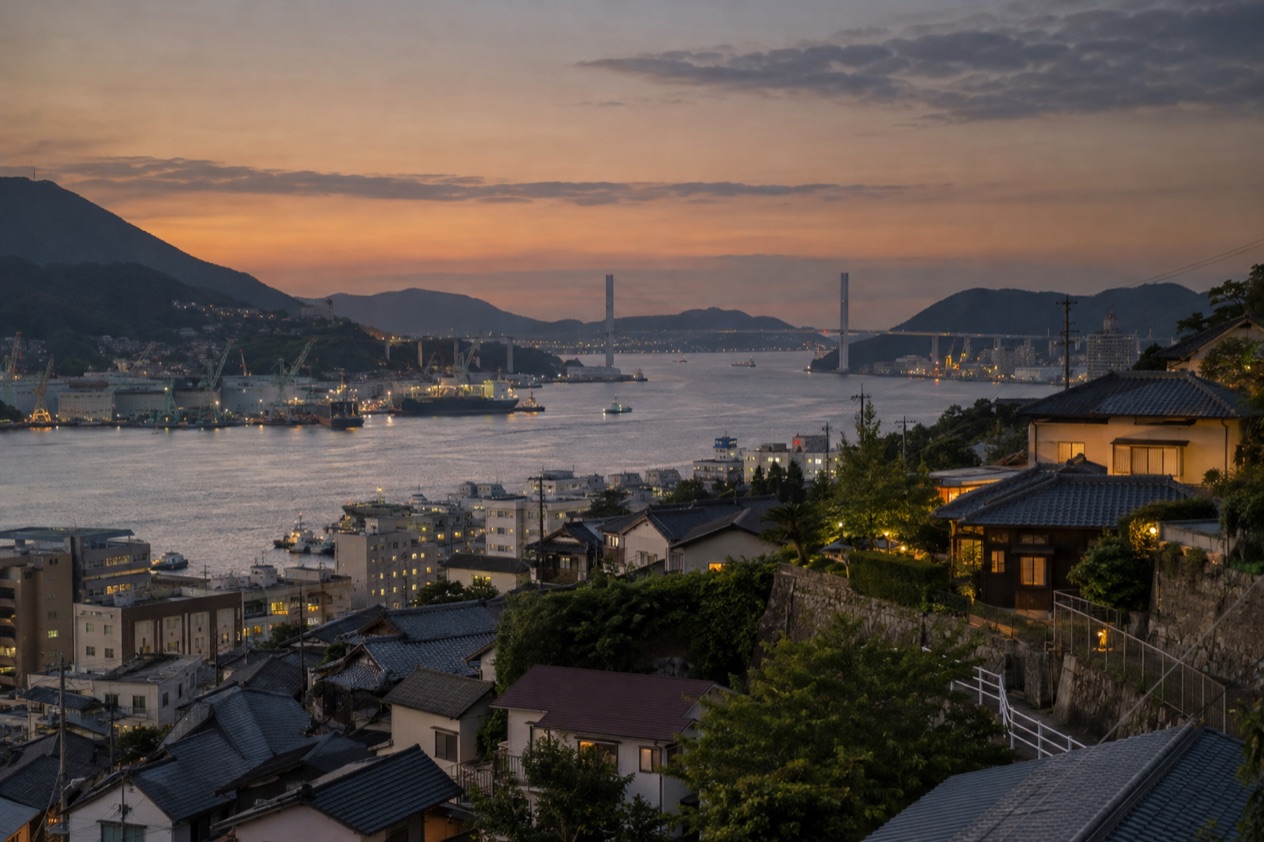
Where is Nagasaki and what is it like?
Nagasaki sits at the western extremity of Kyushu, the southwestern main island of Japan, and it is the capital and largest city of Nagasaki Prefecture. It is a harbor city with a long habit of looking outward, and that shows in the food, the architecture and the churches, temples and Chinese-style halls that share the same neighborhoods.
The pace is that of a mid-sized port rather than a megacity. You can spend a morning in a memorial park, an afternoon among Western-style houses and an evening over a bowl of champon, the thick noodle soup of pork, seafood and vegetables that grew out of the city’s Chinese community. Trams link the districts, so a day here tends to be a series of short rides between very different places: solemn, graceful, a little exotic.
The city rewards people who enjoy history and are happy to read a plaque, listen to a story or sit quietly for a moment. Some of its main sights deal directly with war, persecution and isolation, so the mood is often reflective rather than festive.
If you want nightlife, shopping towers or a checklist of neon, other Japanese cities will give you more. If you want a place where the past is part of the street scene and the table, Nagasaki fits.
Beyond the city, the surrounding prefecture holds the Hidden Christian Sites, recognized on the UNESCO World Heritage list, which tell of communities that kept their faith through years of prohibition. They give the region a second layer: after the city, there is a countryside and island history to follow.
What is there to do in Nagasaki?
The things to do in Nagasaki fall into four groups: remembrance, trading-port history, Western-style houses with harbor views, and the Christian heritage of the wider region. Few Japanese cities pack so many chapters of the country’s relationship with the outside world into one place.
Nagasaki Peace Park
Nagasaki Peace Park commemorates the atomic bombing of the city on August 9, 1945, during World War II. It is a place of lawns, monuments and sculptures offered by people and countries around the world, and the atmosphere is reflective. Visitors tend to walk slowly, read the inscriptions and speak in low voices.
It suits anyone who wants to understand the city, and it works best when you give it time rather than treating it as a quick photo stop. Many travelers pair it with the nearby museum and memorial sites, then take a break afterward at a café or a tram stop before turning to lighter subjects.
Dejima and the trading-port story
Dejima was an artificial island off Nagasaki that served as a trading post for the Portuguese from 1570 to 1639 and subsequently for the Dutch from 1641 to 1858. The story it tells is one of a narrow door through which goods, books, medicine and ideas passed while the rest of the country kept its distance from foreign contact.
Visiting is about imagining that exchange: warehouses, merchants’ quarters and the daily life of a small foreign community in a country that had closed itself. It suits history readers, and anyone curious about how Japan learned of the Western world long before the modern era. Pair it with an hour in the harbor streets nearby to see how the old port connects to the present city.
Glover Garden
The Glover Residence in Glover Garden is the oldest Western-style house surviving in Japan and Nagasaki’s foremost tourist attraction. Wooden verandas, shuttered windows and tidy gardens give the place a calm, almost domestic feel, quite unlike the weight of the memorial sites.
It is a good counterweight to a day of heavy subjects, and it rounds out the picture of a foreign settlement that took root in the port. Couples, families and photographers will all find something to look at, from the architecture to the views over the city and the harbor.
Hidden Christian Sites of the region
The Hidden Christian Sites in the Nagasaki Region are on the UNESCO World Heritage list. They commemorate communities that practiced their faith in secret, and they reach beyond the city into villages and coastal settlements of the prefecture.
They are best for travelers who have time to leave the city and who like to follow a story across the landscape, from churches to quiet viewpoints. Plan them as a separate outing rather than squeezing them between city sights, because they ask for attention and a slower rhythm.
How many days do you need in Nagasaki?
A long weekend is enough to see the essentials of Nagasaki, and a few more days let you add the wider region. The city’s main sights sit in different districts, so the days are shaped by tram rides and by how long you want to linger at each stop.
In two days you can pair Nagasaki Peace Park with Dejima on one day, then give the other to Glover Garden and the harbor streets. Add meals built around local dishes: champon, the flat fried noodles of sara udon, and castella, the soft sponge cake that arrived with Portuguese traders and became a souvenir staple. That is a satisfying short stay for anyone who likes a clear theme to a trip.
With three or four days, the pace loosens. You can return to a place that moved you, wander a covered shopping street, stop for a long lunch and spend an evening at a harbor-side restaurant. A day can also go to the Hidden Christian Sites, which turn the visit from a city break into a look at the whole region.
A longer stay works well as part of a loop through Kyushu. Fukuoka is reachable by bus from its airport, and Kamome Limited Express trains run from Hakata, so Nagasaki fits easily into a trip that also includes other Kyushu cities. Give it at least a night or two rather than a hurried stop between trains, because the city’s character comes through in the evenings and early mornings as much as in its sights.
Where to stay in Nagasaki
The most practical base is the city center, around the Shinchi bus terminal, where buses from Nagasaki Airport arrive. From there you are close to the tram lines, to restaurants and to the harbor streets, and you can start and end each day without long transfers. It suits first-time visitors, travelers who like to eat out at night and anyone relying on public transport.
The area around Nagasaki Station is the other natural choice for rail travelers, since it is the terminal of the Nagasaki Main Line and of the Nishi Kyushu Shinkansen. Staying near the station means your arrival and departure are simple, and the trams are close by for moving on to the memorial sites and the Western-style houses of Glover Garden.
A third option is to choose by theme. Those who want to spend their time on remembrance and history may prefer a stay near the Peace Park side of town, while those drawn to the old foreign settlement can look closer to the Glover Garden district. Lodging in Nagasaki ranges across the kinds of places found elsewhere in Japan, from city hotels to guesthouses, and the tram network makes it workable to stay in one neighborhood and reach the rest.
If you plan to continue to other parts of Kyushu, a base by the station keeps the trip simple. If your focus is evenings, harbor views and local food, the center near the bus terminal has the advantage of putting dinner a short step from your door. Either way, think of Nagasaki as a city you move through by tram.
How do you get to Nagasaki and get around?
You reach Nagasaki by air, by rail or by bus, and then you get around mainly by tram. The nearest airport is Nagasaki Airport in the nearby city of Ōmura, and from there buses carry passengers to the Shinchi bus terminal in the city center.
Coming in by train or bus
JR Kyushu runs the Nishi Kyushu Shinkansen and the Nagasaki Main Line, whose terminal is at Nagasaki Station. For Japan Rail Pass holders, the best option is to take the Kamome Limited Express from Hakata in Fukuoka to Nagasaki Station.
Buses are another route from Fukuoka. They depart from Fukuoka Airport for Nagasaki every hour, and a one-way trip takes about 2 hours 30 minutes. That makes the bus a natural fit for travelers who land in Fukuoka and want to go straight on to Nagasaki without a stop in town.
Getting around the city
The Nagasaki Electric Tramway operates five routes in the city, and the trams are the everyday way to move between districts. Riding one is part of the experience: you see ordinary neighborhoods go by, rather than moving underground from sight to sight.
A one-day tram pass is available for purchase, but it is not covered by the Japan Rail Pass, so rail pass holders buy it separately. Between the trams and your own feet, you can reach the main sights around the center. Buses link the airport to the Shinchi terminal, and they remain an option for places away from the tram lines.
When is the best time to visit Nagasaki?
Nagasaki suits spring and autumn for walking between sights, and winter and early summer have their own events and moods. Because so much of a visit here is outdoors, from park lawns to garden paths and tram stops, the season shapes the day more than it does in a city of indoor malls, so choose the months with that in mind.
The calendar has a few fixed points. August 9 is the anniversary of the 1945 bombing, and the city marks it with ceremonies at the Peace Park, which makes it a meaningful moment to be there and also one that calls for respect and a plan.
Autumn brings the Nagasaki Kunchi, the autumn festival of the city’s shrines, with processions and dragon dances that show off the port’s mixed heritage. In late winter, around the Lunar New Year, the Lantern Festival fills the streets with colored lights, a nod to Nagasaki’s Chinese community.
Summer months are the time to check for rain and typhoon news before you travel, since both can reshape a day of outdoor sightseeing. The festivals mentioned above are worth building a trip around if they match your interests, and the quieter stretches between them suit travelers who prefer a slower look at the museums, gardens and harbor streets.
Good to know before you go
Nagasaki asks for the same habits as the rest of Japan: shoes come off in some houses and traditional rooms, voices drop at memorials, and trash is often carried until you find a bin. The Peace Park and similar sites are places of remembrance, so visitors tend to dress and behave with that in mind. In the rainy and typhoon seasons of Japan, keep an eye on forecasts, because weather can change the plan for a day of trams and outdoor sights.
Sources
- Japan National Tourism Organization, Nagasaki (https://www.japan.travel/en/destinations/kyushu/nagasaki/nagasaki-city-and-around/), checked October 11, 2026
- Wikipedia, Nagasaki (https://en.wikipedia.org/wiki/Nagasaki), checked October 11, 2026
- Wikivoyage, Nagasaki (https://en.wikivoyage.org/wiki/Nagasaki), checked October 11, 2026
- Wikipedia, Dejima (https://en.wikipedia.org/wiki/Dejima), checked October 11, 2026
- Wikipedia, Glover Garden (https://en.wikipedia.org/wiki/Glover_Garden), checked October 11, 2026
All our pages
Things to do
- Things to Do in Nagasaki: Peace Park, Glover Garden, Dejima and Champon
- Nagasaki Peace Park and Atomic Bomb Museum: Peace Statue, Hypocenter and the August 9 Ceremony