
Paper cranes in bright strings hang near the memorials, and the first thing you notice on the slope is the white statue with one arm raised to the sky. Visitors walk slowly here, reading inscriptions and stopping at a black stone marker on the ground. The Nagasaki Peace Park is a memorial to the people killed when the atomic bomb fell on the city, and a visit is a thoughtful walk through monuments from Japan and from around the world.
Is visiting the Nagasaki Peace Park worth it?
Yes, for almost any traveler who comes to Nagasaki, and especially for those who want to understand the city beyond its harbor and its food. The park suits anyone interested in twentieth-century history, anyone who travels to reflect as much as to sightsee, and families with older children who are ready for a serious subject. It asks for attention more than for stamina, and it gives a clear sense of what happened here and how the city answers it today.
What sets it apart is that it is built around a single exact spot. The black monolith marks the point below where the bomb exploded, so the park is not only a monument placed in a pleasant green space but the ground of the event itself. Around that point, the city has spent decades adding statues, a fountain and gifts from other countries, so the park reads as a conversation between Nagasaki and the world.
It also feels different from other memorial sites in Japan because of its tone. Rather than dwelling only on loss, the park keeps turning toward the future, with the statue’s gestures, the fountain’s water and the international monuments all speaking about peace. Visitors pair the park with the Atomic Bomb Museum for the story in objects and photographs, then come back out to the open air to take it in.
Nagasaki itself gives the visit context. It sits at the western tip of Kyushu, and the city also holds the Hidden Christian Sites, which UNESCO has placed on the World Heritage list. A day that begins at the park can widen into the rest of the city’s layered history, which is part of why the memorial works so well as an anchor for a stay.
What to see at the Nagasaki Peace Park
It unfolds from the hypocenter at one end to the fountain at the other, so a walk through it is also a walk through the way the city chose to remember.
The Peace Statue
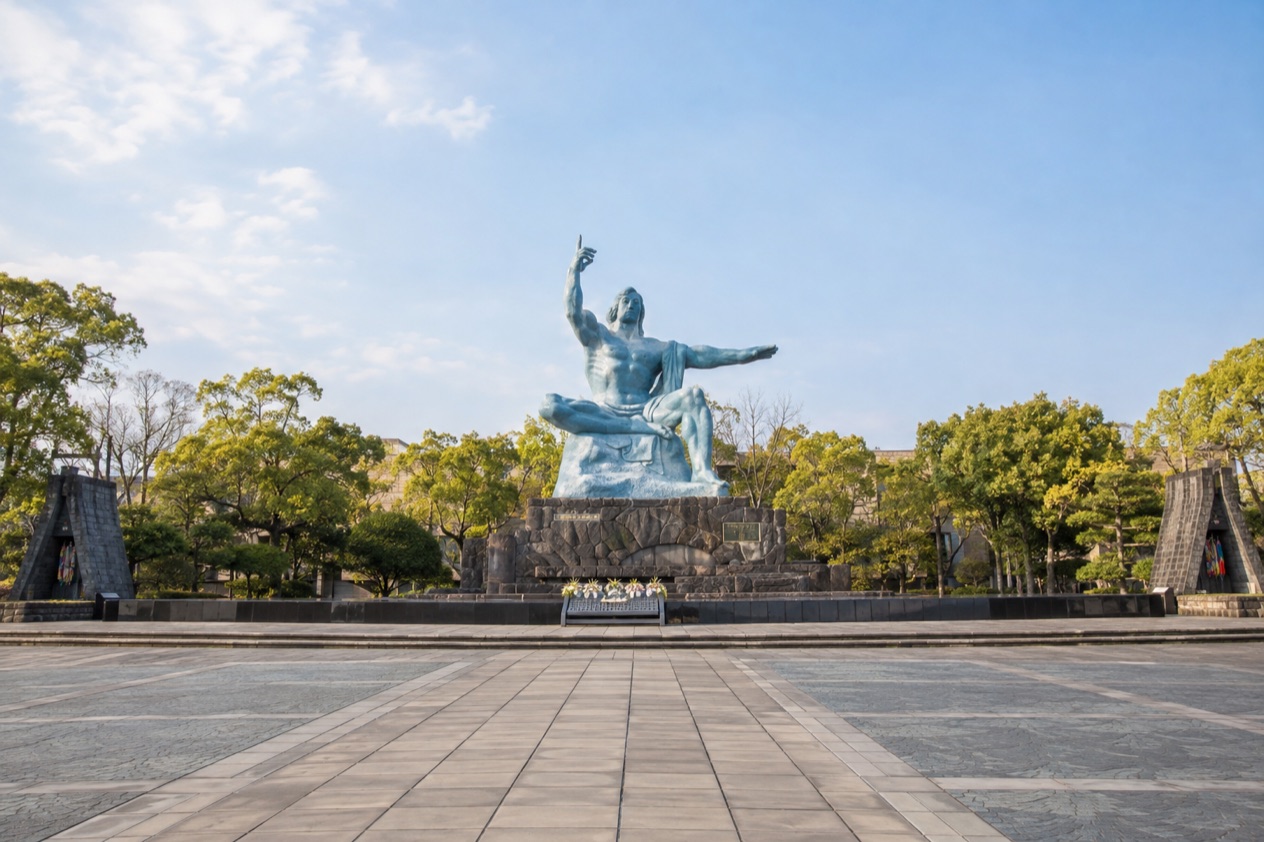
The statue is the park’s centerpiece, a seated figure about 33 feet tall, made by Seibo Kitamura of Nagasaki Prefecture. It is usually read as a figure of prayer and watchfulness, and its gestures are explained in many ways. The raised right hand points to the threat from the sky, the outstretched left hand stands for peace, and the closed eyes offer a prayer for the victims.
Stand at the base and look up, then step back and see how it holds the whole open space together. The annual Peace Memorial Ceremony takes place in front of it, so this is also the stage of the city’s most solemn day. Flowers and offerings often gather near the foot of the statue.
The hypocenter monolith
A black stone monolith marks the spot beneath the explosion. The bomb detonated at 11:02 in the morning, in the air above this place, which explains why the marker is so plain: the point it records is a location in the sky above the ground.
Visitors tend to stop here longer than anywhere else, and many lay flowers or fold their hands. Look at the ground around the marker and at the inscriptions nearby. The simplicity is deliberate, and it gives the whole park a center of gravity that the larger statue alone could not.
The Fountain of Peace
At the south end of the park, the Fountain of Peace was built in August 1969. It is a quiet counterpoint to the statue, a wide basin of water in a space that is otherwise stone and sculpture. Its meaning is tied to the survivors who, in the hours after the bombing, searched desperately for water, and the fountain is a way of offering it to them in memory.
The sound of falling water changes the feeling of the park as you reach this end. It is a natural place to sit for a while after the more intense stops, and to look back along the length of the grounds toward the statue.
The Peace Symbols Zone and its monuments
In 1978 the city set up the Peace Symbols Zone on both sides of the park and invited countries around the world to donate monuments. The result is a loose gallery of sculptures in different styles, each with its own message about peace, and it is worth walking slowly along both sides to read the plaques.
One piece, Constellation Earth, came from St. Paul, Minnesota, in 1992 and represents global peace and solidarity, which gives American visitors a personal connection. The Monument for Korean Atomic Victims was unveiled on August 9, 1979, and remembers the roughly 2,000 Koreans who died. Together these show that the victims came from more than one nation.
Hours, tickets and rules
The park is a memorial ground laid out around the statue, the monolith and the fountain, and its one fixed date in the calendar is August 9, when the city holds its annual ceremony. It opened in April 1955 as a public park dedicated to the victims of the atomic bomb, and it has kept that purpose ever since.
The setting is that of a place of remembrance, so the habits are those of any memorial. Voices drop, people walk rather than hurry, and photographs are taken with care around those who are praying or laying flowers. At the monolith and the statue, visitors simply stand for a moment before moving on.
On the morning of August 9, the Peace Memorial Ceremony is held in front of the statue, and the Mayor of Nagasaki delivers a Peace Declaration to the World. On that day the park serves the ceremony first, and its atmosphere is entirely different from an ordinary visit. Travelers who plan around the date should expect the grounds to be given over to the commemoration.
When to visit the Nagasaki Peace Park
The date that matters most is August 9, the anniversary of the bombing and the day of the Peace Memorial Ceremony. The ceremony takes place in front of the statue, with the Mayor’s Peace Declaration to the World as its central moment, and it draws people who come specifically to take part or to witness it. For anyone who wants to feel the full weight of the place, it is the most meaningful day to be in the city.
That meaning comes with a different kind of visit. The park on that day belongs to the ceremony, to survivors, families and officials, and a traveler is a guest at an occasion rather than a sightseer. Others prefer to come on an ordinary day, when the monuments can be read one by one and there is room to linger at the fountain without a program running.
Outside the anniversary, no month is closed to the park. It is an outdoor space, so you will feel the season in it: the warmth of a summer day, the cooler air of autumn and the bare light of winter all change how the white statue and the black monolith look. Because it is open air, a walk here pairs well with the weather you have rather than the weather you hope for.
Time of day is a matter of taste. A walk early lets the park be a reflective start to a day in Nagasaki, while a visit later can follow the museum and work as a place to sit and absorb what you saw. Either way, leave room to stay at the fountain and the Peace Symbols Zone, since those are the parts people tend to rush.
Tips for your visit
Start with the monolith, move to the statue, then follow the length of the park to the fountain, reading the monuments of the Peace Symbols Zone on the way. That order follows the story from the event itself toward the city’s message of peace, and it ends in open space where you can sit down.
Pair the park with the Atomic Bomb Museum, which tells the story through objects, photographs and testimony. Doing the museum and the park on the same day lets each deepen the other, and the walk between indoor and outdoor gives you a break from the heavier material. Leave the rest of the day lighter if you can, because this is emotionally demanding sightseeing.
Reaching Nagasaki is straightforward from the air. Nagasaki Airport is in the nearby city of Omura, and buses carry passengers from it to the Shinchi bus terminal in the city center. Buses also leave Fukuoka Airport for Nagasaki every hour, with a one-way trip of about 2 hours 30 minutes, which suits travelers who arrive in Fukuoka and continue across Kyushu.
Bring comfortable shoes for walking the length of the grounds, and a layer for whatever the season brings, since you will be outside. Families with older children can approach the visit as a conversation, explaining the statue’s gestures and the meaning of the fountain, and letting young people read the plaques of the international monuments at their own pace.
If you want more of the city afterward, the Hidden Christian Sites, recognized by UNESCO, tell another side of Nagasaki’s history. Together with the park, they make a day or two in the city that covers both its older faith story and its modern role as a voice for peace.
Good to know before you go
Treat the park as a place of remembrance: speak softly, keep phones quiet and give people space at the monolith and the statue. Dress for being outdoors in the season, and carry some yen for the museum and for meals in the city. Because the grounds are open air, a rainy day changes the walk but not its meaning, and the stone and water of the park have their own character in wet weather.
Sources
- Wikipedia, Nagasaki Peace Park (https://en.wikipedia.org/wiki/Nagasaki_Peace_Park), checked October 11, 2026
- Japan National Tourism Organization, Nagasaki (https://www.japan.travel/en/destinations/kyushu/nagasaki/nagasaki-city-and-around/), checked October 11, 2026
- Wikivoyage, Nagasaki (https://en.wikivoyage.org/wiki/Nagasaki), checked October 11, 2026