
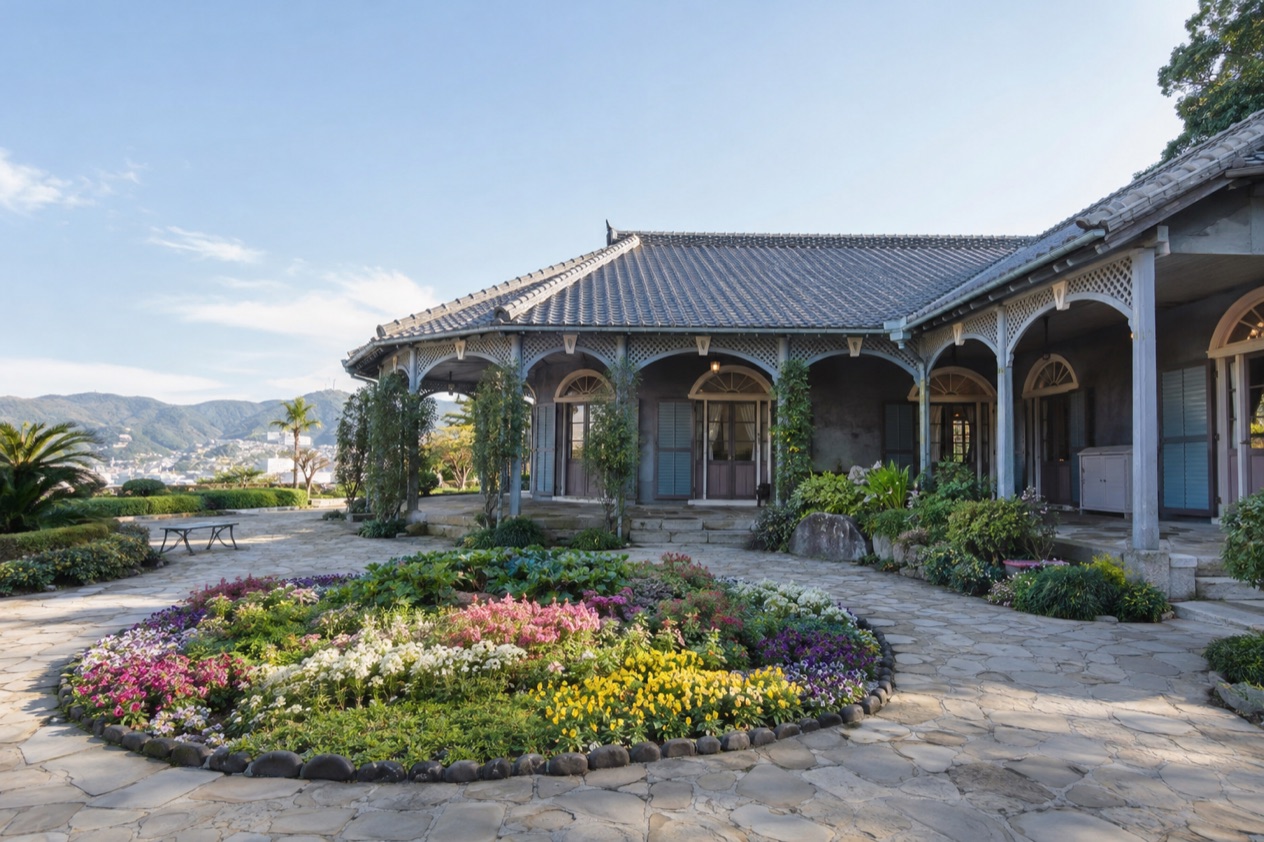
You arrive at Glover Garden to a cluster of wooden houses with verandas, shuttered windows and stone paths, set among trees and lawns. The first thing you notice is how different the architecture looks from the temples and shrines found elsewhere in Japan. The visit is a slow walk from house to house, with the story of Nagasaki’s foreign merchants told through the rooms and the grounds.
Is visiting Glover Garden worth it?
Yes, if you like to walk through the places where history happened, and especially if Nagasaki’s role as a port that met the outside world interests you. The Glover Residence is the oldest Western-style house surviving in Japan and Nagasaki’s foremost tourist attraction.
That is reason enough for most travelers to put it on a Nagasaki itinerary. It also suits anyone who knows Puccini’s opera, since the house and its surroundings are reminiscent of it, which is why the garden is also called the Madame Butterfly House.
What sets it apart from the other sights of Nagasaki is that it is a garden of several buildings rather than a single monument. Instead of one hall to look at and leave, you move through a small group of residences built for foreign merchants, each with its own owner and story.
The houses were designed by Japanese craftsmen working with Western ideas, so you see how two building traditions met in the same timber and tile. If you want something quite different from a temple visit, this is the place.
It also helps that the place is about people. Names such as Glover, Ringer and Alt belonged to real merchants who lived and worked in the port, and the grounds let you picture their daily lives. For travelers who prefer to feel a city’s past through its houses and gardens, rather than through museum cases, that human scale is the main draw.
What to see at Glover Garden
The garden is organized around a handful of historic buildings and a few pieces of the port’s past that were moved or preserved on the site. Plan to take them one at a time, and to look at the details of each: the verandas, the roof lines, the way the rooms open onto the grounds.
The Glover Residence
This is the heart of the garden. The house was built by Hidenoshin Koyama of Amakusa island and completed in 1863, and it has been designated as an Important Cultural Asset of Japan. It stands as the oldest Western-style house surviving in the country, so you are looking at a pioneering example of a style that later spread through Japanese cities.
Look at how the building mixes foreign form with local craft. The wooden structure, the tiled roof and the covered veranda wrapping around the house reflect a Japanese builder interpreting a Western plan. The residence belonged to Thomas Glover, a Scottish merchant who did business in Nagasaki, and the house is the reason the whole garden carries his name.
Ringer House and Alt House
Two more residences share the grounds. Ringer House was built in 1865 for Frederick Ringer, and Alt House was built for William Alt. Both men belonged to the circle of foreign merchants in Nagasaki, and seeing their houses next to the Glover Residence gives a sense of a small community with its own tastes in architecture.
Compare the three buildings as you go. Each has its own proportions and arrangement of rooms and verandas, and together they show that the Western-style house in Japan was never one single design. Pause at the windows and doorways, where the mix of materials is easiest to read.
The stone gate of the Nagasaki Masonic Lodge
A quieter find in the garden is the stone gate of the Nagasaki Masonic Lodge. The lodge was inaugurated at No. 50 Oura on October 5, 1885, and its gate has been preserved here. A gate is a modest object next to a house, but it records the social life of the foreign community in the port, with clubs and gatherings alongside trade.
Stop and look at the stonework itself. It stands as a fragment of a vanished building, and it gives the garden an extra layer beyond the residences, one that speaks of how the merchants organized their lives in a distant city.
The Madame Butterfly House
Glover Garden is also known as the Madame Butterfly House, because the house and its surroundings are reminiscent of Puccini’s opera. The opera tells of a Japanese woman in Nagasaki and an American naval officer, and the setting of houses above the harbor has long been linked with its imagined stage.
Whether or not you know the music, the association adds a layer to a walk through the garden. You can read the grounds as both a real merchant quarter and a place that foreign imagination turned into romance. Humming an aria as you stroll the paths is a fine way to spend a few minutes.
Hours, tickets and rules
Glover Garden is open to the public and draws nearly two million visitors a year, which tells you it is a place built for people to walk through, with paths and grounds meant for visitors. You enter as a visitor to a historic garden rather than to a private estate or a ceremonial site, and you move among the houses at your own pace.
The buildings are protected heritage, and the Glover Residence in particular carries the designation of an Important Cultural Asset of Japan. As with any historic house, the sensible habit is to treat the interiors and fittings with care, to move gently along the verandas and to look rather than touch.
Think of the visit as a stroll through a small historic quarter. The garden asks for nothing more than curiosity and a little time at each house, and the reward is the chance to see closely a type of building that is now rare in Japan.
When to visit Glover Garden
Because the garden is an outdoor walk between buildings, it responds to the weather and the light more than a single hall would. The wooden houses, the stone paths and the trees all look different under bright sky, soft cloud or after rain, so the visit changes with the day you choose.
Nearly two million people come through in a year, so you will probably share the paths with other visitors whenever you go. The grounds are a good match for a day when you want to be outside, and the houses give you something to look at whichever season you pick.
Consider the other plans for your day in Nagasaki. The garden fits well alongside the city’s other sights, and a mix of indoor and outdoor stops lets you adapt if the weather turns. If rain arrives, the covered verandas and the house interiors give you something to see while the grounds are wet.
Pair the visit with the Madame Butterfly story. If the opera is on your mind before you travel, listening to a recording beforehand makes the setting more vivid, and the houses and their surroundings take on the mood of the scenes the music describes.
Tips for your visit
Bring comfortable shoes, since a garden of several houses is a walk along paths and between buildings. Bring curiosity too: the details of the architecture reward a slower look, and a few minutes at each house adds up to a fuller picture of the merchants who built them.
Getting to Nagasaki is straightforward to plan. Nagasaki is a city at the western extremity of Kyushu. The nearest airport is Nagasaki Airport in the nearby city of Omura, and from there buses transport passengers to the Shinchi bus terminal in the city center. If you are arriving through Fukuoka, buses depart from Fukuoka Airport for Nagasaki every hour, and a one-way trip takes about 2 hours 30 minutes.
Pair the garden with other parts of Nagasaki’s story. The Hidden Christian Sites in the Nagasaki Region have been recognized and included in the UNESCO World Heritage Sites list, and they add another side to the history of a port that opened itself to foreign contact. Seeing Glover Garden and learning about those sites gives you two views of the same city.
For families, the houses and garden paths give children things to find and compare: balconies, doorways, stone gates and the story behind the opera. For anyone who wants to take things slowly, the garden rewards a leisurely pace, with a pause on a veranda to look at the grounds.
Good to know before you go
Glover Garden is a place for strolling and looking, so a camera and some curiosity are the only real essentials. Keep your belongings with you as you move between houses, and carry what you need for the weather, since much of the visit is outdoors. Nagasaki is the capital of its prefecture on the island of Kyushu, and the garden is among the sights that make the city a rewarding stop for travelers interested in how Japan met the wider world.
Sources
- Wikipedia, Glover Garden (https://en.wikipedia.org/wiki/Glover_Garden), checked October 11, 2026
- Japan National Tourism Organization, Nagasaki (https://www.japan.travel/en/destinations/kyushu/nagasaki/nagasaki-city-and-around/), checked October 11, 2026
- Wikipedia, Nagasaki (https://en.wikipedia.org/wiki/Nagasaki), checked October 11, 2026
- Wikivoyage, Nagasaki (https://en.wikivoyage.org/wiki/Nagasaki), checked October 11, 2026
To plan your stay
- Best Time to Visit Japan: Cherry Blossoms, Autumn Colors, Weather and Festivals
- Where to Stay in Japan: Ryokan, Temple Stays, Capsule Hotels and the Best Cities to Base In
- Sending Luggage from the Airport in Japan: Hands-Free Travel, Hotel Delivery and Coin Lockers
- Know Before You Go to Japan: Entry, Money, Etiquette and Getting Around