
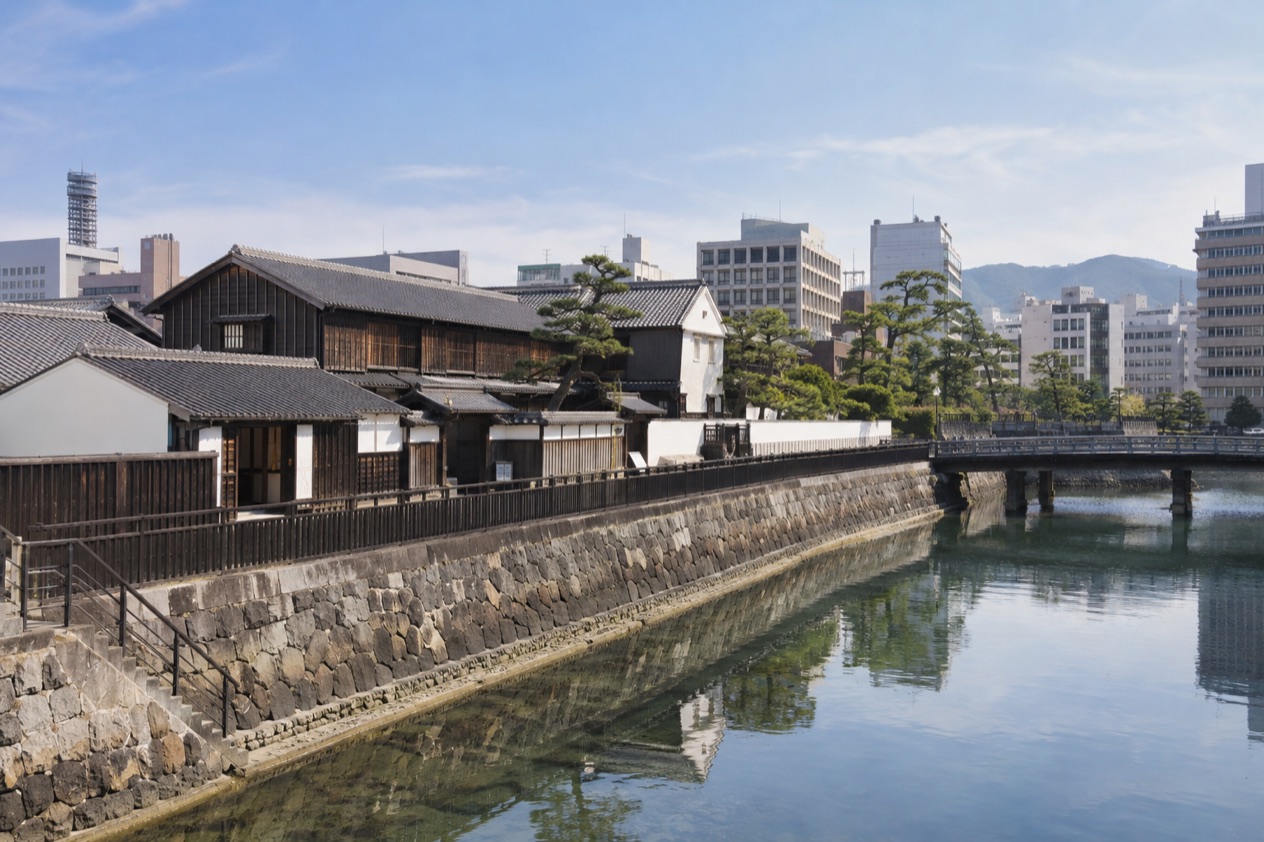
You come to Dejima through a part of Nagasaki that looks like any other stretch of city, and then the pieces appear: low wooden warehouses with dark timbers and white plaster, a residence with a long veranda, a gate that once faced open water. The island is no longer an island, but the rivets set into the ground mark where its edge used to run. It is a visit built around one question, what it was like when this was the only door Japan kept open to the Western world.
Is visiting Dejima worth it?
Yes, if you like history you can walk through rather than read about, and it suits travelers curious about how Japan stayed connected to Europe while it kept its borders closed. For 220 years Dejima was the central conduit for foreign trade and cultural exchange during the Edo period, and the only Japanese territory open to Westerners. Few places in the country hold such a specific, well-defined chapter.
What sets it apart from the temples and castles that fill most itineraries is its subject. Here the story is trade, language and ideas rather than shoguns or shrines. Portuguese merchants used the island first, and Dutch traders followed and stayed until the middle of the nineteenth century. Through them came books, medicine, astronomy, glassware, and a body of learning that Japanese scholars called Dutch studies.
Dejima also rewards those who like to see a reconstruction in progress. Restoration began in 1996 with plans to rebuild 25 buildings as they stood in the early nineteenth century.
The work gives the site the feel of a place being slowly pieced back together, and the long-term aim is for the island to be surrounded by water on all four sides again. If you want ruins and ancient stone, this is a different kind of visit. If you want to stand inside a rebuilt trading post and imagine a harbor of ships, it delivers.
What to see at Dejima
The island was small, about 390 feet from end to end, and the visit follows that scale: a cluster of restored buildings, open ground between them, and the outline of the old shoreline. Everything here is tied to the years when Dutch traders lived on this plot of reclaimed land.
The Chief Factor’s Residence
The chief factor was the senior Dutch trader on the island, and his residence was the grandest house on it. It was restored in the spring of 2006, along with several neighboring buildings. Inside, rooms are furnished to show how Dutch and Japanese ways of living met under one roof, with European-style furnishings set in a Japanese timber structure.
Look at how the building mixes both traditions: the plaster walls, the wooden framing, the windows and the way rooms open onto each other. It is also the place to picture the formal gatherings where the Dutch hosted Japanese officials and interpreters. The residence gives the clearest sense of daily life on the island.
The Japanese Officials’ Office and the Head Clerk’s Quarters
Two other buildings restored in 2006 show the machinery behind the trade. The Japanese Officials’ Office is a reminder that the Dutch did not simply come and go. Their movements, goods and contacts were supervised by Japanese authorities, and the island was closely watched.
The Head Clerk’s Quarters belonged to the man who kept the trading records. Look for how these buildings differ from the chief factor’s residence: they are more modest and more practical, and they show the working side of the settlement rather than its ceremonial face.
No. 3 Warehouse and the Sea Gate
Trade was the whole reason for the island, and the warehouses are where it becomes concrete. No. 3 Warehouse was also restored in 2006. Goods arriving by ship were stored in buildings like it, and the trade is often remembered through items such as sugar, textiles, and the books and instruments that moved in the other direction from Europe into Japan.
The Sea Gate, restored in the same spring, marks where the water once met the island. Standing at it, you can picture ships unloading from the harbor and goods carried through. Today the city has grown up around the site, so the gate is as much a clue to what has vanished as a piece of what remains.
The marked outline of the island
Dejima was eventually absorbed into Nagasaki through land reclamation, and a major redesign of the harbor in 1904 hid its original location. To help visitors read the ground, the original footprint of the island has been marked by rivets.
Follow them and the shape appears: a fan, about 246 feet across at its widest, set against a modern city. It is a quiet detail, but it turns an ordinary street into a map of the past. The restoration plans aim to bring back the fan-shaped form with all the embankment walls rebuilt.
Hours, tickets and rules
Dejima is a designated Japanese national historic site, a status it received in 1922, and it is treated as a protected heritage site rather than an ordinary park. That status shapes what you find on the ground: preserved and reconstructed buildings, marked outlines, and an emphasis on seeing the place as it was in the early nineteenth century.
Opening hours, closing days and admission are not given in the information we hold, so no times or amounts appear here. What can be said is what the visit consists of: the restored residence and offices, the warehouse, the Sea Gate, and the open ground marked with rivets where the island’s edge once lay.
The restoration is still moving forward, with plans to bring back more of the 25 buildings once envisioned. That means the site continues to change from one visit to the next, and the layout you see reflects the stage that the work has reached.
When to visit Dejima
Dejima is a place to see in any kind of weather, since the story is told by buildings and ground you walk past rather than by a single seasonal spectacle. No festival or special date is tied to the site in what we hold, so the choice of month rests on your wider Nagasaki plans.
The setting is a Kyushu port city, at the western extremity of the island, so the weather is that of a coastal city. A clear day shows the wood and plaster of the buildings against the sky. A gray day suits the subject well, since the story is one of ships, harbors and long journeys, and the rain-dark timbers fit the mood of a trading post.
If you come in the warmer part of the year, the rainy season and typhoon months can bring wet days to Nagasaki, so it makes sense to treat Dejima as a visit that moves easily around the weather. It pairs well with other parts of the city when showers pass.
Tips for your visit
Think of Dejima as a site where background pays off. A little reading before you arrive makes the buildings come alive: the Portuguese traders who used the island first, the Dutch who held it afterward, and the idea that a few acres of reclaimed land carried so much of Japan’s contact with the world.
In 1823 Philipp Franz von Siebold brought Japan’s oldest piano to Dejima. That piano is not here today. It is on display at the Kumaya Art Museum in Hagi City, so it belongs to another trip, but it shows how objects and ideas moved through this island.
Getting to Nagasaki is straightforward to plan around. From Nagasaki Airport, buses run to the Shinchi bus terminal in the city center. From Fukuoka Airport, buses leave for Nagasaki every hour, and a one-way trip takes about 2 hours 30 minutes. The airport itself lies in the nearby city of Omura.
Nagasaki has more to offer around Dejima. The Hidden Christian Sites in the Nagasaki Region have been included in the UNESCO World Heritage list, and they add a very different layer to a trip centered on the city’s history of contact with outsiders. Details of parking, guides and access for families or travelers with limited mobility are not stated in what we hold, so we leave them aside.
Good to know before you go
Dejima sits within the city of Nagasaki, the capital of Nagasaki Prefecture on Kyushu, so the usual habits of a city visit apply: carry some yen for small purchases, keep an eye on your belongings in busy areas, and plan around the weather during the rainy and typhoon months. The visit also fits easily into a day of walking through the older parts of town.
Sources
- Wikipedia, Dejima (https://en.wikipedia.org/wiki/Dejima), checked October 11, 2026
- Japan National Tourism Organization, Nagasaki (https://www.japan.travel/en/destinations/kyushu/nagasaki/nagasaki-city-and-around/), checked October 11, 2026
- Wikipedia, Nagasaki (https://en.wikipedia.org/wiki/Nagasaki), checked October 11, 2026
- Wikivoyage, Nagasaki (https://en.wikivoyage.org/wiki/Nagasaki), checked October 11, 2026
To plan your stay
- Best Time to Visit Japan: Cherry Blossoms, Autumn Colors, Weather and Festivals
- Where to Stay in Japan: Ryokan, Temple Stays, Capsule Hotels and the Best Cities to Base In
- Sending Luggage from the Airport in Japan: Hands-Free Travel, Hotel Delivery and Coin Lockers
- Know Before You Go to Japan: Entry, Money, Etiquette and Getting Around