
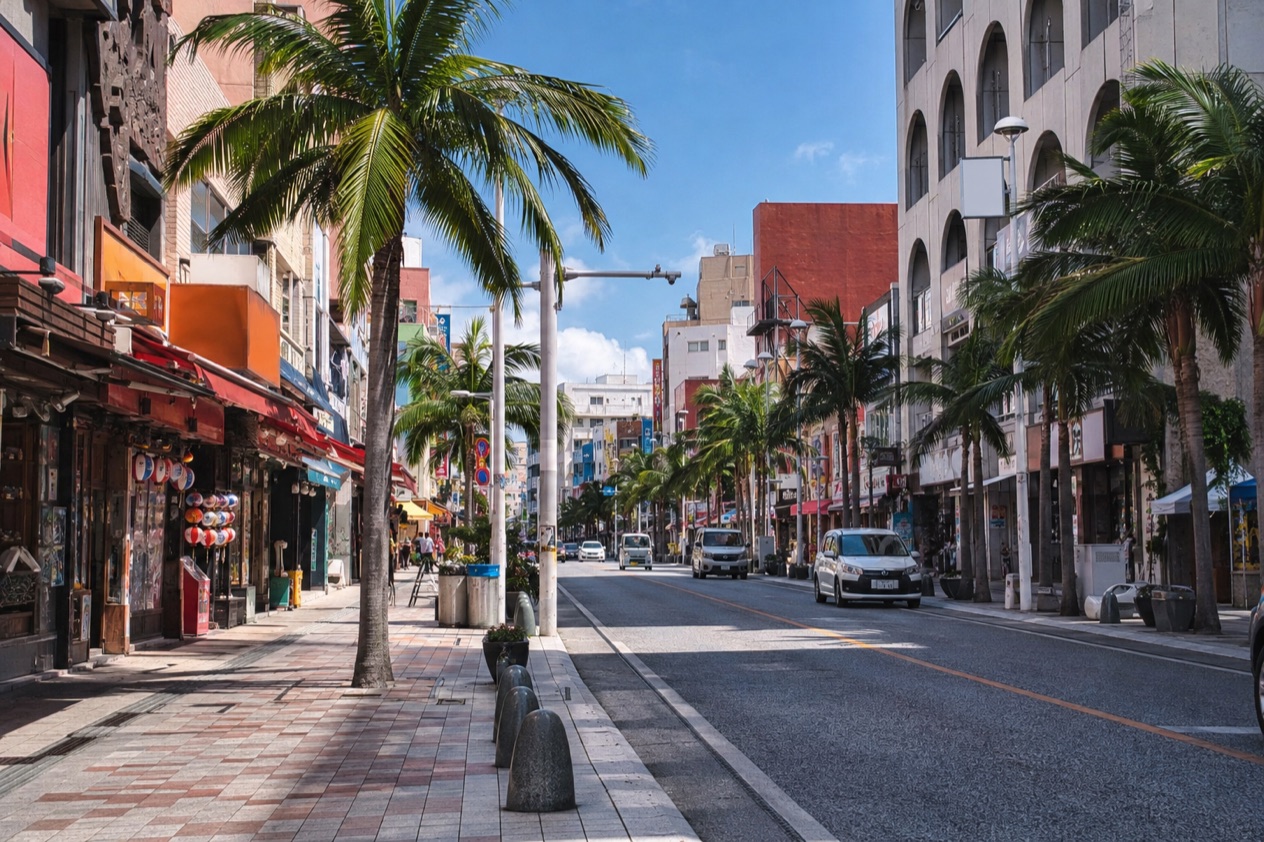
Walking onto Kokusai Dori, you hear a mix of shopkeepers calling out, music drifting from bars and the hum of the monorail passing overhead. Shops selling Okinawan sweets, souvenir shirts and pottery crowd both sides of the avenue, and side streets lead off into covered arcades. It is a street for wandering with no fixed plan, grazing on snacks and ending up somewhere you did not expect.
Is visiting Kokusai Dori worth it?
Yes, if you like cities best when you can graze, browse and people-watch, and it suits travelers who want a first taste of Naha before heading to the beaches or the aquarium. The avenue is a stretch of stores, restaurants and bars, so it is a place for shopping, eating and an evening out rather than a single sight to tick off.
What sets it apart from other parts of Naha is how much branches off it. Spurring away from the main avenue are the covered Heiwa Dori Shopping Arcade and Makishi Public Market, so one street gives you the souvenir stalls, the fish counters and the produce stands in a single outing. The avenue also ends at the main bus terminal, and several Yui Rail stations serve it, which makes it a natural place to start or finish a day.
If your idea of a good trip is quiet shorelines and mountain views, this street will feel like a detour. If you want to see how Naha eats, shops and spends its evenings, it is the right place. Pair it with Shuri Castle, which is registered as a UNESCO World Heritage Site, and you have a good picture of the city.
Naha is the largest city in Okinawa, and the avenue feels like its main stage. Visitors from the island’s resorts, travelers passing through the airport and people who live in the city all end up here at some point in the day. That mixture gives the street an easygoing energy that suits an unhurried visit.
What to see at Kokusai Dori
Along the way you pass stores, restaurants and bars, with the Yui Rail running above the city. Three parts of the visit deserve a closer look.
The main avenue
Kokusai Dori is also called International Avenue, and it runs for about a mile through the middle of Naha. Souvenir shops stack up shirts, snacks, sweets and crafts, and you find shops selling Okinawan pottery and the region’s spirits. Restaurants serve Okinawan home cooking such as goya champuru, a stir-fry built around bitter melon, and soki soba, noodles topped with tender pork.
Look up as you walk, because the signs, the balconies and the monorail track above all add to the scene. Stop for a cold drink or a bowl of shaved ice when the sun gets strong, and duck into the side lanes where small bars and eateries tuck behind the main storefronts. Ending at the bus terminal, the street makes a satisfying line to follow from one end to the other.
Heiwa Dori Shopping Arcade
Turn off the main avenue and you step into the covered Heiwa Dori Shopping Arcade, where the roof keeps off both sun and showers. It is lined with small shops selling clothing, textiles, tableware and local goods, and it feels more like a neighborhood passage than a tourist strip. Wander slowly and you will see craft stores and snack counters alongside everyday shops.
The arcade is a good place to browse when the weather turns, because you can keep walking without needing an umbrella. Look for shops selling Okinawan textiles and ceramics, which make lighter souvenirs than bottled spirits. Take a break at one of the small cafés and watch the flow of shoppers go by.
Makishi Public Market
Makishi Public Market is a massive shotengai (a covered market street) filled with fresh fish, meat and produce stands, as well as restaurants, tourist goods shops and liquor shops. The fish counters are the draw for visitors, with colorful tropical fish laid out on ice that look nothing like what you find in mainland Japan. Pork is central to Okinawan cooking, and you see it in many forms across the stalls.
A common way to enjoy the market is to pick out seafood at a counter and have it cooked at a restaurant in the building. Even if you do not eat there, walking the aisles is a lively way to learn what ends up on Okinawan tables. Look for sea grapes, tropical fruit and the local tofu, which has a firmer texture than the mainland kind.
How to get to Kokusai Dori
It is the only train system in Okinawa Prefecture, so it is the one rail line you will use on the island.
From Naha Airport, the Yui Rail carries passengers from Naha Airport Station to the center of Naha and Kokusai Dori. Naha Airport is the gateway to all of Okinawa’s islands, served by flights from dozens of cities across Japan, including low-cost carriers. That means visitors land, ride the monorail and are on the avenue without needing a car.
The same line continues beyond the avenue to Shintoshin, Shuri and the terminal at Tedako-Uranishi Station in Urasoe. If you are staying near Shuri, you can ride the monorail to the avenue and back again without changing modes. The line also makes it simple to combine the street with a visit to Shuri Castle on the same day.
Buses are the other option. Kokusai Dori ends at the main bus terminal in Okinawa, so travelers arriving from elsewhere on the main island can reach the avenue by bus as well. If you are coming from a resort on the coast or from the aquarium area in the north, the bus terminal marks the end of the avenue, and you can walk back along the street toward the monorail stations.
When to visit Kokusai Dori
The street works in any month, since the stores, restaurants and bars keep it alive through the day and into the evening, and the covered arcades give shelter from sun and rain. What changes is how you feel while walking, so the season shapes how you plan the day.
| Month | Average high (°F) | Average low (°F) | Precipitation (in) | Rain days | Sunshine (hours) |
|---|---|---|---|---|---|
| January | 67.6 | 58.8 | 4.00 | 10.2 | 93 |
| April | 75.7 | 66.4 | 6.34 | 10.3 | 121 |
| July | 89.4 | 80.6 | 7.41 | 9.4 | 227 |
| October | 82.6 | 74.3 | 7.06 | 8.8 | 163 |
Winter is mild, with January afternoons warm enough for a light layer and a long stroll. Spring is warmer and more humid, and the street feels comfortable for browsing from shop to shop. Summer is hot and humid, with July and August the warmest months of the year, so the covered arcades and air-conditioned shops become welcome breaks, and a cold drink is never far away.
October is still warm, and the rain comes in showers across fewer days than in spring. September is the wettest month in Naha and December is the driest, so late autumn can suit a day of walking if you prefer fewer showers. Whatever the season, the hours when stores glow and bars fill are a good time to see the avenue with its lights on, and daytime suits the markets, which are the most active when the stalls are fully stocked.
Because the Heiwa Dori arcade is covered, a rainy afternoon does not need to cancel the plan. Start under the roof, move on to Makishi Public Market, and come back to the open avenue when the sky clears.
Tips for your visit
Plan to walk, and bring comfortable shoes, since the best moments come from drifting between the main avenue, the arcade and the market. A hat and sunscreen help in the summer months, when the average high passes the upper 80s, and a light rain layer is useful in the wetter months. Carry a small bag for souvenirs and snacks, because the stalls tempt you at every turn.
Combine the street with the places the Yui Rail reaches. The monorail runs from the airport through the center of Naha, Kokusai Dori and Shintoshin to Shuri, so a day can pair the avenue with Shuri Castle, which is part of the UNESCO World Heritage listing for Okinawan gusuku and sacred sites. Naha itself is the capital of Okinawa Prefecture, the southernmost prefecture of Japan, and the avenue gives you a base for exploring it.
Eating is a large part of the visit, so arrive hungry. Try a plate of Okinawan dishes at a restaurant on the avenue, sample snacks from a stall, and pick up a bottle of the local spirit or a sweet as a gift at one of the liquor and souvenir shops. Makishi Public Market is a good place to look at ingredients you might not recognize, from tropical fish to local produce.
Families and travelers who prefer a gentler pace can use the covered arcade as a place to rest from the sun, and the Yui Rail stations along the avenue give you several points to start or stop. If you are heading on to a beach such as Emerald Beach or Okuma Beach on Okinawa Island, treat the avenue as a morning or evening stop and keep the beach for another part of the trip. Okinawa Churaumi Aquarium is a separate outing, and its hours should be planned as their own day.
Good to know before you go
Kokusai Dori is a city street with ordinary city habits: keep to the side when you stop to take a photo, and step into a shop when you want to browse without blocking the flow of walkers. The warm, humid climate means a water bottle is welcome in summer, and the typhoon season is worth keeping in mind when planning a trip to Okinawa, since weather can change the plan for a day. Wherever the sky stands, the covered arcades and the monorail give you ways to keep exploring.
Sources
- Wikipedia, Naha (https://en.wikipedia.org/wiki/Naha), checked October 11, 2026
- Japan National Tourism Organization, Okinawa (https://www.japan.travel/en/destinations/okinawa/okinawa/naha-and-the-main-island/), checked October 11, 2026
- Okinawa Churaumi Aquarium (https://churaumi.okinawa/en/), checked October 11, 2026
- Wikipedia, Okinawa Island (https://en.wikipedia.org/wiki/Okinawa_Island), checked October 11, 2026
- Japan Meteorological Agency (JMA), Normal values 1991-2020, monthly (https://www.data.jma.go.jp/stats/etrn/view/nml_sfc_ym.php?prec_no=91&block_no=47936), station Naha, elevation 28 m, checked October 11, 2026
To plan your stay
- Best Time to Visit Japan: Cherry Blossoms, Autumn Colors, Weather and Festivals
- Where to Stay in Japan: Ryokan, Temple Stays, Capsule Hotels and the Best Cities to Base In
- Sending Luggage from the Airport in Japan: Hands-Free Travel, Hotel Delivery and Coin Lockers
- Know Before You Go to Japan: Entry, Money, Etiquette and Getting Around