
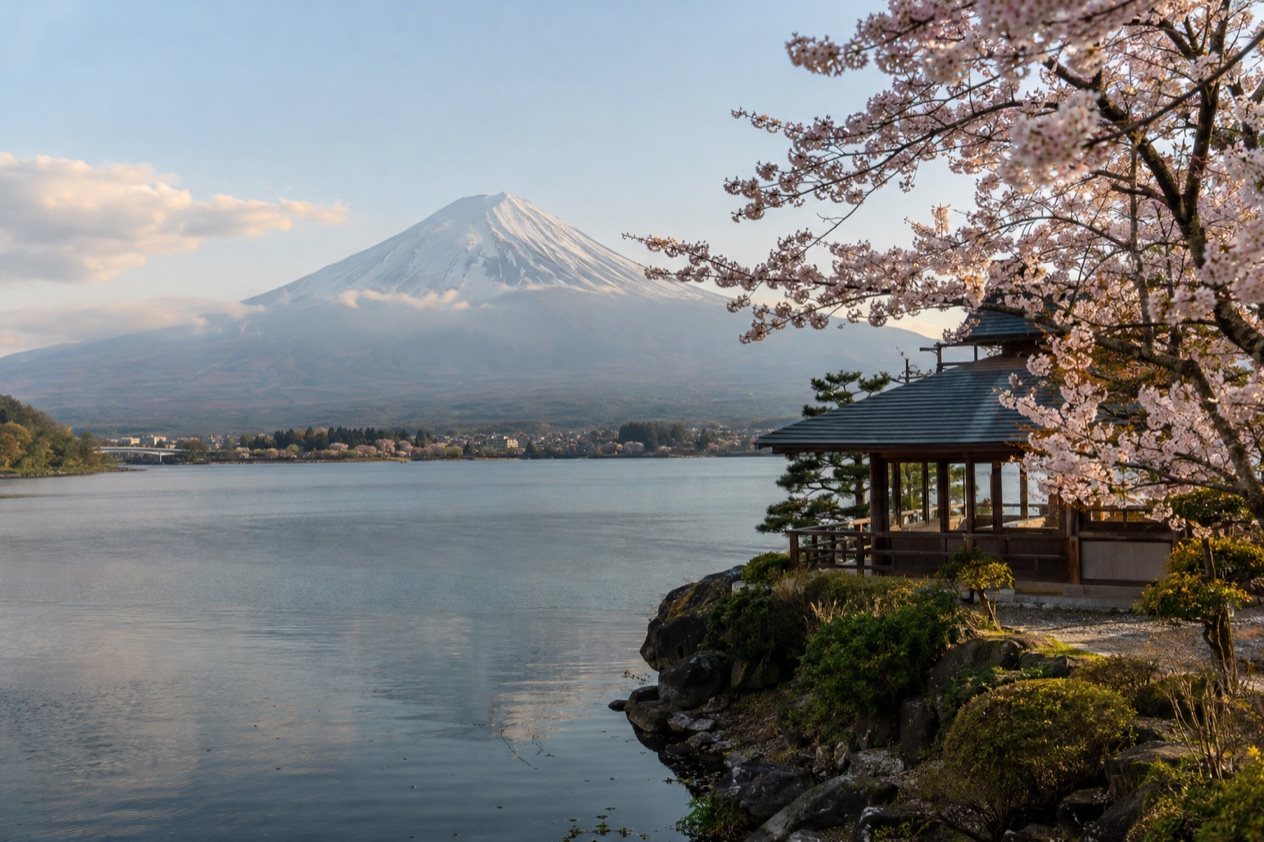
A morning at Lake Kawaguchi starts with the sound of a train pulling into the little station, shop shutters rolling up, and mist lifting off the water while Mount Fuji sits somewhere behind the clouds. By evening the lakeshore has gone dim and the smell of grilled fish and simmering broth drifts out of small restaurants. The choice that shapes your stay is where to sleep: beside the station, along the water, or around one of the neighboring lakes.
What is the best area to stay in Lake Kawaguchi?
For a first visit and for sightseeing, the area around Kawaguchiko station and the nearby lakeshore is the best base, while Lake Sai suits travelers who want to be away from the main strip, and the Fujikyu-Highland station area suits anyone organizing a day around the amusement park. Budget travelers tend to look at the streets near the station, where guesthouses and simple rooms cluster.
Families often want space and a short link to the train or bus. Nightlife is not what this place is about, so if you want late bars, Lake Kawaguchi will feel like a different kind of trip.
The lake sits within the town of Fujikawaguchiko in southern Yamanashi Prefecture, in the foothills of Mount Fuji. The town holds three of the Fuji Five Lakes: Lake Kawaguchi, Lake Sai and Lake Shoji.
That matters for your choice because each lake gives the surroundings a different character, and the rail line ties only some of them together. The Fujikyuko Line has stations at Kawaguchiko and at Fujikyu-Highland, which gives you two natural anchors if you plan to travel by train.
Think of the area as three layers. The first is the station district, where arrivals happen and where buses, shops and restaurants gather. The second is the shore of Lake Kawaguchi itself, where lodging turns toward the water and the mountain.
The third is the neighboring lakes, where the pace changes and the lodging is more likely to be a small inn than a hotel with a lobby full of luggage. Which layer you choose says more about your trip than the star rating of any single property.
Your trip purpose helps too. Lake Kawaguchi serves as a major hub for climbing Mount Fuji during the climbing season in July and August, so people heading up the mountain often treat the lake as a staging post. If you are here for the autumn color, a hot bath after a day outdoors, or a morning of looking at the mountain over breakfast, you can stay a little farther out and still reach the main sights.
A third consideration is the kind of stay. Ryokan, the traditional Japanese inns, bring tatami floors, futons, private baths (sometimes outdoor), yukata robes, a kaiseki dinner and a traditional Japanese breakfast.
They turn the night into part of the sightseeing, and a few lakeside districts are known for them. A conventional hotel gives you a bed, a desk and freedom to eat wherever you like. Neither is better, but your evening looks quite different with each.
The altitude is part of the picture as well. The lake sits high enough that summers stay relatively cool and winters are frequently icy, so the season changes what you want from a room.
In summer, a room facing the water and a terrace can decide the choice. Lake Kawaguchi also lies within Fuji-Hakone-Izu National Park, so even the busiest streets are never far from woods and water.
Finally, consider how you get here. The Fuji Excursion limited express and the highway bus both finish at Kawaguchiko, so the station district is the point where your journey ends and your luggage is lightest to carry. Staying there removes one more transfer. Staying farther out means adding a local bus ride or a taxi to the end of a long day of travel, which some people happily accept in exchange for a view and a quieter doorstep.
The best areas to stay in Lake Kawaguchi
Around Kawaguchiko station
This is where trains and buses arrive, and the streets fan out into restaurants, souvenir shops, bakeries and noodle counters. Mornings begin with people heading to the bus stops and shopkeepers sweeping their doorsteps. The lodging mix includes business-style hotels, guesthouses and small family-run inns, and you step from the station almost directly into the town.
It suits first-time visitors, travelers on a tight schedule and anyone who prefers to leave the luggage at the front desk and go straight out. Kawaguchiko station is served by the Fujikyuko Line, and a two-day Retro Bus ticket is sold at the bus ticket office inside the station. A two-day ticket for that bus costs ¥1,200 from the ticket office inside the station, a handy tool if you plan to circle the lake over a couple of days.
A tip: pick a street a few minutes from the station platform rather than directly on the main road, since the side lanes tend to be where the small guesthouses and local eateries hide.
The shore of Lake Kawaguchi
Staying along the water puts the lake at the center of the experience, but convenience and views vary by property. The lake has no natural outlet, which gives it a calm, closed look, and lodgings here turn toward the shoreline and the mountain beyond. This is where you find resort-style hotels, lakeview ryokan and a handful of boutique places with terraces, along with apartments and cottages for longer stays.
The shore suits couples, anyone celebrating something, and travelers who want the room itself to be part of the trip. Many properties here have baths, and a ryokan stay brings the kaiseki dinner and Japanese breakfast that define the experience. Fishing is also popular on the lake, which introduced Japanese white crucian carp and wakasagi in the Meiji period, so you will see anglers along the edges.
To get around, plan on the local bus or a taxi, since this stretch is not the station district. Tip: when choosing a room, look at which way it faces, because a lakeview and a mountain view are different things and not every room offers both.
Lake Sai
Lake Sai belongs to the same town of Fujikawaguchiko and has its own character, shaped by woods, water and the sound of wild birds, which the Ministry of the Environment designated as one of the 100 Soundscapes of Japan. A stay here means mornings with birdsong instead of traffic and an evening with few lights beyond your own window.
It suits travelers who want to hear the place rather than just see it: walkers, photographers, birdwatchers and anyone who prefers a small inn or a cottage over a large hotel. Expect guesthouses, lodges and rental houses more than big resort properties.
The trade-off is distance from the station district, so you will rely on buses or a taxi to reach Kawaguchiko for restaurants and rail. Tip: if your trip includes a day on the Fuji Five Lakes, remember the order from east to west runs Yamanaka, Kawaguchi, Sai, Shoji and Motosu, which helps you picture how the lakes line up.
Lake Shoji
Lake Shoji is the third lake inside the town and the one that tends to attract people looking for a retreat with few distractions. Lodging here leans toward small inns, minshuku-style family guesthouses and cottages, where the host often serves a home-style dinner and breakfast.
It suits travelers who plan to spend more of the day in their room, on a terrace or on a walk than in town. Because you will rely on local transport to reach the station district, it makes sense for a slower itinerary rather than a day packed with stops.
Tip: if you like staying in a traditional inn, ask what the room includes. Ryokan typically offer tatami floors, futons, yukata, a private bath, a kaiseki dinner and a traditional Japanese breakfast, so the price of the night usually covers more than a bed.
Near Fujikyu-Highland station
The Fujikyuko Line has a second station in town, Fujikyu-Highland, and the neighborhood around it makes sense for anyone planning a day at the amusement park or who wants a base along the rail line rather than at the end of it. Lodging here is a mix of hotels, guesthouses and a few larger properties.
It suits families with children, groups and travelers who like having a train stop within reach but do not need to be in the thick of the shops. The rail link means you can reach Kawaguchiko station for dining and sightseeing without a taxi.
Tip: think about whether you want to be at the park’s door or at the lake. The two settings give very different mornings, and your choice should follow the main activity of your trip.
Lake Kawaguchi areas compared
| Area | Best for | Feel | Getting around |
|---|---|---|---|
| Around Kawaguchiko station | First visit, sightseeing, budget | Shops, restaurants and the arrival point of trains and buses | Fujikyuko Line, Retro Bus, on foot |
| Shore of Lake Kawaguchi | Couples, ryokan stays, longer stays | Lodging turned toward the water and the mountain | Local bus or taxi |
| Lake Sai | Walkers, birdwatchers, photographers | Woods, water and birdsong | Local bus or taxi |
| Lake Shoji | A slow stay in a small inn | Retreat with family-run lodging | Local bus or taxi |
| Near Fujikyu-Highland station | Families, groups, amusement park day | Rail stop along the line | Fujikyuko Line |
The main trade-off is between being near the station and being near the water. Near the station you have restaurants, shops and the Retro Bus within a few steps, and a train or bus to take you onward whenever you like. The cost is that the surroundings feel more like a town than a lakeside retreat, and the view may be of roofs and signs rather than of the mountain.
On the shore, the view and the atmosphere improve, and so does the chance of a bath with a vista. What you give up is the ability to wander out of your door and find three restaurants within a minute. You will plan your dinners more deliberately, often eating at your lodging, which is exactly how a ryokan stay is meant to work.
Lake Sai and Lake Shoji take that logic a step further. They ask you to slow down and accept that the day revolves around the lodging, a walk and a meal. For some travelers that is the whole point. For others, particularly those with a packed list of sights, it adds transfers that take away from the time on the ground.
There is also a choice between new and old. Newer hotels around the station tend to offer predictable rooms and Western-style beds, while a traditional inn brings tatami and futons and a more ritual evening. Heritage Stays go a step further, letting visitors take part in cultural activities such as tea ceremony, calligraphy and wearing traditional Japanese clothing, though reservations are required.
Finally, weigh the time of year. In July and August the lake serves as a hub for climbing Mount Fuji, which changes who you share the station area with. Outside the climbing season, the town reverts to a mix of lakeside strollers, day-trippers and travelers seeking a hot bath and a mountain view, so your choice of area matters more for the mood than for logistics.
How to choose your hotel in Lake Kawaguchi
Start with the kind of evening you want, because that decides the kind of lodging. A ryokan makes the night the event: you arrive, change into a yukata, bathe, and sit down to a kaiseki dinner of small seasonal courses on a tatami floor.
Ryokan typically pair a kaiseki dinner with a traditional Japanese breakfast, making the meals part of the stay. If that sounds like the heart of the trip, choose the ryokan and let the sightseeing fit around it.
A conventional hotel gives you more freedom. You eat where you like, come and go without a dinner appointment, and treat the room as a base. This approach fits travelers who plan to try the town’s noodle shops, bakeries and small restaurants, and who prefer a bed to a futon. For many, the station district is the natural place for this style of stay.
Ryokan are believed to have emerged in Japan in the 8th century, and the format has kept its essentials: tatami, futons, private baths (sometimes outdoor) and a set meal. That continuity is part of the pleasure, but it also means the rhythm is set by the inn. Dinner is served at a fixed time, and the evening is slower than in a hotel.
If you want something between the two, look at guesthouses and small inns, which give a friendlier, more personal setting than a large hotel without the full ceremony of a ryokan. Apartments and rental houses suit longer stays or groups who want a kitchen and a living area.
This kind of stay suits travelers who want the lodging to be the experience, not just the place to sleep.
Think about transport next. If you arrive by the Fuji Excursion limited express from Shinjuku, which runs two roundtrips daily on weekdays and three on weekends and holidays since 2019, you finish at Kawaguchiko station. The highway bus from Shinjuku takes approximately 1 hour 45 minutes and also ends at Kawaguchiko. A hotel near the station makes the last leg trivial, while a lake lodging adds a local ride.
Families should look at the practical side: a room with space for everyone, a location on the Fujikyuko Line or near the station so that day trips do not need a taxi each time, and a property whose meals can suit children. The Fujikyu-Highland station area is worth considering when an amusement park day is the highlight.
Finally, match the room to the weather. The lake’s altitude brings cool summers and frequently icy winters, so in cold months a lodging with its own bath is a real comfort after a day outside, and a place with a good doorstep restaurant saves a walk in the dark. In warmer months, a terrace or a window toward the water gives the room its own reason to exist.
Good to know before you go
From Shinjuku, the Fuji Excursion limited express and the highway bus both run to Kawaguchiko, so the town can be reached from Tokyo without changing lakes or lines. Once you are there, the Kawaguchiko Retro Bus has a two-day ticket for ¥1,200 sold at the ticket office inside the station, a useful tool if you are staying a couple of nights and want to circle the lake without a taxi.
Sources
- Wikipedia, Fujikawaguchiko, Yamanashi (https://en.wikipedia.org/wiki/Fujikawaguchiko,_Yamanashi), checked October 11, 2026
- Wikipedia, Lake Kawaguchi (https://en.wikipedia.org/wiki/Lake_Kawaguchi), checked October 11, 2026
- Wikivoyage, Fuji Five Lakes (https://en.wikivoyage.org/wiki/Fuji_Five_Lakes), checked October 11, 2026
- Japan National Tourism Organization, ryokan stays, what is included, etiquette (https://www.japan.travel/en/guide/japanese-ryokan/), checked October 11, 2026
- Japan National Tourism Organization, heritage stays (https://www.japan.travel/en/heritage-stays/), checked October 11, 2026