
A train leaves Shinjuku Station and the city thins out. Apartment blocks give way to river valleys, and then the line starts to climb toward the mountains of Yamanashi.
At the end waits a lake in the foothills of Mount Fuji, with a small station that sits close to the water.
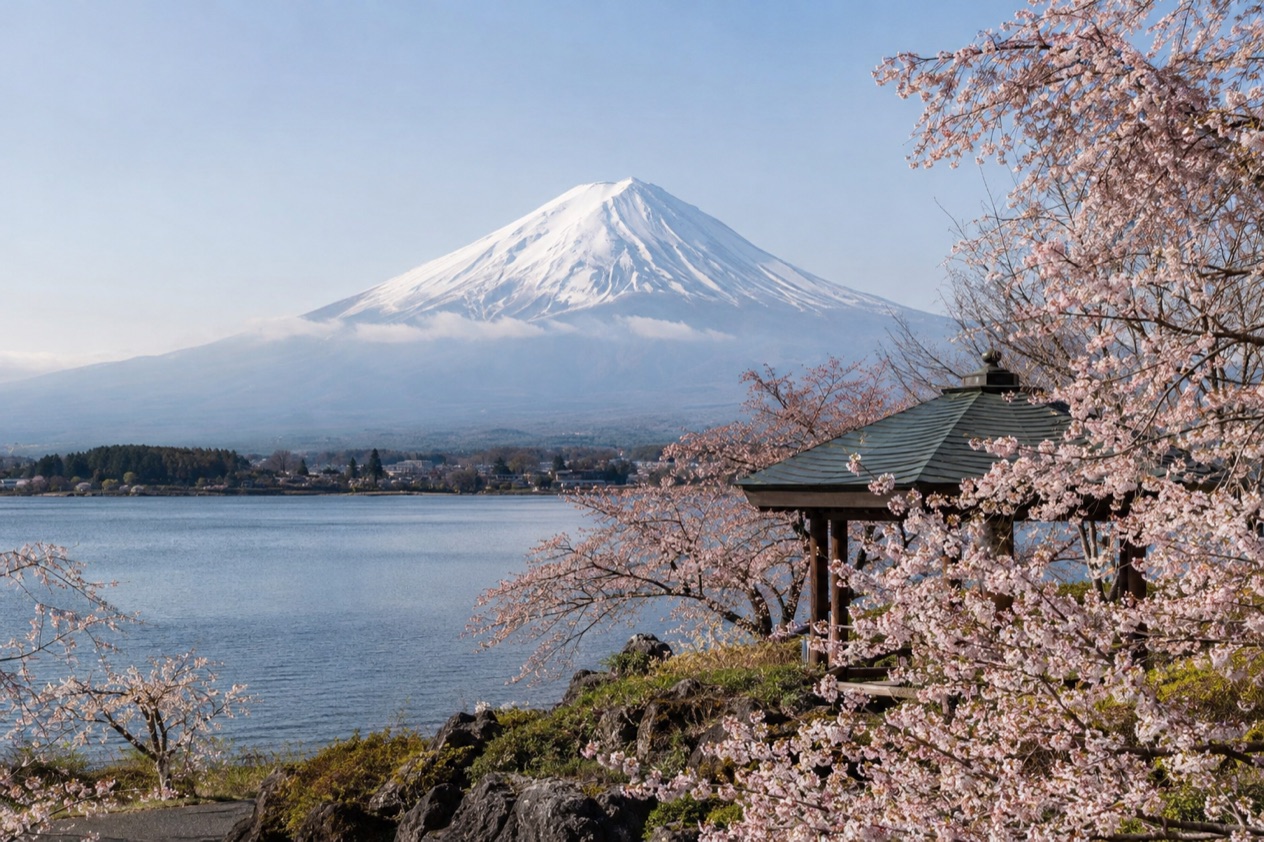
How do you get to Lake Kawaguchi from Tokyo?
The most direct way is the Fuji Excursion, a limited express that runs from Shinjuku Station in Tokyo to Kawaguchiko Station in Yamanashi Prefecture, using the Chuo Line and then the Fujikyuko Line. Kawaguchiko Station is the end of the line, and the lake lies in the town of Fujikawaguchiko, which also holds Lake Sai and Lake Shoji.
What decides your choice is how you like to travel. The Fuji Excursion keeps the trip to a single train for most of the way, with a few timetabled departures each day.
The alternative is to ride the Chuo Line as far as Otsuki and change there to the local Fujikyuko trains, which stop at every station and give you more freedom to pick your own time and your own pace. The second route asks a little more of you, one change of train, but it lets you get off at stations along the way.
Both routes end up on the same short private railway. The Fujikyuko Line is operated by Fuji Kyuko, and it is the only railway that reaches the northern Yamanashi side of Mount Fuji and the Fuji Five Lakes, which are part of Fuji-Hakone-Izu National Park. So whichever train you take from Tokyo, the last stretch is the same, and it is the part of the ride that people remember.
Japanese trains have a reputation for being always on time, which means you can plan the day around a departure, a change at Otsuki and an arrival at the lake with some confidence. In Tokyo itself you will meet Japan Railways (JR) trains, Tokyo Metro lines and Toei Subway lines, so getting to Shinjuku first is a matter of picking the line that suits your hotel.
Ways to get to Lake Kawaguchi from Tokyo
The Fuji Excursion limited express
The Fuji Excursion has run between Shinjuku and Kawaguchiko since 16 March 2019. Four round trips operate each day, and every service uses a 3-car E353 series electric train. It stops at Shinjuku, Tachikawa, Hachioji, Otsuki, Tsurubunkadaigakumae, Shimoyoshida, Mt. Fuji, Fujikyu-Highland and Kawaguchiko, so you can see the whole run of the route in the station names.
Between Otsuki and Shinjuku, Fuji Excursion cars are coupled with Azusa or Kaiji limited express services. The train then splits at Otsuki, and the Fuji Excursion portion carries on alone up the Fujikyuko Line. To ride, you buy a limited express ticket in addition to the basic fare ticket.
This is the option for travelers who want one train for most of the journey and are happy to build the day around a set departure. Because only a few services run each day, it helps to choose your return train before you sit down at the lake.
The local train on the Fujikyuko Line
The Fujikyuko Line runs from Otsuki Station to Kawaguchiko Station, a distance of 17 miles. Local trains stop at all stations and run about every 30 minutes, so a missed train does not wreck the plan. Along the way the track climbs from 358 meters above sea level at Otsuki to 857 meters at Kawaguchiko, a rise of 500 meters, and the air at the lake is noticeably different from the air in Tokyo.
In many places along the line, Mount Fuji can be seen from the train. That makes the local ride a pleasure in itself, and it gives you a reason to sit by a window. The line also serves Fujikyu-Highland, one of the two stations in Fujikawaguchiko, so the same railway takes you to the town’s amusement park area and to the lakeshore.
The Chuo Line and a change at Otsuki
The Chuo Line is the Tokyo end of the longer Chuo Main Line, which connects Tokyo and Nagoya. Its eastern portion is operated by JR East. Rapid trains in Japan skip the smaller stations and do not require a supplement, while local trains stop at every station and suit short distances.
From the Chuo Line you change at Otsuki onto the Fujikyuko Line and finish the trip on its local trains. The route suits anyone who prefers to put together their own connection rather than follow the Fuji Excursion timetable, and who wants to see the stations of the Yatsugatake side of the country go by. The Chuo East Line section offers views of the Akaishi and Kiso peaks as well as Mount Yatsugatake from the train.
Options compared
| Option | Best for | What to know |
|---|---|---|
| Fuji Excursion | Staying on one train from Shinjuku to Kawaguchiko | Four round trips per day, a limited express ticket is needed in addition to the basic fare |
| Chuo Line, then Fujikyuko local | Choosing your own departure and stopping at stations on the way | Change at Otsuki, local trains stop at all stations and run about every 30 minutes |
The Fuji Excursion gives you a named train with stops at Shimoyoshida, Mt. Fuji and Fujikyu-Highland before the terminus. The local route trades that for frequency, with a train about every 30 minutes up the hill.
If your day depends on a particular hour at the lake, such as a lunch reservation or a boat, the fixed departures of the Fuji Excursion give you something to plan around. If your day is open, the local option removes the worry of missing the one train. Either way, the railway ends at Kawaguchiko Station, and there is nothing to decide about the last leg.
Making a day of it
The ride is part of the outing, so treat it that way. The Fujikyuko Line climbs from Otsuki into the hills, and in many places Mount Fuji appears in the window. Keep a camera within reach and a seat on the side where the mountain shows up, because the view is one of the reasons to come by rail.
Stops on the way
The Fuji Excursion names its stops, and those names double as a short list of places to know. Shimoyoshida and Mt. Fuji stations lie on the Fujikyuko Line before the lake, and Fujikyu-Highland is the station in Fujikawaguchiko that serves the amusement park of the same name. Otsuki is the junction where the Fujikyuko Line meets the Chuo Line.
If you take the local train, you can break the ride at any of those stations, since every train stops at all of them and the next one comes about 30 minutes later. That gives you room for a walk through a small town, a coffee, or a photograph of the mountain before you carry on to the lake.
At the lake
Fujikawaguchiko holds three of the Fuji Five Lakes, Lake Kawaguchi, Lake Sai and Lake Shoji, all in the foothills of Mount Fuji. The sound of wild birds at Lake Sai was designated by the Ministry of the Environment as one of the 100 Soundscapes of Japan, which gives a reason to look beyond Kawaguchi if you have the day to spend.
Around Lake Kawaguchi, a day usually falls into a pattern of looking at the mountain, walking by the water and eating something warm. Yamanashi is known for hoto, a thick noodle stew cooked with pumpkin and vegetables in a miso broth, and it suits a day by a mountain lake. The prefecture is also known for its grapes and wine, which you may spot on menus and in shops.
What to bring and when to head back
The line climbs 500 meters between Otsuki and the lake, so the air at Kawaguchiko can feel different from the air in Tokyo. Bring a layer you can add or take off, and shoes you are happy to walk in. A camera or a phone with room for photographs is the other essential.
Look at the return timetable before you settle in. If you came on the Fuji Excursion, there are four round trips per day, so the last one sets the end of your afternoon. If you came by local train, a departure about every 30 minutes gives you more room, though it is still worth knowing which one you plan to catch.
Good to know before you go
Japanese trains have a reputation for being always on time, so arrive at Shinjuku with a little room and let the timetable do the rest. Local trains on the Fujikyuko Line stop at all stations, and the Fuji Excursion calls only at the stations named in its stopping pattern, so check which train you are boarding before you take your seat.
Both routes end at Kawaguchiko Station, and the lake lies in the town of Fujikawaguchiko in Yamanashi Prefecture. Whatever the weather over Tokyo, the hills around the lake have their own conditions, so a light rain jacket is a sensible thing to carry in the bag.
Sources
- Wikipedia, Chūō Main Line (https://en.wikipedia.org/wiki/Ch%C5%AB%C5%8D_Main_Line), checked October 11, 2026
- Wikipedia, Fuji Excursion (https://en.wikipedia.org/wiki/Fuji_Excursion), checked October 11, 2026
- Wikipedia, Fujikyuko Line (https://en.wikipedia.org/wiki/Fujikyuko_Line), checked October 11, 2026
- Wikipedia, Fujikawaguchiko, Yamanashi (https://en.wikipedia.org/wiki/Fujikawaguchiko,_Yamanashi), checked October 11, 2026
- Japan National Tourism Organization, trains and buses (https://www.japan.travel/en/guide/how-to-travel-by-train-and-bus-in-japan/), checked October 11, 2026
- Japan National Tourism Organization, traveling by rail (https://www.japan.travel/en/guide/traveling-by-rail/), checked October 11, 2026
- Japan National Tourism Organization, getting around Japan: trains, subways, buses, taxis (https://www.japan.travel/en/plan/getting-around/), checked October 11, 2026