
Coming in over the water toward Ishigaki, you see the reef first, a pale ring of shallows around a green island with red-tiled roofs scattered across it. On the ground, the talk is of sanshin music drifting from a bar, bowls of Yaeyama soba and the colors of the sea.
Is visiting Ishigaki and Kabira Bay worth it?
Yes, if what you want from a trip is reef water, island food and a slow pace, and it suits couples, friends and families who like to spend their days around the sea. Ishigaki is the second-largest and most populated island of the Yaeyama Islands, so it has real town life as well as beaches: restaurants, a harbor, shops and a working market culture.
What sets it apart from the other islands of Okinawa is the sense of being far out. Ishigaki is the southernmost city in Japan, about 1243 miles from Tokyo, and the island is surrounded by coral reefs.
The food, the music and the festivals lean toward the Yaeyama tradition rather than toward the main island of Okinawa. Visitors use it as the base for the smaller islands of the group, but the island itself holds enough to fill several days.
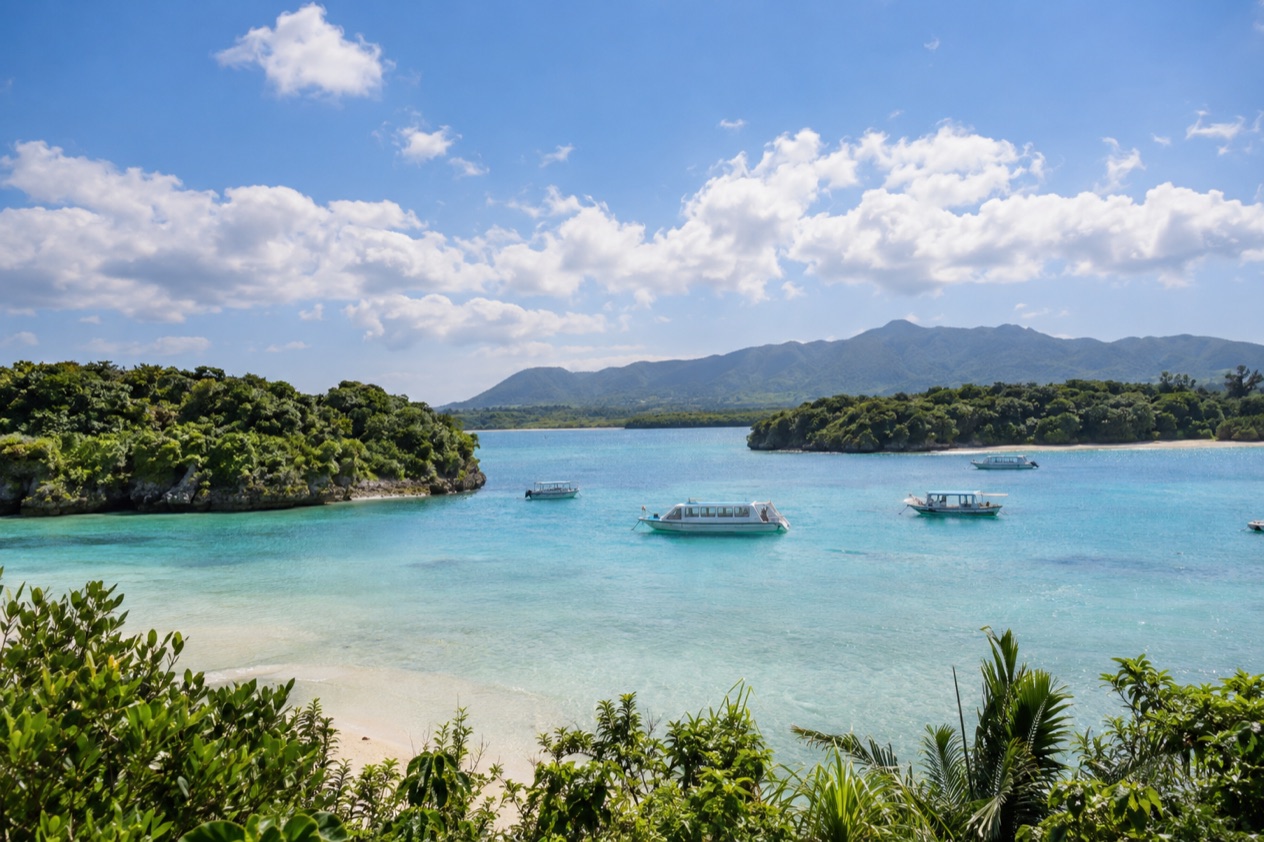
Kabira Bay is the image of the island that people carry home: green and turquoise water, small wooded islets and a curve of sand. Then there are the manta rays, the animal people associate with these waters. A sighting is a chance, never a promise, and it depends on the day and the spot. Plan the trip around the whole island and the reef, and treat a manta as a bonus.
Add the history in town, with a Buddhist temple and an old residence, and the island gives you rainy-day options too. It is a place where a morning on the water, a lunch of local noodles and an evening of island music fit comfortably into one day.
What to see at Ishigaki and Kabira Bay
Kabira Bay
Kabira Bay is the postcard of Ishigaki. Small islets sit in water that shifts between jade, turquoise and deep blue depending on the sky and the tide. The shoreline is lined with trees, and a sweep of pale sand curves around the head of the bay.
The bay also has a link with pearls. Black pearl cultivation grew up in these waters, and you will see the theme in local shops and jewelry across the island. Look at the changing color of the water and the way the islets break up the horizon.
Yonehara Beach and the reef
Rip currents there are notoriously strong, and visitors should stay in the western portion of the beach, between the stream mouth and the cliff.
The reason to go is the coral that surrounds Ishigaki. Near the shore you look down on branching and table corals, with small reef fish drifting between them. Mantas are a possibility in the wider waters off the island, though a sighting depends on the day. Stay inside the western portion, and treat the strong currents as the rule of the beach.
Torin-ji temple
In Ishigaki town, Torin-ji is a Buddhist temple founded in 1614. Its statues date from 1737. A visit gives you a quiet change from the beaches, a look at the religious life of the Yaeyama Islands and a reminder that the island has a long history behind the resort image.
Look at the roof lines and the carved details, and at the way the temple blends Okinawan building habits with Buddhist tradition. It fits comfortably into a morning in town, alongside a stroll to the market streets.
Miyaradunchi residence
Miyaradunchi is a residential building in Ishigaki dating from 1819. Its hip roof is covered with red tiles, the look you will see again on houses across the island. It shows how a well-off family lived in the Ryukyu period, with its low profile and its closeness to the garden.
Look at the tile work, the proportions of the roof and the way the house meets the ground. It pairs well with Torin-ji, since both sit in town and both give a view of the island that has nothing to do with the sea.
How to get to Ishigaki and Kabira Bay
You reach Ishigaki Island by air, from Naha Airport on Okinawa and from Haneda Airport in Tokyo. New Ishigaki Airport, code ISG, is the island’s airport and serves Ishigaki city. It sits 9.3 miles from the center of Shiraho on the island, so you land on the island itself and start your trip from there.
Ishigaki Port also serves the city. It is the harbor of the island and the base for sea traffic around the Yaeyama Islands. If your plans include other islands of the group, you will see the port as part of your trip, though the way you first arrive from Tokyo or Naha is by plane.
The island covers 222 km² (86 mi²), with Omotodake its highest point at 1,724 feet. Everything you want, from the town to the bay to the beaches, lies on this one island.
Flights are the way in, so choose your arrival with the island’s pace in mind. The distance from Tokyo is large, and that remoteness is part of what you are coming for. Settle into town for the first evening, find a bowl of Yaeyama soba, and leave the bay and the reef for the days that follow.
When to visit Ishigaki and Kabira Bay
The climate decides the trip. Ishigaki has a tropical rainforest climate with frequent tropical cyclones, so the weather behaves differently from most of Japan. The island is warm in a way that suits time on the water, and the year is shaped more by rain and storms than by cold.
The rainiest months are August and September, when tropical storms and typhoons bring the heaviest weather. Keep days loose if you travel then.
The driest months come in late winter. That is the part of the year when you can expect fewer rainy days, and it makes planning outdoor days more straightforward. Still, a dry month is not a guarantee of sun, and showers can pass through at any time on a subtropical island.
For manta rays and marine life, treat every month as a chance rather than a promise. Sightings depend on conditions on the day, and no calendar can guarantee them. What the calendar can do is steer you away from the stormiest weeks, so your days on the water are more likely to go ahead as planned.
If you want the town side of the island as well, rainy days are not wasted. Torin-ji, Miyaradunchi, the market streets and a long lunch of local dishes all work when the sky is gray. Build a trip with a few of those in reserve, and the weather matters less.
Tips for your visit
A dry bag helps on boat outings. Water shoes are useful around coral and rocky edges. A light rain jacket earns its place in the luggage, since showers pass through often.
The island rewards a slow schedule, with one day for the bay and the beach, one for the town and its temple and residence, and room in between for a long meal. Because the weather can shift, keep one day free for whatever the sea allows.
Combine the water with the town. Torin-ji and Miyaradunchi give you a historical counterpoint to the reef, and the market streets are where you try Yaeyama soba, island vegetables and a glass of awamori, the local spirit. Ishigaki is the political, cultural and economic center of the Yaeyama Islands, so it has the best selection of places to eat and shop in the group.
The rip currents there are notoriously strong, so this is the one habit worth following without exception. Do not treat the rest of the beach as equivalent.
Families and travelers who want less time in the water can still fill their days. The bay is a place to look at rather than to rush through, and the town gives you shade, history and food.
Good to know before you go
Plan for the island’s weather as much as its scenery. Tropical cyclones are frequent, and the rainiest months are August and September, so keep some flexibility in your schedule and listen to local updates when a storm is near.
For payments, keep some yen on hand for small shops and island eateries, and take the time to enjoy the slower rhythm of the Yaeyama Islands.
Sources
- Wikipedia, Ishigaki, Okinawa (https://en.wikipedia.org/wiki/Ishigaki,_Okinawa), checked October 11, 2026
- Japan National Tourism Organization, Ishigaki (https://www.japan.travel/en/destinations/okinawa/okinawa/ishigaki-island-and-around/), checked October 11, 2026
- Wikivoyage, Ishigaki (https://en.wikivoyage.org/wiki/Ishigaki), checked October 11, 2026