
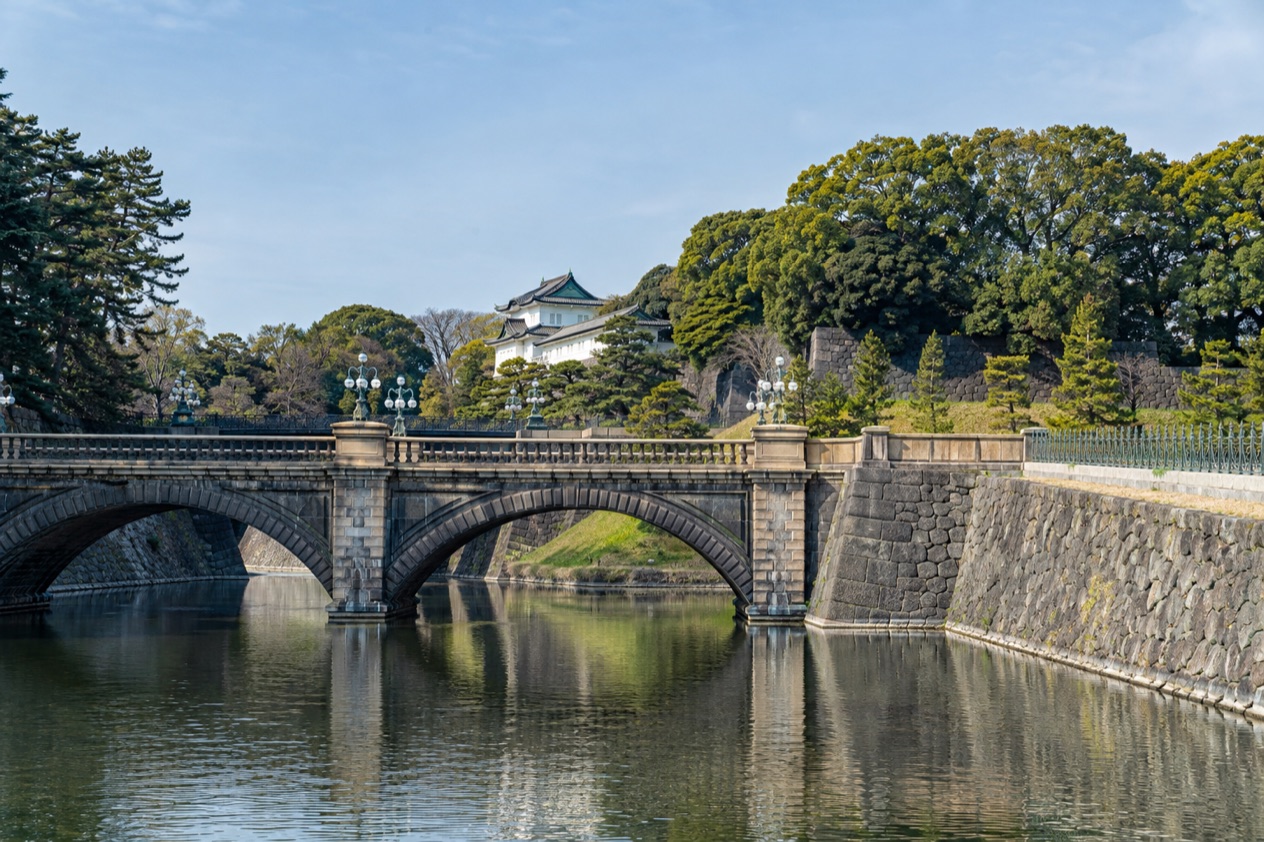
Stone walls rise straight out of a wide moat, and above them a pine-dotted slope hides the residence of the Emperor from the busy streets of Chiyoda. The crowd on the pavement moves slowly here, looking across the water instead of at a phone. This is the Tokyo Imperial Palace, a place where most of the grounds stay out of sight and the visit is about the gardens, the walls and the old castle site around them.
Is visiting the Tokyo Imperial Palace worth it?
Yes, if you like history, gardens and open space in the middle of a very dense city, and if you accept that you will not walk through the palace itself. The main grounds are generally closed to the public except for reserved guided tours from Tuesdays to Saturdays, so what you actually enjoy is the setting: the moats, the gates, the lawns and the foundations of what was once Edo Castle.
The visit suits travelers who enjoy walking slowly and reading a landscape. You look at stone walls laid without mortar, at gate towers reflected in dark water, and at old castle terraces that now hold open lawns. If you hope for lavish halls and gilded rooms, you will find that this is a different kind of sight.
What sets it apart from the temples and shrines elsewhere in Tokyo is the sense of absence and scale. Instead of a single building to photograph, you have a whole former castle site, ringed by outer gardens and flanked by Kitanomaru Park.
Around it sit the glass towers of Nihonbashi and the luxury shops of Ginza, so the contrast between the calm grounds and the financial and shopping districts is part of the experience.
What to see at the Tokyo Imperial Palace
The East Gardens
The East Gardens cover the former Honmaru and Ninomaru areas of Edo Castle and are open to the public. This is the part of the palace where you can wander on your own, and it is where the castle’s past is easiest to read. Honmaru was the inner heart of the castle, and Ninomaru the next enclosure outward, and today both are laid out with lawns, paths and trees.
Look for the heavy stone foundations and walls that remain from the castle, which give a feeling for how large the fortress once was. The planting changes with the seasons, so a stroll here can bring blossom in spring and turning leaves in autumn. It is a good place to slow down, sit on the grass and let the city noise fade.
Kokyo Gaien National Garden
Kokyo Gaien National Garden is made up of the outer gardens that ring the palace. It is the open frame around the moats and walls, and it is where you get the classic view of the stone bridge and gate towers across the water. The wide spaces make it natural for a long walk around the edge of the grounds.
Pine trees line much of the approach, and their shapes against the stone and sky are what people remember. Come here for the postcard picture of the palace and for the feeling of how the grounds sit inside the city, with office buildings standing just beyond the trees.
Kyuden Totei Plaza and the guided tour
The reserved guided tours access only the Kyuden Totei Plaza, in front of the Chowaden. That means the tour brings you into the ceremonial heart of the grounds, but only as far as this plaza, not into the buildings or the private residence. It is the one way to stand inside the main grounds on an ordinary day.
Twice a year the public can also pass through the Nakamon inner gate, on January 2 for the New Year and on February 23 for the Emperor’s Birthday. On those days the gate that is normally closed becomes the way in to the inner grounds.
Kitanomaru Park
Kitanomaru Park lies to the north of the palace and is a public park. It gives you a green, shaded counterpart to the formal stone and lawn of the gardens, and it makes a natural spot to sit after a walk. Because it is a park rather than a historic enclosure, it feels more relaxed, the kind of place where office workers and walkers share the paths.
Hours, tickets and rules
The palace works on two tracks. The main grounds can be seen only on a reserved guided tour, offered from Tuesday to Saturday, while the East Gardens, the outer gardens and Kitanomaru Park are open to the public. On two dates each year, January 2 and February 23, the Nakamon inner gate opens to visitors.
| Site | Open |
|---|---|
| Main grounds (guided tour, Kyuden Totei Plaza only) | Tuesdays to Saturdays, reserved tours only |
| Nakamon inner gate | January 2 and February 23 |
| East Gardens | Open to the public |
The guided tours reach only the Kyuden Totei Plaza in front of the Chowaden, and the main grounds are otherwise generally closed to the public. The Imperial Household Agency manages the grounds, which cover about 0.44 square miles.
How to get to the Tokyo Imperial Palace
The palace stands at 1-1 Chiyoda, in the Chiyoda district of Chiyoda ward, in the middle of Tokyo, the capital, on Tokyo Bay in the Kanto region. That address is the one to give a taxi driver or to enter into a map app, and it places you at the center of the city rather than on its edge.
From the airports, Tokyo is served by Haneda Airport, officially Tokyo International Airport, and by Narita Airport, Japan’s largest international airport. Both are the gateways to the city, and from either one you continue into Tokyo to reach Chiyoda.
Ginza is an upscale downtown area with high-end restaurants and luxury shops, and Nihonbashi is known for its heritage and is the main financial district of Japan. Roppongi and Akasaka are also districts of the city, and they can be reached from Shibuya Station in about 10 minutes by train.
Roppongi Station is served by the Tokyo Metro Hibiya Line and the Toei Oedo Line, Nogizaka Station by the Tokyo Metro Chiyoda Line, and Roppongi-Itchome Station by the Tokyo Metro Namboku Line. These give you the metro lines of the nearby Roppongi and Akasaka area when you plan a day that links them with the palace.
When to visit the Tokyo Imperial Palace
The gardens reward a visit in every season, and the weather shapes the kind of walk you will have. April brings mild afternoons, with highs in the upper 60s and rain on some days, and it is the month when the planting around the moats comes into leaf and flower. Humidity is moderate, and sunshine is generous.
July is hot and humid, with highs in the mid-80s and humidity high, so a long outdoor walk feels heavier. October is milder, with highs in the low 70s, though it is a wetter month with rain on about ten days and a lot of precipitation, so a gray, damp day is quite possible. Leaf color in the gardens can add to an autumn walk.
January is cold and bright, with highs near 50 and lows just above freezing. It is also the month of one of the two special openings, since on January 2 the public may enter through the Nakamon inner gate for the New Year. The other falls on February 23, the Emperor’s Birthday. For the guided tour, plan around the days it runs, Tuesday to Saturday, since the main grounds are otherwise closed.
Tips for your visit
Bring comfortable shoes, because the pleasure here is in walking the gardens and the paths around the moats. The grounds cover about 0.44 square miles, so even a visit to only the public gardens involves a good amount of ground to cover. In the warm months, add water and a hat, and in the wet months, a light rain jacket.
Combine the palace with its neighbors. Ginza is the place for high-end restaurants, and Nihonbashi suits a walk through the financial district’s historic streets.
If you want to stand in the main grounds, reserve a guided tour, remembering that it reaches only the Kyuden Totei Plaza in front of the Chowaden. If your trip falls in early January or on February 23, those two openings through the Nakamon inner gate are a chance to see a part of the palace that stays closed the rest of the year.
Go with an unhurried mind. The sight is less a building than an atmosphere of stone walls, water and old castle ground in the middle of the capital, and it rewards people who stop to look at the details of the walls and the trees.
Good to know before you go
The gardens and park are public, so a visit costs nothing to enter, and a guided tour is a reserved experience rather than a walk-in one. Autumn is a wet season in Tokyo, so a compact umbrella is a sensible companion on a gray day, and summer brings heat and humidity that make shade and water welcome. Treat the grounds as a place for quiet walking, the way the people who stroll the paths and sit on the lawns do.
Sources
- Wikipedia, Tokyo Imperial Palace (https://en.wikipedia.org/wiki/Tokyo_Imperial_Palace), checked October 11, 2026
- Japan National Tourism Organization, Tokyo (https://www.japan.travel/en/destinations/kanto/tokyo/), checked October 11, 2026
- Japan Meteorological Agency (JMA), Normal values 1991-2020, monthly (https://www.data.jma.go.jp/stats/etrn/view/nml_sfc_ym.php?prec_no=44&block_no=47662), station Tokyo, elevation 25 m, checked October 11, 2026
To plan your stay
- Best Time to Visit Japan: Cherry Blossoms, Autumn Colors, Weather and Festivals
- Where to Stay in Japan: Ryokan, Temple Stays, Capsule Hotels and the Best Cities to Base In
- Sending Luggage from the Airport in Japan: Hands-Free Travel, Hotel Delivery and Coin Lockers
- Know Before You Go to Japan: Entry, Money, Etiquette and Getting Around