
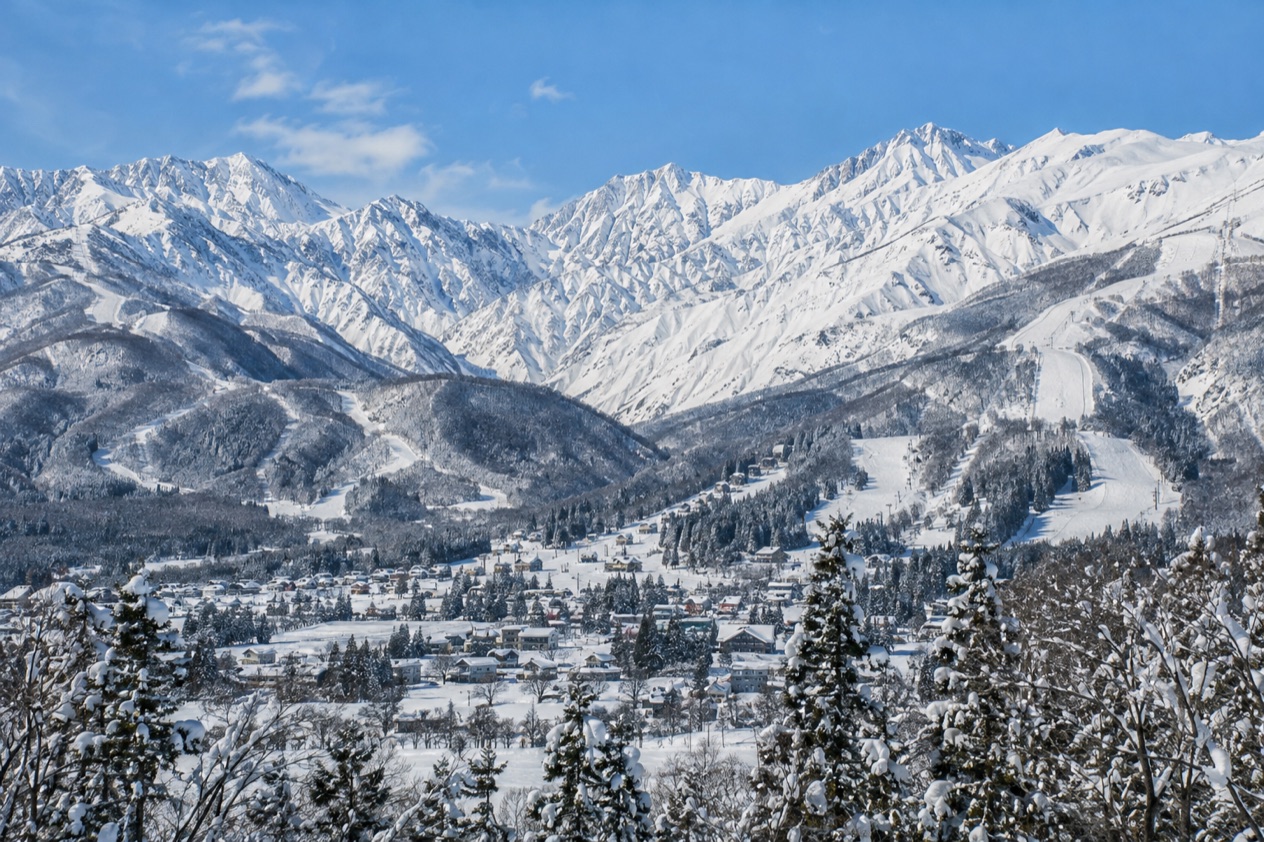
Leaving Nagano in the morning means leaving a station of travelers with skis in long bags and hiking poles clipped to packs, all headed for the same mountain wall. The Northern Alps start to fill the windows well before you arrive, and the white ridgelines tell you the village is close. Hakuba, the old ski venue of the Winter Olympics and a base for big summit hikes, is the place where this trip from Nagano ends.
How do you get to Hakuba from Nagano?
The bus from Nagano Station is the road link to Hakuba, and the last one of the day leaves at 20:30. That evening departure matters more than anything else on the trip, because it sets the outer limit of your day in Nagano and tells you how late you can linger over lunch near Zenkoji before heading for the mountains.
What decides the choice is the shape of your day and your baggage. Hakuba is a village in northwestern Nagano Prefecture, in the eastern foothills of the Hida Mountains, at the base of the Northern Japan Alps.
It is not a single resort town with one center but a valley of ten ski areas spread across Hakuba Village, Omachi City and Otari Village. Where you sleep inside that valley changes how you arrive, so look at your lodging address before you pick a way of traveling.
A traveler with skis, snowboards and large suitcases wants a way that goes straight from the platform or the bus bay to the village and keeps the handling to a minimum. A hiker coming for Mount Shirouma or Mount Goryu, the two peaks of the One Hundred Mountains of Japan that Hakuba serves as a starting point for, carries less and has more flexibility about timing. Someone arriving from Narita Airport in winter has a dedicated shuttle to think about as well, and it comes up below.
Japanese trains have a reputation for running exactly on time, and that habit lets you plan a connection to the minute. Buses in the region follow the same logic of a set timetable. Treat the last bus as a firm door that closes and build your afternoon around it rather than hoping to catch it with minutes to spare.
Ways to get to Hakuba from Nagano
The bus from Nagano Station
The bus is the connection that is certain: it leaves from Nagano Station and runs to Hakuba, with the last departure in the evening. You ride from the city, past the edges of town and into valley country, and the mountains grow taller in the windows as you go. Riding a bus rather than a train means one fewer change with luggage, which suits skiers and snowboarders hauling gear.
It also suits anyone who likes to arrive without a map of connections in their head. Settle into a seat, watch the Alps appear, and step off in the village. The practical tip is to keep your outbound plan simple: finish your Nagano sightseeing, collect your bags and be at the station with room to spare for the final departure, since there is no later bus to fall back on.
Trains in general: local, rapid and faster services
Rail in Japan works in tiers, and knowing them helps you read any timetable. Local trains stop at every station, which makes them a fit for short distances and for travelers who want to watch small towns slide past. Rapid trains skip the smaller stations and do not require a supplement, so you board with an ordinary ticket and reach the bigger stops sooner.
Faster tiers above those, such as limited express services and the shinkansen, exist on Japan’s network, and they are the usual way to cover long distances between regions. For this trip, check the exact service and the connection you are given at the station, because the right train depends on the day and the timetable in front of you. Keep that logic in mind and a ticket window, an information desk or an operator’s board will point you the right way.
The Nagano Snow Shuttle from Narita Airport
In the winter season, the Nagano Snow Shuttle runs daily from Narita Airport to Hakuba. It is a direct answer for travelers whose trip begins at the airport rather than in Nagano city, and it replaces a chain of changes with a single ride toward the ski valley.
It suits groups with skis, families with a pile of bags and anyone landing after a long flight who would rather not figure out a rail network on arrival. It operates in winter only, so for a summer hiking trip you build the journey from other pieces. Treat it as a seasonal tool for the ski months, and plan around the season you travel in.
Flying into the region
Narita Airport is the airport the winter shuttle starts from, and that is the air link to Hakuba these notes can place. Flights from abroad are long, and a flight from France to Japan takes twelve hours, which gives a sense of how much of the journey the airplane takes before any ground travel begins. After landing, the rest of the trip is by ground, whether by the shuttle in winter or by the routes through Nagano.
Options compared
| Option | Best for | What to know |
|---|---|---|
| Bus from Nagano Station | Travelers with skis, boards and large bags | Has a last departure in the evening, so plan the day around it |
| Local train | Short distances and slow travel | Stops at every station |
| Rapid train | Reaching larger stops sooner on an ordinary ticket | Skips smaller stations and needs no supplement |
| Nagano Snow Shuttle from Narita Airport | Winter visitors arriving by air | Runs daily during the winter season |
Seen side by side, the options split by season and starting point more than by anything else. If your day begins in Nagano city, the bus is the connection with a confirmed evening departure. If your trip begins at Narita Airport in winter, the shuttle skips the city altogether and takes you to the valley.
Trains in their local and rapid forms are the general rail logic you will meet at any Japanese station, and they reward travelers who enjoy watching a landscape change at their own pace. Whatever you choose, bring the name of your lodging written down, since the valley covers three municipalities and a stop name alone can leave you guessing which part of it you are in.
Making a day of it
Nagano gives you a reason to start slowly. The city hosted the 1998 Winter Olympics, and Hakuba was the main event venue for the Alpine, ski jump and cross-country events, so the trip links two places that share one Games. Spend the first hours of the day in Nagano, with a temple visit or a long breakfast, and treat the ride as the second half of a single story.
What waits at the end of the road
Hakuba is the central hub for ten ski resorts with more than 200 runs, and one of them is a long cruising course that stretches for 5 miles. In winter the village is built around that skiing, and an all-mountain day pass is offered across the valley for anyone who wants to move between areas. When the season ends, the resort announces the end of its ski season and of the sightseeing lift operations, and the village shifts toward other pleasures.
Those pleasures are mostly on foot. Hakuba is the starting point for trekking Mount Shirouma and Mount Goryu, and the walking season gives the village a different character, with boots by the door instead of ski bags. In spring a patch of snow on the mountainside takes the shape of a horse, which is where the name Hakuba, white horse, comes from.
Planning the hours
Build the day backward from the departure. Pick the bus or train you will take, work out when you need to be at Nagano Station, and fit your sightseeing into the time before it. Pack the things you will want within reach on the ride, such as a warm layer, a charger, snacks and the address of your lodging, and keep the larger bags together so loading is quick.
If you plan to ski, think about your first morning in the valley as well, because arriving in the village the evening before lets you start the next day without a long ride behind you. A hiker will want the same margin before heading for the trailheads, and a night or more in Hakuba is the sensible length of stay for either plan. The mountains are the reason to come, and they reward time spent there rather than a rushed turnaround.
Good to know before you go
Trains in Japan are known for running on time, and buses follow a firm timetable, so a missed connection is usually a matter of arriving late rather than the service being late. Keep your lodging details and your onward plan on your phone, and carry a little cash for small purchases along the way. In winter the mountain weather can change the look of the road quickly, so give yourself room in the schedule rather than a tight margin.
Sources
- Hakuba Valley (https://www.hakubavalley.com/en/), checked October 11, 2026
- Wikipedia, Hakuba, Nagano (https://en.wikipedia.org/wiki/Hakuba,_Nagano), checked October 11, 2026
- Wikivoyage, Hakuba (https://en.wikivoyage.org/wiki/Hakuba), checked October 11, 2026
- Japan National Tourism Organization, trains and buses (https://www.japan.travel/en/guide/how-to-travel-by-train-and-bus-in-japan/), checked October 11, 2026
- Japan National Tourism Organization, traveling by rail (https://www.japan.travel/en/guide/traveling-by-rail/), checked October 11, 2026
- Japan National Tourism Organization, getting around Japan: trains, subways, buses, taxis (https://www.japan.travel/en/plan/getting-around/), checked October 11, 2026