
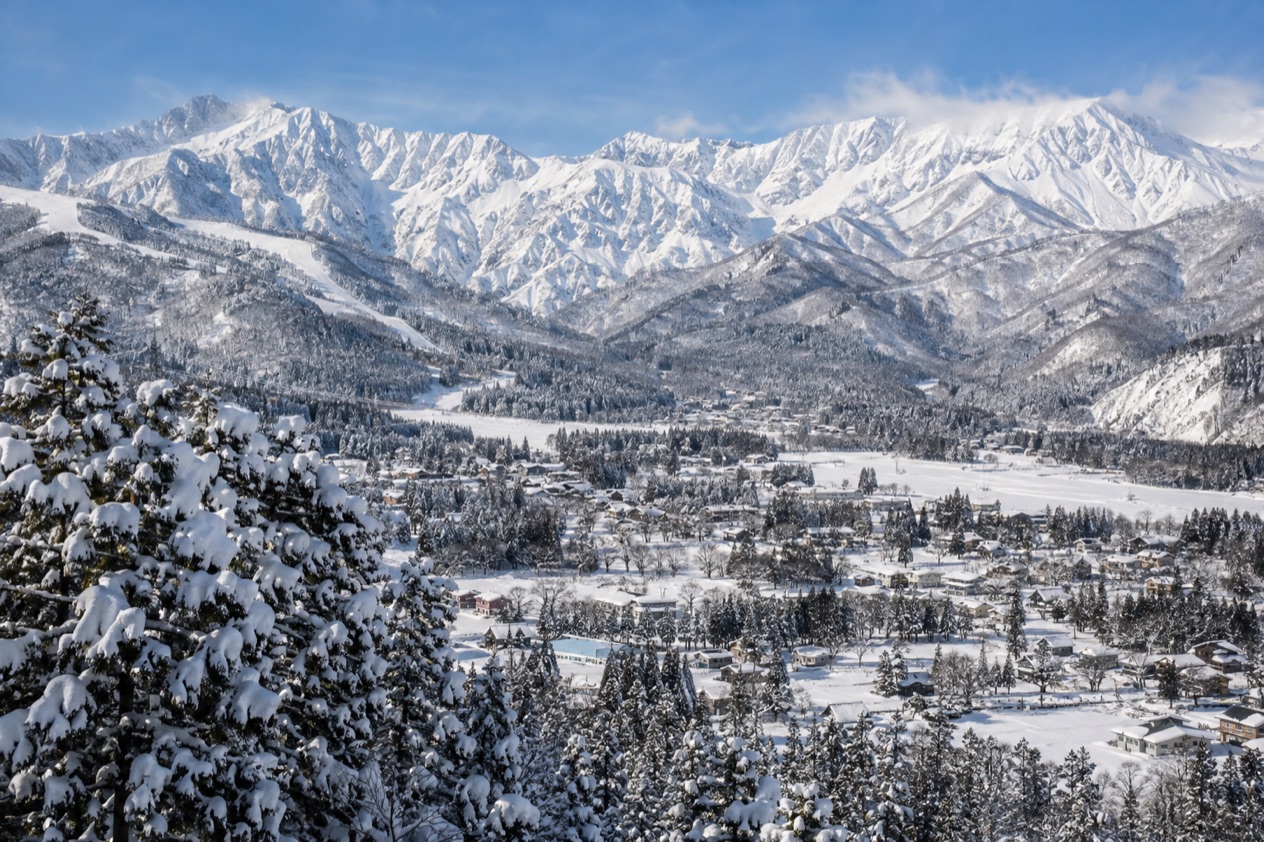
On a winter morning in Hakuba, the peaks of the Northern Japan Alps stand over the village and skis click into bindings outside the lodges. By evening the talk turns to the day’s runs, over bowls of noodles and cups of hot tea. The valley spreads across three municipalities, and where you sleep shapes how you spend your mornings, so the choice of base deserves a little thought.
What is the best area to stay in Hakuba?
For a first visit, the village of Hakuba itself is the base to choose, because it is the hub of the whole valley and the place most trips are built around. It was the main venue for the Alpine, ski jump and cross-country events of the Winter Olympics in 1998, and it is also where trekkers start for Mount Shirouma and Mount Goryu, two of the One Hundred Mountains of Japan. Staying in the village keeps skiing, hiking and the mountain scenery within one stay.
If your plans are mostly about skiing across several mountains, think of the valley as a whole rather than a single village. Hakuba Valley groups ten ski resorts across Hakuba Village, Omachi City and Otari Village, and it offers an all-mountain day pass. That means a bed in any of the three municipalities can still put you on the valley’s slopes, and the choice comes down to which side of the valley you want to wake up on.
For sightseeing beyond the slopes, the village is the better fit. The mountain trailheads, the lakes and the Olympic history are all part of Hakuba’s story, and a base in the village keeps you close to that.
Hakuba Valley also has a long cruising run, which suits travelers who like to settle into a rhythm on skis. Those who want something quieter to look at between ski days can turn to Lake Aoki-ko, where engines and outboard motors are banned, which makes it the quietest of the three lakes near Hakuba.
Travelers who want a cultural night out of the ski-lodge routine can look at a ryokan, the traditional Japanese inn. Ryokan typically have tatami floors, futons, private baths (sometimes outdoor), yukata robes, a kaiseki dinner and a traditional Japanese breakfast. After a day in the snow, that combination of a hot bath and a long dinner suits the mountain setting well.
Arrival also deserves a thought when you pick a base. In winter a daily Nagano Snow Shuttle runs from Narita Airport to Hakuba, and the last bus from Nagano Station to Hakuba leaves at 20:30. Plan your lodging around a realistic arrival time, because a late train into Nagano and that last bus are linked.
Budget, families and nightlife are not areas in themselves here. What the valley offers is a spread of municipalities, each tied to the same ski network, so weigh the kind of lodging first (a ryokan, a lodge or an apartment-style stay) and the municipality second. Matching the lodging to the group is what makes the stay work, whether that group is a family with children, friends who ski from first lift to last, or a couple who came for the hot baths.
The best areas to stay in Hakuba
Hakuba Village
Hakuba Village sits in the eastern foothills of the Hida Mountains, in the northern part of the Japanese Alps, and it is the center of the valley’s winter life. Hakuba Happo-one Snow Resort belongs to this side of the valley, and the village is the main starting point for the Shirouma and Goryu treks in the warmer months. Its name means white horse, taken from the shape of a horse of snow that appears on the mountainside in spring.
This is the area for a first visit, for skiers who want the Olympic slopes close at hand, and for hikers who plan to come back in summer. Lodging here ranges across the kinds of places you find in a ski village, from ryokan with tatami rooms and shared or private baths to lodges and apartment-style stays for groups. A tip: the sightseeing lifts at Happo-one close with the ski season, so if you are visiting at the edge of winter, confirm that they are still running.
Omachi City side of the valley
Part of Hakuba Valley lies in Omachi City, which is one of the three municipalities that share the valley’s ski resorts. Choosing a base on this side puts you in a different municipality from the village but within the same valley, and the valley’s all-mountain day pass is built for skiing across its resorts.
It suits travelers who care more about the slopes than about being at the center of village life, and who are comfortable working out their own routes between mountains. In Omachi, compare individual properties by their location and amenities. A tip: when you compare places to stay, ask which resort is closest to the door, because the valley is large and each of its ten resorts has its own character.
Otari Village
Otari Village is the third municipality of Hakuba Valley, and it holds some of the valley’s ski resorts. A stay here appeals to travelers who would like to be in the valley without being in the village that gets most of the attention. The Northern Japan Alps rise around this part of the valley.
It suits skiers who have already been to Hakuba, couples who want a ryokan evening with a kaiseki dinner, and anyone who prefers to trade a central address for a different corner of the valley.
Hakuba areas compared
| Area | Best for | Linked to |
|---|---|---|
| Hakuba Village | First visit, skiing, trekking | Happo-one, Olympic events, Mount Shirouma and Mount Goryu |
| Omachi City | Skiing across the valley | Hakuba Valley ski resorts |
| Otari Village | Skiing across the valley | Hakuba Valley ski resorts |
The main trade-off is between the village and the rest of the valley. Which one fits depends on whether you want to be where everyone gathers or simply near the snow.
A second trade-off is between a hotel-style stay and a ryokan. A ryokan brings tatami floors, futons, a yukata to wear around the house, a kaiseki dinner and a Japanese breakfast, so your evening is arranged for you. A lodge or apartment leaves the evenings open for you to plan, which suits groups that want to cook, eat out or keep their own hours.
A third is the season. The valley receives a great deal of snow, around two hundred fifty-eight inches in an average winter, so the stay is shaped by winter first. In spring the snow on the mountainside takes the shape that gave Hakuba its name, and in the warmer months the trekking starts. Pick the area for the season you plan to visit, not only for the ski map.
How to choose your hotel in Hakuba
A ryokan is the most distinctive choice. It is a traditional Japanese inn, believed to have emerged in Japan in the eighth century, and a stay usually means a tatami room with futons, a private bath that is sometimes outdoors, a yukata and a kaiseki dinner served in courses. Breakfast is traditional Japanese, so expect rice, fish and small side dishes rather than a buffet of pastries.
For a deeper cultural stay, Heritage Stays offer activities such as tea ceremony, calligraphy and wearing traditional Japanese clothing. Reservations for Heritage Stays are required and can often be made through the property’s website or by phone. Not every property in the valley is part of that program, so treat it as a specific kind of stay rather than the default.
Think about how you will spend your days. If you ski from the first lift to the last, a base close to your preferred resort matters more than the style of the room, and the valley’s live conditions help you decide where to go each morning. If you plan to trek Shirouma or Goryu, a base in Hakuba Village keeps the trailheads within your reach.
Families and travelers with limited mobility should look at the layout of a property before the name. A ryokan with tatami floors and futons asks you to sit and sleep close to the ground, which is a real consideration for older travelers or anyone with stiff knees.
Ask the property how its rooms are arranged, whether there are beds as well as futons, and how the baths are set up. For children, compare the room size and layout of individual properties.
Finally, match the stay to your arrival. In winter the Nagano Snow Shuttle runs daily from Narita Airport to Hakuba, which helps if you land from overseas. If you come by way of Nagano Station, remember the last bus to Hakuba leaves at 20:30, and choose a place that makes sense for that hour.
Good to know before you go
In winter, the Nagano Snow Shuttle runs daily from Narita Airport to Hakuba, and buses also link Nagano Station with the valley, the last one leaving at 20:30. The valley’s lifts and weather conditions are worth checking each morning, since a ski day depends on both. Hakuba Happo-one Snow Resort announces the end of its ski season and of its sightseeing lift operations, so travelers visiting at the edges of the season should look for that announcement.
Sources
- Hakuba Valley (https://www.hakubavalley.com/en/), checked October 11, 2026
- Wikipedia, Hakuba, Nagano (https://en.wikipedia.org/wiki/Hakuba,_Nagano), checked October 11, 2026
- Wikivoyage, Hakuba (https://en.wikivoyage.org/wiki/Hakuba), checked October 11, 2026
- Japan National Tourism Organization, ryokan stays, what is included, etiquette (https://www.japan.travel/en/guide/japanese-ryokan/), checked October 11, 2026
- Japan National Tourism Organization, heritage stays (https://www.japan.travel/en/heritage-stays/), checked October 11, 2026
- Japan National Tourism Organization, skiing and snowboarding in Japan: regions, resorts, seasons (https://www.japan.travel/en/sports/snow/), checked October 11, 2026
- Niseko United, winter (https://www.niseko.ne.jp/en/winter/), checked October 11, 2026