
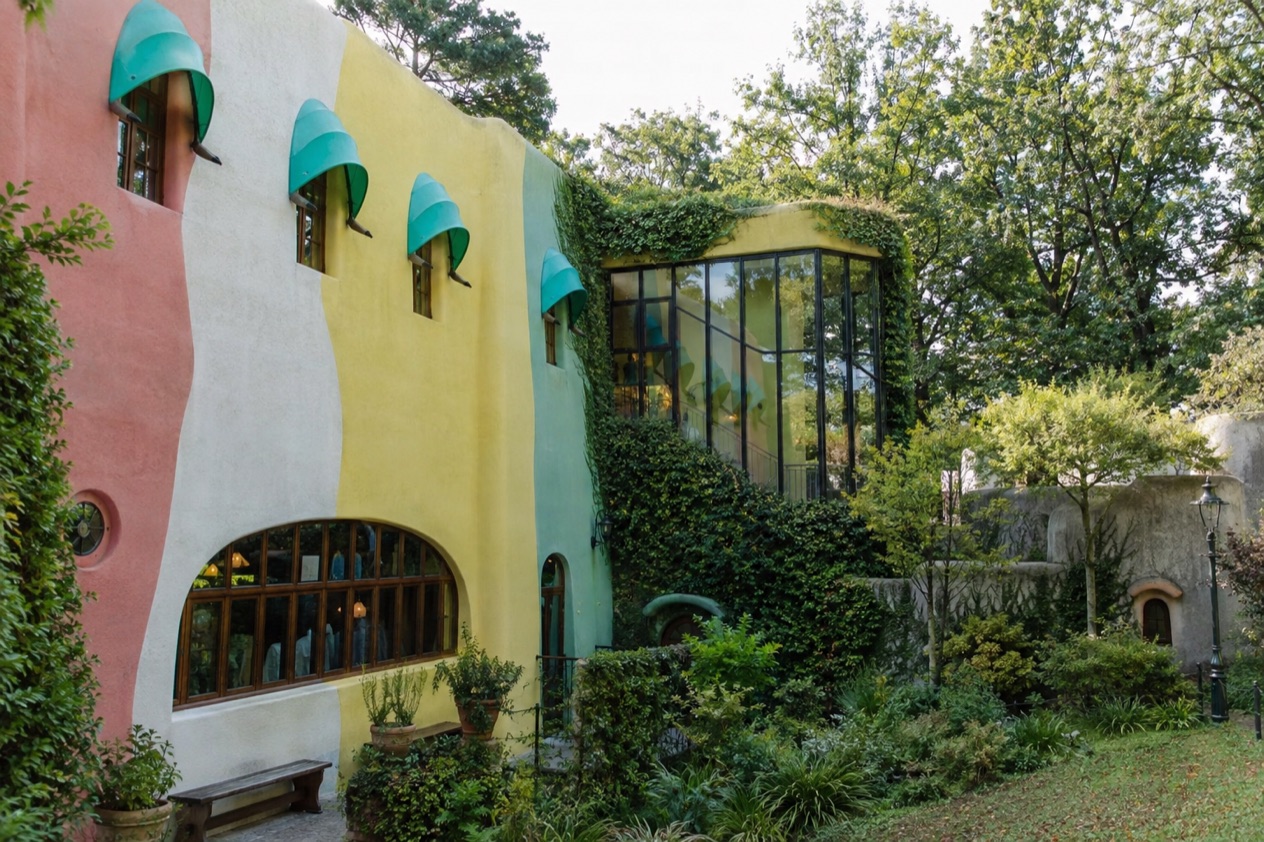
A path leads through the trees of Inokashira Park, and then the building appears, with its curving walls, its ivy and its odd windows, looking more like a house from one of the films than a museum. Inside, no two rooms feel alike, and the whole place was drawn by the man behind the films. The Ghibli Museum in Mitaka, in western Tokyo, is a visit for fans of Studio Ghibli, and for anyone curious about how drawings come to move.
Is visiting the Ghibli Museum worth it?
Yes, if you love Studio Ghibli films or the craft of animation, and it suits families with young children especially well. The museum opened on 1 October 2001, and Hayao Miyazaki designed it himself, working from storyboards much like the ones he draws for his films. That shows. The rooms read like scenes laid out one after another, and the building asks you to wander rather than follow a line.
What sets it apart from other anime sites around Japan is that it is about making films rather than only displaying characters. The Fujiko F Fujio Museum in Kawasaki is devoted to Doraemon and shows characters, official sketches and artwork, and in Odaiba a giant Gundam transforms with lights and music. Here the subject is the studio’s own way of working, with short films shown that are not available elsewhere.
It is also a different thing from Ghibli Park, the themed park that opened on November 1, 2022 in Nagakute, Aichi. The museum sits in a park in Mitaka, within the Tokyo Metropolitan Area, so it fits into a Tokyo stay without a trip to another region.
One firm rule shapes the experience: photography and video recording are prohibited inside. You end up looking at the rooms instead of at your phone, which many visitors come to appreciate.
If you have no interest in animation, the building itself is still odd and charming, but the visit is clearly built for people who care about the films. Fans will find a lot to recognize, and children will find a lot to climb into and explore.
What to see at the Ghibli Museum
The animation room on the bottom floor
The bottom floor holds an exhibit room on the history and science of animation. Its star is a three-dimensional zoetrope called Bouncing Totoro, a spinning device that turns still figures into a moving scene before your eyes. It explains, in a way that needs no words, how a series of separate images becomes motion.
Stand at the zoetrope long enough to watch the figures settle into their rhythm. Children tend to crowd around it, and adults often find it the most satisfying object in the building. It is the clearest answer the museum gives to the question of how animation works.
Where a Film is Born
On the first floor, a mock-up of an animation studio called Where a Film is Born fills five rooms and shows the creative process of an animation filmmaker. It is laid out like a working space, as if the artists had just stepped away from their desks.
Look at the details: the materials, the drawings and the clutter of a place where ideas are worked out. The five rooms follow the path of a film from first idea toward finished picture, and they reward slow looking more than fast walking.
The Catbus playroom
A playroom for children aged 12 and under holds a stuffed Catbus toy that they can play in. Anyone who knows My Neighbor Totoro, the 1988 film that gave the studio its best-known character, will recognize the grin at once.
Adults looking on from the edge of the room are usually smiling as much as the children. It is the part of the visit that younger travelers talk about afterward.
The rooftop garden and the robot
On the roof, a garden holds a life-size statue of a robot, five meters tall, from the final episode of Lupin III Part II and from the film Castle in the Sky. It stands among the plants as if it had been there for years.
The garden gives you a moment in the open air after the rooms inside, and a last look at the building from above. Museum exhibits also include short films shown only here, so a screening is part of the visit.
Hours, tickets and rules
Tickets to the Ghibli Museum are only accepted if bought in advance, so nobody is admitted by turning up at the door with money in hand. That one rule shapes the whole plan, and it comes before choosing a day or an hour.
| Site | Ticket |
|---|---|
| Ghibli Museum, Mitaka | Accepted only if bought in advance |
Photography and video recording are prohibited inside the museum. That applies to every room, the playroom and the rooftop garden included, so the visit is something you keep in memory and in the shop rather than on a camera roll.
When to visit the Ghibli Museum
The park around the museum changes with the seasons, and so does the weather you walk through to reach it. For Tokyo as a whole, the figures give a clear picture of each stretch of the year, and the museum itself is a place to be indoors for most of the visit.
| Month | Average high (°F) | Average low (°F) | Precipitation (in) | Days with rain |
|---|---|---|---|---|
| January | 49.6 | 34.2 | 2.35 | 4.5 |
| April | 66.9 | 49.6 | 5.26 | 9.5 |
| July | 85.8 | 72.3 | 6.15 | 10.5 |
| October | 71.6 | 58.6 | 9.24 | 10.5 |
January is cold and bright, with a good amount of sunshine and the occasional day of snow or sleet. A walk through the park to the museum is crisp rather than comfortable, and the warm interior is a relief. April is mild, with a few more wet days, and a light jacket is enough.
July is hot and humid, so the air-conditioned rooms are a pleasure after the walk. October is mild, but it is also the wettest of these four months, with rain on about ten days, so an umbrella is a sensible companion on the way through the park. Since tickets must be bought in advance, you choose your day before you know the forecast, and the museum works on a gray day as well as a sunny one.
No month is closed to the museum’s exhibits, but the park outside is part of the experience in every season, whether it is bare branches in winter or green in summer.
Tips for your visit
Leave the camera in the bag, because photography and video are prohibited inside. Come ready to look closely: the zoetrope, the studio rooms and the rooftop robot all repay attention, and nothing here is meant to be rushed through.
Families with children aged 12 and under have the Catbus playroom, which makes the museum a good stop for younger travelers. Adults who grew up with the films will find plenty to recognize in the exhibits and the short films.
The museum stands in Inokashira Park in Mitaka, so the setting is a park rather than a city street. Combine the visit with the surrounding park, and use the rest of the day for another side of Tokyo.
Fans who want more can look farther afield. The Edo-Tokyo Open Air Architectural Museum inspired some scenes in Spirited Away, and Hakone is a favorite of Evangelion fans because its landscapes inspired the anime’s illustrations. In Odaiba, the Gundam Unicorn transforms four times daily with lights and music, and the Gundam shops there sell model kits from any part of the series.
Good to know before you go
Plan the day around the advance ticket, since it is the one thing the museum asks for before anything else. Studio Ghibli itself is headquartered in Koganei, Tokyo, while the museum stands in Mitaka, so the two are separate places. Tokyo is served by Haneda Airport, officially Tokyo International Airport, and by Narita Airport, Japan’s largest international airport. The wettest weather of the year can come in autumn, so keep a rain layer handy.
Sources
- Japan National Tourism Organization, anime and manga (https://www.japan.travel/en/guide/japanese-anime-and-comics/), checked October 11, 2026
- Wikipedia, Ghibli Museum (https://en.wikipedia.org/wiki/Ghibli_Museum), checked October 11, 2026
- Wikipedia, Studio Ghibli (https://en.wikipedia.org/wiki/Studio_Ghibli), checked October 11, 2026
- Japan National Tourism Organization, Tokyo (https://www.japan.travel/en/destinations/kanto/tokyo/), checked October 11, 2026
- Japan Meteorological Agency (JMA), Normal values 1991-2020, monthly (https://www.data.jma.go.jp/stats/etrn/view/nml_sfc_ym.php?prec_no=44&block_no=47662), station Tokyo, elevation 25 m, checked October 11, 2026
To plan your stay
- Best Time to Visit Japan: Cherry Blossoms, Autumn Colors, Weather and Festivals
- Where to Stay in Japan: Ryokan, Temple Stays, Capsule Hotels and the Best Cities to Base In
- Sending Luggage from the Airport in Japan: Hands-Free Travel, Hotel Delivery and Coin Lockers
- Know Before You Go to Japan: Entry, Money, Etiquette and Getting Around