
In early May, the streets of Fukuoka fill with the clatter of wooden paddles and the sight of parade groups in bright costume, as Hakata Dontaku rolls through the city. Warm evenings pull people toward the food stalls and the river, and the air carries the smell of pork-bone broth. May is the month when Fukuoka, a port city on the north coast of Kyushu, is easy to enjoy outdoors, with a festival, a ramen bowl and a long walk on offer.
What is the weather like in Fukuoka in May?
May in Fukuoka is warm and fairly bright, with T-shirt afternoons, cooler evenings and rain that stays moderate before June turns wetter.
| Month | Average high (°F) | Average low (°F) | Precipitation (in) | Days with 1 mm or more of precipitation | Hours of sunshine | Daylight on the 15th |
|---|---|---|---|---|---|---|
| April | 67.8 | 52.7 | 4.65 | 9.7 | 188 | 12 h 59 min |
| May | 75.9 | 61.0 | 5.26 | 8.6 | 204 | 13 h 52 min |
| June | 81.0 | 68.5 | 9.83 | 11.6 | 145 | 14 h 22 min |
Compared with April, May feels like a clear step toward summer. Afternoons are warm enough for short sleeves, and nights stay mild enough to eat outside at a stall without a heavy coat. The sunshine is at its fullest of the three months, which suits long days on foot between shrines, parks and shopping streets.
Rain still visits, usually on fewer days than in April, and it is a fraction of what June brings. A compact umbrella or a thin rain jacket covers it. Humidity is climbing toward the sticky weeks ahead, and the air is noticeably damper by June, so May is the last month when it still feels fresh.
For clothes, the usual spring advice holds: a light jacket or a simple sweater is enough in Japan at this time of year. In Fukuoka that means a breathable shirt for the day and one extra layer for the evening. The light stretches late, which leaves room for a stroll after dinner.
What to do in Fukuoka in May
The big event of the month is Hakata Dontaku, held on May 3 and 4, and it sets the mood for the whole week around it. Those days sit inside Golden Week, so the city celebrates while much of Japan is on holiday. Cherry blossoms are long gone in Kyushu by now, since the Somei-Yoshino trees bloom there in late March, which leaves the stage to fresh greenery, open-air eating and the festival.
May also suits a city that is best explored on foot. Fukuoka is the largest city on Kyushu and the capital of its prefecture, with a long history of exchange with the Asian mainland, and you can read that in its food, its shrines and its harbor. Most of what follows is easy to string together in a day or two.
Hakata Dontaku
Dontaku is a city-wide parade and street party. Groups in costume march and dance along the main avenues, and children and adults alike keep rhythm with wooden paddles called shamoji, which click together like castanets. Floats and performers in the dress of Hakata’s old traditions pass through the downtown, with stages and music in several spots.
The festival is a street event, so you can drift in and out as you like, watch from a curb, then slip into a café or a shop. Because it falls on Constitution Memorial Day and Greenery Day, the mood is that of a national holiday, with families out in force. Wear comfortable shoes, since you will be standing and walking for a good part of the day.
Yatai and ramen
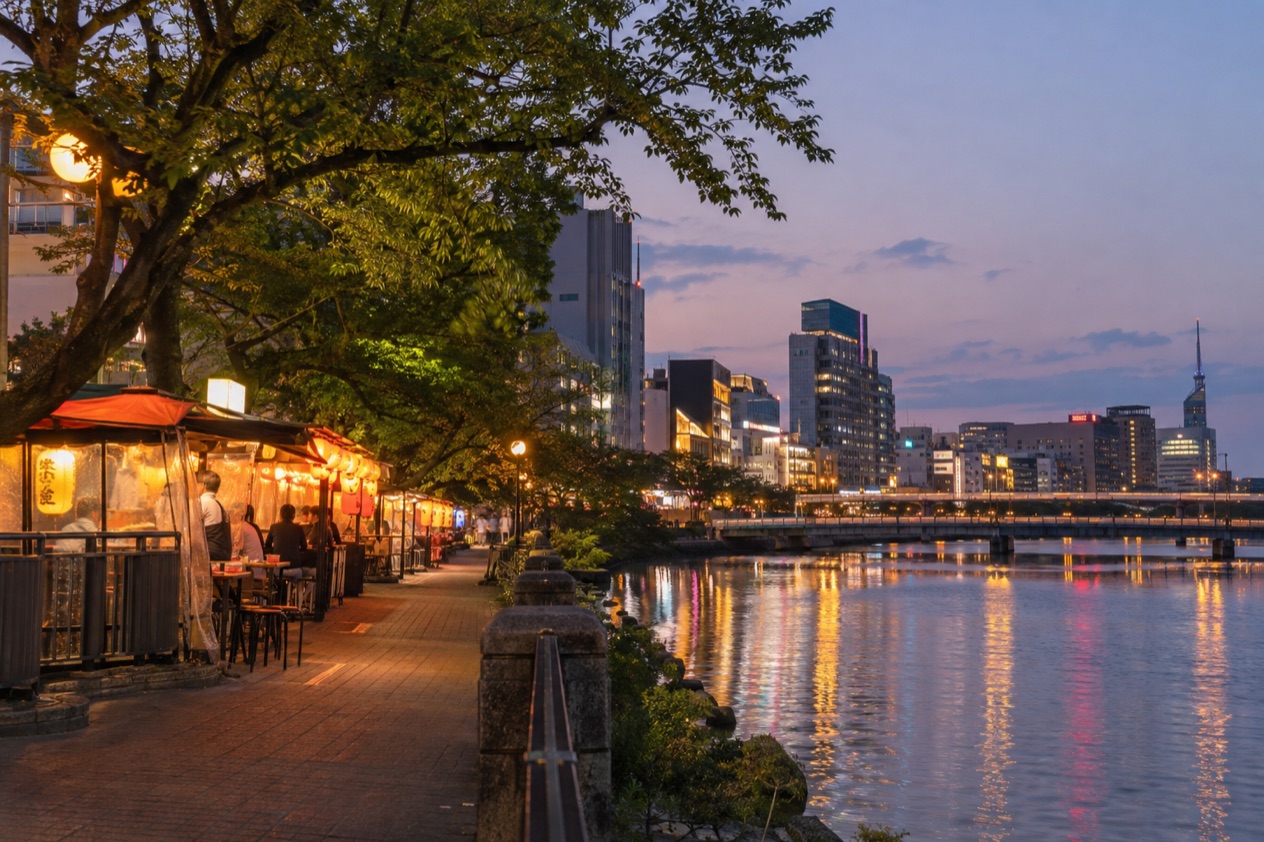
A yatai is a small, mobile food stall, and Fukuoka’s open-air stalls in Hakata were chosen for The New York Times’ list of places to go in 2023. A seat is usually a stool at a counter, shoulder to shoulder with strangers, with steam rising from pots in front of you. May’s mild evenings are well suited to this kind of eating.
The dish to order is tonkotsu ramen, a milky pork-bone broth with thin noodles, which first appeared in Kurume, also in Fukuoka Prefecture. Many stalls and shops also serve other local dishes: mentaiko (spicy cod roe), motsunabe (a hot pot of offal), and grilled skewers.
A bowl of ramen is a fine way to end a night of festival walking. The city itself was picked for the food category of Lonely Planet’s Best In Travel 2023.
Ohori Park and the castle grounds
Ohori Park is built around a large pond, with a path that loops around the water and bridges leading out to small islands. It also holds one of Fukuoka City’s major art galleries, a good stop when the sun is strong or the sky turns gray. In May the trees are in full leaf, and the green reflects in the water.
Beside the park, the stone walls and grassy slopes of the old castle site invite a slow climb for a wide view over the city. This is a spot for a picnic from a convenience store, a stroll with an ice cream, or a long sit on a bench. Sunshine is generous in May, so a hat is useful here.
Dazaifu Tenmangu
Dazaifu Tenmangu is a shrine devoted to Tenjin, the deity of scholarship, and students come to ask for success in exams. The approach is lined with small shops selling umegae mochi, a grilled rice cake with sweet bean paste, and the grounds include a pond with arched bridges and old trees. Plum trees are the shrine’s emblem, though their blossoms are a late-winter sight.
The honden, the main hall, is under renovation, expected to take about three years. That means you may find scaffolding or a temporary structure instead of the usual view of the sanctuary. The grounds, the pond and the shops along the way are still there to enjoy.
Kushida Shrine, Canal City and the shopping streets
Kushida Shrine sits in the old merchant quarter of Hakata and is the heart of the city’s festival life, home to the great floats of the summer Yamakasa. Around it, covered shopping arcades, small temples and old-fashioned sweet shops make a pleasant afternoon on foot. These covered streets also keep you dry when a shower rolls in.
For a modern counterpart, Canal City is a shopping and entertainment complex built around a canal, with fountains and shows. Tenjin, the main downtown district, has department stores and underground malls. Both are handy for waiting out the rain.
A two-day itinerary for Fukuoka in May
Day 1 starts in old Hakata. Begin with Kushida Shrine and its neighborhood of temples and covered arcades while the day is still cool. Move on to a lunch of ramen or a set meal in a small shop near the station. In the afternoon, explore Canal City and the nearby streets, then drift toward the river as the light softens.
As evening comes, settle on a stool at a yatai along the river for pork-bone ramen, skewers and a drink with neighbors. May’s late light gives you time to walk after dinner. If it is raining, stay in the arcades and Canal City, and eat in a ramen shop instead of an open stall.
Day 2 turns toward green space and history. Spend the morning at Ohori Park, circling the pond and visiting the art gallery, then climb to the old castle grounds for the view. Have a light lunch in the Tenjin district, then spend the afternoon at Dazaifu Tenmangu, with the pond, the old trees and a sweet rice cake from a stall on the approach.
Finish with a mentaiko dish or a hot pot in a small restaurant. On a rainy day, trade the park for the gallery and the department stores of Tenjin, and keep the shrine for a lighter spell.
Is Fukuoka busy in May?
May begins with its liveliest stretch, because Hakata Dontaku falls inside Golden Week, the national holiday period that runs from April 29 to May 5.
Four of those days are public holidays: Showa Day, Constitution Memorial Day, Greenery Day and Children’s Day. When a holiday lands on a Sunday, the next working day becomes a holiday too, and a day squeezed between two holidays also becomes one. So the days off can stretch a little further than the calendar suggests, and the streets around the festival reflect that spirit.
Once the holiday period closes on May 5, the month settles into the ordinary rhythm of a large port city, with shops open daily in urban areas and the stalls and parks back to a regular pace. That is a gentler time to wander the shrines, take a long lunch and sit by the pond in Ohori Park.
Fukuoka has the fastest population growth of any city in Japan, and you can feel a busy, young energy in its downtown at any time. In May that energy mixes with the festival and the green season, rather than the heat that comes later.
What to pack for Fukuoka in May
Pack for warm days on foot with cooler evenings and a few showers, since you will be walking between shrines, parks and stalls.
- A light jacket or a simple sweater, for evenings at an outdoor stall.
- Breathable short-sleeved shirts for the warm part of the day.
- A compact umbrella or thin rain jacket for passing showers.
- Comfortable walking shoes for the park paths and festival streets.
- A hat and sunglasses for the sunniest hours of the three spring months.
Good to know before you go
May sits just ahead of the wettest stretch, since June brings noticeably more rain and heavier air. The big calendar fact is Golden Week, with several public holidays between April 29 and May 5 that shape the first days of the month. Dazaifu Tenmangu’s main hall is being renovated, so plan on the grounds rather than the sanctuary view. Hakata Gion Yamakasa, the big summer event, comes in July.
Fukuoka in May vs April and June
Moving the trip four weeks earlier brings cooler days, with more rain days than May and less sun. Cherry blossoms are over in Kyushu by then, so April does not bring a flower season to make up for it. Late April does open Golden Week, with Showa Day on April 29, but Hakata Dontaku belongs to May.
Four weeks later, June is hotter and far wetter, with the lowest sunshine of the three months and the stickiest air. Daylight is at its longest, which stretches the evenings, but you will spend more time under an umbrella or in the arcades. The summer festival season, with Hakata Gion Yamakasa in July, comes after.
Travelers who want festival energy, open-air eating and comfortable walking should stay with May. Those who prefer cooler weather for long walks can lean toward April, while anyone happy with indoor plans and summer heat can try June.
Is May a good time to visit Fukuoka?
Yes, May is a good time for travelers who like to eat outdoors, follow a festival and walk for hours in mild weather.
It suits first-time visitors who want ramen, stalls, shrines and a park in one trip, and anyone who enjoys parades and street music. Those who prefer cooler days or dislike holiday crowds may want a different part of the year, especially around the first days of the month. Anyone who wants guaranteed dry days should look elsewhere, since showers still come.
On arrival, head first to Hakata and walk its covered streets and the old shrine quarter, then settle at a ramen counter. That gives you a feel for the city before you move on to the park, the gallery and Dazaifu. What stays with you from May here is the sound of paddles clicking through the parade and the steam rising from a bowl at a river stall.
Sources
- Japan Meteorological Agency (JMA), Normal values 1991-2020, monthly (https://www.data.jma.go.jp/stats/etrn/view/nml_sfc_ym.php?prec_no=82&block_no=47807), station Fukuoka, elevation 2 m, checked October 11, 2026
- Computed from the date and the latitude of the place (sunrise equation, solar elevation -0.833 degrees), October 11, 2026
- Japan National Tourism Organization, shop and attraction hours, national holidays (https://www.japan.travel/en/plan/business-hours-and-holidays/), checked October 11, 2026
- Wikipedia, Golden Week (Japan) (https://en.wikipedia.org/wiki/Golden_Week_(Japan)), checked October 11, 2026
- Wikipedia, Public holidays in Japan (https://en.wikipedia.org/wiki/Public_holidays_in_Japan), checked October 11, 2026
- Japan National Tourism Organization, flowers by season: cherry blossom, plum, wisteria, hydrangea, where and when (https://www.japan.travel/en/see-and-do/flowers/), checked October 11, 2026
- Wikipedia, Wisteria (https://en.wikipedia.org/wiki/Wisteria), checked October 11, 2026
- Japan Meteorological Agency, sakura2020.pdf (https://www.data.jma.go.jp/sakura/data/sakura2020.pdf), checked October 11, 2026
- Japan National Tourism Organization, spring in Japan (https://www.japan.travel/en/guide/spring-guide/), checked October 11, 2026
- Wikipedia, Kanda Matsuri (https://en.wikipedia.org/wiki/Kanda_Matsuri), checked October 11, 2026
- Wikipedia, Sanja Matsuri (https://en.wikipedia.org/wiki/Sanja_Matsuri), checked October 11, 2026
- Japan National Tourism Organization, festivals and events (https://www.japan.travel/en/see-and-do/festivals-and-events/), checked October 11, 2026
- Wikipedia, Gion Matsuri (https://en.wikipedia.org/wiki/Gion_Matsuri), checked October 11, 2026
- Japan National Tourism Organization, Fukuoka (https://www.japan.travel/en/destinations/kyushu/fukuoka/fukuoka-city/), checked October 11, 2026
- Fukuoka City official tourist guide (https://yokanavi.com/en/), checked October 11, 2026
- Wikipedia, Fukuoka (https://en.wikipedia.org/wiki/Fukuoka), checked October 11, 2026
- Wikivoyage, Fukuoka (https://en.wikivoyage.org/wiki/Fukuoka), checked October 11, 2026
- Wikipedia, Dazaifu Tenmangū (https://en.wikipedia.org/wiki/Dazaifu_Tenmang%C5%AB), checked October 11, 2026
- Wikipedia, Yatai (food cart) (https://en.wikipedia.org/wiki/Yatai_(food_cart)), checked October 11, 2026
- Wikipedia, Hakata ramen (https://en.wikipedia.org/wiki/Hakata_ramen), checked October 11, 2026
- Wikipedia, Ramen (https://en.wikipedia.org/wiki/Ramen), checked October 11, 2026