
In July, Fukuoka wakes to the shouts of men in short happi coats and loincloths, running barefoot through the old Hakata streets with a float on their shoulders. The air is thick and warm, the noodle stalls steam along the river after dark, and cold beer disappears fast. It is the month of Hakata Gion Yamakasa, the city’s big summer festival, and a good month for travelers who want Fukuoka at full volume, with the heat part of the show.
What is the weather like in Fukuoka in July?
July in Fukuoka is hot, humid and wet, a month when the sticky air matters as much as the thermometer. It is the rainiest of the three summer months here, and the first month where the highs climb well into the upper 80s.
| Month | Average high (°F) | Average low (°F) | Precipitation (in) | Days with 1 mm or more of precipitation | Hours of sunshine | Daylight on the 15th |
|---|---|---|---|---|---|---|
| June | 81.0 | 68.5 | 9.83 | 11.6 | 145 | 14 h 22 min |
| July | 88.2 | 76.3 | 11.78 | 11.0 | 172 | 14 h 11 min |
| August | 90.5 | 77.7 | 8.27 | 9.8 | 201 | 13 h 26 min |
Kyushu has very humid, hot and sultry summers, and Fukuoka fits the description. Clothes that breathe and dry quickly make the difference between a pleasant day and a sticky one.
Rain arrives on roughly one day in three, and the total is large because the downpours can be heavy. Plan on a compact umbrella that lives in your bag, and treat covered arcades, department stores and museums as part of the route rather than a fallback. A wet afternoon is also the moment for a long bowl of noodles.
The light is generous. Days are long, with daylight stretching well into the evening, which leaves time for a late dinner at the riverside stalls and a slow walk home. Sunshine is more frequent than in June, though gray, heavy skies still turn up between the bright stretches.
What to do in Fukuoka in July
July belongs to Hakata Gion Yamakasa, and the rest of the month is built around eating well, finding shade and ducking into air-conditioned places when the heat presses. Fukuoka is a port city on the north coast of Kyushu, and it is the largest city on the island, so there is plenty to fill the hours between festival moments.
Hakata Gion Yamakasa
Hakata Gion Yamakasa is a big summer event in Fukuoka, held in July, and the whole old quarter rearranges itself around it. Tall decorated floats stand on display in neighborhoods across the city, painted and embroidered with scenes from history and legend. Banners and lanterns go up, and shops and offices in Hakata show the festival in their windows.
The core of it is the running. Teams from the old neighborhoods, called nagare, carry heavy floats through the streets, shouting as they go, while crowds line the route and spectators splash water over the carriers to cool them down.
The sight is physical, loud and wet, a long way from a quiet parade. Kushida Shrine in Hakata is the shrine most closely tied to the festival, and it is a natural place to see the floats and the atmosphere around them.
If you come for the festival, wear things that can get wet and keep your camera protected from splashes. Outside the running itself, the neighborhoods are good to wander for the details of the floats, the happi coats worn by local people and the small shrines that mark each district.
Yatai and ramen on a summer night
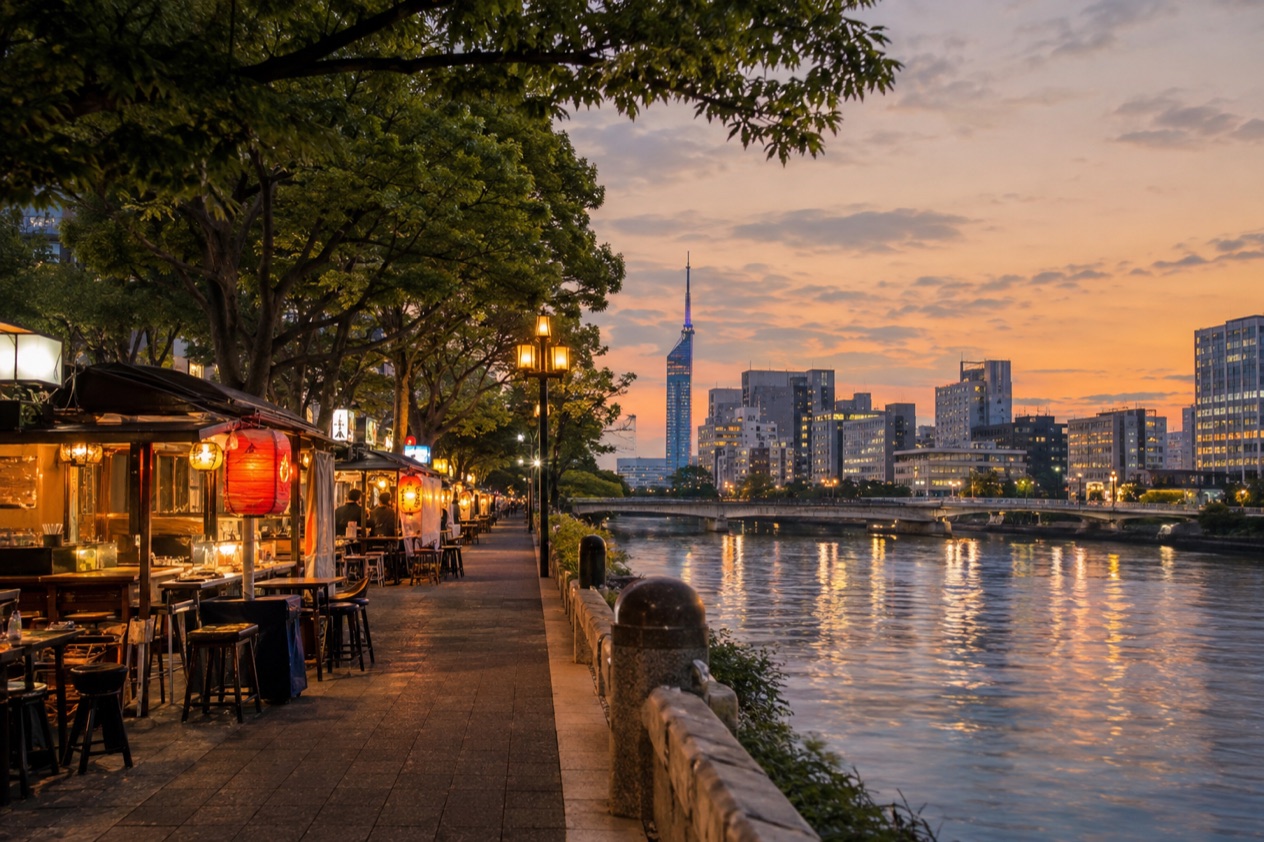
A yatai is a small, mobile food stall, and in Fukuoka the yatai are a city institution. Fukuoka’s yatai in Hakata were chosen for The New York Times’ list of 52 Places to Go in 2023, and Fukuoka City was selected in the Food category of Lonely Planet’s Best In Travel 2023. In July the stalls feel different from winter, with benches open to the warm air and cold beer beside every bowl.
Tonkotsu ramen, the pork-bone broth with thin noodles, originated in Kurume, in Fukuoka Prefecture, and Hakata is where visitors meet it. Order a small second helping of noodles (kaedama) when the first bowl runs out. Beyond ramen, look for mentaiko (spicy cod roe), skewers grilled at the stall and gyoza that come out sizzling.
In July, lighter food tempts too. Chilled noodles, cucumbers pickled in salt, shaved ice with syrup and fruit, and plenty of iced barley tea (mugicha) all suit the humid air. When it rains, the stalls become a cozy, steamy spot rather than a closed door.
Ohori Park and the art gallery
Ohori Park is built around a large pond, with paths that circle the water and small islands connected by bridges. It is also home to one of Fukuoka City’s major art galleries, which is a welcome stop when the heat builds. Trees around the water give some shade, and the park fills with joggers, families and couples as the evening cools.
Spend an hour with the pond and a longer stretch inside the gallery, then continue to a cafe for iced coffee or a cold dessert. In a rainy spell the park still has a calm charm, with raindrops on the water and fewer people on the paths.
Dazaifu Tenmangu and day trips
Dazaifu Tenmangu is a shrine complex that visitors from Fukuoka often add to a day. Renovations of its honden, the main hall, are expected to take about three years, so expect scaffolding or coverings around that building, while the grounds and the approach lined with shops remain part of the visit.
Bring a fan and a bottle of water, and give yourself time to stop for something cold along the approach. The lanes near the shrine sell sweets and small crafts, and the greenery of the grounds feels welcome in summer.
Back in the city, Fukuoka’s long history of contact with the Asian mainland shows in its food, its festivals and its port. The nearest overseas region is Busan in South Korea, and that closeness explains much of the flavor of Hakata’s culture. On a rainy afternoon, department stores, shopping complexes and museums offer plenty to see out of the weather.
A two-day itinerary for Fukuoka in July
Day 1 starts in Ohori Park, where the morning is the time to circle the pond and visit the art gallery before the heat builds. Late morning, move to Hakata for lunch at a ramen shop, one of the casual places with a counter and a steaming broth.
In the afternoon, when highs reach the upper 80s, stay with the old quarter’s covered streets and temples, and look for Kushida Shrine and the festival floats on display around Hakata. Evenings belong to the riverside, where the yatai open and the lights come on. Daylight lasts into the evening, so there is no rush. If rain comes, shift the afternoon into museums and department stores, and keep the yatai for later.
Day 2 heads for Dazaifu Tenmangu, with the honden under renovation but the grounds and the shop-lined approach still there to enjoy. Take a cold drink along and stop for something sweet before heading back toward the city.
Spend the afternoon indoors at a shopping complex or a cafe with air conditioning, which also works as the rain card for the whole trip. Keep dinner for a motsunabe or mizutaki restaurant, the hot pots Fukuoka is known for, or return to a different yatai for a last bowl and a beer.
Is Fukuoka busy in July?
July is a lively month in Fukuoka because of Hakata Gion Yamakasa, a big summer event that gives the old quarter a festival mood. Outside the festival, the heat and humidity set the pace of the city, with people moving from shade to shade and from one cool interior to the next.
The festival changes the feel of Hakata rather than the whole city. Streets near the route fill with spectators, local teams and photographers, and shops and food stalls make the most of it. Parts of the city away from the festival, such as the park and the shopping complexes, keep their usual rhythm.
Fukuoka has the fastest population growth of any city in Japan, so its streets, trains and restaurants run at a busy tempo in any month. In July that energy meets the heat, so people eat later in the evening and gather around the river when the air cools a little. The yatai in particular come into their own after dark.
The other big festival of Hakata, Hakata Dontaku, is held on May 3 and 4, so July is the city’s festival month of the summer. Visiting then, you see Fukuoka at a different moment from the spring celebrations, with the same pride in its neighborhoods but a hotter, wetter backdrop.
What to pack for Fukuoka in July
Pack for heat, humidity and sudden rain, with a few things that suit festival crowds and long evenings outdoors.
- Light cotton or linen clothes that dry fast, because the air is humid and nights stay warm.
- A compact umbrella, since rain falls on a good share of July days.
- A hat and sunscreen for the long daylight hours at Ohori Park and Dazaifu.
- A small towel or handkerchief to wipe off sweat and splashes at the festival.
- Comfortable shoes that can get wet, for rainy streets and the shrine approach.
- A refillable bottle for water on long outdoor stretches.
Good to know before you go
Summers on Kyushu are very humid, hot and sultry, and July in Fukuoka brings that together with the wettest weather of the summer months. Plan outdoor sights in a way that lets you step indoors when it rains or when the heat becomes heavy.
The festival of Hakata Gion Yamakasa is the main event of the month, so check which neighborhoods it touches when you plan where to stay and how to move around. Evenings are the time for the yatai, and the warm air makes sitting outside part of the pleasure.
Fukuoka in July vs June and August
Moving four weeks earlier brings you to June, which is cooler, with fewer hours of sun, slightly longer days and a good deal of rain on a similar number of days. The air is still humid, but the heat is less intense, and you miss the festival atmosphere of July. June suits travelers who prefer to walk the city without the strongest heat.
Four weeks later, August is hotter and sunnier, with less rain and the shortest days of the three months. The mood moves from festival to full summer, and the heat leans toward the hotter end of the scale. It suits people who want bright skies and are comfortable with high temperatures, though the sultry air does not ease.
Choose July if Hakata Gion Yamakasa is the reason for the trip, or if you want the long evenings and the noodle stalls at their liveliest. Choose June for gentler weather, or August for more sun and fewer wet days. The festival is the strongest argument for July, and it is not the same in either neighboring month.
Is July a good time to visit Fukuoka?
Yes, July is a good time to visit Fukuoka for travelers who enjoy festivals, street food and warm evenings and who can handle heat and humidity. The month rewards people who like to eat late, watch a local tradition up close and treat a rain shower as a reason to find a cafe or a museum.
It is less suited to anyone who finds sticky summer heat hard to bear, or who wants long outdoor days without a break. In that case, another month will give more comfortable walking.
On arrival, start with the old quarter of Hakata, where the festival floats, the shrine and the food stalls sit close together, and let that set the mood for the trip. Then add Ohori Park and Dazaifu around it. What is special about July here is the sound and the steam: shouting teams carrying floats through the streets, then a bowl of tonkotsu ramen and a cold beer at a riverside stall, with the evening still warm and light.
Sources
- Japan Meteorological Agency (JMA), Normal values 1991-2020, monthly (https://www.data.jma.go.jp/stats/etrn/view/nml_sfc_ym.php?prec_no=82&block_no=47807), station Fukuoka, elevation 2 m, checked October 11, 2026
- Computed from the date and the latitude of the place (sunrise equation, solar elevation -0.833 degrees), October 11, 2026
- Japan National Tourism Organization, weather and seasons in Japan (https://www.japan.travel/en/plan/weather/), checked October 11, 2026
- Wikipedia, Climate of Japan (https://en.wikipedia.org/wiki/Climate_of_Japan), checked October 11, 2026
- Japan National Tourism Organization, summer in Japan (https://www.japan.travel/en/guide/summer-guide/), checked October 11, 2026
- Japan National Tourism Organization, festivals and events (https://www.japan.travel/en/see-and-do/festivals-and-events/), checked October 11, 2026
- Wikipedia, Hanabi (https://en.wikipedia.org/wiki/Hanabi), checked October 11, 2026
- Wikipedia, Gion Matsuri (https://en.wikipedia.org/wiki/Gion_Matsuri), checked October 11, 2026
- Japan National Tourism Organization, Mount Fuji guide (https://www.japan.travel/en/fuji-guide/), checked October 11, 2026
- Official website for Mt. Fuji climbing, about the climb (https://www.fujisan-climb.jp/en/about/), checked October 11, 2026
- Wikipedia, Tanabata (https://en.wikipedia.org/wiki/Tanabata), checked October 11, 2026
- Wikipedia, Fukuoka (https://en.wikipedia.org/wiki/Fukuoka), checked October 11, 2026
- Wikivoyage, Fukuoka (https://en.wikivoyage.org/wiki/Fukuoka), checked October 11, 2026
- Japan National Tourism Organization, Fukuoka (https://www.japan.travel/en/destinations/kyushu/fukuoka/fukuoka-city/), checked October 11, 2026
- Fukuoka City official tourist guide (https://yokanavi.com/en/), checked October 11, 2026
- Wikipedia, Dazaifu Tenmangū (https://en.wikipedia.org/wiki/Dazaifu_Tenmang%C5%AB), checked October 11, 2026
- Wikipedia, Yatai (food cart) (https://en.wikipedia.org/wiki/Yatai_(food_cart)), checked October 11, 2026
- Wikipedia, Hakata ramen (https://en.wikipedia.org/wiki/Hakata_ramen), checked October 11, 2026
- Wikipedia, Ramen (https://en.wikipedia.org/wiki/Ramen), checked October 11, 2026