
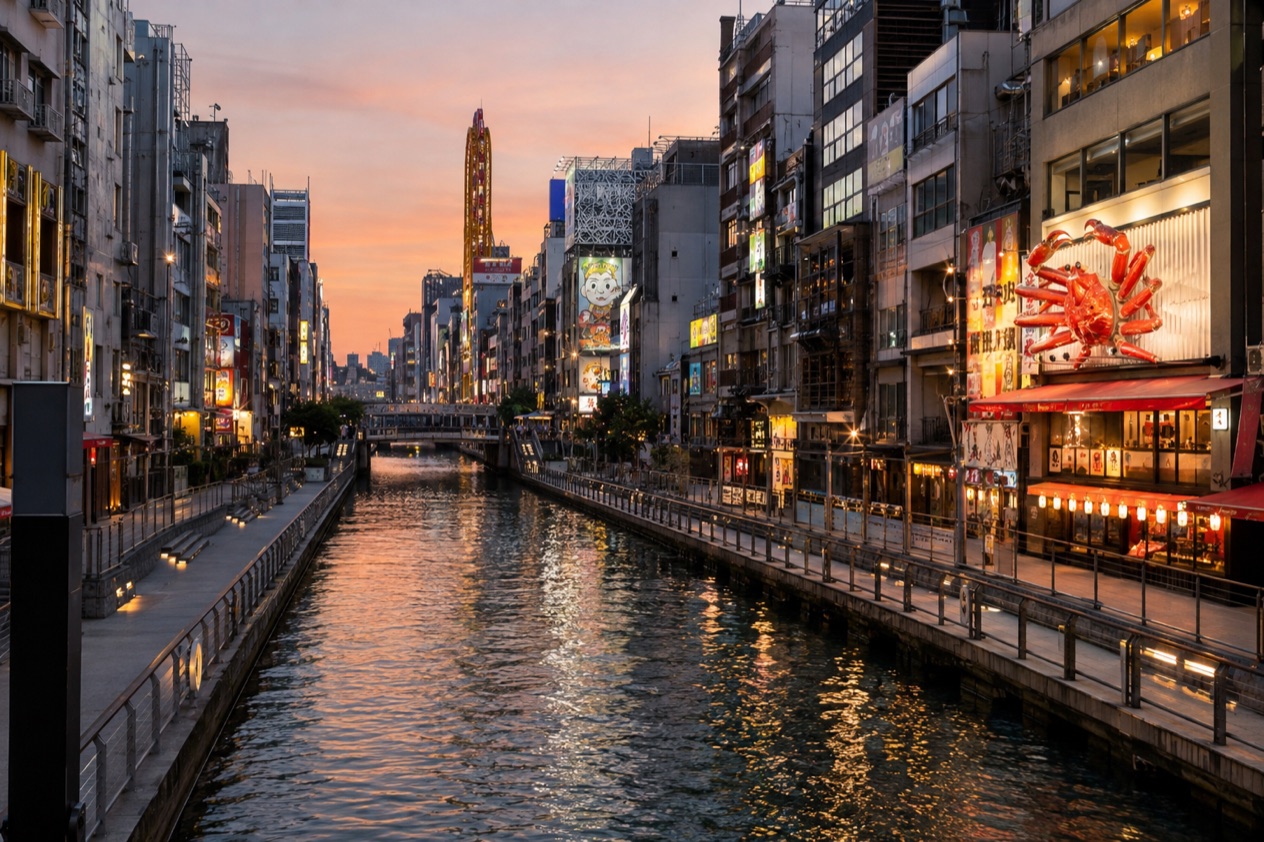
Lights come on along the canal and the Glico Man, arms raised mid-sprint, glows over the water while a mechanical crab waves its claws above a restaurant front. Dotonbori in Osaka is a stretch of neon, steam from grills and the rhythm of people looking for dinner. It is a district you come to for the evening, to eat your way down the street and watch the signs reflect in the canal.
Is visiting Dotonbori worth it?
Yes, if you like food, signs and a street that never seems to stop moving, and it suits first-time visitors to Osaka as well as people coming back for another meal. Dotonbori runs along the canal in the Namba district of Chuo ward, and what you do here is simple: walk, look up, eat, walk again.
Osaka is known for its food, entertainment and nightlife, and Dotonbori concentrates all three in one place. The old saying goes that you ruin yourself with fashions in Kyoto and with meals in Osaka.
The word for it is kuidaore, to spend yourself into ruin on food, and this district is where that idea is easiest to understand. Nearby Shinsaibashi is a neighbor with a different pull, more about shopping, while Dotonbori is about the plate, the billboard and the canal.
What sets it apart from other entertainment streets is the way the buildings themselves perform. Restaurants wear giant sculptures on their facades, a ferris wheel is built into a discount store, and the canal gives you a waterfront to stand on and take it all in. You can spend an hour here or an entire evening, depending on how many stalls and counters tempt you.
What to see at Dotonbori
The Glico Man sign
The illuminated Glico Man, a runner with both arms raised, stands on the south bank of the canal just west of Ebisubashi bridge. The sign was first installed in 1935 by Ezaki Glico to promote caramel candy, and the version you see now is the sixth, using LEDs, installed in October 2014.
People photograph it from the bridge, with the canal and the glowing lights below. Because everyone knows the sign, it has become the place where friends say they will meet, and Ebisubashi, just east of the billboard, works as a gathering point for that reason.
Kani Doraku and the moving crab
Kani Doraku is a crab restaurant with three locations along Dotonbori Street, and it is famous for its moving crab billboard measuring six and a half meters. The crab flexes its claws and legs over the entrance, and it draws a small crowd of phones at any hour of the evening.
You do not need to eat there to enjoy the show, though crab is the whole point of the menu. Look up at it first, then look at the neighboring fronts, because the street is built on this kind of friendly competition between signs.
Ebisu Tower ferris wheel
Built into the facade of the Dotonbori Don Quijote store, the Ebisu Tower ferris wheel reaches a height of 77 meters (253 feet). It is an odd sight, a wheel growing out of a discount shop, and it adds a circle of light to the skyline above the canal.
From the street you see it over the heads of the crowd, and it makes a good marker when you lose your bearings among the side alleys. The store below sells a bit of everything, so it is also a stop if you want to browse after eating.
Street food and ramen counters
The food is the real attraction. Think of takoyaki, the octopus balls turned on hot griddles, okonomiyaki, the savory pancakes, and skewers of fried food, all part of the Osaka table. Kinryu Ramen is open 24 hours and offers a free garlic and kimchi bar, a useful stop for a late bowl.
Restaurants come and go here. Zubora-ya, a fugu restaurant on the street, closed permanently on September 15, 2020, after closing temporarily in April of that year, so go with an open mind and let the lines and smells guide you.
Hours, tickets and rules
Dotonbori is a public street along a canal, so walking it carries no admission, and the signs shine for as long as you are there. The one place with a fixed schedule in the information we have is the ramen shop that never closes.
| Site | Open | Admission |
|---|---|---|
| Kinryu Ramen | 24 hours | Free garlic and kimchi bar |
No rules about drones, tripods or photography are given for the district, so there is nothing to add on that front. Individual shops and restaurants set their own hours.
When to visit Dotonbori
Evening is when Dotonbori earns its reputation, since the neon is the show and the canal turns into a mirror of colored light. Daytime gives you a calmer look at the facades and the details of the signs, but the glow of the Glico Man and the crab belongs to the dark hours.
October is a comfortable month for walking. Highs reach the mid-70s and nights drop to around 60, which suits an evening outside, though rain falls on about eight days and can arrive as a proper downpour. Carry a small umbrella and keep going, because the covered arcades nearby give you somewhere to wait.
April brings highs in the upper 60s and lows around 52, mild enough to eat standing at a stall without chilling, with rain on about nine days. July is hot and humid, with highs near 89 and nights in the mid-70s, and rain on about ten days. A cold bowl or a shaded stop helps, and the lights feel better once the sun has gone down.
January is cold, with highs near 50 and lows in the high 30s, and some days bring snow or sleet. Bundle up, and warm food becomes part of the pleasure. Rain is lighter then, falling on fewer days.
Tips for your visit
Come hungry and plan to graze rather than sit down for one big meal. Sharing a few plates from different stalls lets you taste more of the street, and it fits the spirit of kuidaore, the local habit of eating generously.
To get there, take the Midosuji Line from Osaka or Umeda Station to Shinsaibashi Station, which puts you at Shinsaibashi and Dotonbori. You can also stay on the Midosuji Line until Namba Station and reach Dotonbori from there. If you are coming from Tokyo, the Tokaido-Sanyo shinkansen runs to Shin-Osaka Station in about two and a half hours, and from there a JR local line goes to Osaka Station.
Pick a meeting point before you arrive. Ebisubashi, just east of the Glico Man, is the spot people know, and it saves wandering the crowd looking for each other. Comfortable shoes help, as the street is a slow shuffle of people and you will be on your feet.
Pair the visit with Shinsaibashi for shopping, or with Osaka Bay, reachable from Osaka or Umeda stations via the JR Loop Line and the Chuo subway line.
Good to know before you go
Keep some cash and a card handy for the stalls and counters, and keep your belongings close in the evening crowd, as you would on any busy street. Rain showers are common in the warmer months, so a compact umbrella earns its place in your bag.
Sources
- Wikipedia, Dōtonbori (https://en.wikipedia.org/wiki/D%C5%8Dtonbori), checked October 11, 2026
- Japan National Tourism Organization, Osaka (https://www.japan.travel/en/destinations/kansai/osaka/), checked October 11, 2026
- Japan Meteorological Agency (JMA), Normal values 1991-2020, monthly (https://www.data.jma.go.jp/stats/etrn/view/nml_sfc_ym.php?prec_no=62&block_no=47772), station Osaka, elevation 23 m, checked October 11, 2026
To plan your stay
- Best Time to Visit Japan: Cherry Blossoms, Autumn Colors, Weather and Festivals
- Where to Stay in Japan: Ryokan, Temple Stays, Capsule Hotels and the Best Cities to Base In
- Sending Luggage from the Airport in Japan: Hands-Free Travel, Hotel Delivery and Coin Lockers
- Know Before You Go to Japan: Entry, Money, Etiquette and Getting Around