
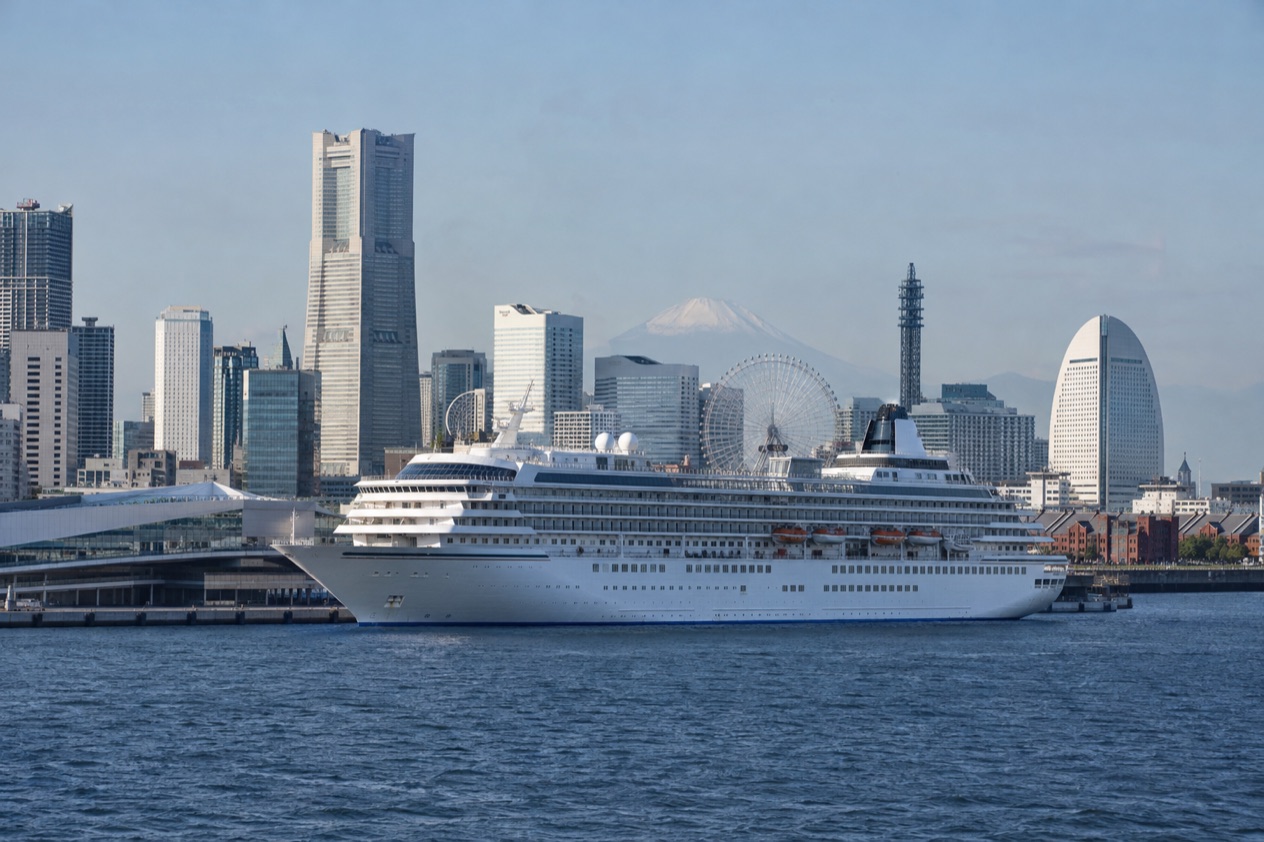
On the last morning of a cruise, passengers lean on the rail as Yokohama’s harbor opens up. Cranes line the water, and the towers and the big Ferris wheel of the Minato Mirai waterfront stand across the bay.
Then the practical questions arrive all at once: where do we land, and how do we reach Tokyo? Cruise passengers are handled at Osanbashi Pier, the port’s passenger terminal, and Tokyo is reached by rail through Yokohama Station.
Where do cruise ships dock in Yokohama?
Cruise passengers in Yokohama are handled at Osanbashi Pier, the part of the port built for passenger traffic. The port describes the pier as handling passenger traffic including cruises, and it has customs, immigration and quarantine facilities for international travel. Everything else in this busy harbor is a working pier for cargo or for other users, so Osanbashi is the name to remember.
The Port of Yokohama is run by the Port and Harbor Bureau of the City of Yokohama and opens onto Tokyo Bay. It formally opened to foreign trade on June 2, 1859, and that long history as a gateway shows in the city today. Yokohama grew up around the harbor, and its neighborhoods of brick warehouses, foreign-style architecture and a Chinatown trace back to the years when ships from abroad first tied up here.
Osanbashi Pier, the passenger terminal
Osanbashi is where the paperwork of an international voyage happens. Customs, immigration and quarantine all have facilities on the pier, so arriving and departing passengers deal with the formalities of the trip at the same place where they step off the ship. The pier is part of a harbor front that locals use as a place to stroll and look at the water, with the skyline of the city rising behind.
For a traveler, the useful thing to hold on to is simple: the pier belongs to the passenger side of the port, and the cargo terminals belong elsewhere. If a ship’s itinerary says Yokohama, Osanbashi is the pier the port itself ties to cruises. From there you are in the city of Yokohama, on the western shore of Tokyo Bay, directly south of Tokyo.
The working piers around it
The port counts ten major piers, and most of them have nothing to do with vacationers. Honmoku is the core cargo facility, Daikoku sits on an artificial island with vast warehouse space, and Minami Honmoku has deep berths for the largest class of container ships. If you hear these names from a taxi driver or see them on a map, they are the industrial side of the harbor.
One more pier has its own role. Part of Mizuho Pier is used by the United States Forces Japan, which is another reason a cruise passenger should not simply head for the nearest pier on the map.
| Pier | What it handles |
|---|---|
| Osanbashi | Passenger traffic including cruises, with customs, immigration and quarantine facilities for international travel |
| Honmoku | Core facility of the port, 24 berths including 14 container berths |
| Daikoku | Artificial island of 321 hectares with a million square meters of warehouse space at the Yokohama Port Cargo Center |
| Minami Honmoku | Two 350 meter operational berths, 16 meters deep, for larger post-Panamax container ships |
| Mizuho | Seven berths used by the United States Forces Japan |
What to expect on board before landing
Dining on almost all cruise ships is included in the cruise price, so the last breakfast aboard is part of the fare. Cruise ships themselves are large passenger vessels used mainly for vacations, and Yokohama is a port where the ship, the harbor and the city are close enough together that the view from the deck already sets the scene for the day.
How do you get to Tokyo from the port?
You get to Tokyo by rail, using Yokohama Station as the hub, since Tokyo lies directly south of the city’s northern neighbor on the same shore of the bay. Travelers from central Tokyo take a JR train or one of several private railway lines to Yokohama Station, and the same links join the two cities in the other direction. The station is a major one and handles two million passengers a day, so expect a large, busy concourse.
Yokohama Station is more central than Shin-Yokohama Station, the other stop in the city, which is the one used by the Shinkansen. Keep the two names apart, because they are different stations and the choice affects where you end up.
By train between Yokohama and Tokyo
Two kinds of operators run between the cities: JR, the national railway group, and several private railway lines. Both reach Yokohama Station, and the ride between central Tokyo and the station takes about an hour. The route runs through the dense urban belt that links the two cities, so the trip is a long stretch of rooftops, rail yards and glimpses of the bay rather than open country.
A traveler who has a late afternoon departure from Tokyo, or a hotel booked there for the night after the cruise, can plan around that hour of travel at either end. Yokohama has been twinned with San Diego, California, since October 1957, which gives American visitors a small point of connection with the city they are about to leave or arrive in.
To and from the airports
Many cruise passengers fly in or out of Tokyo around their sailing. Haneda Airport and Yokohama Station are linked by the Keikyu train line, and a shuttle bus runs the same route. Narita Airport and Yokohama Station are linked by Narita Express trains and by shuttle buses.
| Route | Service | Time |
|---|---|---|
| Haneda Airport to Yokohama Station | Keikyu train line | 20 minutes |
| Haneda Airport to Yokohama Station | Shuttle bus | 30 minutes |
| Narita Airport to Yokohama Station | Narita Express trains and shuttle buses | Approximately 1 hour 30 minutes |
| Central Tokyo to Yokohama Station | JR train or private railway lines | About 1 hour |
These times run between each airport and Yokohama Station, so the stretch between the station and Osanbashi Pier is on top of them.
Onward by Shinkansen from Shin-Yokohama
For travelers heading west after the cruise, the fastest rail connection is the Nozomi Shinkansen, which stops at Shin-Yokohama Station. From there the trip to Nagoya takes 1 hour 25 minutes, Kyoto and Osaka are 2 hours away, and Hiroshima is 3 hours 40 minutes away.
| From Shin-Yokohama Station | Nozomi Shinkansen travel time |
|---|---|
| Nagoya | 1 hour 25 minutes |
| Kyoto | 2 hours |
| Osaka | 2 hours |
| Hiroshima | 3 hours 40 minutes |
Which excursions leave from Yokohama?
The city of Yokohama itself and Tokyo, to its north, are the two places this harbor puts within reach, and what you do there depends on what you like to see and eat. Shore programs differ from one cruise line to another, so the clearest picture comes from what stands around the port and what the rail network connects.
Yokohama on its own terms
Yokohama is the second largest city in Japan, and it rewards time on its own. Its Chinatown is a grid of lanes lined with steamed buns, sesame balls, roasted chestnuts and restaurants serving Cantonese and Sichuan dishes, with painted gates marking the entrances. Minato Mirai, the waterfront district of towers and a Ferris wheel, is where the city shows its modern face, and the brick warehouses nearby are the kind of buildings that give the harbor its older character.
The city is also known for its history of foreign contact since the port opened to trade, and you read that in the street names, in the stone and brick buildings, and in the many restaurants that take foreign cooking as their theme. A traditional garden, a noodle museum and a stretch of harbor park round out what visitors tend to put on a list. Treat these as options to pick from, not a fixed route.
Tokyo as a day out
Tokyo is the excursion that most cruise itineraries call to mind, since the capital lies directly south of nothing in the way and is reached from Yokohama by JR or private rail.
A day built around Tokyo means giving up most of Yokohama, and the reverse is also true. Travelers who prefer one place done well may find the harbor city enough, and those who want the sprawl of the capital can build a day around a few districts and a meal at an izakaya, the casual pub where small plates arrive one after another.
Farther west by rail
Kyoto, Osaka, Nagoya and Hiroshima all connect to Shin-Yokohama by the Nozomi Shinkansen, which makes them part of the picture for travelers who extend the journey on land after the ship. Kyoto brings temples, wooden machiya townhouses and kaiseki, the multi-course meal built around the season. Osaka is a city that loves to eat, with takoyaki and okonomiyaki as its calling cards. Hiroshima offers its Peace Memorial Park and okonomiyaki layered with noodles.
These are places to plan around before or after the cruise, with a night or two on land, rather than something to squeeze into a single port call.
Good to know before you go
Money in Japan is the yen, and a cruise passenger who stays aboard for meals will spend less on shore than one who plans lunch in Chinatown and a coffee in Minato Mirai. The Port of Yokohama is a working harbor on Tokyo Bay, and the Port and Harbor Bureau of the City of Yokohama runs it, so the piers around Osanbashi are industrial in character. Keep the pier name handy when you speak to a driver or ask directions, and match station names carefully, because Yokohama Station and Shin-Yokohama Station are not the same place.
Sources
- Wikipedia, Yokohama Port (https://en.wikipedia.org/wiki/Yokohama_Port), checked October 11, 2026
- Wikipedia, Cruise ship (https://en.wikipedia.org/wiki/Cruise_ship), checked October 11, 2026
- Wikipedia, Port of Kobe (https://en.wikipedia.org/wiki/Port_of_Kobe), checked October 11, 2026
- Japan National Tourism Organization, Yokohama (https://www.japan.travel/en/destinations/kanto/kanagawa/yokohama-and-around/), checked October 11, 2026
- Wikivoyage, Yokohama (https://en.wikivoyage.org/wiki/Yokohama), checked October 11, 2026
To plan your stay
- Japan Cruise in March: Weather by Port, Cherry Blossom Timing and What You See
- Celebrity Japan Cruises: Asia Voyages, Hiroshima and Tokyo Sights, and the Port of Kobe
- How Much Does a Japan Cruise Cost?: What the Fare Covers, Drinks and Shore Excursions
- Japan Cruise in April: Cherry Blossoms, Spring Weather and What You See From Port