
Somewhere between a bowl of ramen in a Tokyo side street and a train window full of rice fields, plenty of travelers start wondering whether they could have arrived by sea, with the whole Pacific as the approach. A crossing to Japan is a different kind of voyage, one that depends on ships changing regions, and it ends at a passenger pier in Yokohama.
Are there cruises from Vancouver to Japan?
For a traveler, that makes a Pacific crossing less a standing weekly service and more a seasonal opportunity tied to what the cruise lines decide to do with their ships.
Think of it as a one-way voyage with a long middle. You board in a Canadian city, spend your days on the ship, and step off in a Japanese port. Since the cruise is also your transportation, you are choosing it for the journey itself, not as a quick way to cross.
What a repositioning cruise means for you
A repositioning cruise is built around a ship’s schedule, not around a resort stay. The ship may be arriving in Asia to start a different season of sailings, and you are invited aboard for the move. The result is a one-way voyage shaped by the ship’s move from one region to another.
It suits travelers who enjoy the ship as much as the destination, who like reading on a deck chair, attending an evening show and taking their time getting somewhere. It is a poorer fit for anyone who wants to be on the ground in Kyoto at the first opportunity.
What the fare covers and what it does not
A cruise package includes accommodation, meals and entertainment. Dining on almost all cruise ships is part of the cruise price, so breakfast in the buffet and dinner in the main dining room do not appear as separate charges.
Extras are where the bill grows. Alcohol, fine dining, spa treatments and shore excursions can all carry additional fees. Over a long voyage with several ports, it helps to think of the base fare as the room and the table, and everything else as optional add-ons you choose along the way.
Choosing a line
Cruise lines have very different personalities, and on a long crossing that matters more than on a weekend trip. The three largest holding companies and operators in the world are Carnival Corporation & plc, Royal Caribbean Group and Norwegian Cruise Line Holdings, and their ships are the kind of large, entertainment-heavy vessels most people picture.
Smaller operators offer other styles. Regent Seven Seas Cruises runs medium-sized vessels designed so that virtually all of their suites have balconies, which suits days spent watching open water. Star Clippers sails only tall ships, a very different experience again. Saga Cruises, for its part, only allows passengers over 50 aboard. Match the personality of the ship to how you want to spend your days at sea.
Which routes cross the Pacific?
Canada Place is Vancouver’s main cruise passenger terminal, while Osanbashi Pier handles cruise passengers in Yokohama. What happens between the two depends on the itinerary each cruise line publishes for its own repositioning voyage, so the ports in the middle belong to the specific sailing you choose.
The Vancouver end: Canada Place
Its roofs of white fabric are shaped like sails, so the terminal looks like a ship itself when you walk along the waterfront. The building also holds the Vancouver Convention Centre East Building, the Pan Pacific Vancouver hotel, the Vancouver World Trade Centre and Flyover, a virtual flight experience.
Getting there is straightforward by transit. Canada Place is reached along West Cordova Street and stands near Waterfront Station, a major hub with connections to SkyTrain, SeaBus and the West Coast Express. The street address is 999 Canada Place. If you arrive a day early, the Pan Pacific hotel is part of the same complex, and at noon every day the Heritage Horns on the building play the first four notes of O Canada, loud enough to be heard across downtown.
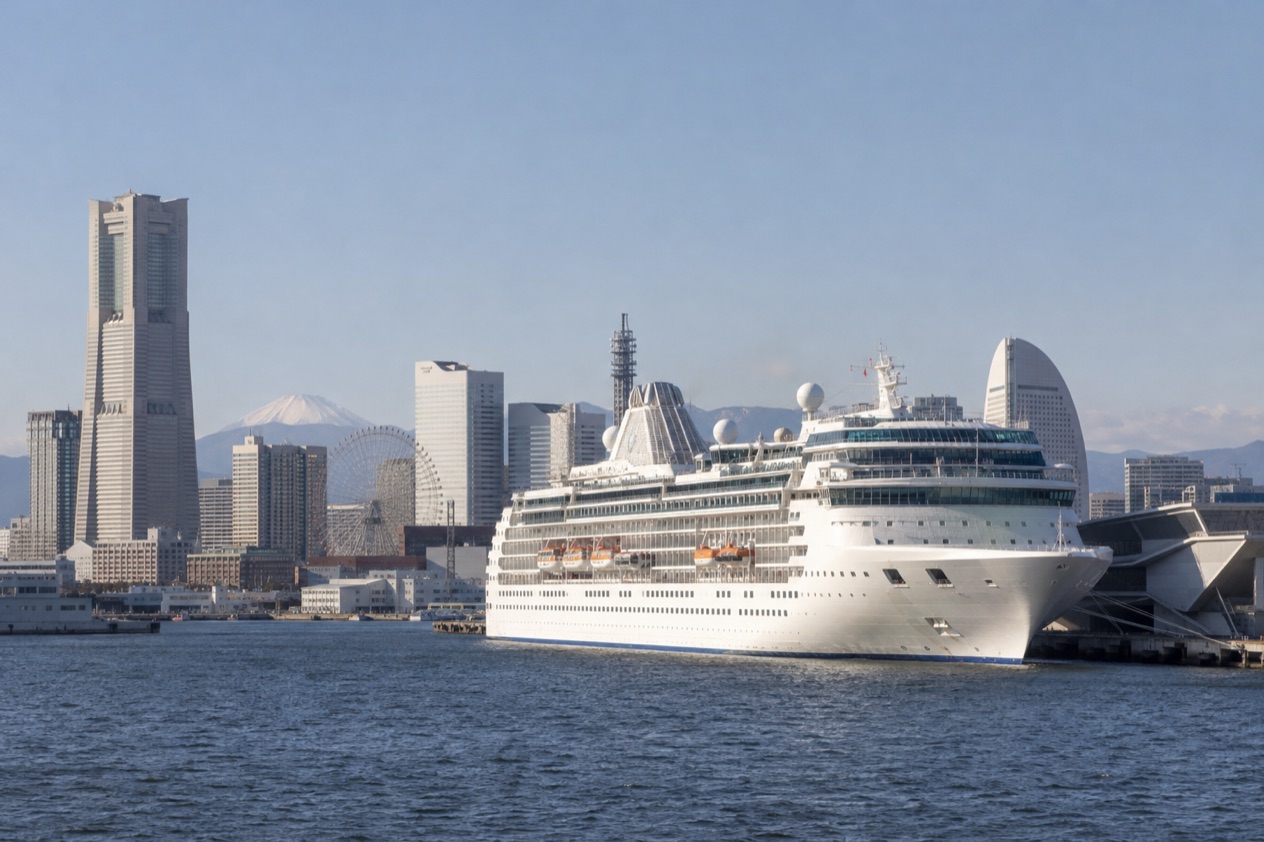
The Japan end: Yokohama and Osanbashi Pier
Yokohama opens onto Tokyo Bay and is run by the Port and Harbor Bureau of the City of Yokohama. Of its ten major piers, Osanbashi is the one that handles passenger traffic, including cruises, and it has customs, immigration and quarantine facilities for international travel. The others mostly serve freight, which explains why a cruise passenger hears about one pier and not the rest.
| Pier | What it is used for |
|---|---|
| Osanbashi Pier | Passenger traffic including cruises, with customs, immigration and quarantine facilities |
| Honmoku Pier | Core facility of the port, 24 berths including 14 container berths |
| Daikoku Pier | Artificial island of 321 hectares with warehouse space at the Yokohama Port Cargo Center |
| Mizuho Pier | Seven berths used by the United States Forces Japan |
The port has a long history as a gateway. It formally opened to foreign trade on June 2, 1859, and the habit of receiving ships from abroad runs deep in the waterfront.
Kobe and other Japanese ports
Yokohama is not the only Japanese port a traveler may meet on a sailing. The Port of Kobe sits in Kobe, Hyogo, in the Keihanshin area, backed by the Hanshin Industrial Region. Because flat land is limited there, the city built artificial islands, among them Port Island and Rokko Island, and the island that carries Kobe Airport.
Whether a given sailing calls at Kobe or ends at Yokohama is something the cruise line’s itinerary states. When you compare voyages, look at where each one finishes, since your onward plans in Japan start from that pier.
How long do they take?
The length of a Vancouver to Japan voyage is set by the cruise line’s itinerary, and it is always longer than a typical Alaska sailing because it is an ocean crossing, with open water for much of the way.
Days at sea, days ashore
On a repositioning cruise, the balance leans toward sea days. That changes how you plan. Instead of rushing from a gangway to a sightseeing bus, you settle into the ship: a morning walk around the deck, lunch, a lecture or a film, a long dinner. People who enjoy that rhythm tend to love these voyages, and people who need a new view each day often find them slow.
Crossing the Pacific toward Asia also means moving across the international date line, so a calendar day disappears from the trip.
Planning around the voyage
Because the cruise is also your transportation, both ends of the trip deserve thought. In Vancouver, Canada Place has transit connections close by, and the Pan Pacific hotel stands in the same complex if you want to sleep beside the ship the night before. On the Japanese side, Osanbashi Pier handles customs, immigration and quarantine, so arrival formalities for an international sailing are dealt with at the pier itself.
What you do after landing is open. Yokohama is a city in its own right, and trains lead on to the rest of Japan from there. Leave a little room in the schedule for the day you arrive, since a long voyage tends to end with luggage, a new city and plenty to look at.
Who the long way suits
This is a trip for travelers with time, who see the voyage as part of the vacation. Cruise tourism has grown a great deal, from an estimated 14 million passengers worldwide in 2005 to 34.5 million in 2024, and the repositioning crossing is one of its quieter corners, aimed at people who like long days on deck and a slow approach to a new country.
If your vacation is short, a flight will fit better. If it is open-ended, arriving in Yokohama by ship, with Tokyo Bay opening up ahead, is a memorable way to begin.
Good to know before you go
Think about money in two parts: the cruise fare, which covers your cabin, meals and entertainment, and the extras you add on board or ashore, such as drinks, spa visits and excursions. Once you are in Japan, spending is in yen. Ask the cruise line what its itinerary includes, then plan your first days ashore around where the ship docks, since each port has its own character and its own way into the city.
Sources
- Wikipedia, Yokohama Port (https://en.wikipedia.org/wiki/Yokohama_Port), checked October 11, 2026
- Wikipedia, Canada Place (https://en.wikipedia.org/wiki/Canada_Place), checked October 11, 2026
- Wikipedia, Cruise line (https://en.wikipedia.org/wiki/Cruise_line), checked October 11, 2026
- Wikipedia, Cruise ship (https://en.wikipedia.org/wiki/Cruise_ship), checked October 11, 2026
- Wikipedia, Port of Kobe (https://en.wikipedia.org/wiki/Port_of_Kobe), checked October 11, 2026
To plan your stay
- Japan Cruise in March: Weather by Port, Cherry Blossom Timing and What You See
- Celebrity Japan Cruises: Asia Voyages, Hiroshima and Tokyo Sights, and the Port of Kobe
- How Much Does a Japan Cruise Cost?: What the Fare Covers, Drinks and Shore Excursions
- Japan Cruise in April: Cherry Blossoms, Spring Weather and What You See From Port