
On the quay at Singapore’s HarbourFront, a ship’s horn sounds over Keppel Harbour while passengers drift toward the terminal with their luggage, and some of them are already wondering how far this ship can carry them. The question comes up just as often from the other end, for a traveler in Japan who sees a liner moored at Yokohama and wonders where it sailed from.
Are there cruises from Singapore to Japan?
Both countries have terminals built for international cruise traffic, and that is where a voyage would begin and end.
One general idea is useful. A cruise ship moving from one region to another will commonly operate a repositioning cruise while doing so. When a ship shifts from Southeast Asian waters to Japanese ones, that is the kind of voyage involved, and it often shows up as a one-way itinerary rather than a round trip.
Departing from the Singapore Cruise Centre
The Singapore Cruise Centre sits in the south of the island, next to HarbourFront Centre in Keppel Harbour, near HarbourFront MRT station. It was inaugurated in December 1991 and renovated in December 1998, and it is run by Singapore Cruise Centre Pte Ltd. Over seven million cruise and ferry passengers pass through it in a year, about 950,000 of them on cruises.
It is made up of two terminals, the International Passenger Terminal and the Regional Ferry Terminal. The International Passenger Terminal handles international cruise ships, and it also handles ferry rides between Singapore and the Indonesian islands of Batam and Karimun. So you may share the building with commuters and day-trippers heading to Indonesia, while the cruise passengers go up to level 2, a restricted area for those who have cleared immigration and security.
The HarbourFront terminal has six berths. The centre also manages two other ferry terminals, Tanah Merah and Pasir Panjang, with four berths each, though those serve ferries rather than the cruise ships that leave from HarbourFront.
Arriving in Japan at Yokohama
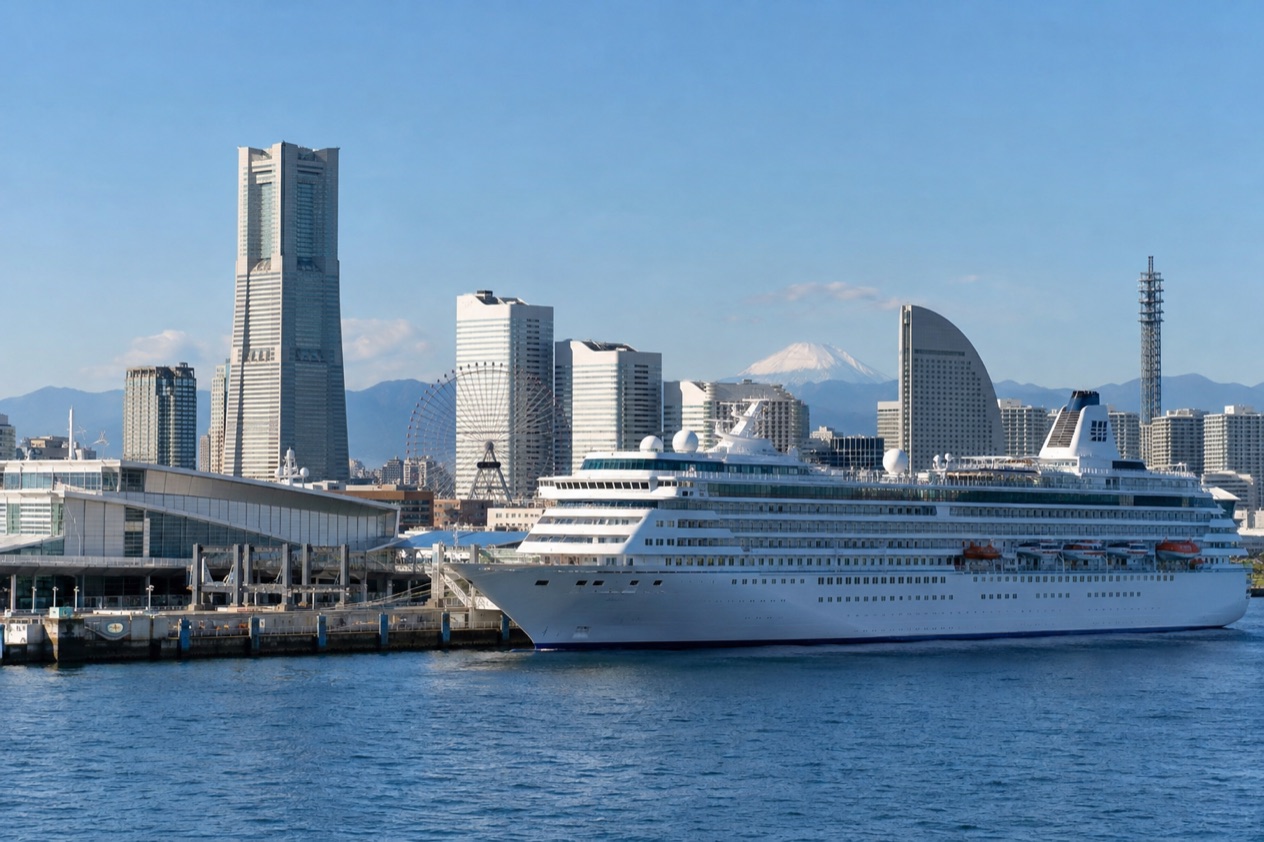
Osanbashi Pier handles passenger traffic including cruises, and it has customs, immigration and quarantine facilities for international travel. In other words, it is the pier where a ship arriving from abroad can process its passengers.
The Port of Yokohama opens onto Tokyo Bay and is operated by the Port and Harbor Bureau of the City of Yokohama. It formally opened to foreign trade on June 2, 1859, and it now has ten major piers.
Most of them are working piers: Honmoku Pier is the core facility with 24 berths, and Daikoku Pier stands on an artificial island. Seven berths of Mizuho Pier are used by the United States Forces Japan, so they are not part of the passenger picture.
What a cruise ticket covers
All cruise packages include accommodation, meals and entertainment, and dining on almost all cruise ships is included in the cruise price. Extra fees may be charged for alcohol, fine dining, spa treatments and shore excursions, so a day ashore in Japan is often something you add on top.
Lines differ in character. Regent Seven Seas operates medium-sized vessels designed so that virtually all of their suites have balconies. Star Clippers sails only tall ships. Saga Cruises allows only passengers over 50 aboard. The three largest holding companies are Carnival Corporation & plc, Royal Caribbean Group and Norwegian Cruise Line Holdings.
Which routes do they take?
A voyage of this kind would begin at the International Passenger Terminal in Singapore and reach a Japanese port with international facilities.
Yokohama and Tokyo Bay
Yokohama is the Japanese port with the clearest cruise credentials here. Osanbashi Pier takes the passengers, with customs, immigration and quarantine under one roof, and the port sits on Tokyo Bay. For a traveler, that means a ship can arrive close to the Tokyo area and the harbor itself is part of the welcome.
The port has a long story of its own. Opened to foreign trade in 1859, it grew into a harbor of ten major piers, and the container berths at Honmoku and Minami Honmoku show how much of it is given over to freight. Minami Honmoku has two operational berths, each 350 meters long and 16 meters deep, built for large container ships.
Kobe and the Osaka Bay side
The Port of Kobe is a Japanese maritime port in Kobe, in Hyogo, in the Keihanshin area, with the Hanshin Industrial Region behind it. Flat land is limited there, so artificial islands were built: Port Island, Rokko Island and the island of Kobe Airport. Standing on the waterfront, you are often looking at land that was made rather than found.
It shows how a ship could finish a voyage on the western side of Honshu instead of near Tokyo.
How other regions compare
Cruise routes elsewhere tend to be built around a cluster of well-known calls. In the Baltic, the most visited ports are Copenhagen, St. Petersburg, Tallinn, Stockholm and Helsinki. In the Mediterranean, they are Barcelona, Civitavecchia, Palma and Venice.
A Singapore to Japan voyage is different. It is a crossing between two regions, which is why the repositioning idea fits better than a looped itinerary of fixed stops.
How long do they take?
What can be said is what shapes the time you spend aboard and ashore.
What decides the length
A cruise that moves a ship from one region to another is a repositioning cruise, and these are built around the transfer itself. The ports in between, if there are any, and the time spent at each one change how long you are away. A direct crossing and a voyage with several calls are very different trips, even when they start and end in the same two places.
Because cruise packages include accommodation, meals and entertainment, the days at sea are part of the holiday rather than dead time. Dining on almost all cruise ships is included in the price, so the pace aboard is set by the ship, not by finding places to eat.
Time at each end
In Singapore, passengers pass through the International Passenger Terminal and go up to level 2, the restricted area reserved for people who have cleared immigration and security. In Yokohama, Osanbashi Pier has customs, immigration and quarantine facilities on site, so arrival formalities happen at the pier itself.
Shore excursions are an extra fee, so how much of Japan you see during a call depends on what you add. A ship that stops in Tokyo Bay gives you the Yokohama waterfront and, beyond it, whatever outings you choose to pay for.
Cruising as a trend
Cruising has grown a great deal. The number of cruise tourists worldwide rose from an estimated 14 million in 2005 to 34.5 million in 2024. More ships and more passengers mean more itineraries between regions, which is part of why crossings like this one get talked about.
Good to know before you go
Extra costs are the main thing to plan around: alcohol, fine dining, spa treatments and shore excursions are charged on top of the package. Dining itself is included on almost all ships, so most of your meals are covered. Ask which line you are sailing with about its own rules, since some set an age limit and others have a particular style of ship.
Sources
- Wikipedia, Yokohama Port (https://en.wikipedia.org/wiki/Yokohama_Port), checked October 11, 2026
- Wikipedia, Cruise line (https://en.wikipedia.org/wiki/Cruise_line), checked October 11, 2026
- Wikipedia, Singapore Cruise Centre (https://en.wikipedia.org/wiki/Singapore_Cruise_Centre), checked October 11, 2026
- Wikipedia, Cruise ship (https://en.wikipedia.org/wiki/Cruise_ship), checked October 11, 2026
- Wikipedia, Port of Kobe (https://en.wikipedia.org/wiki/Port_of_Kobe), checked October 11, 2026
To plan your stay
- Japan Cruise in March: Weather by Port, Cherry Blossom Timing and What You See
- Celebrity Japan Cruises: Asia Voyages, Hiroshima and Tokyo Sights, and the Port of Kobe
- How Much Does a Japan Cruise Cost?: What the Fare Covers, Drinks and Shore Excursions
- Japan Cruise in April: Cherry Blossoms, Spring Weather and What You See From Port