
On a gray Seattle morning, the big white ships lined up along the waterfront look like they could go anywhere, and plenty of travelers standing on the pier wonder whether that includes Japan.
Are there cruises from Seattle to Japan?
The Alaska season is what fills the piers, with ships calling at Juneau, Ketchikan, Skagway, Anchorage and Glacier Bay National Park. Seattle’s closeness to Alaska and the layout of its terminals are what make that season work so well.
When a ship does leave Seattle for Asia, it is usually a ship changing regions, and that kind of trip has its own name. A cruise ship moving from one region to another commonly operates a repositioning cruise while doing so.
Where ships leave from in Seattle
Seattle has two cruise terminals in regular use, and which one you go to depends on the line. The first brought cruise ships back to the city after decades without them, with Norwegian Cruise Line and Royal Caribbean International using Seattle as a home port. The second gave Holland America Line and Princess Cruises a permanent base, after they had worked from temporary berths at Terminal 30.
| Terminal | Location | Opened | Lines tied to it |
|---|---|---|---|
| Bell Street Pier Cruise Terminal | Pier 66 | 2000 | Norwegian Cruise Line, Royal Caribbean International |
| Smith Cove Cruise Terminal | Pier 91 | 2009 | Holland America Line, Princess Cruises |
Once Smith Cove opened, Terminal 30 went back to handling containers as part of an expanded Terminal 28. The Port of Seattle also supplies shore power, so ships alongside do not need to run their engines, and it bans the discharge of untreated sewage by cruise ships. Those are details you notice at the waterfront, where ships sit quietly at the berth.
The other pier on the waterfront
Pier 69 is not a cruise terminal. It is the Seattle terminal for the Victoria Clipper hydrofoil service run by Clipper Navigation. It is easy to confuse with the cruise piers when you look at a map of the waterfront, so if your plans involve a ship, the two terminals in the table are the ones to keep in mind.
Who sails and how the trip is sold
The world of cruising is dominated by three holding companies: Carnival Corporation & plc, Royal Caribbean Group and Norwegian Cruise Line Holdings. Beyond them are lines with a narrower identity. Regent Seven Seas Cruises runs medium-sized vessels designed so that virtually all of their suites have balconies. Star Clippers sails only tall ships, and Saga Cruises welcomes only passengers over 50.
Which line suits a crossing is a matter of taste, and these differences are the ones worth weighing: the size of the ship, the type of cabin and who else is on board. The whole sector has grown a great deal, with worldwide cruise tourists rising from an estimated 14 million in 2005 to 34.5 million in 2024, which is part of why ships are constantly being moved between regions.
Which routes cross the Pacific?
A crossing from Seattle to Japan is a repositioning route, which means the ship is relocating between regions and sells the passage as a cruise. Where it stops along the way depends on the line and the year, so the itinerary is the first thing to read when a sailing is offered.
Yokohama and Osanbashi Pier
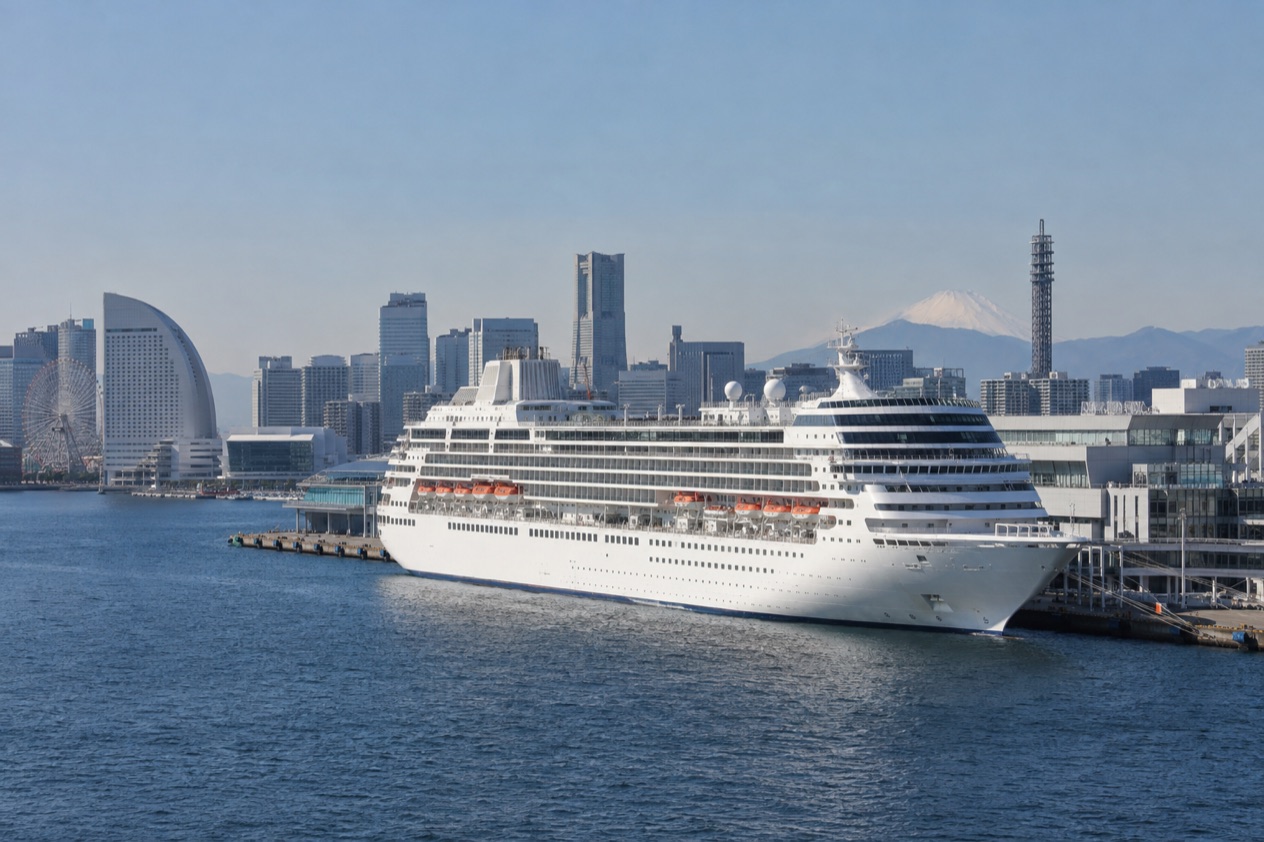
The Port of Yokohama opens onto Tokyo Bay and is run by the Port and Harbor Bureau of the City of Yokohama. It formally opened to foreign trade on June 2, 1859, and it has ten major piers, most of them given over to cargo. The one that matters for a cruise passenger is Osanbashi Pier, which handles passenger traffic including cruises.
That is the reason a crossing can end here, with the ship tied up on the same bay where Japan’s trade with the world began.
The working piers around it
The rest of Yokohama’s harbor is a reminder that this is a working port. Honmoku Pier is the core facility, with 24 berths including 14 for containers. Minami Honmoku has two operational berths built for larger container ships. Daikoku Pier sits on an artificial island and houses the Yokohama Port Cargo Center, a vast warehouse complex.
Seven berths of Mizuho Pier are used by the United States Forces Japan. For a passenger, the picture is of a bay lined with cranes and warehouses, with the cruise berth set apart from that cargo world.
Kobe as another Japanese port
The Port of Kobe is a Japanese maritime port in Kobe, Hyogo, in the Keihanshin area, set against the Hanshin Industrial Region. Flat land is limited there, so the port grew by building artificial islands: Port Island, Rokko Island and the island that holds Kobe Airport.
A cruise that includes Kobe lets you see a city shaped by its harbor, with land reclaimed from the water to make room. It is a port to know about if an itinerary lists it, though whether a Seattle crossing calls there depends entirely on the sailing you choose.
How long do they take?
The length of a crossing is set by the itinerary of the particular ship, because a repositioning cruise follows the route its line plans for moving the vessel. A ship that sails straight across spends most of its time at sea, while one that adds ports between Seattle and Japan stretches the trip out. For that reason the schedule printed for each sailing is the thing to read, not a general rule.
What a long passage feels like on board
A trip like this is lived mostly on the ship. Dining on almost all cruise ships is included in the cruise price, and packages cover accommodation, meals and entertainment, so the days settle into a rhythm of breakfast, deck time, shows and dinner. Cruise ships are large passenger vessels used mainly for vacationing, and on a long passage that vacation happens in the ship’s lounges, theaters and restaurants.
Extras are charged on top: alcohol, fine dining, spa treatments and shore excursions can all carry additional fees. On a long crossing, the spa and specialty restaurants are the things people weigh, and the choice shapes the final bill more than the cabin does.
Choosing a ship for the time you will spend aboard
With a lot of time on board, the type of ship matters. For a long voyage, compare only the ships offered on the specific itinerary, paying particular attention to cabin type and onboard spaces.
Larger ships from the big holding companies bring more entertainment and more dining rooms to fill the days. Think about who you are traveling with and how you like to spend a quiet afternoon, then match the ship to that.
The arrival
If the itinerary ends at Osanbashi Pier in Yokohama, the ship arrives in Tokyo Bay and entry formalities are handled at the terminal. Because the pier has its own customs, immigration and quarantine facilities, the formalities of arrival are handled at the terminal. After weeks of open water, the sight of the harbor, with its container cranes and the city beyond, is when the trip turns into Japan.
Good to know before you go
Budget for what the package leaves out. Accommodation, meals and entertainment are included, but alcohol, fine dining, spa treatments and shore excursions can add fees, and the cabin you choose changes the experience as much as the line.
Read each sailing’s itinerary closely, since a repositioning voyage depends on how the line is moving its ship. A cruise that begins in Seattle starts at one of two terminals, so confirm which one your line uses before you travel.
Sources
- Wikipedia, Yokohama Port (https://en.wikipedia.org/wiki/Yokohama_Port), checked October 11, 2026
- Wikipedia, Cruise line (https://en.wikipedia.org/wiki/Cruise_line), checked October 11, 2026
- Wikipedia, Port of Seattle (https://en.wikipedia.org/wiki/Port_of_Seattle), checked October 11, 2026
- Wikipedia, Cruise ship (https://en.wikipedia.org/wiki/Cruise_ship), checked October 11, 2026
- Wikipedia, Port of Kobe (https://en.wikipedia.org/wiki/Port_of_Kobe), checked October 11, 2026
To plan your stay
- Japan Cruise in March: Weather by Port, Cherry Blossom Timing and What You See
- Celebrity Japan Cruises: Asia Voyages, Hiroshima and Tokyo Sights, and the Port of Kobe
- How Much Does a Japan Cruise Cost?: What the Fare Covers, Drinks and Shore Excursions
- Japan Cruise in April: Cherry Blossoms, Spring Weather and What You See From Port