
FLORIDA · MAY · WET SEASON, MONTH ONE
Florida in May is not one temperature. Tampa’s average high is 88.3°F, Fort Lauderdale’s is 85.8°F, and between those two the daytime state barely varies. The nights split it open: 63.9°F at the Jacksonville gauge that stands in for St. Augustine, 76.4°F at Key West International. Twelve and a half degrees, one state border.
What the month hands you is water: 83.0°F off Miami, 84.6°F off Key West, and a hurricane season that does not open until June 1. What it takes back is the dry season, which ended April 30, with the Everglades’ concentrated wildlife and any promise of a rainless afternoon in Miami, where the gauge collects 6.32 inches. May is a trade, and the terms depend on which coast you pick.
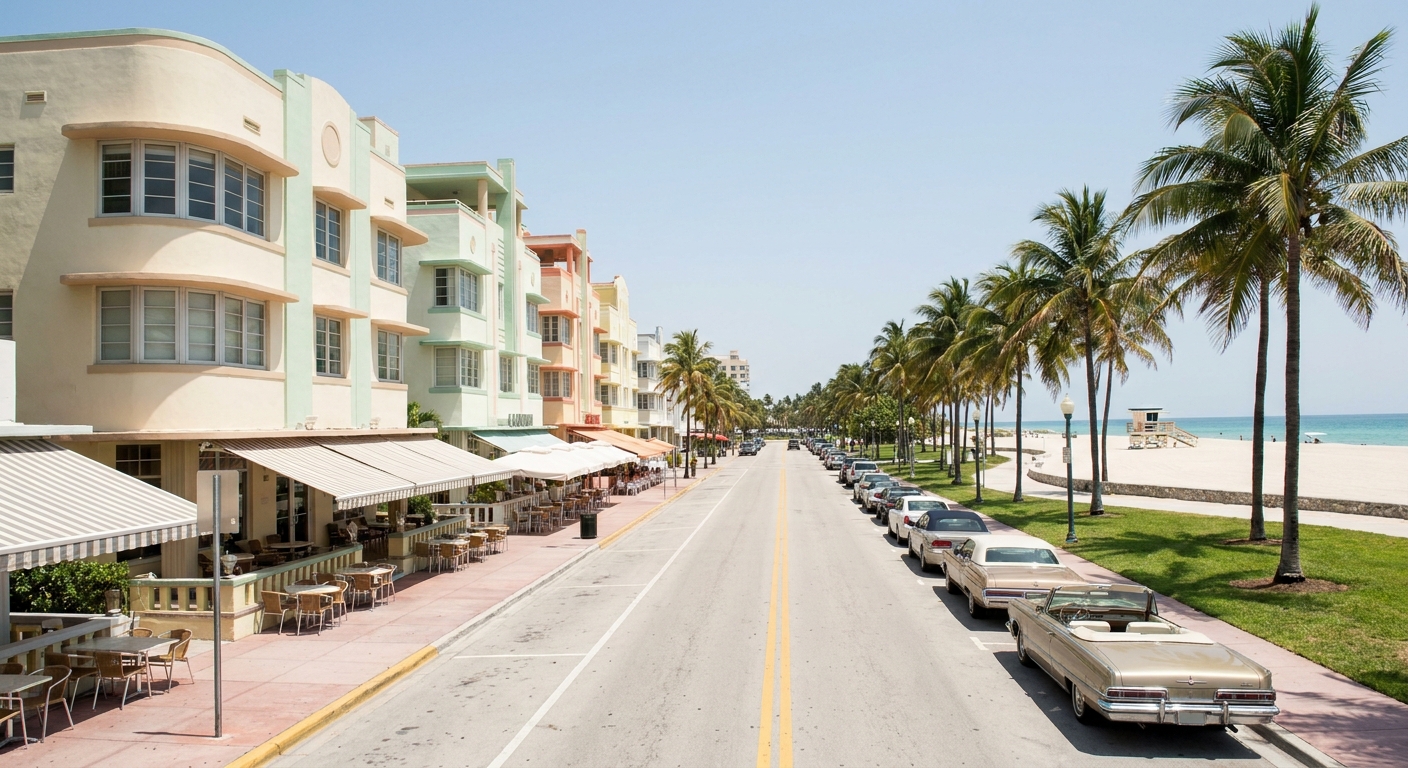
THE MONTH AT A GLANCE · FLORIDA IN MAY
May is the wet season’s first month and the Gulf coast’s best beach weather of the year: hot days, warm water, and no hurricane season until June 1.
WET SEASON: MAY–OCT · HURRICANE SEASON OPENS JUN 1 · SIX NOAA STATIONS, SIX CLIMATES
Go for: Gulf beaches at 2.60 inches of monthly rain, reef water at 84.6°F, 13-hour days with 8 p.m. sunsets, and March’s spring-break apparatus long gone from Miami Beach.
Think twice before: building the trip around Everglades wildlife: the dry season closed April 30, and the water spreading back across the sawgrass scatters what April concentrated.
Climate: NOAA NCEI 1991-2020 normals · Sea: Open-Meteo Marine · Hurricanes: NOAA NHC · full sources at the end
On this page
- Florida temperatures in May, city by citySix NOAA stations, six sets of normals
- Is May wet season in Florida?Wet season, May through October
- Sea temperature in Florida in May83.0°F Atlantic, 82.9°F Gulf
- Crowds in Florida in MayAfter spring break, before summer
- Things to do in Florida in MayEverglades, Vizcaya, PAMM
- Where to go in Florida in MayTampa, Key West, St. Augustine
- May or June in Florida?Miami rain: 6.32 vs 10.51 inches
- Is May a good time to visit Florida?Who the month suits
The twelve-month comparison lives in our best-time guide. Every figure here is a May figure, city by city, from NOAA’s 1991-2020 monthly normals.
Florida weather in May: Miami, Tampa, Orlando and Key West
| City · NOAA station | Avg high | Avg low | Rain | Days ≥ 0.10 in | Daylight May 15 |
|---|---|---|---|---|---|
| Miami · USW00012839 | 86.7°F | 73.4°F | 6.32 in | 6.9 | 13h 27m |
| Fort Lauderdale · USW00012849 | 85.8°F | 73.5°F | 5.56 in | 7.4 | 13h 29m |
| Key West · USW00012836 | 85.9°F | 76.4°F | 3.12 in | 4.1 | 13h 23m |
| Orlando · USW00012815 | 88.4°F | 66.3°F | 4.02 in | 5.7 | 13h 38m |
| Tampa · USW00012842 | 88.3°F | 70.6°F | 2.60 in | 3.9 | 13h 35m |
| St. Augustine · USW00013889 (Jacksonville) | 85.9°F | 63.9°F | 3.42 in | 4.6 | 13h 43m |
The gap is in the nights. St. Augustine, whose normals come from Jacksonville International (station USW00013889), averages a low of 63.9°F in May, while Key West International averages 76.4°F, a difference of 12.5 degrees inside one state border. Daytime numbers hide that split almost entirely, running from 85.8°F at Fort Lauderdale to 88.4°F at Orlando, a spread of 2.6 degrees. These are NOAA’s official 1991-2020 normals, computed from real airport gauges rather than a reanalysis grid.
Grouped rather than listed, the six make three Floridas. Miami and Fort Lauderdale are the warm, wet pair, at 6.32 and 5.56 inches. Orlando and Tampa are the hot, dry pair, and the Gulf gauge is the driest of all six at 2.60 inches. Then the two ends of the map, Key West and St. Augustine, agree on the daytime figure to the tenth of a degree (85.9°F each) and on almost nothing else.
Rain in May is counted in hours, not days. Fort Lauderdale records 7.4 days with at least a tenth of an inch, the highest of the six, and only 1.9 days with an inch or more. Tampa’s counts are 3.9 and 0.8. Even the wettest of these cities leaves roughly 24 days out of 31 without measurable rain, and the wet-season pattern puts the downpour in the late afternoon rather than across the morning.
The day-to-night swing is the packing question. Orlando moves 22.1 degrees between its 88.4°F high and its 66.3°F low, and St. Augustine moves 22.0. Key West moves 9.5. A light layer earns its place for an evening in the interior or the northeast, and no place at all on Duval Street.
On May 15 the sun is up 13 hours 43 minutes at St. Augustine and 13 hours 23 minutes at Key West, the north holding the longer day on this side of the solstice. Miami rises at 6:33 a.m. and sets at 8:00 p.m. Eastern, and Tampa keeps light until 8:13 p.m. That buys a beach afternoon after a park morning, plus dinner outdoors without a flashlight.
Is May in Florida’s dry season or wet season?
May is the first month of Florida’s wet season. Statewide the dry season runs November through April and the wet one May through October, the split our twelve-month guide is built on. Which makes May a threshold: the southeast is already posting wet-season totals at 6.32 inches, while Tampa’s 2.60 inches still reads like the dry season it just left.
In practice the wet season rewrites the afternoon rather than the day. Heat and humidity build, a thunderstorm arrives late and moves through fast, and the sky is often clear again by dinner. Put the outdoor hours before 3 p.m. and keep an indoor card in hand: Vizcaya takes its last admission at 4:30 p.m.. That is roughly when a South Florida sky makes up its mind.
The Atlantic hurricane season runs June 1 to November 30 and peaks on September 10, with most activity between mid-August and mid-October, per the NOAA National Hurricane Center. May falls outside it. That is a calendar fact and nothing more: it does not make a May afternoon stormproof, and it does not make June dangerous.
Book May the way you would book a dry-season month, with one date to watch. A trip that starts on May 28 and runs a week crosses into hurricane season on the drive, and June is Miami’s wettest month of the year at the airport gauge, 10.51 inches against May’s 6.32. If your dates spill over, put the refundable rate on the beach nights and check the tropics before you fly, as our know-before-you-go notes spell out.
Can you swim in Florida in May? Sea temperature by coast
Water is swimmable everywhere south of Jacksonville. Off Fort Lauderdale the surface averages 83.1°F in May, off Miami 83.0°F, and off Tampa on the Gulf side 82.9°F, which leaves the Atlantic-versus-Gulf argument with almost nothing to stand on at that latitude. The real split runs north to south: 77.6°F off St. Augustine against 84.6°F off Key West, seven degrees along the same ocean.
One caveat on those numbers. They are ten-year averages (2015-2024) of daily maxima from Open-Meteo’s marine data, so they read a shade warmer than a 24-hour mean. A 7 a.m. swim off Siesta Key will sit a degree or two under the figure, and a 4 p.m. one at Lummus Park, free and open around the clock with lifeguards on duty, a shade over it.
How busy is Florida in May?
Florida’s demand curve belongs to the dry season. Holiday weeks and March spring break are the loud spells, and hotel rates across the state run highest February through April and lowest August through October, which is a market pattern rather than an official statistic. May lands in the seam: spring break is over, the school-holiday summer has not started.
What disappears by May is the March apparatus in Miami Beach. For spring break 2026 the city ran a traffic plan from 6 p.m. Thursday through Sunday, put four Art Deco District garages on flat rates of $40 to $100, and doubled the non-resident tow to $548. In May the parking is the ordinary kind: the South Pointe Park lot starts at $2 an hour with a $20 flat rate on weekends and holidays, and Crandon Park charges $7 on weekdays, $10 at weekends.
We hold no monthly rate or occupancy series for Florida, so nothing here will crown May the cheapest or the quietest of the twelve. Crowding at beach level sits outside the data too. A Saturday on Siesta Key and a Wednesday on the same sand are two different trips, and no statewide figure catches that. For what a week costs, our trip-cost guide works in tiers instead of months.
Things to do in Florida in May
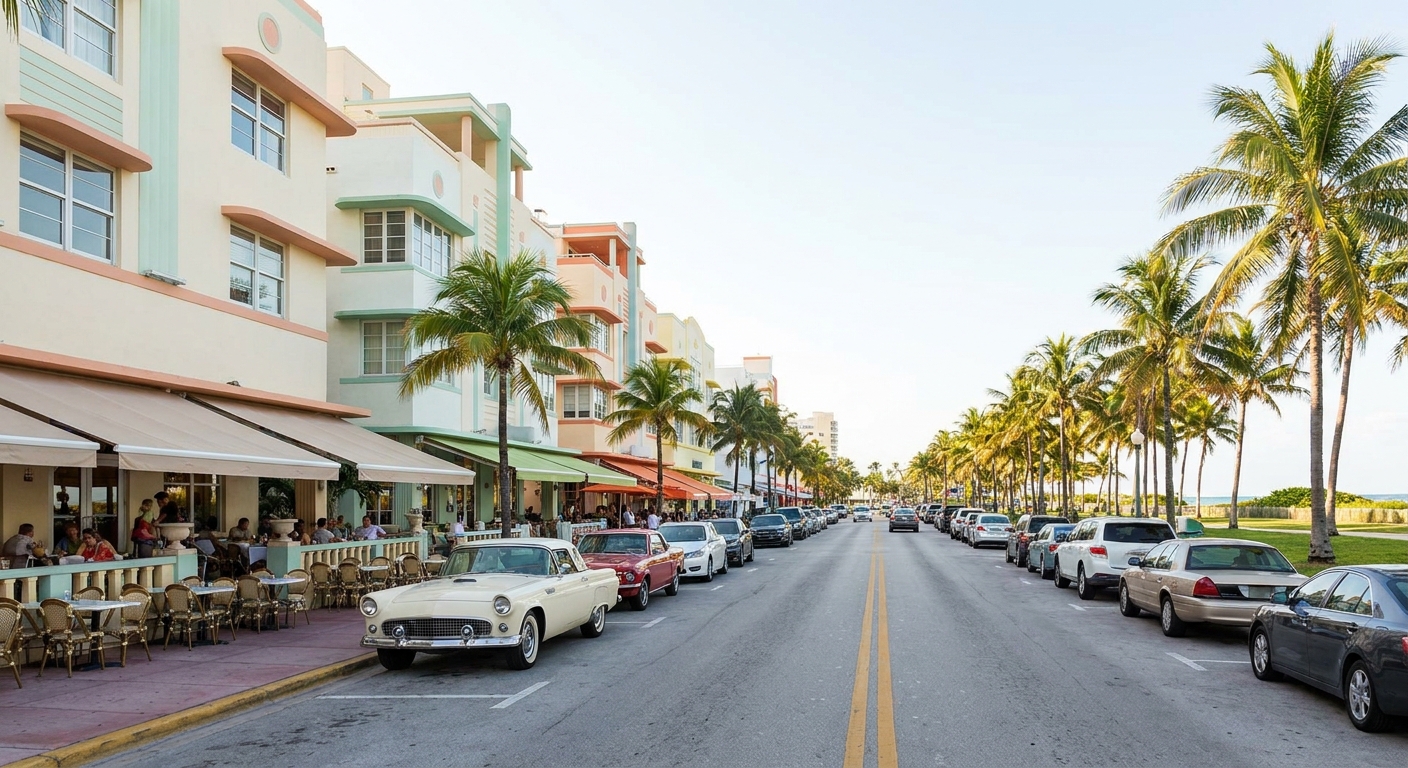
May is the last month before the rain doubles. The Miami gauge collects 6.32 inches now and 10.51 in June, so reef days, sandbar swims and boat trips belong to these four weeks rather than the next four. Daylight helps the plan: 13 hours 38 minutes at Orlando on May 15 makes room for a park morning, a flat hour indoors while the sky works, and a beach at six.
Targets with their numbers attached: Everglades National Park charges $35 per vehicle for seven days, and its three entrances sit at least an hour’s drive apart, so choose one. Vizcaya opens Wednesday to Monday from 9:30 a.m., last admission 4:30 p.m., closed Tuesdays, $20 for adults during restoration work and $5 for ages 6 to 12. PAMM is free Thursdays 5 to 9 p.m. and free all day on the second Saturday, with art-making 11 a.m. to 3 p.m. The Miami Beach trolley runs free, 8 a.m. to 11 p.m., about every 20 minutes.
Where to go in Florida in May: Tampa and the Gulf coast
The central Gulf takes the month. Tampa International’s normals give the second-highest daytime figure of the six at 88.3°F, the lowest rainfall at 2.60 inches and the fewest wet days at 3.9, with water at 82.9°F, a tenth of a degree off Miami’s. Siesta Key in May delivers beach weather on dry-season rain totals, which no other coast manages.
The month loses for one traveler in particular, and that is the wildlife-first one. The Everglades’ dry season ended April 30, and as the water spreads back over the sawgrass the wading birds and alligators that crowded the Anhinga Trail in March disperse across the park. The $35 vehicle fee is unchanged either way. The southeast loses a smaller argument: Fort Lauderdale’s 7.4 wet days and 73.5°F nights make for a sticky after-dinner walk.
The Keys keep their own books. Key West holds a 76.4°F low, the warmest night of the six, with a 3.12-inch month and only 4.1 wet days, which is northern-Florida rainfall attached to water at 84.6°F. It also runs the shortest day of the six on May 15, 13 hours 23 minutes, with the sun down at 8:05 p.m. Key West in May is the reef trip, taken before June arrives.
One line, if that is all you take: sand and dry afternoons go to the Gulf, the warmest water goes to Key West, cool evenings go north to St. Augustine and its 63.9°F nights, and the Everglades wait until November.
Florida in May vs April and June
| Month | Miami avg high | Miami rain | Sea off Miami | Hurricane season |
|---|---|---|---|---|
| April | 83°F (est.) | 3.4 in (est.) | 79°F (est.) | Not open, dry season to Apr 30 |
| May | 86.7°F | 6.32 in | 83.0°F | Not open, starts Jun 1 |
| June | 89°F (est.) | 10.51 in | 85°F (est.) | Open from Jun 1 |
Rainfall carries the comparison on its own: about 3.4 inches in April (est.), a verified 6.32 in May, and 10.51 in June at the same Miami station. Temperature moves far less, roughly six degrees of average high across the three months, and the water climbs steadily, from around 79°F (est.) in April to 83.0°F in May and about 85°F (est.) in June.
Shift back four weeks and you buy the dry season’s last afternoons, cooler nights and Everglades wildlife still concentrated, paying for it in water temperature. Shift forward four weeks and the sea peaks, the school calendar opens, hurricane season starts on June 1, and Miami’s rainfall nearly doubles.
April suits wildlife and dry-afternoon travelers. June suits the warmest swim and anyone the school calendar decides for. May suits the traveler who wants beach weather without March’s crowds or June’s rain, which covers most people planning a week in the state.
Is May a good time to visit Florida?
Yes for a trip built around water and sand, and especially on the Gulf: 88.3°F days, 2.60 inches of rain, sea at 82.9°F, and no hurricane season until June 1. No for the wildlife traveler, whose window shut on April 30. No, too, for anyone who needs a guaranteed dry afternoon in the southeast, where Fort Lauderdale logs 7.4 days with measurable rain and 1.9 with an inch or more.
If that lands on no, April is the nearest fix, the dry season’s final month with the same beaches and cooler water, or a winter trip for the Everglades at their best. Our best-time guide works through all twelve months, and the family guide handles the school-calendar constraint.
The last word
Decide the coast before the dates. May gives the Gulf a dry month and hands the southeast the year’s first serious rain, and that one choice moves the trip more than which week you fly. Then keep the logistics small: the Metromover through Downtown Miami and Brickell costs nothing and comes every 90 seconds at rush hour, and a full day of Metrorail and Metrobus caps at $5.65, which is less than the parking at most of the beaches you’ll be aiming for.
Sources & data for this guide
- May normals for six stations (Miami USW00012839, Fort Lauderdale USW00012849, Key West USW00012836, Orlando USW00012815, Tampa USW00012842, Jacksonville USW00013889, which serves St. Augustine) · NOAA NCEI 1991-2020 monthly normals · checked Sep 14, 2026
- Sea surface temperatures, mean of daily maxima 2015-2024 · Open-Meteo Marine API · checked Sep 14, 2026
- Sunrise, sunset and daylight length on May 15, converted to America/New_York · sunrise-sunset.org · checked Sep 14, 2026
- Hurricane season dates and the September 10 peak · NOAA National Hurricane Center · checked Sep 14, 2026
- Dry season November-April, wet season May-October · our Florida best-time guide · checked Sep 14, 2026
- Everglades entrance fee, $35 per private vehicle for seven days, and entrance spacing · National Park Service · checked Sep 14, 2026
- Vizcaya hours, Tuesday closure and admission ($20 adult during restoration, $5 ages 6-12) · vizcaya.org · checked Sep 14, 2026
- PAMM free Thursday evenings and second Saturdays · pamm.org · checked Sep 14, 2026
- Free Miami Beach trolley, free Metromover, $2.25 fares and the $5.65 daily cap · City of Miami Beach and Miami-Dade County · checked Sep 14, 2026
- Spring break parking, towing and traffic measures · City of Miami Beach, relayed by NBC 6 and CBS News Miami · checked Sep 14, 2026 · these are the announced 2026 measures, republished and adjusted each winter
- Editorial admission: the April and June table columns are estimates apart from June’s verified 10.51 inches at the Miami gauge. We hold no monthly rate or occupancy series for Florida, and the February-April / August-October rate pattern quoted is a market trend, not an official statistic.