
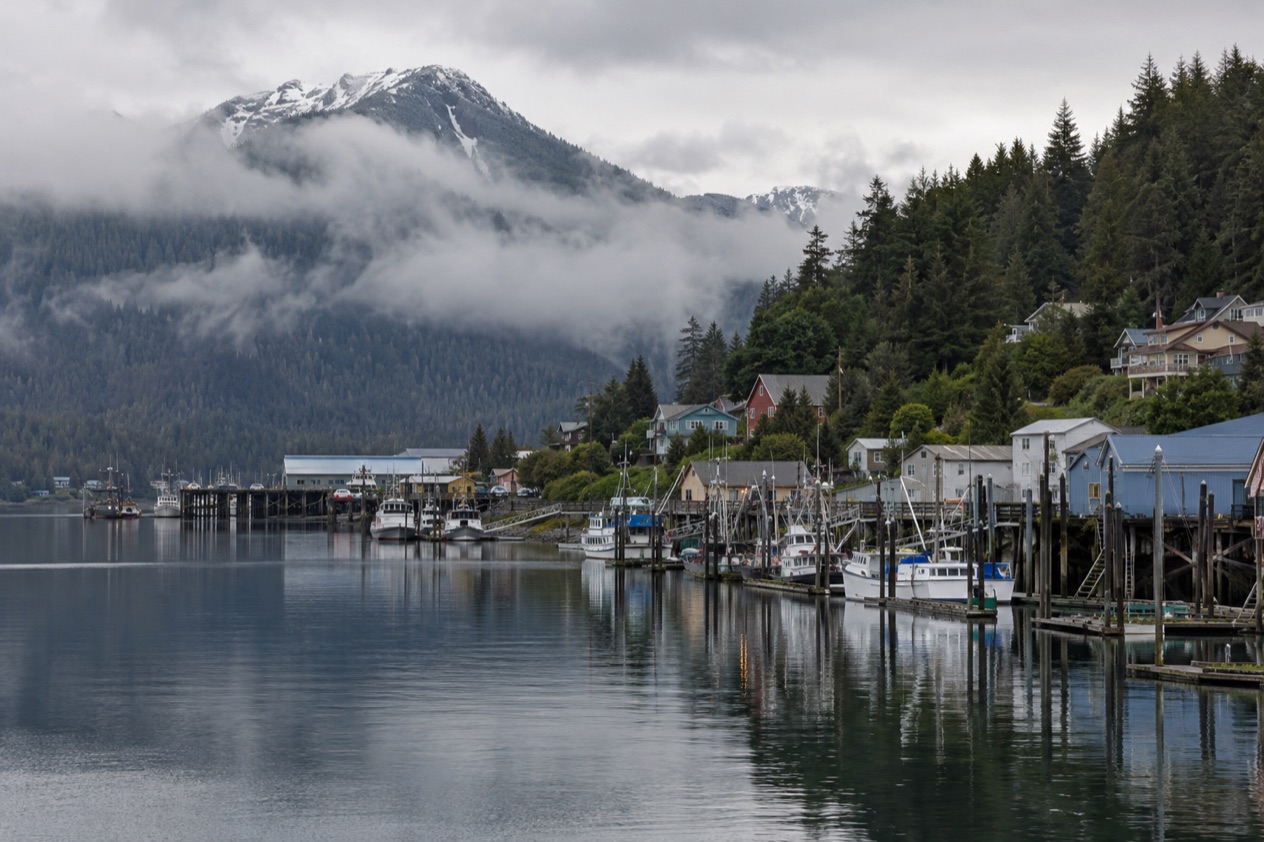
A jetboat idles at the Wrangell waterfront while a fishing boat unloads nearby, and the smell of salt and spruce drifts over the docks. Behind the town the forest climbs straight up from the shoreline, and the Stikine River pours its silty water into the strait just beyond.
Wrangell is a working Southeast Alaska town on an island, with Tlingit history carved into its beaches and a wild river at its doorstep. It suits travelers who like their destinations quiet and tied to the water and the woods.
Where is Wrangell and what is it like?
Wrangell sits on the northern tip of Wrangell Island in the Alaska Panhandle, 155 miles south of Juneau, and it is a small island town built around the water. It belongs to Southeast Alaska, a region of islands, fjords and glaciers that reaches along the coast between the Gulf of Alaska and the Canadian border. The land around the town lies inside the Tongass National Forest, and a ranger district office of the Forest Service is based in Wrangell itself.
The character of the place comes from its setting. Wrangell has no sprawling resort strip and no row of glossy shops built for crowds. Streets run along the harbor, boats come and go through the day, and the horizon is a wall of dark evergreen forest and mountain. The pace is that of a town where people fish, work the water and know their neighbors, and a visitor quickly slips into the same rhythm.
The Stikine River shapes the landscape and the town’s story. It is known as the fastest-flowing navigable river in North America, and it drains into the Inside Passage near Wrangell after crossing from British Columbia into Alaska.
For centuries the river was a route between the coast and the interior, and the Tlingit people lived and traveled here long before outsiders arrived. That deep history is still visible in the carved stones along the shore.
Wrangell rewards people who enjoy places that ask for a little curiosity. If you want nightlife, a long list of attractions or a boardwalk lined with souvenir stands, the town will feel quiet.
If you like walking a waterfront, reading a beach for its petroglyphs, heading out on a river by jetboat or paddling a coastal inlet, it feels exactly right. Southeast Alaska’s larger cities, Juneau, Sitka and Ketchikan, are the names travelers know first, and Wrangell offers a calmer alternative to them.
What is there to do in Wrangell?
The big reasons to come are the ancient carvings on the beach, the Stikine River, the coastal forest and the paddling that goes with it. Each one is about being outdoors and close to the water, which is what sets Wrangell apart from its neighbors. Here the day revolves around the river, the shoreline and the trees rather than around a cruise-ship strip.
Petroglyph Beach
Petroglyph Beach lies just north of Wrangell and holds numerous petroglyphs, carved images that attest to the long Tlingit presence in the area. You walk along a shore of rocks and tidewater and look for the designs pecked into the stone, spirals, faces and shapes that suggest animals and sea creatures. Finding them is part of the experience, since they sit among ordinary beach boulders and reveal themselves slowly.
This is a place to go with patience and a quiet mind. Look rather than touch, and let the setting do the work: the water close by, the forest edge behind, the sense that people have stood on this same shore for a very long time. It suits anyone curious about Native history, photographers who like textures and details, and families who enjoy a treasure hunt on a beach.
The Stikine River by jetboat or on the water
The Stikine River flows from northern British Columbia through southeastern Alaska, a journey of 379 miles, and single-day jetboat and kayak tours of its lower stretch operate out of Wrangell. That makes the river reachable in a single outing, so you can see its braided channels, mountain walls and forested banks without committing to an expedition. The river’s reputation as the fastest-flowing navigable river in North America gives the day an edge of drama.
For those who want more, the 167-mile section from Telegraph Creek down to Wrangell is a canoe and raft trip of 7 to 10 days, rated Class I to II with only a few small rapids. It is a real multi-day journey, one that ends in the town where you started to feel the river’s pull. Day trippers and long-haul paddlers alike find the Stikine a worthy centerpiece for a Wrangell stay.
Kayaking, hiking and the coastal forest
Wrangell offers guided kayak tours in summer and access to coastal forest wilderness for hiking, camping and climbing. The Tongass National Forest, the largest national forest in the United States, wraps around the island with its islands, fjords, glaciers and peaks of the Coast Mountains. That means the places to wander begin almost at the edge of town.
A guided kayak outing lets you see the shoreline from water level, where the forest meets the tide line and the quiet is broken only by paddles and birds. On land, the forest invites you into moss, cedar and spruce. Choose paddling if you like gliding along a coast, and choose the trails and the camping if you want to settle into the woods for a longer stretch.
How many days do you need in Wrangell?
A long weekend covers the heart of Wrangell, and a few more days let you add the river properly. The town is compact in spirit and its main draws are few and focused, so you do not need a week to feel you have seen it. You do need to leave room, since weather and water shape what happens on any given day.
With a short stay, spend one morning at Petroglyph Beach, then wander the waterfront and the harbor in the afternoon. Save a second day for the Stikine, taking a single-day jetboat or kayak outing out of Wrangell. Those two days give you the carved history of the shore and a taste of the river that made the town matter. A third day can go to a guided kayak tour or to the forest edge.
With more time, the options widen. You can add hiking and camping in the coastal forest, or give yourself space for slow days around town when the clouds sit low and you would rather linger over coffee than head out. Wrangell suits unhurried travelers, and an extra day often feels more like a gift than a stretch.
The long option is the river itself. The lower Stikine from Telegraph Creek to Wrangell is a canoe or raft journey of 7 to 10 days, so anyone planning it builds the trip around the water rather than around the town.
Wrangell also pairs well with other Southeast towns. Alaska Airlines connects it with Seattle, Juneau, Ketchikan and Sitka, and the Alaska Marine Highway stops at its ferry terminal.
Where to stay in Wrangell
The Alaska Marine Highway ferry terminal has a dock near the Stikine Inn, so the area around the water is the natural starting point for anyone arriving by ferry. From there the town’s streets, shoreline and boat activity are close at hand.
Staying in town suits travelers who want to step out and feel the place: the harbor in the morning, the docks where tour boats and fishing boats come and go, the pull of the river just past the last buildings. It also keeps you near the departure points for the jetboat and kayak outings that make the area special, so a day on the water starts without a long trek first.
Petroglyph Beach lies just north of Wrangell, which makes the town side of the island a convenient base for visiting it. A traveler who wants the carved shore as a morning or evening visit will find that the north end of the island, where the town sits, keeps it in easy reach.
For travelers who prefer to go further into the wild, the forest and coast around Wrangell allow camping, as the area offers access to coastal forest wilderness for hiking, camping and climbing. That is a different kind of stay, one built around the outdoors rather than a bed in town, and it suits people who are comfortable in the woods and want the Tongass at their doorstep.
Wrangell is not a place with a resort district or a string of neighborhoods to choose between. The decision comes down to whether you want the comfort of the town and its harbor or the immersion of a night in the forest. Visitors will find the town the practical answer, and the wilderness a good extra for those who crave it.
How do you get to Wrangell and get around?
You reach Wrangell by air or by ferry, since it sits on an island in Southeast Alaska. Alaska Airlines provides twice daily service from Wrangell to Seattle, Juneau, Ketchikan, Sitka and other southeastern Alaska destinations. That makes the plane the link to the rest of the state and to the Lower 48 for travelers who want to arrive quickly.
The other way in is the Alaska Marine Highway, whose ferry system operates a terminal in Wrangell with a dock near the Stikine Inn. Arriving by water suits the setting, since the town’s story and its present-day life are tied to the sea routes of the Inside Passage. You step off the boat right into the waterfront.
Getting around is mostly about the water and the shoreline. The jetboat and kayak tours of the lower Stikine River leave from Wrangell, so the town itself is the launch point for the river. Petroglyph Beach lies just north of town, and the coastal forest begins where the streets end, so the places you will want to see are gathered close together around the north end of the island.
Southeast Alaska is a region of 35,138 square miles, and Wrangell is one of its island communities, so plan your travel as links in a chain of towns rather than as roads between them. Juneau lies 155 miles to the north, and the larger cities of the region, Juneau, Sitka and Ketchikan, are the other places you can reach through the same air and ferry connections.
When is the best time to visit Wrangell?
Summer is the season to aim for, because that is when Wrangell’s guided kayak tours operate. The same period suits the single-day jetboat and kayak outings on the lower Stikine River, the trips that give the town its main reason to visit. If your goal is to be on the water, summer is when the offerings are laid out for you.
Beyond the summer season, Wrangell shows a quieter face. Petroglyph Beach is a place to visit whenever you are in town, and the waterfront has its own character at any time of year. Still, the tours that bring visitors out onto the river and the coast are the thing that shapes a trip, so a visit outside summer is a different, more contemplative kind of stay.
Wrangell lies within the Tongass, a coastal forest of fjords and glaciers, and Southeast Alaska is known as a green, damp region. Bring that expectation with you at any time of year and pack for changeable skies, so that a cloudy day becomes a reason to linger rather than a disappointment. The forest and the river keep their appeal in gray light.
Long multi-day trips, like the canoe and raft journey of 7 to 10 days down the lower Stikine, are worth planning around the summer window as well, since they depend on the operators and conditions that make river travel possible. For anything on the water, the guided tours are where you will want to look first.
Good to know before you go
Wrangell is a small island town, so plan your arrival and departure around the flights and ferry sailings that connect it to the rest of Southeast Alaska. Guided kayak tours run in summer, and the single-day jetboat and kayak tours of the lower Stikine River leave from the town. Treat the water with respect, and let the local operators set the terms for any outing on the river or the coast.
Petroglyph Beach is a place of history, so look at the carvings with care and leave the shore as you found it. Come with an unhurried mind, a layer for changing weather and a taste for quiet places, and Wrangell will do the rest.
Sources
- Wikipedia, Wrangell, Alaska (https://en.wikipedia.org/wiki/Wrangell,_Alaska), checked October 11, 2026
- Wikipedia, Stikine River (https://en.wikipedia.org/wiki/Stikine_River), checked October 11, 2026
- Wikipedia, Southeast Alaska (https://en.wikipedia.org/wiki/Southeast_Alaska), checked October 11, 2026
- Wikipedia, Tongass National Forest (https://en.wikipedia.org/wiki/Tongass_National_Forest), checked October 11, 2026
- Wikipedia, Climate of Alaska (https://en.wikipedia.org/wiki/Climate_of_Alaska), checked October 11, 2026