
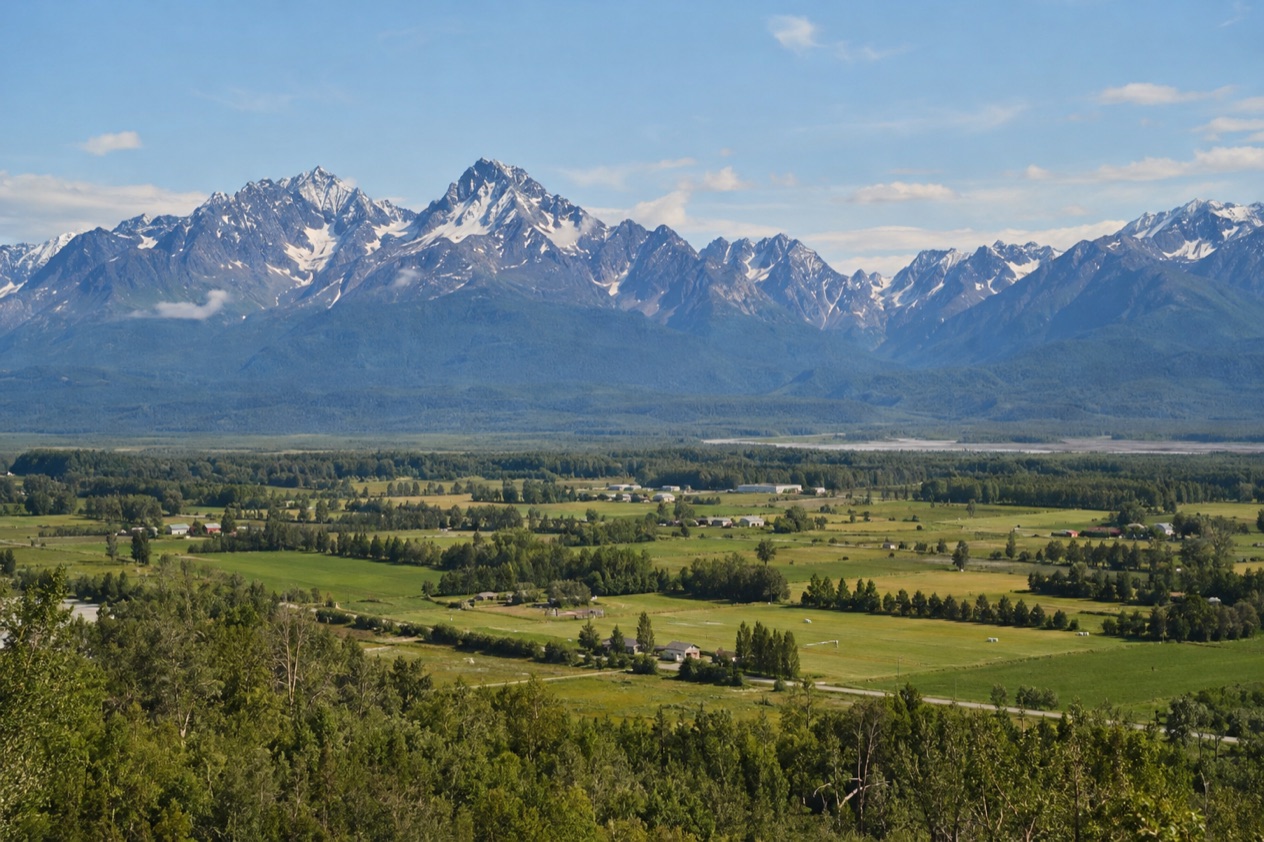
In Wasilla, sled dogs lift their heads from the dirt yards and bark at the first sign of cold, and on the Parks Highway the traffic pulls in for coffee before pushing on toward Denali. A few minutes away in Palmer, the old farm fields run up to the Chugach Mountains, and gardeners grow vegetables to sizes that make you laugh.
Together the two towns make a lived-in, working corner of the Mat-Su Valley. They suit travelers who want dog-mushing history, mountain passes, glaciers and farm-stand food within reach of Anchorage.
What are the best things to do in Wasilla and Palmer?
The best things to do here mix mushing culture, a high mountain pass, two big glaciers and the farm life that gave the valley its character. Most of it is spread along the Parks and Glenn Highways, so a day can easily hold three or four very different stops.
- Iditarod Trail Committee headquarters in Wasilla, for a close look at the race that defines the town and the dogs behind it.
- Hatcher Pass, where the road climbs into rugged peaks and the old gold-mining buildings of Independence Mine sit among them.
- The Alaska State Fair in Palmer, with its giant cabbages, live music and rides at the foot of the Chugach Mountains.
- Matanuska Glacier, a huge valley glacier you can reach by car and see from the roadside.
- Knik Glacier and Lake George, a wide ice field and a glacial lake that earned National Natural Landmark status.
- Palmer’s farm country and its colony history, a thread that runs from the 1930s settlers to today’s produce stands.
- Paddling the canoe trails of the Wasilla Lakes, Nancy Lakes and Meadow Creek, for quiet water and loon calls.
- Eklutna Native Historical Park on the way up from Anchorage, a place where Dena’ina history is still tended.
Wasilla is where you find the services and the sled-dog stories, while Palmer is the quieter, more handsome town, with its mountain backdrop and old colony buildings.
What you can do depends on the calendar for some things. The Alaska State Fair has its own late-summer dates, and the central part of the Hatcher Pass road is usually closed by snow for part of the year. The sections below give those seasons where they matter.
Sights and landmarks in Wasilla and Palmer
The landmarks of the Mat-Su Valley are modest in scale and large in story. Wasilla carries the weight of the Iditarod, Palmer carries the farming experiment of the 1930s, and the road between them passes fields, small lakes and mountain walls that make the stops feel connected.
Iditarod headquarters in Wasilla
The headquarters of the Iditarod Trail Sled Dog Race is in Wasilla, and it is the natural first stop for anyone curious about why dog yards line so many side roads here. The race runs from Willow through Rainy Pass in the Alaska Range, along the Bering Sea shore, to Nome, passing through places like Skwentna, McGrath and Unalakleet. Seeing the route laid out on a map makes the scale of it real.
Expect photographs of mushers, race memorabilia and talk of the rules that shape the race. Mushers must take three mandatory rests: a 24-hour layover at any checkpoint, an 8-hour layover at any checkpoint on the Yukon River, and an 8-hour stop at White Mountain. The ceremonial start takes place in downtown Anchorage, and the official restart is in Willow the day after, so Wasilla is where the race lives between those moments.
Independence Mine at Hatcher Pass
Independence Mine State Historical Park sits in Hatcher Pass near Palmer, surrounded by rugged peaks. The weathered mine buildings cling to the slope, and walking among them you get a feel for how hard and cold the work of hard-rock gold mining was. It is as much a mountain viewpoint as a history stop.
The pass itself has an elevation of 3,886 feet, and the road over it is unpaved and minimally maintained for about 20 miles. The central portion is usually closed by snow from late September to July, so the high stretch is a season-bound pleasure. Bring a camera and a sense of patience on the road, because the views tend to stop you every few minutes.
Palmer and the colony story
Palmer is the borough seat of Matanuska-Susitna Borough, and its streets still tell the story of the 1930s, when farmers settled the valley through a government project. Low colony-era buildings, church spires and neat blocks of storefronts sit under mountains that seem close enough to touch. A slow walk through the center is worth the time, with a stop at the old railroad depot area for a feel of how the colony was supplied.
Palmer also hosts the National Tsunami Warning Center, a quiet piece of science tucked into a farm town. You will not tour it as a sight, but it is a neat detail to carry around while you look at the fields and mountains. The Matanuska-Susitna Borough remains one of the few agricultural areas in Alaska, and that shows in every roadside stand.
Smaller stops around town
A few smaller places fill gaps in a day. In Wasilla, the old town center holds local history museums and the Dorothy Page Museum style of small-town exhibits about the early settlers, trappers and the railroad. In Palmer, the Colony-era houses and the farm museums tell the same story from the farmer’s side, and many of them are modest buildings that reward a few minutes each.
Eklutna Native Historical Park, reached from the Glenn Highway on the way up from Anchorage, is a place to see colorful spirit houses and hear the history of the Dena’ina people. It sits 9 miles south of the Glenn and Parks Highway junction, and the exit is a right turn on the southbound lane. For questions, the park lists a toll-free number, +1-866-EKLUTNA (3558862).
Outdoor things to do in Wasilla and Palmer
The outdoors here means mountain hikes, glacier views and quiet lakes, all within the reach of two small towns. The Mat-Su region contains 24 parks and more than 650,000 acres of land, so there is more to choose from than a single visit can hold.
Hiking near Wasilla
In summer, mountain hiking near Wasilla is available in Hatcher Pass, at The Butte, Lazy Mountain, Crevasse Moraine and Matanuska Glacier. Each has its own character. Hatcher Pass offers open alpine ground and big views, while Lazy Mountain and The Butte climb above the valley farms and let you see how the patchwork of fields fits between the ranges.
Crevasse Moraine is a different kind of walk, through ground shaped by ice, with the odd landforms that glaciers leave behind. Pick the trail by the view you want, and remember that mountain weather turns quickly, so layers belong in the pack.
Paddling the canoe trails
Canoeists can paddle the Wasilla Lakes canoe trail, the Nancy Lakes canoe trail and Meadow Creek near Wasilla. These are routes of small lakes linked together, where the pace is set by your paddle and the sounds are loons, wind in the spruce and the occasional splash. They suit people who like to travel slowly and look closely.
Lake water here is cold, so the point is the paddling and the scenery, not getting in. A dry day on the Nancy Lakes route can be a calm contrast to the highway miles behind it. Meadow Creek offers a flowing alternative to the still lakes.
Matanuska Glacier
Matanuska Glacier is a valley glacier 27 miles long and 4 miles wide, and it is the largest glacier accessible by car in the United States. It lies near the Glenn Highway in Glacier View, and the sight of that wall of blue and gray ice beside a highway is strange and wonderful. It flows about 1 foot per day, so it is always, slowly, remaking itself.
Stand back, look at the textures of the ice, and listen for the sound of meltwater running beneath it.
Knik Glacier and Lake George
Knik Glacier is on the northern end of the Chugach Mountains and averages over 25 miles long and over 5 miles across, which makes it one of the largest glaciers in southcentral Alaska. It feeds the Knik River, which empties into the Knik Arm section of Cook Inlet. The scale of the ice field is hard to take in until you see it.
Lake George, the glacial lake formed near the face of the glacier, was recognized as a National Natural Landmark by the National Park Service. People simply enjoy the glacier from a distance and the story of the river it feeds.
Day trips from Wasilla and Palmer
The day trips from Wasilla and Palmer point in all directions, toward glaciers, mountain passes, the Denali corridor and Anchorage itself. Distances from Anchorage give a sense of how the pieces fit.
| Place | Distance from Anchorage (miles) |
|---|---|
| Palmer | 42 |
| Wasilla | 43 |
| Knik Glacier | 50 |
| Matanuska Glacier | 100 |
Matanuska Glacier along the Glenn Highway
The Glenn Highway is the route to Matanuska Glacier, reached by taking the Glenn Highway north from Anchorage or south from its connection with the Tok Cutoff and Richardson Highway. The glacier lies near the road in Glacier View. Because it is the largest glacier in the country you can reach by car, the day has a clear goal, and the highway itself is part of the pleasure.
Go for the long views of ice, and let the drive through the valley fill the rest of the day. It suits travelers who want a big natural sight without a boat or a plane. Pair it with a stop in Palmer for lunch on the way back.
Hatcher Pass and Independence Mine
Hatcher Pass lies about 12 miles from Palmer and Wasilla, and it makes a day of mountains, old mine buildings and wide alpine views. The road is unpaved and minimally maintained for about 20 miles, and the central stretch is usually closed by snow from late September to July. That seasonal window shapes when this trip is possible.
Independence Mine State Historical Park is the anchor stop, set among rugged peaks. Pack layers and take your time, because the scenery slows everyone down. It suits hikers, photographers and anyone who likes a bit of history with their views.
Talkeetna and the Denali corridor
Wasilla is the last city of significant size on the Parks Highway northward, so it is the gateway to Denali National Park, Fairbanks and other points north. Talkeetna, one of the Mat-Su Valley towns, serves as a tourist hotspot and as the starting point for mountaineers who climb Denali. A visit there feels like a step toward the big mountains.
Denali State Park offers sweeping vistas, and it sits along the same corridor. If you are heading north anyway, Wasilla is a natural base for the first night. For a day trip, Talkeetna works as a small-town stop with a mountaineering flavor.
Eklutna and Anchorage
Going the other way, Eklutna Native Historical Park is on the road to Anchorage, and Anchorage itself is about an hour from Wasilla by car at the airport end. Nearly a third of Wasilla residents commute there for work each day in a 40-minute drive, so the cities are closely tied. That makes Anchorage an easy add-on for museums, shops and restaurants if you want a city day.
Eklutna is a good pause between the two, with its historic spirit houses and the story of the Dena’ina people. It suits travelers who want a cultural stop between a mountain day and a city evening.
What to eat in Wasilla and Palmer
Eating here starts with the soil, because the Matanuska-Susitna Borough is one of the few agricultural areas in Alaska. Roadside stands sell vegetables that grew under long summer days, and menus lean on what the valley farms and nearby waters give. The result is a plainer, fresher kind of Alaskan table than the tourist harbor towns.
Valley produce and farm stands
Cabbages, potatoes, carrots, lettuce, broccoli and berries are the staples of the valley’s farm stands. The Alaska State Fair displays world-record-sized cabbages and other vegetables every year, which is the joking proof of how well things grow in the long light. Buy what is in season and eat it the same day.
In Palmer, the colony history makes a market feel like the continuation of a long habit rather than a visitor attraction.
Salmon, halibut and Alaskan comfort food
Menus around Wasilla and Palmer often feature salmon and halibut, served grilled, smoked or in chowders and fish and chips. Reindeer sausage turns up at roadside carts, fair stalls and breakfast plates, and game meats appear in burgers and stews. It is hearty food meant for people who spend days outdoors.
Breakfast is a serious meal in Alaska, with sourdough pancakes, eggs, potatoes and strong coffee. Pair a big breakfast with a hike on Lazy Mountain or the canoe trails, and you will understand why portions are what they are.
Fair food, local beer and coffee
At the Alaska State Fair in Palmer, food stalls turn out fried treats, roasted corn, hot sandwiches and sweets, and the cabbage displays are the conversation piece. It is a fair in the old American sense, with farm pride and midway snacks side by side.
Outside the fair, small breweries, coffee stands and bakeries fill the towns. A drive-up espresso hut is a local institution along the Parks Highway, and a stop for a hot drink before the mountains is part of the rhythm.
Things to do in Wasilla and Palmer at night
Evenings in Wasilla and Palmer are quiet and unhurried, built around dinner, a drink and a slow drive rather than a nightlife scene. People gather in small restaurants, breweries and sports bars, and the long highway means lights are few and far between. That makes the night an easygoing counterpart to a busy day outdoors.
Dinner and a drink
Wasilla has the larger spread of restaurants, from diners to steakhouses to family places, and Palmer offers a quieter selection in its small downtown. A table by a window with mountains outside is often the best entertainment. Order the local fish or a plate of valley vegetables and linger.
Local breweries and taprooms make a relaxed place to end the day, with the talk usually about the trail, the glacier or the race. It is a conversational kind of night, and visitors are drawn in easily.
The fair after dark
During the Alaska State Fair, which runs for about 12 days in late August and early September, Palmer’s evenings change. Rides light up, music plays, and the grounds fill with families and farmers. It is the one time of year when Palmer feels like a lively night destination, with the Chugach Mountains darkening behind the midway.
Outside those days, the grounds are quiet. If your dates match, the fair evening is worth planning around, because it is the valley at its most social. Concerts, food and the sight of enormous vegetables under lights make for a good evening.
Quiet nights and open skies
Away from town lights, the Mat-Su Valley has dark, quiet roads and open views, and on a clear night you may sometimes see the aurora. That is a chance, not a promise, and it depends on sky and timing. Even without it, a walk beyond the streetlights shows more stars than most cities allow.
Travelers simply head to bed early, because mountain and glacier days are tiring. A lodge or cabin evening with a view and a warm drink is a perfectly good night out here.
Things to do in Wasilla and Palmer with kids
Children tend to love this area because the big things are easy to understand: sled dogs, giant vegetables, glaciers you can see from the car and farm animals. The valley gives them space to run and plenty to look at. Distances between stops are real, so plan around naps and snack breaks.
Sled dogs and the Iditarod
Wasilla is Iditarod headquarters, and kids who like animals will enjoy the dog culture. Hearing how mushers care for their teams, and how the race crosses Rainy Pass, the Yukon River and the Bering Sea shore to Nome, makes a good story for a car ride. Maps and race photographs help them picture the trail.
A talk about the mandatory rests, like the 24-hour layover, often fascinates children because it shows that the dogs come first. It turns a sports event into a lesson about teamwork.
The Alaska State Fair
The Alaska State Fair in Palmer is the family event of the valley, held at the foot of the Chugach Mountains in late August and early September. Children can see the giant cabbages and other record-sized vegetables, eat fair food and watch the midway lights come on. It is a place built for wandering with a snack in hand.
The Alaska Railroad operates a special train from Anchorage to Palmer only when the fair operates, though it did not operate in 2021.
Glaciers, lakes and farm country
Seeing Matanuska Glacier, a mass of ice that flows about 1 foot a day, is a hit with curious kids, especially when you explain that the whole thing is moving. It lies near the highway, so the viewing is part of a car trip. The sheer size of the ice makes an impression that lasts.
Keep children back from edges, water and steep ground, and remember that glacier and lake water is cold. The canoe trails of the Wasilla Lakes give older children a gentle chance to paddle and watch for birds. Bring layers, snacks and patience, because the highways are long.
Good to know before you go
Wasilla is roughly 43 miles by highway northeast of Anchorage via the George Parks Highway, and Ted Stevens Anchorage International Airport is about an hour away by car. Palmer sits on the Glenn Highway, so most of what you do here depends on a vehicle. Some mountain roads, like the central part of Hatcher Pass, close by season, and the Alaska State Fair has its own late-summer dates.
Wasilla is the larger town for services and Palmer the more picturesque one, and the Mat-Su Valley also includes Big Lake, Houston, Willow, Sutton and Talkeetna. Plan stops along the Parks and Glenn Highways with the seasons in mind, and keep the Hatcher Pass road in mind as a summer pleasure.
Sources
- Wikivoyage, Wasilla (https://en.wikivoyage.org/wiki/Wasilla), checked October 11, 2026
- Wikipedia, Wasilla, Alaska (https://en.wikipedia.org/wiki/Wasilla,_Alaska), checked October 11, 2026
- Wikipedia, Palmer, Alaska (https://en.wikipedia.org/wiki/Palmer,_Alaska), checked October 11, 2026
- Wikipedia, Mat-Su Valley (https://en.wikipedia.org/wiki/Mat-Su_Valley), checked October 11, 2026
- Wikivoyage, Matanuska-Susitna Borough (https://en.wikivoyage.org/wiki/Matanuska-Susitna_Borough), checked October 11, 2026
- Wikipedia, Matanuska-Susitna Borough, Alaska (https://en.wikipedia.org/wiki/Matanuska-Susitna_Borough,_Alaska), checked October 11, 2026
- Wikipedia, Matanuska Glacier (https://en.wikipedia.org/wiki/Matanuska_Glacier), checked October 11, 2026
- Wikipedia, Hatcher Pass (https://en.wikipedia.org/wiki/Hatcher_Pass), checked October 11, 2026
- Alaska State Parks, Mat-Su region (https://dnr.alaska.gov/parks/aspunits/matsu/matsuindex.htm), checked October 11, 2026
- Wikipedia, Alaska State Fair (https://en.wikipedia.org/wiki/Alaska_State_Fair), checked October 11, 2026
- Wikipedia, Knik Glacier (https://en.wikipedia.org/wiki/Knik_Glacier), checked October 11, 2026
- Wikipedia, Iditarod Trail Sled Dog Race (https://en.wikipedia.org/wiki/Iditarod_Trail_Sled_Dog_Race), checked October 11, 2026
To plan your stay
- Best Time to Visit Wasilla and Palmer: Summer Daylight, the State Fair, Weather and Seasons
- Where to Stay in Wasilla and Palmer: Parks Highway Base, Farm Country and Valley Towns
- Wasilla and Palmer in January: Weather, Daylight, Northern Lights and Winter Outings
- Wasilla and Palmer in February: Weather, Northern Lights Chances and Things to Do