
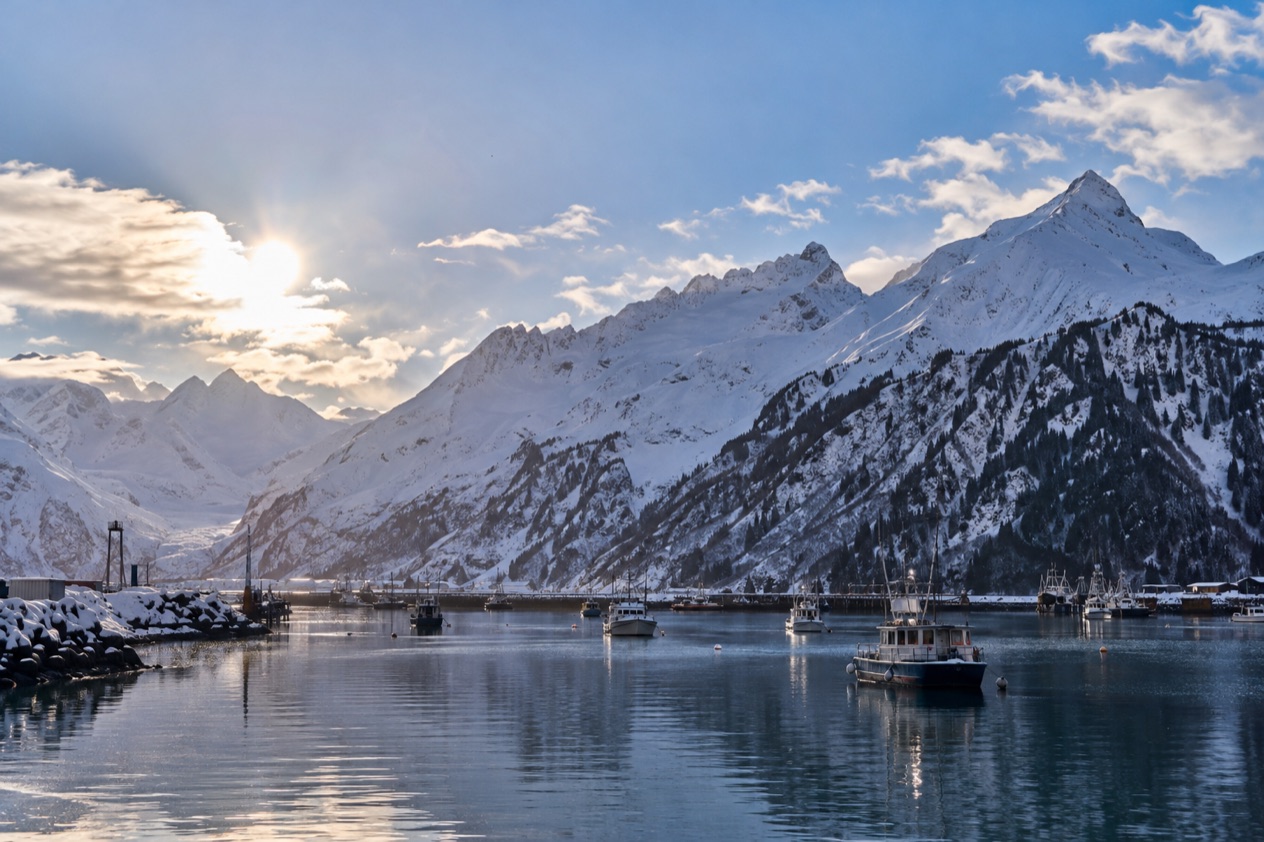
In March, Valdez still sits under a deep, soft layer of snow, and the plowed banks along the streets rise higher than a parked car. The mountains around the harbor catch the low sun and turn pink and gold at the edges of the day, and the sound of boots squeaking on cold snow carries across the town.
It is a month when winter is still fully in charge but the evenings have started to stretch. For travelers who like snow, big mountain scenery and a small port town on its own terms, this is a quiet and striking time to come.
What is the weather like in Valdez in March?
March in Valdez is cold, snowy and getting brighter: afternoons hover just above freezing, nights drop well below it, and snow is far more likely than rain.
| Month | Average high (°F) | Average low (°F) | Precipitation (in) | Days with precipitation | Daylight on the 15th |
|---|---|---|---|---|---|
| February | 31.9 | 21.4 | 5.92 | 10.5 | 8 h 58 min |
| March | 36.7 | 23.0 | 4.10 | 8.8 | 11 h 38 min |
| April | 46.4 | 31.9 | 3.37 | 8.2 | 14 h 36 min |
Daytime in March is the pleasant part. On a calm afternoon with sun on the snow, a warm coat is often enough, and you can stand outside at the harbor without hurrying back in. Mornings and evenings are another matter, because the temperature slides well below freezing once the sun leaves the valley. Layers you can add and remove are the sensible approach.
Precipitation comes on about every third day, and in this month it mostly falls as snow, around 45.8 inches over the month. That means fresh powder on the streets, soft flakes in the harbor lights and the occasional gray day when the peaks disappear behind cloud. Waterproof outer layers matter more than an umbrella, and the glare off new snow on a clear day can be strong.
The light is what changes most. Days have grown by almost three hours since February, so you can plan a full outing and still be back before dark. Evenings have started to linger, which makes a late walk or an after-dinner look at the sky much more realistic than it was a few weeks earlier.
What to do in Valdez in March
March in Valdez is about winter scenery at a pace you can enjoy: snowy mountains, a working harbor, a highway that climbs through some of the snowiest country in the nation, and, with a little luck, a night sky that glows. Valdez is described as the snowiest city in the United States, with well over 300 inches in a year, and in March you can see why. Snowbanks line the roads, rooftops carry thick white caps, and the Chugach peaks look close enough to touch.
The town itself is small and easy to read. You can spend a morning wandering the streets near the harbor, watching boats and gulls, stopping in a café for something hot, and looking up at the mountains that wall the town in.
Valdez is also the northernmost port in North America that stays ice-free year-round, which gives the waterfront a working feel even in the depths of winter. Fishing boats, cargo and the long industrial story of the port are part of the scene.
Valdez sits at the southern end of the Trans-Alaska Pipeline System, and that fact shapes the town’s identity as much as its scenery does. The harbor is a place to watch the cold light change on the water and the mountains rather than a place to linger on a beach. Dress for standing still, because the best views are often the ones that make you stop.
Worthington Glacier and the Richardson Highway
The ice covers 5,774 acres and was listed as a National Natural Landmark in 1968, which tells you something about how much this one matters to people who study glaciers. In March the whole landscape around it is under snow, and the blue-white tongue of ice blends into the mountain slopes.
What you see is a wide, tilted sweep of ice framed by dark rock and fresh white slopes. On a clear day the contrast is dramatic, and on a gray day the glacier softens into the cloud and the mood becomes quiet and stark. Either way, it is a place for standing, looking and taking photographs, with a thermos of something hot if you have one.
The drive itself is part of the outing. The Richardson Highway is the only road into Valdez, and it passes through Keystone Canyon and over Thompson Pass on its way out of town. It was the first major road built in Alaska, and today the stretch near Valdez is a procession of steep, snow-loaded mountainsides. Leave room in the day for stopping to look, because the views change with every bend.
Thompson Pass and the Keystone Canyon corridor
Keystone Canyon is the narrow gateway out of Valdez, where rock walls close in on the highway and frozen waterfalls can hang off the cliffs in cold spells. Further along, the road climbs to Thompson Pass, a high, open stretch of mountain country that is famous among skiers and snowboarders for its deep snow. In March, the pass looks like a landscape of pure white, with peaks standing sharp against a pale sky.
You do not need to ski to enjoy it. The appeal is the scale: wide snowfields, glacier-carved valleys and weather that can change quickly, with clear spells followed by drifting cloud. Pull-outs and viewpoints give you places to take in the view, and the light in March, lower and softer than in summer, is generous to photographers.
Keep the day flexible, because mountain weather sets the rhythm here. A clear window is a gift, and a snowy afternoon turns the whole scene into a moving, quiet world of its own.
Prince William Sound from the waterfront
Prince William Sound is the great body of water that Valdez looks onto, and Valdez is its largest port. From the waterfront, you take in a seascape of mountains falling into dark water, with snow descending nearly to the shoreline. Other settlements on the sound include Cordova, Whittier and the Alaska Native villages of Chenega and Tatitlek, a reminder of how much of this region is reached by water rather than road.
In March, the sound is a place to watch rather than to play on. The cold air makes the view crisp, and on clear days the far mountains show every ridge. Wildlife may show up along the shore or over the water, but treat any sighting as a chance, not a plan. A slow stroll along the harbor, with stops for a hot drink, is a fine way to take it in.
The northern lights in March
The Northern Lights oval covers most of Alaska, and March sits inside the season. Around Anchorage, the lights are active from late September through the middle of April. Researchers at the University of Alaska Fairbanks also note that auroral activity tends to be stronger around the equinoxes, and the spring equinox falls in March, which gives the month a statistical edge over midwinter.
None of this is a promise. The aurora needs clear skies and some solar activity, and a cloudy stretch can shut the show down for days. Treat a glow in the sky as a bonus, and dress as though you might be outside for a while if the sky opens up, since the cold bites when you stand still.
Valdez winters bring plenty of cloud and snow, so the lights are a chance rather than a plan. If you do get a clear night, step away from street lamps and let your eyes adjust, because the faint green arcs are easiest to see when the sky is truly dark.
A two-day itinerary for Valdez in March
Day 1 is for the town and the harbor. Start the morning with a hot breakfast at a local café, then walk to the waterfront while the light is still low and the mountains are tinted pink.
Spend the late morning along the harbor, watching the boats and the working port, and look up at the peaks that surround the town. Lunch can be a simple bowl of soup or a seafood plate at a harbor-side restaurant, the kind of place where boots are left by the door.
In the afternoon, when the day is at its warmest, walk the streets of the town and take in the snowbanks, the church and the small shops. If a gray, snowy spell sets in, the rain card is a museum visit or a long café stop, with a view of the weather outside. As evening falls, have dinner in town, and if the sky is clear, step outside for a look at the stars and any hint of aurora.
Day 2 belongs to the Richardson Highway. Set out after a good breakfast, early enough to have the whole bright part of the day, and head through Keystone Canyon toward Thompson Pass, stopping at pull-outs to admire the snowfields and frozen cliffs. Continue to Worthington Glacier at milepost 28.7 and spend time at the viewpoint, letting the scale of the ice sink in.
Pack a lunch or a thermos so you can linger in the mountains, and turn back toward Valdez in the afternoon while the light is still good. If the weather closes in on the pass, shorten the outing and spend the rest of the day with a hot drink back in town. Finish the evening with a warm dinner and another look at the sky.
Is Valdez busy in March?
March in Valdez feels like a winter month, and the pace of the town follows the snow and the short days rather than a summer rush. With one road in, the Richardson Highway, and a port that stays open through the cold, the town keeps working through the season.
What you notice most is space: quiet streets, a harbor with a working rhythm and mountain viewpoints you may have largely to yourself. Daylight is lengthening, so mornings and afternoons feel more usable than in midwinter. Expect the day to be shaped by the weather, and let the town’s small scale set the mood.
What to pack for Valdez in March
March days hover near freezing, nights are colder, and snow is the usual form of precipitation, so pack for standing outside in the cold.
- A warm, insulated coat, because afternoons are cold and evenings colder.
- Waterproof, insulated boots, for snowy streets and viewpoints.
- Warm layers, such as fleece and thermal tops, to add or remove through the day.
- A hat and gloves, since you will be standing still for views and for the sky.
- Sunglasses, to cut the glare when sun hits fresh snow.
- A thermos, for the long stops at the glacier and the pass.
Good to know before you go
The Richardson Highway is the only road to Valdez, and it crosses Thompson Pass and runs through Keystone Canyon, so the mountains decide how and when you arrive and leave. Winter conditions can shift quickly in the mountains, so build a little flexibility into each day.
Valdez in March vs February and April
Going four weeks earlier brings a colder, snowier Valdez with much shorter days. February has more precipitation and more snow, and the light is thin, so outings are shaped tightly around the middle of the day. If you want the deepest winter mood and do not mind the dark, February delivers it.
Going four weeks later brings a noticeably softer month. April days are warmer and much longer, with less snow falling and more time to be outside, though the mountains are still wintry. The Northern Lights season around Anchorage runs to the middle of April, but the lengthening light makes a dark sky harder to find as the month goes on.
Choose February if you want the full snow-globe feel and are happy with short days. Choose April if daylight and milder afternoons matter most. March sits in between, with real winter scenery, a good span of daylight and the spring equinox bringing a lift to the aurora chances.
Is March a good time to visit Valdez?
Yes, March is a good time to visit Valdez for travelers who love snow, big mountains and quiet places, and less so for anyone hoping for mild weather or open-water outings.
It suits photographers, winter-landscape lovers and anyone drawn to the drive over Thompson Pass to Worthington Glacier. It also suits people who like the idea of a small working port in the snow, with the chance of an aurora on a clear night. It is a poor match for anyone who wants warm afternoons, long evenings or a busy summer atmosphere.
On arrival, start with the harbor and a slow walk around town to get your bearings and see how the weather is behaving. Then use the first clear window for the highway and the glacier. March in Valdez is a month of snowbanks, low gold light on the peaks and a town that is quietly itself.
Sources
- NOAA NCEI, U.S. Climate Normals 1991-2020, monthly (https://www.ncei.noaa.gov/access/services/data/v1?dataset=normals-monthly-1991-2020&stations=USW00026442), station Valdez Wso, elevation 95 feet, checked October 11, 2026
- Computed from the date and the latitude of the place (sunrise equation, solar elevation -0.833 degrees), October 11, 2026
- University of Alaska Fairbanks Geophysical Institute, Aurora forecast (https://www.gi.alaska.edu/monitors/aurora-forecast), checked October 11, 2026
- Wikivoyage, Northern lights (https://en.wikivoyage.org/wiki/Northern_lights), checked October 11, 2026
- Wikipedia, Aurora (https://en.wikipedia.org/wiki/Aurora), checked October 11, 2026
- Visit Anchorage, northern lights viewing (https://www.anchorage.net/winter/things-to-do/northern-lights-viewing/), checked October 11, 2026
- Wikipedia, Valdez, Alaska (https://en.wikipedia.org/wiki/Valdez,_Alaska), checked October 11, 2026
- Wikipedia, Worthington Glacier (https://en.wikipedia.org/wiki/Worthington_Glacier), checked October 11, 2026
- Wikipedia, Richardson Highway (https://en.wikipedia.org/wiki/Richardson_Highway), checked October 11, 2026
- Wikipedia, Prince William Sound (https://en.wikipedia.org/wiki/Prince_William_Sound), checked October 11, 2026
- Wikipedia, Whittier, Alaska (https://en.wikipedia.org/wiki/Whittier,_Alaska), checked October 11, 2026
- Wikipedia, Climate of Alaska (https://en.wikipedia.org/wiki/Climate_of_Alaska), checked October 11, 2026
To plan your stay
- Things to Do in Valdez: Glaciers, Thompson Pass, Prince William Sound and Local Seafood
- Where to Stay in Valdez: Town Center, Richardson Highway, Glacier Lake and How to Choose
- Valdez from Anchorage: the Richardson Highway, Thompson Pass and Worthington Glacier
- Best Time to Visit Valdez: Weather by Month, Seasons and Festivals