
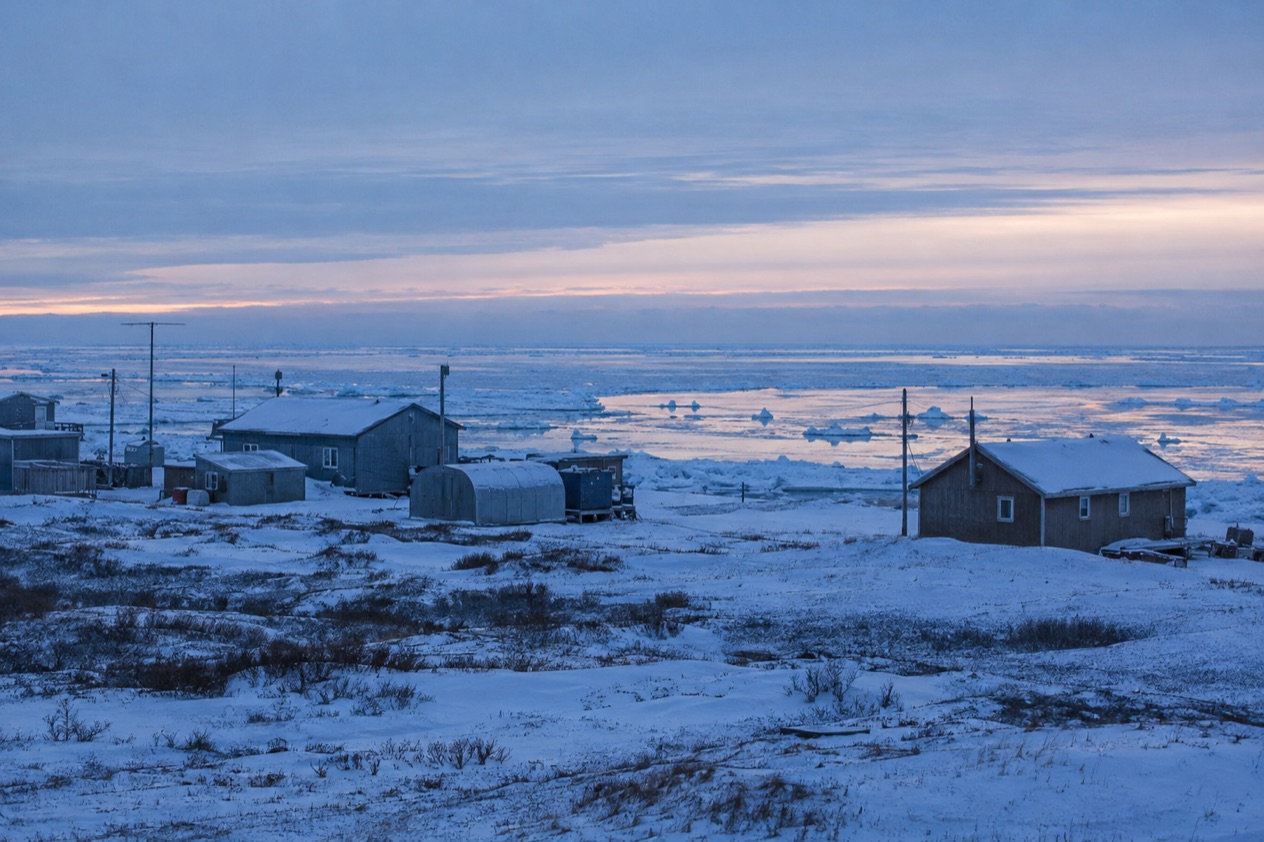
In November the sun at Utqiagvik barely lifts above the tundra before it slides away again, leaving a long pink and blue dusk over the frozen edge of the Chukchi Sea. Snow squeaks underfoot, engines idle outside the shops, and the town of Iñupiat families and Arctic workers settles into the dark months. This is the northernmost city in the United States, and November is the month when it tips toward polar night, a quiet and starkly beautiful time for travelers who come for the cold itself.
What is the weather like in Utqiagvik in November?
November in Utqiagvik is deep winter: bitterly cold, mostly dry, and dim for all but a few hours of the day.
| Month | Average high (°F) | Average low (°F) | Precipitation (in) | Days with precipitation | Daylight on the 15th |
|---|---|---|---|---|---|
| October | 25.6 | 16.8 | 0.54 | 1.2 | 9 h 01 min |
| November | 11.5 | -0.1 | 0.37 | 0.7 | 2 h 54 min |
| December | -0.4 | -12.2 | 0.22 | 0.4 | None (polar night) |
Even the warmest part of a November afternoon stays well below freezing, and nights drop under zero. Little precipitation falls, and what does arrives as snow, with about 7.8 inches over the month. Because it is so cold and dry, the snow tends to be fine and dusty, and it can blow across open ground in the wind, so a clear day may still feel like a ground blizzard at street level.
The light is the real calendar here. Mid-month brings only a few hours between sunrise and sunset, and even those hours are mostly low, slanting twilight rather than bright day.
Mornings begin in the dark, the middle of the day is a soft glow along the horizon, and by midafternoon the streetlights are doing the work. The shortening is fast: a month earlier the day was long, and a month later the sun does not rise at all.
For the traveler this means dressing for the cold first and the weather second. Insulated layers, a windproof outer shell, warm boots and covered hands and face matter far more than rain gear, since rain is not the issue. Plan outdoor time for the brightest hours, keep sessions outside short enough that you can warm up indoors, and expect phones and cameras to drain quickly in the cold.
What to do in Utqiagvik in November
What you do in Utqiagvik in November is mostly about the Arctic itself: the light, the cold, the ice and the community that lives with them. There is no long list of sights to tick off. The town of about 5,000 people is the largest U.S. settlement north of the Arctic Circle, and a visit here is a way to see how a northern town carries on through the darkening months.
The place is on the North Slope, the region along the Chukchi Sea and the Beaufort Sea. Except for the highway connecting Fairbanks to Prudhoe Bay, the North Slope is cut off from the rest of Alaska’s road system, and it relies mostly on waterways and small airports. That isolation is part of what you feel on the ground: a town at the edge of the map, with its own rhythm.
The last light and the first polar night
November is the month to watch the sun leave. Each day the twilight is shorter, and the horizon glows in soft rose, peach and steel blue for the few hours when the sun is up or just below the edge of the world. Walk out toward the open tundra or the shore in that window and the flat landscape turns into a wide painted band, with the town lights behind you.
Polar night is when the sun stays below the horizon for more than a day, and at Utqiagvik it lasts 68 days. By December the sun no longer rises, so November is your chance to catch the final rhythm of day and night before that long darkness takes over. It is a good month for people who like the idea of being there at the turning point.
Aurora chances and the long dark sky
With so much darkness, November skies open a window for the aurora. The northern lights oval covers most of Alaska, and the aurora season in the Interior runs from late summer into April. The lights are a chance, never a promise: they depend on solar activity and on clear skies, and clouds can hide even a strong display.
If the sky does clear, step away from the brightest streetlights and give your eyes time to adjust. Dress as though you will stand still for a while, because watching the sky means not moving. Some nights bring only a faint gray-green arc, others a band that shifts and folds. People simply check the sky now and then through an evening and are glad of any glimpse.
Iñupiat community life and traditions
Utqiagvik is an Iñupiat town first, and the culture is what gives the place its depth. The Iñupiat live in villages across the North Slope and beyond, and the Iñupiaq language is spoken by only a small share of the people today, mostly elders, which makes language and storytelling precious. Traditional foods such as caribou and whale remain central to Iñupiat life, and the sharing of food is part of how the community holds together.
In late November the American Thanksgiving falls, and in a community like this gatherings and shared meals are part of the season. As a visitor, the most respectful approach is to be a quiet guest: ask before photographing people, and follow the lead of those you meet. Time in town is as much about listening as seeing, and a conversation at a counter or a store can tell you more than any sign.
The frozen coast and the edge of the town
In November the sea along the coast is turning to ice, and the shoreline looks like a rough white field running off to the horizon. Instead you stand at a distance and take in the stillness, the pressure ridges of ice and the wind. Keep your hands covered, since the cold bites quickly when the air moves.
Back in town, the streets are wide and the buildings low, with snowbanks and trucks, and the feel is of a working place rather than a resort. Warm up in a shop or café and watch the town go about its day. Because the daylight is brief, the best outings are built around the middle of the day and then folded into long evenings indoors.
A two-day itinerary for Utqiagvik in November
Day 1 is for the light and the shore. Sleep in if you like, since the morning is dark, and plan your outdoor time for the brief bright window in the middle of the day. Dress in full layers, walk toward the coast and look out over the ice and the horizon glow while the sky holds its color. Keep the outing modest, then retreat somewhere warm.
In the afternoon, as the sky dims, settle into town: a long lunch or a hot drink at a local café, a stop at a store to see what an Arctic town stocks, and a slow walk through the streets while the lights come on. Dinner is a simple meal in town, and the evening is for stepping out once or twice to check the sky for the aurora, if it is clear.
Day 2 moves to people and place. Spend the late morning on the cultural side of the visit, wherever you can learn about Iñupiat life, from the language to the foods and crafts that anchor the community. Then use the midday light for a second look at the open tundra edge of town, with a different view from the day before, and keep your time outside short.
If the weather turns, with wind lifting the snow and visibility dropping, stay indoors with a long meal, a book or conversation, and wait for the air to clear. Evenings are another chance for the sky, so finish with a last look up before bed.
Is Utqiagvik busy in November?
November is a quiet month in Utqiagvik, the season when the town turns inward as the sun fades and the cold sets in.
The long days of summer, when polar day lasts 84 days and Prudhoe Bay draws visitors for the tundra and the midnight sun, are far behind. In November the pace is that of a community in winter, and what you notice most is space: empty streets in the dark hours, a few trucks, and a sense of calm. Getting here means relying on small airports, as the North Slope is not linked to the rest of the state by road, so the town does not fill with casual drive-through traffic.
What to pack for Utqiagvik in November
Pack for cold and dark rather than for rain or sightseeing days. Everything you carry should help you stay warm for short stretches outside and comfortable in between.
- An insulated parka and a windproof shell, since afternoons stay far below freezing.
- Insulated boots with warm socks, for snow and ice underfoot.
- Warm gloves plus liners, because cameras and phones need bare hands at times.
- A hat, a face covering and a neck gaiter for the wind.
- Thermal base layers for long stretches outdoors on aurora nights.
- A headlamp or small flashlight for the dark mornings and evenings.
- Spare batteries, since the cold drains them fast.
Good to know before you go
The main thing to plan around in November is daylight, which is brief and shrinking. Schedule outdoor time in the middle of the day and leave mornings and evenings for indoor plans.
Getting to Utqiagvik means using the North Slope’s small airports, because apart from the Dalton Highway to Prudhoe Bay the region is not connected to the state’s road system. Thanksgiving falls late in the month, so expect the town’s rhythm to shift around it.
Utqiagvik in November vs October and December
Move the trip four weeks earlier and you get a very different light: October still has a long day, with more than nine hours of daylight in mid-month, and the air is cold but not yet extreme. The shoreline is still in transition, and there is more time to be outdoors in actual daylight. It suits travelers who want to see the town and tundra in a fuller light before winter closes in.
Move four weeks later and the sun is gone altogether. December is the polar night, colder than November, with the sky dark around the clock and the aurora as the main show when it is clear. It suits people who want that total darkness and are ready for the deepest cold.
November sits between the two, with a last sliver of day and the first cold of the dark months. Choose October for light and a gentler chill, December for full polar night, and November for the moment of change.
Is November a good time to visit Utqiagvik?
Yes, November is a good time for travelers who want the Arctic at its most dramatic transition, and a poor one for anyone who wants long days outdoors or milder weather.
It will suit those who love deep cold, big skies and quiet, who are happy to spend part of every day indoors, and who would like a chance at the aurora. Photographers and anyone curious about life at the top of the country will find a lot here. It is less suited to people who need daylight to feel comfortable or who want a full schedule of outings.
On arrival, head out in the first bright window to see the glow on the horizon and get your bearings, then settle in for the evening. Stay warm, move slowly and take the time to talk with people in town.
Sources
- NOAA NCEI, U.S. Climate Normals 1991-2020, monthly (https://www.ncei.noaa.gov/access/services/data/v1?dataset=normals-monthly-1991-2020&stations=USW00027502), station Barrow Post Rogers Ap, elevation 31 feet, checked October 11, 2026
- Computed from the date and the latitude of the place (sunrise equation, solar elevation -0.833 degrees), October 11, 2026
- University of Alaska Fairbanks Geophysical Institute, Aurora forecast (https://www.gi.alaska.edu/monitors/aurora-forecast), checked October 11, 2026
- Wikivoyage, Northern lights (https://en.wikivoyage.org/wiki/Northern_lights), checked October 11, 2026
- Wikipedia, Aurora (https://en.wikipedia.org/wiki/Aurora), checked October 11, 2026
- Visit Anchorage, northern lights viewing (https://www.anchorage.net/winter/things-to-do/northern-lights-viewing/), checked October 11, 2026
- Wikipedia, Polar night (https://en.wikipedia.org/wiki/Polar_night), checked October 11, 2026
- Wikipedia, Midnight sun (https://en.wikipedia.org/wiki/Midnight_sun), checked October 11, 2026
- Wikipedia, Alaska North Slope (https://en.wikipedia.org/wiki/Alaska_North_Slope), checked October 11, 2026
- Wikipedia, Inupiat (https://en.wikipedia.org/wiki/Inupiat), checked October 11, 2026
- Wikipedia, Prudhoe Bay, Alaska (https://en.wikipedia.org/wiki/Prudhoe_Bay,_Alaska), checked October 11, 2026
- Wikipedia, Arctic Circle (https://en.wikipedia.org/wiki/Arctic_Circle), checked October 11, 2026
- Wikipedia, Climate of Alaska (https://en.wikipedia.org/wiki/Climate_of_Alaska), checked October 11, 2026