
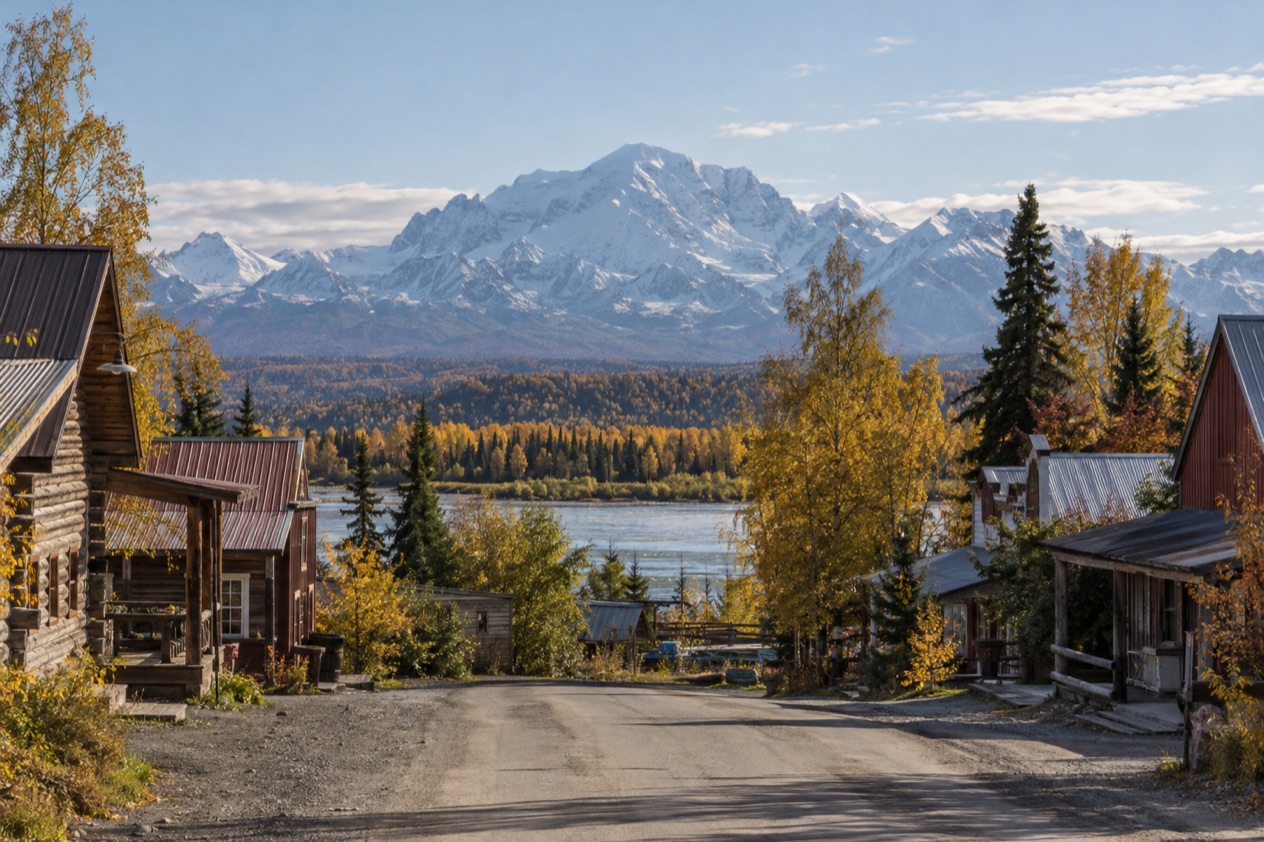
In September the cottonwoods and birches around Talkeetna start to turn yellow, woodsmoke drifts over Main Street in the cool mornings, and the clouds sometimes lift off the Alaska Range to show Denali. The summer rush is thinning, the evenings are getting dark enough for stars again, and the town settles into a slower rhythm. It is a month for walking a small historic district, sitting by a river, and watching the season change.
What is the weather like in Talkeetna in September?
September in Talkeetna is cool and fairly damp, with crisp mornings, mild afternoons at best, and a rainy day roughly one day in three.
| Month | Average high (°F) | Average low (°F) | Precipitation (in) | Days with precipitation | Daylight on the 15th |
|---|---|---|---|---|---|
| August | 65.1 | 47.9 | 4.70 | 10.2 | 16 h 10 min |
| September | 56.0 | 39.0 | 4.48 | 9.7 | 13 h 06 min |
| October | 41.8 | 26.5 | 2.78 | 7.0 | 10 h 07 min |
Mornings start close to freezing, so the first coffee is best drunk with gloves still on. By afternoon the air warms into the mid-50s, which feels pleasant in the sun and sharp the moment a cloud covers it. Evenings cool off fast once the light fades.
Rain tends to arrive as soft, steady showers or gray, drizzly spells rather than a single dramatic storm, and some of what falls can be melted snow. The weather often changes in the course of a day, so a dry morning can turn wet by mid-afternoon and clear again by dusk. Layers and a waterproof shell matter more than any single heavy coat.
The light is the real change from summer. Mornings are slower to brighten, which is good news for anyone who likes to sleep in.
What to do in Talkeetna in September
Talkeetna is a small town in Southcentral Alaska, reached by car on the George Parks Highway, the main road from Anchorage to Fairbanks. It sits in the Mat-Su Valley, which also holds Palmer, Wasilla and Willow. In Palmer the Alaska State Fair shows off world-record-sized cabbages and other vegetables, a reminder that this valley is farm country as well as mountain country.
Denali National Park and Preserve lies about three hours by car to the north, and September is the month when its summer rhythm winds down. Transit bus service along the Denali Park Road ends on the second Thursday after Labor Day, and fall at the park starts in mid-September and lasts until snow accumulates. Talkeetna is a gentler base for the same mountain views.
Nights are also getting dark again, and the Northern Lights oval covers most of Alaska. Auroral activity tends to be stronger around the fall equinox, so a clear night in September may bring a green glow over the treeline. It is a chance, never a promise, and it needs clear skies and a dark spot away from the streetlights.
Main Street and the historic district
Talkeetna is not legally a town or city but a historic district, full of older buildings and vacation homes, and it has no local government other than a cat mayor who lives in the general store. That sets the tone. Wooden storefronts, a roadhouse, a small museum, gift shops and cafés line a few blocks you can cover on foot.
September is a pleasant month to wander here. The crowds are lighter, the autumn air smells of woodsmoke and wet leaves, and the shopkeepers have time to chat. Look for local crafts, Alaska-made food and the climbing history that gives the town its character, since many expeditions to Denali have started in these streets.
Mornings suit the shops and museum, and a drizzly afternoon suits a long lunch in a café or a pub with a wood stove. Evenings are for a beer and a plate of local fish or a burger, with the day’s weather as the main topic of conversation.
The rivers and the mountain views
Three rivers meet near Talkeetna, the Susitna, the Chulitna and the Talkeetna, and the riverbank at the end of the Talkeetna Spur Road is where locals and visitors go to look at the water and, if the clouds allow, the mountains. Denali is the highest peak in North America, with a summit at 20,310 feet, and the Koyukon people have called it Denali for centuries.
A clear September day can reveal the Alaska Range in sharp detail, with fresh snow on the high ridges and yellow leaves in the foreground. Clouds hide the mountain on many days, so treat the view as a bonus rather than the plan. Even without it, the braided rivers and the autumn colors make the walk worthwhile.
Moose and the autumn wildlife
Moose are part of the landscape in this part of Alaska, and you may see one near the road or at the edge of a clearing. An adult can range from about 800 pounds for a small female to 1,600 pounds for a large male, and stand almost 6 feet tall. Only the males carry antlers, and a big bull can grow an 80-pound rack in a single summer.
The moose is the world’s tallest, largest and heaviest species of deer, and the Alaskan subspecies is the largest of all. A sighting is a chance, not a promise. Take a camera with a long lens if you have one, and keep an eye on the tree line at dawn and dusk.
A two-day itinerary for Talkeetna in September
Day 1 is for the town itself. Start with coffee and a bakery breakfast on Main Street while the morning chill is still in the air, then walk the historic district’s shops and the small museum. Late morning is a good time to meet the cat mayor at the general store and browse the local crafts.
After a café lunch, head along the Spur Road to the riverbank, where the three rivers meet, for the mountain views if the clouds are kind. Come back for dinner at a roadhouse or brewpub as daylight fades, and if the sky is clear, step outside afterward and look for the aurora. Rain card: stay in the museum, a gallery and a long lunch.
Day 2 widens the circle. Sleep in, since mornings are cold and slow to brighten, then take a drive on the George Parks Highway to look at the autumn colors and perhaps a moose by the roadside. The Mat-Su Valley towns of Palmer and Wasilla are farm and lake country and give a different feel from Talkeetna.
Return to Talkeetna for a late lunch and an unhurried afternoon of shops you missed, then a last riverside stroll before dusk. Dinner is a relaxed table in town, and the early darkness makes it a good evening for another look at the sky. If the weather turns, a bookshop, a café and a pub with a stove make a fine rain plan.
Is Talkeetna busy in September?
Talkeetna is quieter in September than in midsummer, because the main summer season at Denali National Park and Preserve runs from late May to early September, and that is when most of its roughly 600,000 annual visitors arrive.
By mid-September the transit buses on the Denali Park Road have stopped, fall has begun in the park, and the whole region shifts into a lower gear. In town that means more space on the sidewalks and a calmer pace at the cafés and the riverbank.
The first half of the month still feels like late summer, with the last of the season’s crowds, while the second half moves toward the quiet of autumn. The fall season in the park lasts until snow accumulates, typically between late September and late October.
What to pack for Talkeetna in September
Pack for cold mornings, damp afternoons and dark evenings, and choose pieces that layer well.
- A waterproof shell, because rain comes in steady showers and gray spells.
- A warm fleece or wool layer for the chilly mornings and evenings.
- Gloves and a hat, since the lows sit close to freezing.
- Waterproof walking shoes for wet leaves and riverbank paths.
- A headlamp or small flashlight for walking home after dinner in the dark.
- A camera, ideally with a zoom lens for moose and distant mountains.
Good to know before you go
Talkeetna is reached by car on the George Parks Highway, which is the principal access to Denali National Park and Preserve and Denali State Park, and the Denali Star Train route between Anchorage and Fairbanks has a stop in the town. September is the end of the Denali summer bus season, so plan any park visit around the day the buses stop. The daylight is shorter than in summer, so plan outdoor time for the middle of the day.
Talkeetna in September vs August and October
Moving the trip to August brings warmer afternoons and a long, bright evening, which suits anyone who wants to be outside until late. The trade is more visitors at the height of the Denali summer season, and no real darkness for the aurora. September swaps that for cooler air, fall color and a sky that returns to the stars.
October is a different season. Afternoons are cold, the days are short, and snow may start to accumulate, which marks the end of fall at Denali, typically between late September and late October. It is quieter again, with more of the town to yourself, but the outdoor day is much shorter and the cold is real.
Choose August if long light and warmth matter most, September for the balance of fall color, quiet streets and dark nights, and October only if you want winter’s edge and are ready for cold. There is no sea to compare here, since the water in the rivers is cold in every month.
Is September a good time to visit Talkeetna?
Yes, September is a good time to visit Talkeetna for travelers who like a quiet town, crisp air and the feeling of a season turning.
It suits people who enjoy walking small streets, looking for moose, watching the rivers and hoping for a clear night sky. It is less suited to anyone who wants warm weather, long evenings or the full summer schedule at Denali.
On arrival, walk Main Street first to get your bearings, then go to the riverbank at the end of the Spur Road to see the three rivers and look for the mountain. If the clouds hide it, the cat mayor and a warm café make a good second plan. What makes September special in Talkeetna is the turn of the year: yellow leaves on the cottonwoods, woodsmoke in the cold morning, and the first real darkness of the autumn nights.
Sources
- NOAA NCEI, U.S. Climate Normals 1991-2020, monthly (https://www.ncei.noaa.gov/access/services/data/v1?dataset=normals-monthly-1991-2020&stations=USW00026528), station Talkeetna Ap, elevation 350 feet, checked October 11, 2026
- Computed from the date and the latitude of the place (sunrise equation, solar elevation -0.833 degrees), October 11, 2026
- Alaska Department of Fish and Game, Moose species profile (https://www.adfg.alaska.gov/index.cfm?adfg=moose.main), checked October 11, 2026
- Wikipedia, Moose (https://en.wikipedia.org/wiki/Moose), checked October 11, 2026
- University of Alaska Fairbanks Geophysical Institute, Aurora forecast (https://www.gi.alaska.edu/monitors/aurora-forecast), checked October 11, 2026
- Wikivoyage, Northern lights (https://en.wikivoyage.org/wiki/Northern_lights), checked October 11, 2026
- Wikipedia, Aurora (https://en.wikipedia.org/wiki/Aurora), checked October 11, 2026
- Visit Anchorage, northern lights viewing (https://www.anchorage.net/winter/things-to-do/northern-lights-viewing/), checked October 11, 2026
- National Park Service, Denali National Park & Preserve, plan your visit: shoulder season (https://www.nps.gov/dena/planyourvisit/shoulder-season.htm), checked October 11, 2026
- Alaska Railroad, Train schedules (https://www.alaskarailroad.com/ride-a-train/schedules), checked October 11, 2026
- Alaska Railroad, Denali Star (https://www.alaskarailroad.com/ride-a-train/our-trains/denali-star), checked October 11, 2026
- Wikipedia, Mount Denali (https://en.wikipedia.org/wiki/Mount_Denali), checked October 11, 2026
- Wikipedia, Mat-Su Valley (https://en.wikipedia.org/wiki/Mat-Su_Valley), checked October 11, 2026
- Wikipedia, George Parks Highway (https://en.wikipedia.org/wiki/George_Parks_Highway), checked October 11, 2026
- Wikivoyage, Talkeetna (https://en.wikivoyage.org/wiki/Talkeetna), checked October 11, 2026
- Wikipedia, Climate of Alaska (https://en.wikipedia.org/wiki/Climate_of_Alaska), checked October 11, 2026
To plan your stay
- Things to Do in Talkeetna: Denali Flightseeing, the Hurricane Turn Train and Friday Evenings
- Where to Stay in Talkeetna: Main Street, the River Confluence, Cabins in the Woods and the Parks Highway
- Talkeetna from Anchorage: Parks Highway, Denali Star Train and Hurricane Turn
- Know Before You Go to Talkeetna: Getting There, Weather Layers, Bears and Local Habits