
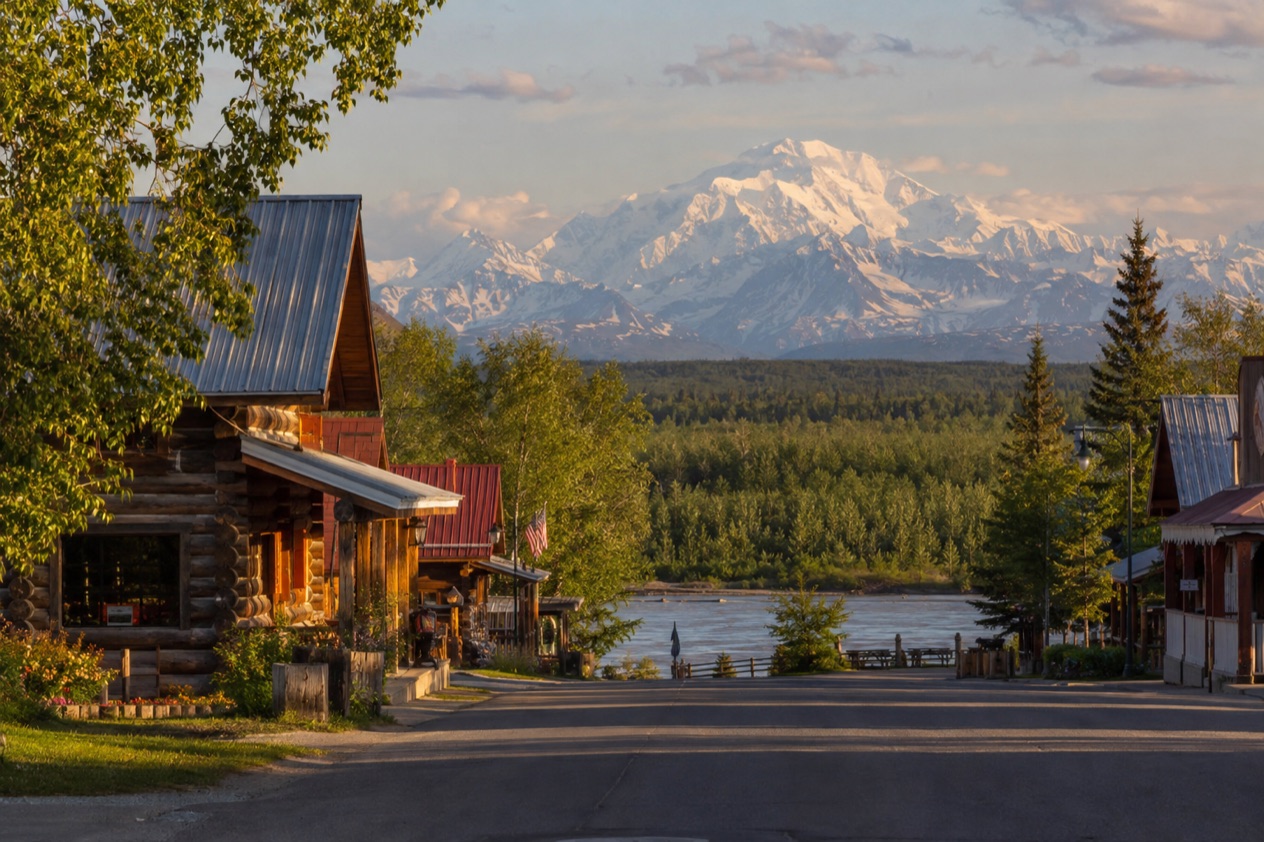
In August, Talkeetna smells of wet spruce and river silt, and the evenings begin to linger without quite going dark. Fireweed along the edges of the lots turns from magenta to cotton, the cafés on Main Street steam up when a shower passes, and a few mornings in a row may open with Denali standing clear above the trees. The summer rush is easing into a calmer, cooler month, with the rivers, the train and the long light still very much on offer.
What is the weather like in Talkeetna in August?
August in Talkeetna is cool, green and showery, a step cooler and wetter than July, with long days that are already shortening. Afternoons are comfortable for walking, mornings and evenings ask for a real layer, and rain comes often enough that you should plan around it.
| Month | Average high (°F) | Average low (°F) | Precipitation (in) | Days with precipitation | Daylight on the 15th |
|---|---|---|---|---|---|
| July | 68.7 | 51.4 | 2.87 | 7.8 | 18 h 58 min |
| August | 65.1 | 47.9 | 4.70 | 10.2 | 16 h 10 min |
| September | 56.0 | 39.0 | 4.48 | 9.7 | 13 h 06 min |
In practice, that means afternoons in the mid-60s, pleasant in a light shirt when the sun is out and brisk the moment a cloud settles over the valley. Nights drop to the upper 40s, so a walk back from dinner calls for a fleece or a light jacket. Rain tends to arrive as passing showers or as a gray, drizzly day that can last for hours, and about one day in three brings some.
The light is generous without being endless. The day is long enough for a late dinner and a stroll to the river afterward, yet the sky now settles into a soft dusk at the end of the evening, a change from the bright nights of early summer. Mornings often start with low cloud or mist hanging in the trees and then open up, which is when the mountains sometimes show themselves.
Pack for changeable conditions rather than for a single kind of day. A waterproof shell matters more than an umbrella along the riverbank and on the trail, and boots that tolerate wet gravel and mud will serve you better than sandals. Water here is for looking at and fishing in, not for swimming.
What to do in Talkeetna in August
August in Talkeetna is about rivers, rails and the chance of a mountain view. The town sits where the Susitna country opens toward the Alaska Range, and a day here is built from small things: a walk along Main Street with its log storefronts, a coffee beside a window streaked with rain, a gravel bar at the water’s edge, and a long look at the sky whenever the clouds lift.
The streets have a lived-in, unhurried mood in August. Shop doors stand open between showers, bakery counters carry pastries and sandwiches for people heading to the river, and conversations on porches are about whether the mountain is out. The rain is part of the rhythm, and locals simply put on a jacket and carry on.
The Hurricane Turn Train
The Hurricane Turn is the Alaska Railroad’s backcountry run from Talkeetna to Hurricane, with stops at Chase, Curry, Sherman, Gold Creek, Twin Bridges and Chulitna. In summer it operates Thursday through Monday from mid-May to mid-September, so August falls within its season. It also offers flagstop service, which means passengers can get on or off anywhere along the route between Talkeetna and Hurricane.
What you see is a long stretch of country with no highway beside it: spruce and birch forest, river bends, small cabins and the wet, bright green of a rainy August. The flagstop tradition gives the ride its character, because the line serves people with homes and cabins off the road system as well as visitors. Rain on the window can make the scenery moodier, and a break in the clouds can change the whole view.
Plan the day around the weekday schedule, since the train does not run on Tuesdays and Wednesdays. It suits travelers who like to watch a landscape unspool from a seat, and it pairs well with a quiet evening back in town.
The Susitna and its salmon
The Susitna River is navigable for 85 miles upstream from its mouth to Talkeetna, and it is counted among Southcentral Alaska’s premier sport fishing streams. Its runs include Chinook and Coho salmon, along with resident grayling, burbot and rainbow trout. For a visitor who does not fish, the river is still the heart of the place, wide and silty, the color of weak coffee with milk, moving steadily past the town.
Walk down to the water after a shower and the air is cool and mineral, with the smell of wet stone and cottonwood. Anglers in waders and rain jackets work the banks and bars, and the talk at the cafés turns to what is running. Watching, rather than casting, is a perfectly good way to spend an hour.
Denali on a clear day
Denali, the highest mountain in North America, rises 20,310 feet in the Alaska Range and is the centerpiece of Denali National Park and Preserve. The Koyukon Athabaskans, who live around the peak, have called it Denali, meaning the tall one, for centuries. On a clear day, passengers on the Denali Star Train can see it, and in Talkeetna the same view is the reason people keep glancing north-bound skies and scanning the horizon whenever the cloud breaks.
August is a month of mixed skies, so the view is a chance and never a promise. Treat any clear spell as a gift, step outside, and let the plans for the day bend around it. When the mountain stays hidden, the forest, the river and the town are still there to fill the hours.
The season is also turning. Fairbanks’s aurora season opens around August 21, and Anchorage sees the aurora swirling from the middle of August through April, so the first dark skies of the year are on their way even though Talkeetna’s August evenings stay bright for most of the month. Local café talk is already shifting from fishing to fall.
Food in August leans toward the comforting and the local: hot soup and sandwiches after a wet walk, baked goods with coffee, and salmon on the menu in a town that lives by its rivers. Pubs and roadhouses fill with people comparing the day’s sightings and weather, which makes an evening meal a social event as much as a meal.
A two-day itinerary for Talkeetna in August
Day 1 is for the town and the river. Start with coffee and a pastry in a Main Street café, then walk the street slowly, ducking into the shops and the log buildings that give Talkeetna its look. Mornings are cool and often misty, so keep a layer on. If the clouds lift, look up for the mountain before anything else.
Spend midday at the water. Walk down to the Susitna and watch the anglers, then have a late lunch of soup, a sandwich or fish at a roadhouse or small restaurant.
Afternoons are the mildest part of the day, ideal for wandering the side streets and the edges of town where the forest begins. Because the evenings are long, dinner can wait, and a stroll back along Main Street after the meal is a good way to end the day.
If rain settles in, let it set the pace: browse the shops, linger over a long lunch, and wait for a clearing before heading back out to the river. Day 2 belongs to the rails. The Hurricane Turn runs Thursday through Monday, so choose one of those days and give the outing the morning and the afternoon. You watch the backcountry slide by, with the chance of flagstop passengers climbing aboard from the bush, and you return to town with a better sense of how far the road system really reaches.
Back in Talkeetna, take a slow late afternoon in a bakery or coffee shop, then an unhurried dinner at a pub or café where people compare notes on the day. If the sky is clear in the evening, a last look toward the Alaska Range is worth a few minutes. On a gray, wet day, the train windows and a warm table still make the plan work.
Is Talkeetna busy in August?
August is still part of the summer season in Talkeetna, with the Hurricane Turn Train running and the Denali Star Train stopping in town, but the pace eases as the month goes on and the evenings begin to cool. The town does not turn sleepy overnight, yet there is a noticeable shift from the peak of July toward a calmer, more local feel.
Denali National Park and Preserve keeps its transit bus service along the Denali Park Road until the second Thursday after Labor Day each year, so August sits within that season. For the visitors who pass through Talkeetna on the way to or from the park, the month is still active, and the Denali Star connects the town with Anchorage, Fairbanks and the park itself.
Because the weather is a little wetter and cooler than July, some days feel quieter simply because people stay indoors or wait for the rain to pass. Cafés and roadhouses are where you see the mix of travelers, anglers and townspeople, and on a clear evening the main street fills again.
What to pack for Talkeetna in August
Layers and rain protection matter most, because the month swings between mild afternoons and cool, wet mornings and evenings.
- A waterproof jacket, because showers come on about a third of the days.
- A warm fleece or light insulated layer for evenings in the upper 40s.
- Waterproof boots or shoes for wet gravel, riverbanks and muddy paths.
- A hat and light gloves for chilly mornings by the river and on the train.
- A small daypack to hold layers as the day warms and cools.
- Binoculars or a camera for the mountain view when the clouds break.
Good to know before you go
The Hurricane Turn Train runs Thursday through Monday until mid-September, so the days of the week matter when you plan the rail outing. The Denali Star Train runs between Anchorage and Fairbanks with a stop in Talkeetna, covering 356 miles in 12 hours overall, and it passes the Knik River with the Chugach Mountains behind it on the way to town.
Daylight is generous but shrinking, and the dark nights that bring the aurora are only beginning to return across the state. Weather can change between morning and afternoon, so keep your plans flexible, and treat any view of Denali as a bonus.
Talkeetna in August vs July and September
Moving the trip four weeks earlier brings a warmer, drier Talkeetna. July has noticeably less rain, warmer afternoons and the longest light of the season, which leaves more room for evening walks and long days outdoors. The cost is that it is the height of the season, and the town runs at its fullest.
Moving four weeks later gives a cooler, crisper place. September afternoons are in the mid-50s, nights approach freezing, and daylight is down to a little over thirteen hours.
The Hurricane Turn is nearing the end of its summer schedule in mid-September, and Denali’s transit buses stop shortly after Labor Day, so some summer pleasures fade as the month goes on. Fall at Denali begins in mid-September and lasts until snow accumulates, and the aurora season gets closer to Talkeetna’s skies.
Choose July if you want the warmest, brightest days and the fullest set of summer options. Choose September if you prefer cool air, a quieter pace and the first dark skies. August sits between the two, with enough summer left to enjoy the rivers and the train and a first hint of autumn.
Is August a good time to visit Talkeetna?
Yes, August is a good time to visit Talkeetna for travelers who like river country, trains and unhurried days, and who are comfortable with showers and cool evenings. It suits anyone who wants summer services still running with a softer, less hectic feel.
People who need warm, dry weather for every hour of the day, or who are counting on a guaranteed mountain view, may prefer another month. Rain comes often, and cloud can hide the Alaska Range for days at a time.
On arrival, walk Main Street first to get your bearings, then head to the Susitna to see the river that defines the town. Check the weekday schedule of the Hurricane Turn and slot the train day around it, keeping the rest of your time loose for the weather. What makes August in Talkeetna special is the turn of the season: salmon in the river, fireweed going to seed, the first cool nights, and a mountain that shows itself when the clouds finally part.
Sources
- NOAA NCEI, U.S. Climate Normals 1991-2020, monthly (https://www.ncei.noaa.gov/access/services/data/v1?dataset=normals-monthly-1991-2020&stations=USW00026528), station Talkeetna Ap, elevation 350 feet, checked October 11, 2026
- Computed from the date and the latitude of the place (sunrise equation, solar elevation -0.833 degrees), October 11, 2026
- National Park Service, Denali National Park & Preserve, plan your visit: shoulder season (https://www.nps.gov/dena/planyourvisit/shoulder-season.htm), checked October 11, 2026
- Alaska Railroad, Train schedules (https://www.alaskarailroad.com/ride-a-train/schedules), checked October 11, 2026
- Alaska Railroad, Denali Star (https://www.alaskarailroad.com/ride-a-train/our-trains/denali-star), checked October 11, 2026
- National Park Service, Lake Clark National Park & Preserve, plan your visit: conditions (https://www.nps.gov/lacl/planyourvisit/conditions.htm), checked October 11, 2026
- National Park Service, Katmai National Park & Preserve, plan your visit (https://www.nps.gov/katm/planyourvisit/index.htm), checked October 11, 2026
- University of Alaska Fairbanks Geophysical Institute, Aurora forecast (https://www.gi.alaska.edu/monitors/aurora-forecast), checked October 11, 2026
- Wikivoyage, Northern lights (https://en.wikivoyage.org/wiki/Northern_lights), checked October 11, 2026
- Wikipedia, Aurora (https://en.wikipedia.org/wiki/Aurora), checked October 11, 2026
- Visit Anchorage, northern lights viewing (https://www.anchorage.net/winter/things-to-do/northern-lights-viewing/), checked October 11, 2026
- Wikipedia, Talkeetna Mountains (https://en.wikipedia.org/wiki/Talkeetna_Mountains), checked October 11, 2026
- Wikipedia, Susitna River (https://en.wikipedia.org/wiki/Susitna_River), checked October 11, 2026
- Alaska Railroad, Hurricane Turn (https://www.alaskarailroad.com/ride-a-train/our-trains/hurricane-turn), checked October 11, 2026
- Wikipedia, Denali (https://en.wikipedia.org/wiki/Denali), checked October 11, 2026
- Wikipedia, Climate of Alaska (https://en.wikipedia.org/wiki/Climate_of_Alaska), checked October 11, 2026
To plan your stay
- Things to Do in Talkeetna: Denali Flightseeing, the Hurricane Turn Train and Friday Evenings
- Where to Stay in Talkeetna: Main Street, the River Confluence, Cabins in the Woods and the Parks Highway
- Talkeetna from Anchorage: Parks Highway, Denali Star Train and Hurricane Turn
- Know Before You Go to Talkeetna: Getting There, Weather Layers, Bears and Local Habits