
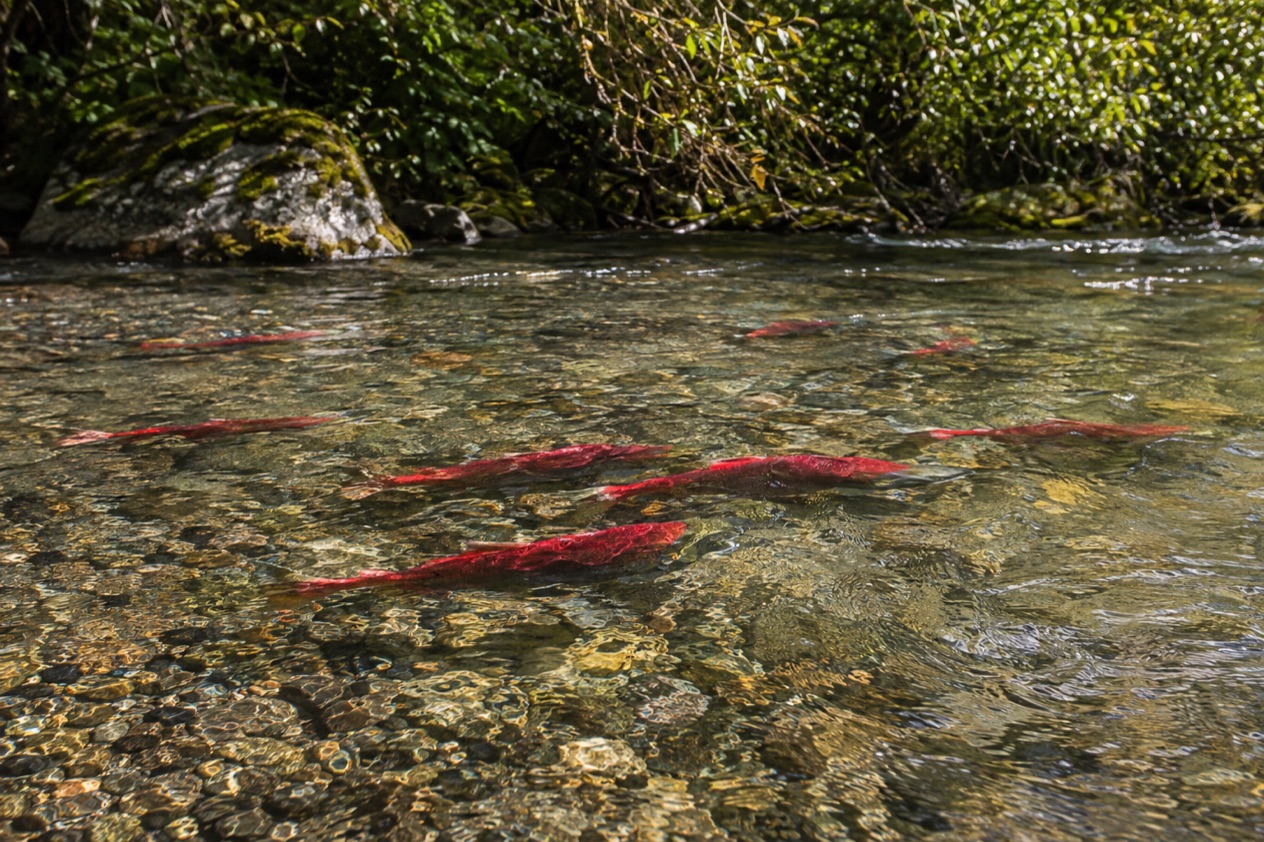
Along a Kenai Peninsula river in the middle of summer, anglers stand in a line at the bank, rods bending, while red-backed sockeye push upstream through water the color of strong tea. Gulls wait on the gravel bars and the talk is all about what is hitting that morning. The salmon run in Alaska is a season made of several runs, each with its own river, its own fish and its own crowd, from the first kings of spring to the last spawners of fall.
When is the salmon run in Alaska?
There is no single run. Alaska’s salmon arrive in waves, species by species and river by river, starting in May with king salmon and ending with fish spawning on their nests into December. Where you stand decides what you see, so it helps to think of the season as a relay, with each runner handing off to the next.
All the Pacific salmon are anadromous, born in fresh water, grown in the ocean and drawn back to the stream of their birth. They are also semelparous, which means they die after spawning once. That is why a salmon river in full run is both a spectacle and a quiet farewell: the fish you watch fighting the current are on the last journey of their lives.
Spring and early summer: the kings
King salmon, also called Chinook, are the opening act. Around Homer they are present in the water all year, but the season anglers wait for begins in May at the Nick Dudiak Fishing Lagoon on the Homer Spit, where kings can be targeted from May through early July. The lagoon is stocked, so the fish are brought to a spot on the spit where you can cast from shore.
The Kenai River is the other great king river, and the one that made the species famous. The sport-caught world record Chinook came out of it on May 17, 1985.
In recent years, though, the king fishery there has been closed or heavily restricted because too few fish returned. A king trip to the Kenai is therefore a matter of how the river stands that season, and the Kenai still has plenty to offer when the kings are off limits.
Midsummer: two runs of sockeye
The Russian River, which drains into the Kenai River near Cooper Landing, has two runs of sockeye each year, one in mid-June and one in mid-July. Between them you get most of the summer’s sockeye drama: bright silver fish in the lower pools that slowly turn red as they near their spawning grounds.
Farther west, the sockeye story gets enormous. Bristol Bay holds the largest sockeye harvest in the world, which can reach 30 million fish in a year. The bears of the Alaska Peninsula are numerous for exactly this reason, because they feed on the world’s largest sockeye runs.
Late summer into fall: silvers and spawners
August belongs to the silver salmon. The Russian River has a run of them that month, and at Homer silvers share the lagoon with the kings, since the lagoon is stocked with both. Silvers tend to be lively on the line, which is part of their following among anglers.
By September the season turns quieter. Chinook salmon can be found on their spawning redds, their nests in the gravel, from September to December. It is a time for watching rather than catching, and for seeing the end of the cycle that began in the spring.
| Run | Where | Timing |
|---|---|---|
| Kings (stocked) | Nick Dudiak Fishing Lagoon, Homer Spit | May through early July |
| Sockeye, first run | Russian River | Mid-June |
| Sockeye, second run | Russian River | Mid-July |
| Silver salmon | Russian River | August |
| Kings on spawning nests | Chinook spawning grounds | September to December |
Where can you watch it?
You can watch the salmon run on the Kenai Peninsula’s rivers, from the Homer Spit, around Katmai and Bristol Bay, and at festivals and hatcheries. The choice depends on whether you want to fish, to photograph, or just to stand at the edge and look.
The Russian River
The Russian River is famous for its fishing, especially for salmon. It flows northward from Upper Russian Lake through Lower Russian Lake before it meets the Kenai River near Cooper Landing. There is no direct road access, so getting there is part of the outing.
One way in is on foot from the parking lots in the Russian River Campground, which sits half a mile beyond Gwin’s Lodge at Milepost 52. The other is the Russian River ferry, which crosses the Kenai River and takes fishermen to the mouth of the Russian River. Parking and the ferry both carry a fee. The two sockeye runs and the August silvers make this a river worth timing carefully.
The Kenai River
The Kenai is the most popular sport fishing destination in Alaska, particularly for king salmon. It runs 82 miles westward from Kenai Lake to Cook Inlet near Kenai and Soldotna. The river changes character as it goes, so each stretch feels like a different place.
The Upper River, from Kenai Lake to Skilak Lake, includes a stretch of whitewater rapids in Kenai Canyon. The Middle River runs from Skilak Lake down to the Sterling Highway bridge near Soldotna. The last miles near Cook Inlet are strongly shaped by the tides, so the water level shifts through the day. Pink salmon run here only in even-numbered years, which is worth knowing if you plan around them.
Homer and the Fishing Lagoon
Homer calls itself the Halibut Fishing Capital of the World, and it is the jumping-off point for the waters of Kachemak Bay, Cook Inlet and the Gulf of Alaska. Across the season, anglers who fish saltwater out of the port can reach king salmon, halibut, lingcod, rockfish and silver salmon. Charter boats are one way to do it, and the lagoon is another.
The Nick Dudiak Fishing Lagoon, also known as The Fishing Hole, sits on the Homer Spit and is stocked with kings and silvers. It has a handicapped accessible platform and ramp, plus a parking lot, fish cleaning tables, restrooms and a picnic area. That makes it a comfortable place to spend a day at the water’s edge, with a lunch on the picnic tables between casts.
Katmai, Crescent Lake and the big bear rivers
Inside Katmai’s boundaries lie important spawning and rearing grounds for Bristol Bay sockeye, which help sustain one of the largest and most economically important salmon runs in the world. The salmon here feed the whole landscape, including the bears of the Alaska Peninsula.
Crescent Lake, tucked into the coastal Chigmit Mountains, offers views of Redoubt Volcano, high bear populations and strong salmon runs. Both places reward people who want the run as part of a wilder scene rather than a fishing line along a road.
Towns, festivals and hatcheries
Tourists come to Anchor Point to fish the Anchor River during the summer salmon runs. In Cordova, the Copper River Wild Salmon Festival brings the Alaska Salmon Runs, a set of races that start on a Saturday morning on the Copper River Highway, from a marathon down to a one-mile race.
For a dry, easy way to understand the fish, hatchery tours are available for visitors to see fish and learn how they are managed. Alaska’s Division of Sport Fish also publishes the GoFishAK interactive maps, which help anglers discover fishing opportunities across the state.
Which species run when?
Five species of Pacific salmon matter in Alaska: king, sockeye, silver, chum and pink. They overlap through the summer, and each has its own habits, range and moment on the river.
King salmon, the state fish
The Chinook is the largest and most valuable species of Pacific salmon, and in Alaska it is the state fish, known as the king for its size and flavorful flesh. On the Kenai River, mature kings have averaged about 37 pounds, which explains the devotion of the anglers who chase them.
Their native range runs from the Ventura River in California to Kotzebue Sound in Alaska. The Yukon River holds the longest freshwater migration route of any salmon, more than 1,900 miles from the Bering Sea to spawning grounds upstream of Whitehorse. Kings appear in the Homer area as early as May and show up on their nests from September to December.
Sockeye, the red fish
Sockeye can grow up to about 2 feet 9 inches long and weigh 5 to 15 pounds. They feed extensively on zooplankton in both fresh and salt water. Juveniles spend one to two years in lakes before heading to the ocean, and adults spend two to three years at sea before coming back to spawn.
That lake-dependent life cycle is why the Alaska Peninsula, with its many large lakes, supports the world’s largest runs. Some sockeye populations, called kokanee, never go to sea at all and live their whole lives in fresh water. On the Russian River, the two sockeye runs come in mid-June and mid-July.
Silvers, chums and pinks
Silver salmon, or coho, are found on both sides of the North Pacific, including around the Bering Sea to mainland Alaska. They are the late-summer species, with a run on the Russian River in August and a place in the Homer lagoon alongside the kings.
Chum salmon range from Alaska to California in the United States and into the Yukon River. Pink salmon are found in coastal waters and rivers from northern California to the Mackenzie River in Canada, and on the Kenai River they run only in even-numbered years. Like every Pacific salmon, both die after spawning.
Good to know before you go
The Russian River charges a fee for parking and for the ferry, and the Division of Sport Fish runs a Rod Loaner Program that rents fishing gear for free, which suits visitors who left their own at home. Guided sport fishing operators must register and report their activity through eLogbooks. The Kenai king fishery has been closed or heavily restricted in recent years, so it is wise to treat kings as a hope rather than a plan, and to let sockeye, silvers and the view carry the trip.
Sources
- Wikipedia, Pacific salmon (https://en.wikipedia.org/wiki/Pacific_salmon), checked October 11, 2026
- Wikipedia, Sockeye salmon (https://en.wikipedia.org/wiki/Sockeye_salmon), checked October 11, 2026
- Alaska Department of Fish and Game, Sport fisheries (https://www.adfg.alaska.gov/index.cfm?adfg=fishingsport.main), checked October 11, 2026
- Homer, fishing (https://www.homeralaska.org/fishing/), checked October 11, 2026
- Wikipedia, Russian River (Alaska) (https://en.wikipedia.org/wiki/Russian_River_(Alaska)), checked October 11, 2026
- Wikipedia, Kenai River (https://en.wikipedia.org/wiki/Kenai_River), checked October 11, 2026
- Wikipedia, King salmon (https://en.wikipedia.org/wiki/King_salmon), checked October 11, 2026
- National Park Service, Lake Clark National Park & Preserve, plan your visit: conditions (https://www.nps.gov/lacl/planyourvisit/conditions.htm), checked October 11, 2026
- National Park Service, Katmai National Park & Preserve, plan your visit (https://www.nps.gov/katm/planyourvisit/index.htm), checked October 11, 2026
- Alaska Railroad, History (https://www.alaskarailroad.com/corporate/history), checked October 11, 2026
- Wikipedia, Alaska Peninsula (https://en.wikipedia.org/wiki/Alaska_Peninsula), checked October 11, 2026
- Wikipedia, Anchor Point, Alaska (https://en.wikipedia.org/wiki/Anchor_Point,_Alaska), checked October 11, 2026
- Wikipedia, Cordova, Alaska (https://en.wikipedia.org/wiki/Cordova,_Alaska), checked October 11, 2026