
A tufted puffin lifts off a rock ledge with its wings whirring and its orange feet trailing, bill full of silver fish, and drops toward the water like a small, overloaded toy plane. The cliffs around it are loud with gulls and murres, and the sea below is cold, green and moving. Alaska holds some of the great puffin colonies of the Pacific, from the islands of the Southeast to the long arc of the Aleutians, and the places where visitors actually meet them are mostly reached by boat.
Where can you see puffins in Alaska?
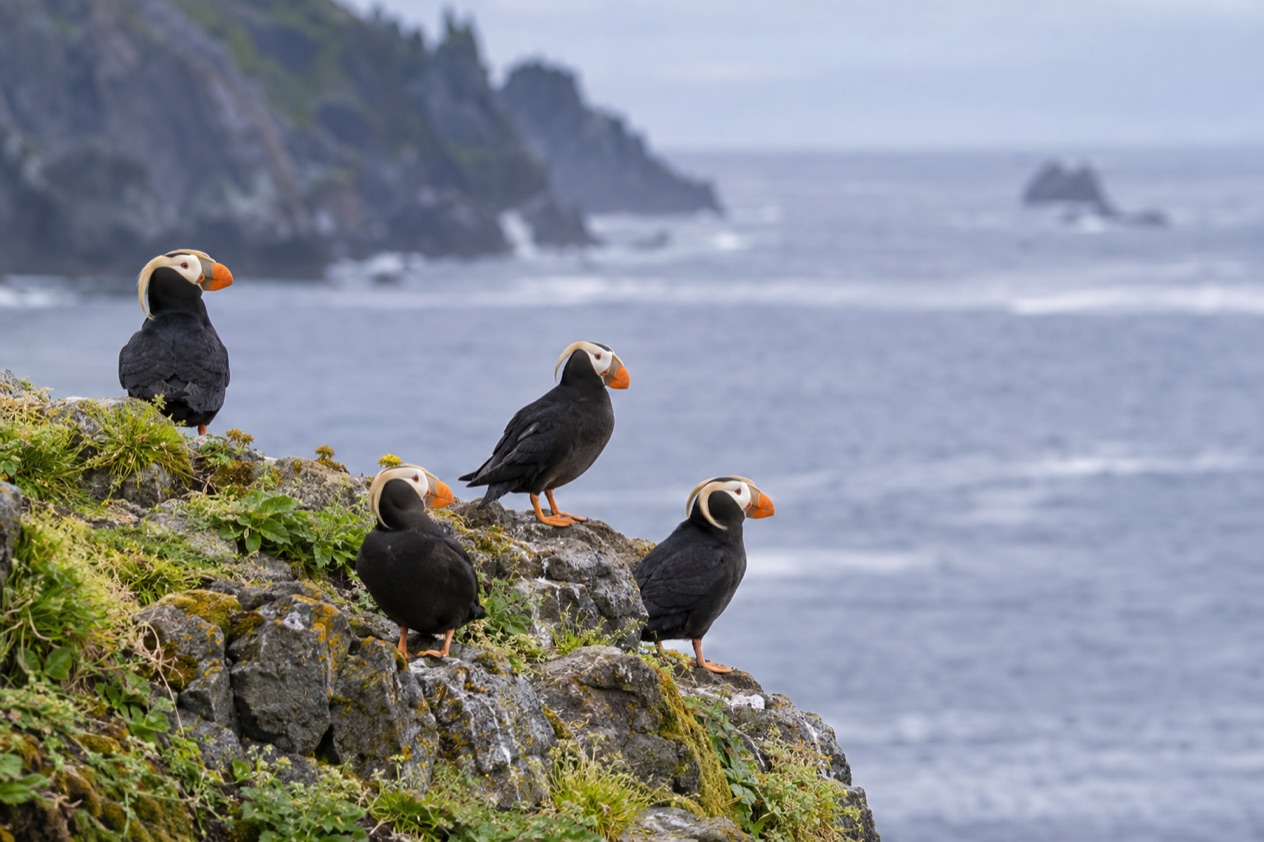
The tufted puffin is the bird people have in mind: a stocky seabird with a black body, a white face, a huge orange and red bill and golden plumes sweeping back from the eyes. It is a seabird in every sense, spending most of its life on open water and coming to land to breed.
That shapes the whole experience. You do not find puffins on a trailhead or in a town park. You find them on rocky islands and sea cliffs, which means a day on the water, a little spray on your jacket and a lot of looking at ledges. The reward is watching a bird that looks painted on, going about a very busy life.
Kenai Fjords National Park, from Seward
Kenai Fjords is the clearest answer for travelers. The park’s waters are crowded with humpback and killer whales, sea otters, harbor seals, sea lions and puffins, so a boat day there is rarely only about birds. Companies run boat tours from Seward that look at both land and marine wildlife, with Steller sea lions, Dall’s porpoises, mountain goats and black bears on the list alongside the puffins.
What you see is a rugged coastline of rock walls, tidewater and forested slopes, with puffins either rafting on the water in small groups or flying low past the boat. Wildlife is always a chance rather than a promise, and the puffins here are often a quick, delightful flash rather than a long, close view.
Glacier Bay
In Glacier Bay, puffins sit in the same list as bears, whales and eagles, part of a wildlife picture that visitors can encounter in the park. The setting is different from Kenai Fjords: a bay shaped by glaciers, with ice, mountains and quiet water around you.
Treat the puffins here as one pleasure among several. A day in Glacier Bay is about the whole scene, the glacier faces, the birds on the rocks and the sudden surfacing of a whale. If puffins are your main goal, pair this park with a stop that centers more squarely on seabird cliffs.
Day cruises from Anchorage
Anchorage is the state’s biggest city, and its wildlife offer is wide: moose can be as close as the city itself, flights go out to see bears fishing, and day cruises look for whales, puffins and otters. For a traveler who lands in Anchorage and wants a seabird morning without rearranging the whole trip, the cruises are the link between the city and the coast.
A cruise like this tends to feel like a sampler. You may glimpse puffins, spot an otter floating on its back and then turn to a whale’s blow on the horizon. It suits families and mixed groups who want a taste of Alaska’s marine life rather than a long, patient birding day.
Southeast Alaska and the Aleutians
Tufted puffins form dense breeding colonies in summer throughout southeastern Alaska and the Aleutian Islands. These are the heartland of the bird’s Alaska range, a long chain of islands and rocky shores where colonies sit on cliffs far from people.
Most of these places are remote, and the birds there live undisturbed by crowds. Part of the appeal for a puffin lover is simply knowing the colonies exist beyond the routes visitors take.
When do puffins nest?
Puffins nest in the summer reproductive season, and the single egg is usually laid in June. After that the schedule runs in two long stretches, incubation and chick-rearing, which together fill much of the season on the cliffs.
| Stage | Timing |
|---|---|
| Egg laid (one egg) | Usually June |
| Incubation by both parents | About 45 days |
| Fledging, after hatching | 40 to 55 days |
In plain terms, the colony is busy for many weeks. Both parents take turns on the egg, and after the chick hatches they spend their days flying out to sea and back with food. Once the young bird is ready, it leaves the nest and heads out onto the water.
Where and how they nest
Tufted puffins choose islands or cliffs that are relatively inaccessible to predators, close to productive waters and high enough that the birds can take to the air successfully. That explains the scenery: steep, grassy or rocky islands rising out of rich water, exactly the kind of place a boat passes at a respectful distance.
From a boat, the colonies look like ledges dotted with small figures, with birds coming and going in a constant stream. Puffins are about 14 inches long, so at a distance they are small, and the first sighting is often a pale face and a flash of orange against dark rock.
What they eat and what hunts them
Adult puffins depend largely on invertebrates, especially squid and krill, and they hunt in the water close to the colony. That is why a fishing trip in the morning and a bill full of food in the afternoon are part of the same story: the bird’s whole routine depends on the richness of the surrounding sea.
The cliffs are not entirely safe. Raptors such as bald eagles and peregrine falcons prey on puffins, as do snowy owls and, in some places, the Arctic fox. If you see gulls and murres suddenly explode off a ledge, an eagle overhead may be the reason.
A sign of the sea’s health
Seabirds are closely tied to the condition of the ocean. A mass die-off of puffins at St. Paul Island occurred between October 2016 and January 2017, a reminder that these birds can be vulnerable when conditions turn hard. Elsewhere, Washington State has created aquatic reserves around Smith and Minor Islands in Puget Sound, and Protection Island has been closed to the public to help breeding marine birds.
For a visitor, the lesson is simple: the colonies deserve distance. Seeing a puffin from the deck of a boat is a privilege that depends on leaving the birds alone on their ledges.
How do you see them?
You see puffins mainly from a boat, on a wildlife cruise that runs along the coast, though you can also meet them up close, in a controlled way, at the Alaska SeaLife Center in Seward. Between those two options lies most of what a visitor needs: the real thing on the water, and a close look indoors.
Boat tours from Seward
Boat tours from Seward give views of both land and marine wildlife in Kenai Fjords National Park. The wildlife list includes puffins, Steller sea lions, Dall’s porpoises, mountain goats, black bears and humpback and orca whales. That variety is part of the pleasure: a day out can turn from a seabird ledge to a spouting whale in a matter of minutes.
Expect to spend your time at the rail or by a window, scanning rock faces and the waterline. Puffins are small and fast, so the best sightings tend to come when the boat slows near a cliff and someone calls out a bird in the air.
The Alaska SeaLife Center
The Alaska SeaLife Center in Seward is the state’s only public aquarium, and it offers special experiences that include a Marine Mammal Encounter, an Octopus Encounter and a Puffin Encounter. The puffin experience is the one for travelers who want to study the birds closely, to see the bill, the feet and the diving style that a boat view can only hint at.
It also works well as a companion to a cruise. After watching distant birds on a ledge, seeing a puffin close at hand makes the next boat trip more rewarding, because you know what to look for in the air and on the water.
Making a day of Seward
Seward is more than a departure point. Its historic downtown and boat harbor hold one of the largest public mural collections, and the town has a reputation as one of Alaska’s premier sportfishing destinations. A walk along the harbor before or after the boat gives the day a shape beyond the wildlife.
There are also many public-use cabins and wilderness lodging options around the Kenai Peninsula, for travelers who want to stay longer in the area. Guided hiking is available through Seward Guided Hikes for those who want to add land to the water.
Other ways to look
Day cruises from Anchorage look for whales, puffins and otters, and Glacier Bay offers puffins in a wider wildlife scene. Each approach gives a slightly different feel, from a quick sampler to a day shaped by ice and mountains.
Whichever you choose, keep expectations flexible. Puffins are birds of the open sea, and a good day is one where you notice small things: the whirr of wings, a bill glowing orange against dark water, a bird landing clumsily on a ledge.
Good to know before you go
Puffins belong to the summer breeding season, so plan around the nesting months rather than the shoulder of the year. Seward is easily accessible from Anchorage, and the Alaska SeaLife Center offers its Puffin Encounter as one of its special experiences.
Dogs are another thing to settle early, because in Seward whether a dog can join an adventure varies through the trip. Whatever you choose, watch the birds from a distance and leave the cliffs to them.
Sources
- Wikipedia, Tufted puffin (https://en.wikipedia.org/wiki/Tufted_puffin), checked October 11, 2026
- Visit Seward, things to do (https://www.seward.com/things-to-do), checked October 11, 2026
- Homer, things to do (https://www.homeralaska.org/things-to-do/), checked October 11, 2026
- National Park Service, Glacier Bay National Park & Preserve, plan your visit (https://www.nps.gov/glba/planyourvisit/index.htm), checked October 11, 2026
- Alaska SeaLife Center, Seward (https://www.alaskasealife.org/), checked October 11, 2026
- Visit Anchorage, wildlife viewing (https://www.anchorage.net/outdoors/wildlife-viewing/), checked October 11, 2026
- Alaska.org, dest seward (https://www.alaska.org/destination/seward), checked October 11, 2026
- Wikipedia, Kenai Fjords National Park (https://en.wikipedia.org/wiki/Kenai_Fjords_National_Park), checked October 11, 2026