
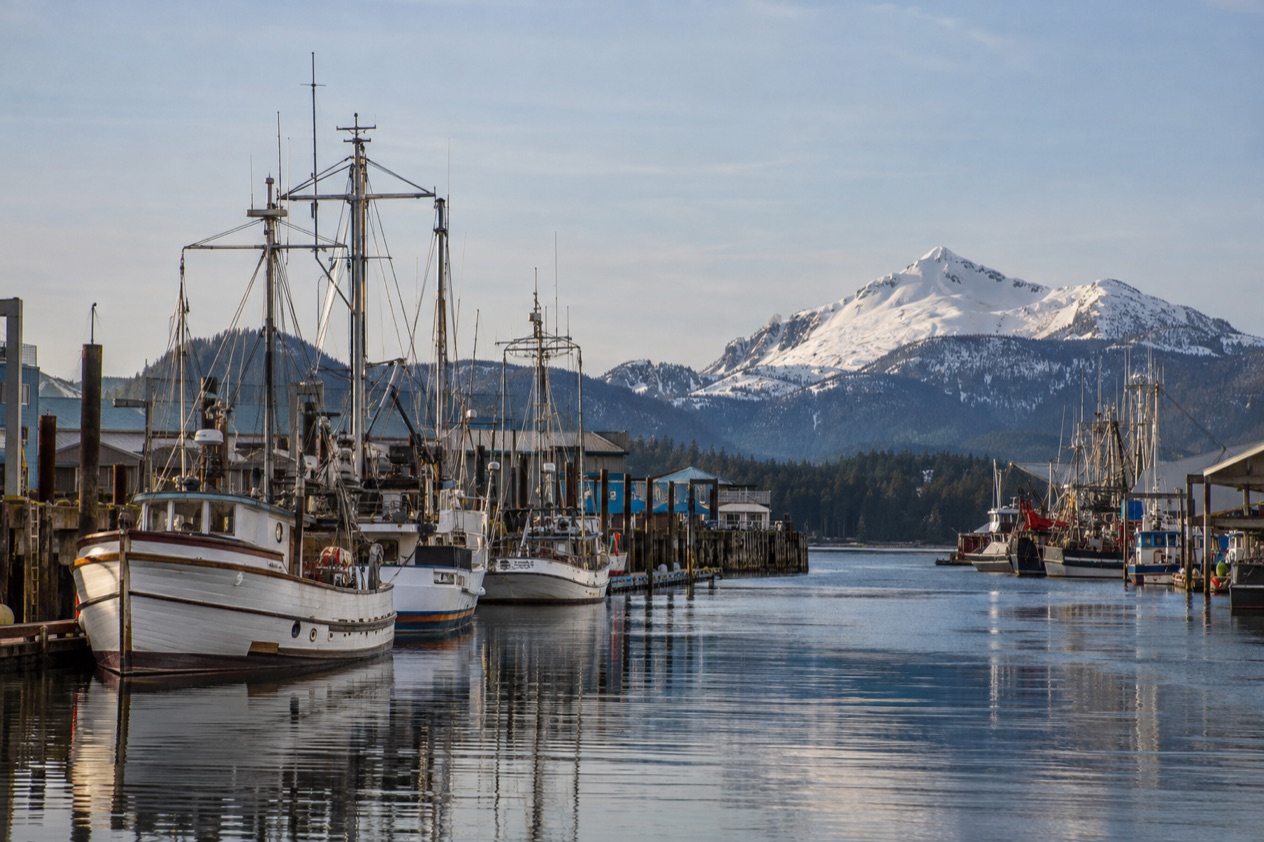
Along the Petersburg harbor, the fishing boats sit hull to hull, nets piled on the decks, and the smell of salt and diesel mixes with fresh coffee from a dockside kitchen. Up the hill, painted rosemaling curls across the gables of houses that look as if they were carried over from a Norwegian fjord. Petersburg is a working fishing town first and a stop for visitors second, and it suits travelers who like their Alaska unhurried, close to the water and a little off the main cruise circuit.
Where is Petersburg and what is it like?
Petersburg sits on the north end of Mitkof Island in Southeast Alaska, where the Wrangell Narrows meets Frederick Sound. It lies halfway between Juneau, 120 miles to the north, and Ketchikan, 110 miles to the south, and it belongs to the Inside Passage, the maze of channels and forested islands that threads along this coast. Wrangell is the nearest neighbor in the airline network, and the Stikine River empties into the sea near it.
There are no bridges to the mainland. Petersburg can be reached only by air or sea, and that single fact shapes the town’s rhythm. Supplies, visitors and fish all travel by plane or boat, and people here keep an eye on the weather, the tides and the ferry schedule the way other towns follow traffic reports.
The character comes from the fishing fleet and from the Norwegian heritage of the families who settled the place. You see it in the Sons of Norway hall, in the rosemaling painted on shop fronts and doors, and in the steady, practical mood of the waterfront. Houses on stilts line Hammer Slough, a tidal channel where the water rises and falls beneath the boardwalks and the boats rock gently at their moorings.
Petersburg is not a resort and does not try to be one. It has no strip of souvenir shops and no crowd of big ships jostling for sidewalk space.
It rewards people who enjoy watching a harbor work, chatting at a café counter, walking forest edges and waiting for the weather to open up. If you want a packed schedule of attractions, Juneau or Ketchikan will feel busier. If you want a town where the main event is the tide coming in, this is it.
The surroundings belong to the Tongass National Forest, the largest national forest in the country, and the Forest Service keeps a local ranger district office in Petersburg. Islands, fjords, glaciers and the peaks of the Coast Mountains fill the horizon, so even a quiet afternoon on the waterfront comes with a view of mountains across the water.
What is there to do in Petersburg?
The big reasons to come are the town’s Norwegian-flavored waterfront, the water and wildlife of Frederick Sound and the Narrows, the forest of the Tongass, and the fishing culture itself. Unlike larger Southeast ports, Petersburg gives you a place to walk around rather than a list of attractions to tick off.
Little Norway on the waterfront
Start on foot in the old part of town, where the boat harbor, the cannery buildings and the painted storefronts sit within sight of each other. Rosemaling, the Norwegian folk art of flowing flowers and scrolls, decorates doors, windows and the front of the Sons of Norway hall. The town’s Viking ship replica, a landmark for photographs, stands near the center and makes an obvious meeting point.
Hammer Slough rewards a slow stroll along its boardwalks. Weathered houses stand on pilings over the water, and the view changes with the tide, from mirror-flat water at high tide to mud flats and rockweed when it drops.
The Little Norway Festival, usually held around mid-May near Norwegian Constitution Day, brings costumes, dancing, music and a lot of baked goods into the streets. It is a good reason to schedule a trip for spring if the culture is what draws you.
Frederick Sound and the Wrangell Narrows
Petersburg looks out on two very different pieces of water. The Wrangell Narrows is a tight, winding channel marked by lights and buoys, where boats of every size pick their way past forested shores. Frederick Sound opens out wide, and its cold, nutrient-rich water is the reason whale watchers talk about it. You may see humpback whales, sea lions, seals, bald eagles and sea birds here, though sightings are never guaranteed.
The LeConte Glacier reaches tidewater in a bay off the sound, and it is one of the sights people hope to reach by boat or from the air. Chunks of ice often drift in the bay, and when the weather clears the blue of the ice is striking against the dark spruce. This is a chance to plan around, not a promise, since conditions and the water decide each day.
Forest, trails and the Tongass
This is Tongass National Forest country, a region of islands, fjords, glaciers and peaks. The Forest Service ranger district office in Petersburg is the local contact for the forest around the town.
Forest walks here are about wet moss underfoot, the smell of cedar and the sound of water running somewhere out of sight. Bring rain layers, since the area gets a lot of precipitation across the year. Birders and photographers do well in the quiet light under the trees, and anyone who enjoys a damp forest will feel at home.
Fishing, seafood and the harbor
The fishing industry is what the town is built around, and it shows. Salmon, halibut and shrimp are the catches the community is known for, and the harbor fills with boats unloading, mending nets or heading out on the tide. Walking the docks is free entertainment, with gulls and eagles watching over every unloading boat.
Eating here is straightforward and good. Look for halibut, salmon, crab and shrimp on local menus, prepared simply, and for baked goods that nod to the Scandinavian side of the town’s story. Petersburg also differs from its neighbors because the fish is not a performance for visitors. The dockside work you see is the real thing.
How many days do you need in Petersburg?
Two to three days is enough to feel the town, and a longer stay suits travelers who want to spend time on the water or in the forest. Because Petersburg is reached only by air or sea, people build a stay around the plane or ferry connection, and a bit of slack in the schedule is natural.
With a short stay, spend one day on foot. Walk the harbor in the morning when the boats are busy, wander Hammer Slough, look at the rosemaling and the Sons of Norway hall, and sit down to a seafood lunch. The afternoon can go to a museum stop, a waterfront walk or simply watching the Narrows from the shore. Evenings are quiet, which suits the place.
A second day can go to the water. Frederick Sound is where you may spot humpback whales, and the LeConte Glacier is the sight that pulls people out onto the water. If the weather is poor, a forest walk in light rain still feels right for this part of Alaska, and a long café stop is no hardship.
With more time, the town opens up. You can walk the edges of the Tongass, return to the harbor at a different tide, and let weather decide which day is for the glacier and which is for the museum or a book.
Wrangell, the next stop for Alaska Airlines and the gateway to the Stikine River, is the natural neighbor to add. Day trips on the lower Stikine run out of Wrangell, with jetboat and kayak options, so it pairs well with a longer Southeast itinerary.
Travelers connecting Petersburg with Juneau or Ketchikan can treat it as the quiet middle of the route. A day here between two busier ports gives the trip a change of pace, but staying three nights or more lets you take in the slow routine that defines the town.
Where to stay in Petersburg
Visitors stay in town, close to the harbor and the Norwegian-flavored streets, where everything from the waterfront to a cafe breakfast is within a walk. This is where the day starts with the sound of boats and where the best views of the Narrows open from the shore. It suits anyone who wants to step outside and be in the middle of the working harbor.
Petersburg is small, so the choice is less about neighborhoods and more about the kind of stay. In town you get the waterfront, the shops and restaurants, and the rhythm of the fleet. Travelers who lean toward quiet, forest and water views can look for places set a little outside the center, and fishing-minded visitors often prefer being near the docks.
What you will find across the town is a mix of small inns, bed-and-breakfasts, vacation rentals and a few larger lodgings, in keeping with a place that runs on a modest scale. Expect a homey feel more than resort polish. Hosts here tend to know the local water and weather, which is part of the appeal of a small place.
Families, couples and solo travelers all fit in, since the town is easy to read and the main sights cluster near the harbor. Anglers and boat-minded guests will want to be close to the docks, while those drawn by the forest and the quiet might prefer a spot a little way from the center. In either case, the best view is usually the one over the water, with a mug of coffee and the tide moving in the Narrows.
How do you get to Petersburg and get around?
You get to Petersburg by air or by sea, because the town sits on an island with no bridges to the mainland. Alaska Airlines serves the Petersburg James A. Johnson Airport with passenger and cargo service, with daily flights from Wrangell and Juneau and onward connections reaching Anchorage and Seattle.
The other way in is the Alaska Marine Highway, which stops in Petersburg on its Inside Passage route. Scheduled service runs both southbound and northbound to other Southeast Alaska communities, as well as to Bellingham, Washington and Prince Rupert, British Columbia. Arriving by ferry means gliding down the Wrangell Narrows, a passage of tight turns and close forested shores that is a highlight in itself.
Once in town, the center is built around the harbor, and the Norwegian-flavored streets, the waterfront and Hammer Slough sit close together. You can see a good deal on foot, and the pace of the place invites it. For anything beyond the center, such as forest edges or other points around Mitkof Island, you will need to sort out transport locally.
Being halfway between Juneau and Ketchikan makes Petersburg a natural link in a Southeast Alaska trip, whether you fly in from one and out to the other or travel by ferry along the route. Plan your movements around the plane and boat connections, and treat the Narrows and the sound as the roads of the region.
When is the best time to visit Petersburg?
Summer, with July as the clearest reference, is the most comfortable time to visit. Afternoons reach the low 60s, nights stay in the low 50s, and the days are the kind for a harbor walk in a light jacket and a boat trip out on the water. It is still a wet place, with rain on about twelve days of the month, and the showers come and go, so rain gear stays in the bag even then.
Spring is when the town shows its cultural side. The Little Norway Festival, usually around mid-May, fills the streets with folk dancing, Scandinavian food and costumes, and it gives the town a festive character that the quieter months do not have. Travelers who care about local culture more than about warm weather often aim for it.
Winter is another world. January brings highs in the mid-30s and lows in the upper 20s, with a lot of precipitation, falling on most days of the month, and about 20 inches of snow. The harbor goes quiet, the light is low and the mood is cozy. Services that cater to visitors may be limited, so winter suits people who want a real fishing town at its own pace rather than a sightseeing schedule.
Good to know before you go
Pack for rain in any month, with waterproof layers and sturdy shoes, since this is temperate rainforest country with wet weather in every season. Because the town can be reached only by air or sea, flights and ferries set the shape of a trip, so leave some slack in your plans for weather. Petersburg is small, and a relaxed attitude to timing fits the place well.
Sources
- Wikipedia, Petersburg, Alaska (https://en.wikipedia.org/wiki/Petersburg,_Alaska), checked October 11, 2026
- Wikipedia, Stikine River (https://en.wikipedia.org/wiki/Stikine_River), checked October 11, 2026
- Wikipedia, Southeast Alaska (https://en.wikipedia.org/wiki/Southeast_Alaska), checked October 11, 2026
- Wikipedia, Tongass National Forest (https://en.wikipedia.org/wiki/Tongass_National_Forest), checked October 11, 2026
- Wikipedia, Climate of Alaska (https://en.wikipedia.org/wiki/Climate_of_Alaska), checked October 11, 2026
- NOAA NCEI, U.S. Climate Normals 1991-2020, monthly (https://www.ncei.noaa.gov/access/services/data/v1?dataset=normals-monthly-1991-2020&stations=USW00025329), station Petersburg 1, elevation 107 feet, checked October 11, 2026