
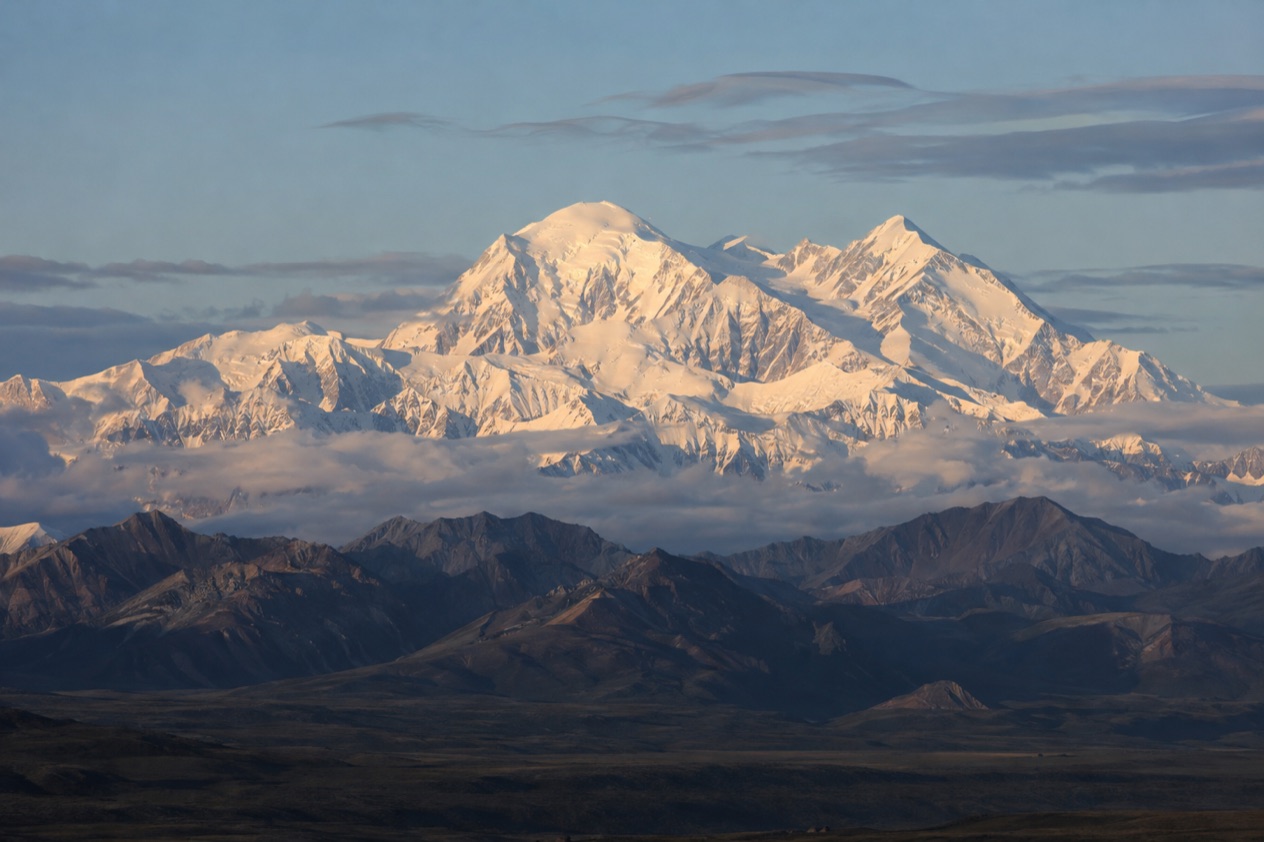
Denali rarely announces itself the way a postcard promises. Cloud banks sit on the Alaska Range for long stretches, and then a gap opens and a vast white mass fills the sky, so much bigger than the ridges in front of it that it takes a moment to understand what you are looking at. This is the mountain at the heart of Denali National Park and Preserve, the tallest in North America, and a visit is mostly about looking: from the park road, from a lakeshore, and from the stories of the people who have climbed it.
Is visiting Denali, the mountain worth it?
Yes, if you like big landscapes and are happy to let a mountain set the terms of the day, because Denali is a sight that rewards patience more than a checklist. It suits photographers, wildlife watchers, people curious about climbing history, and anyone who wants to stand in front of the highest summit on the continent and feel how large it is. It is less suited to travelers who need a guaranteed view, since clouds often hide the peak.
Denali rises from a sloping plain, so nearly its whole height shows, from foothills to summit, instead of sitting on top of a high plateau.
That is why it looks so tall even from a distance. The mountain also sits inside two million acres of designated wilderness, so the surroundings are open tundra, glacier valleys and river bars with no towns in sight.
Add the park around it, with moose, caribou, Dall sheep and many bird species, and the visit becomes more than one photograph. The mountain is the centerpiece, and the land and the animals are what you spend the day among.
What to see at Denali, the mountain
The summit and its enormous base
Denali tops out at 20,310 feet, the highest point in North America. The number matters less than the shape. The mountain climbs from a plain whose elevations run from about 1,000 to 3,000 feet, which gives it a base-to-peak rise of 17,000 to 19,000 feet. Few mountains on earth show that much of themselves at once.
The name comes from the Koyukon Athabaskans, who have called the peak Denali, meaning the tall one, for centuries. The federal government also designates it Mount McKinley, and you will see both names on older maps and signs. Look for the double summit, with the South Summit as the higher point, and for the long ridges that fall away from it in every direction.
The view from Wonder Lake
On a still day the lake can hold a reflection of the peak, and photographers come hoping for exactly that. The mountain is also visible from the Denali Park Road inside the park, though how much you see depends on the weather that day.
Take the view as a chance, not a promise. Clouds often cover the summit, and a clear morning can turn gray by afternoon. Give the mountain time, bring patience, and pay attention to the tundra, ponds and ridges in front of it, which are worth looking at even when the peak hides.
Kahiltna Glacier and Mount Foraker
On the southwest side of Denali flows the Kahiltna Glacier, the longest glacier in the Alaska Range at 44 miles. It is a river of ice, and the standard base camp for Denali climbers sits on a fork of it. Mount Foraker rises almost directly above that camp, so the glacier is a place climbers know well, even if visitors only picture it from afar.
Foraker is a mountain worth knowing in its own right. It stands at 17,400 feet, the third highest peak in both Alaska and the United States, and lies 14 miles southwest of Denali. Charles Houston, T.
Graham Brown and Chychele Waterston made the first ascent of its higher south peak on August 10, 1934, via the west ridge. Seen alongside Denali, it shows how a very tall mountain can look almost modest next to a taller one.
The climbing story and the West Buttress
The first verifiable ascent reached the summit on June 7, 1913. Hudson Stuck, Harry Karstens, Walter Harper and Robert Tatum made it via the South Summit, and their climb is still the foundation of the mountain’s mountaineering story.
Bradford Washburn later pioneered the West Buttress Route in 1951. It is considered the safest and easiest route on the mountain, which is why it is the most popular, and it is a glacier and snow climb.
Climbers typically spend two to four weeks on the mountain. For a visitor who is not climbing, that duration is a good way to feel its scale. A mountain that demands weeks of effort from experienced mountaineers is one you see from a distance with some respect.
Hours, tickets and rules
The mountain itself has no opening hours. It stands in Denali National Park and Preserve, and the park’s ranger line is the one schedule the information gives. A ranger answers questions by phone on most days, which is a useful starting point for anything about the park.
| Site | Open |
|---|---|
| Denali National Park and Preserve ranger line (907 683-9532) | 9 am to 4 pm daily, except major holidays |
Everything else you need to know about visiting the park comes from the rangers.
How to get to Denali, the mountain
Denali is in the interior of Alaska, in the Alaska Range, and it is the centerpiece of Denali National Park and Preserve. The park’s mailing address is in Denali Park, and that small community is the name that anchors the area on maps. Getting to the mountain means getting to the park.
Inside the park, the Denali Park Road is the route from which the peak can be seen. The information does not say how far the road goes or which stretches give the best views, so plan around the road itself and the weather rather than a particular stop. Wonder Lake is the named viewpoint, and it looks toward the mountain from the north.
Climbers reach the mountain by way of the Kahiltna Glacier, where the standard base camp stands. That route is for mountaineering expeditions, and it is a separate matter from the visit travelers make. For drive times, bus service and train connections, the information here does not give details, so it is best to ask the park’s rangers by phone.
When to visit Denali, the mountain
The mountain is a presence in every season, but the weather around it depends on which side of the Alaska Range you are on. The park has two distinct climates, divided by the range. The south side is transitional maritime, shaped by the Gulf of Alaska, with milder air, less seasonal variation and more precipitation.
The northern regions have a true interior climate, with very warm summers and cold winters, and precipitation is relatively low. The record high at Denali Park Headquarters is 91°F, so warm summer days do happen, while the record low is -54°F, a reminder of how cold winter can get.
The mountain’s own weather is harsher. A record windchill of -118.1°F was recorded at the Denali weather station on November 30, 2003, a North American record. Rain can also be heavy: the most in a single day at park headquarters was 3.28 inches on July 24, 1967. Snow fell to a depth of 69 inches on February 19, 2022, so winter conditions are serious.
The information does not name a best month or a best hour for seeing the peak. Treat clear views as a chance in any weather, and keep your plans flexible so you can wait for the clouds to move.
Tips for your visit
Bring patience first. The mountain is often partly or fully hidden, so a flexible schedule helps more than any gear. Bring a camera with a good zoom, because the peak is far from most viewpoints and the details, such as ridges, snowfields and the shape of the summit, only show up when you reach for them.
Bring layers too. The park’s records show wide swings, from warm summer days to bitter winter cold, and the two climates on either side of the range mean weather can change quickly. Give the visit real time, since a mountain this large is best seen slowly, with pauses to scan the horizon and watch the light move across the slopes.
The park around the mountain is worth the extra hours. It holds 39 species of mammals, 169 species of birds and more than 1,500 species of vascular plants, mosses and lichens, so a day outdoors is full even when the summit stays in cloud. Scientists in the Road Ecology Program also study how the Denali Park Road and its traffic affect wildlife, which tells you how seriously the park treats the animals that live along it.
People have made their homes on these lands for perhaps as long as 12,000 years, and mushing remains part of the park’s tradition.
Good to know before you go
Denali is a wild place, and the weather can change fast, so the best habit is to treat every forecast as a guide and not a promise. The mountain’s size can make distances feel shorter than they are, so keep that in mind when you plan a day. When you want to know more about the park, rangers answer by phone at the number above, and the park also covers topics such as climate change and fire management for anyone who wants to read further.
Sources
- Wikipedia, Mount Denali (https://en.wikipedia.org/wiki/Mount_Denali), checked October 11, 2026
- Wikipedia, Mount McKinley (https://en.wikipedia.org/wiki/Mount_McKinley), checked October 11, 2026
- Wikipedia, Denali (https://en.wikipedia.org/wiki/Denali), checked October 11, 2026
- National Park Service, Denali nature (https://www.nps.gov/dena/learn/nature/index.htm), checked October 11, 2026
- National Park Service, Denali history and culture (https://www.nps.gov/dena/learn/historyculture/index.htm), checked October 11, 2026
- National Park Service, Denali weather and climate (https://www.nps.gov/dena/learn/nature/climate.htm), checked October 11, 2026
- Wikipedia, Mount Foraker (https://en.wikipedia.org/wiki/Mount_Foraker), checked October 11, 2026