
A cow moose steps out of the willows beside a trailhead, calf close behind, and every camera in the parking lot comes up at once. It is one of the most ordinary and most memorable moments of an Alaska trip, and it is also the one where people most often forget how big the animal is. Moose can be dangerous, they live across most of the state, and watching them well mostly means giving them room.
Are moose dangerous?
Yes, they can be, even though they look placid while chewing willow twigs. A moose is a very large animal, and it does not need to be a predator to hurt you.
Adult moose range from about 800 pounds for a small female to 1,600 pounds for a large male, and they stand up to almost 6 feet tall. The Alaskan subspecies is the largest moose race, and the moose as a whole is the second-largest land animal in North America, behind only the American bison.
Moose are solitary animals. They do not gather in herds, so the one you meet on a path is usually alone or, in the case of a cow, with a calf. That matters because most trouble comes from a single animal that feels cornered, startled or crowded.
When a moose may charge
Moose may charge when they are harassed or startled by people, and also when a dog is present. A dog that barks or runs toward a moose can pull the animal’s attention, and the moose may then come after the dog and the person holding the leash. Walking a dog near willow thickets, lake edges and trailheads is where this tends to come up.
The Anchorage Visitor Centers warn tourists that a moose with its hackles raised is a thing to fear. The hackles are the hair along the neck and shoulders, and when they stand up, the animal is telling you it is not at ease. That is the moment to stop approaching and back away.
Cows with calves
Cow moose are protective of young calves and will attack humans who come close, especially if they come between mother and calf. Calves stay with their mother until the cow begins estrus again, typically 18 months after the birth of a calf, so a young animal beside a cow can be there for a long time.
The practical lesson is to look for the calf before you look for the photo. If a cow is in view, assume a calf is somewhere near, perhaps hidden in the brush, and keep well away from the space between them.
Bulls in the fall rut
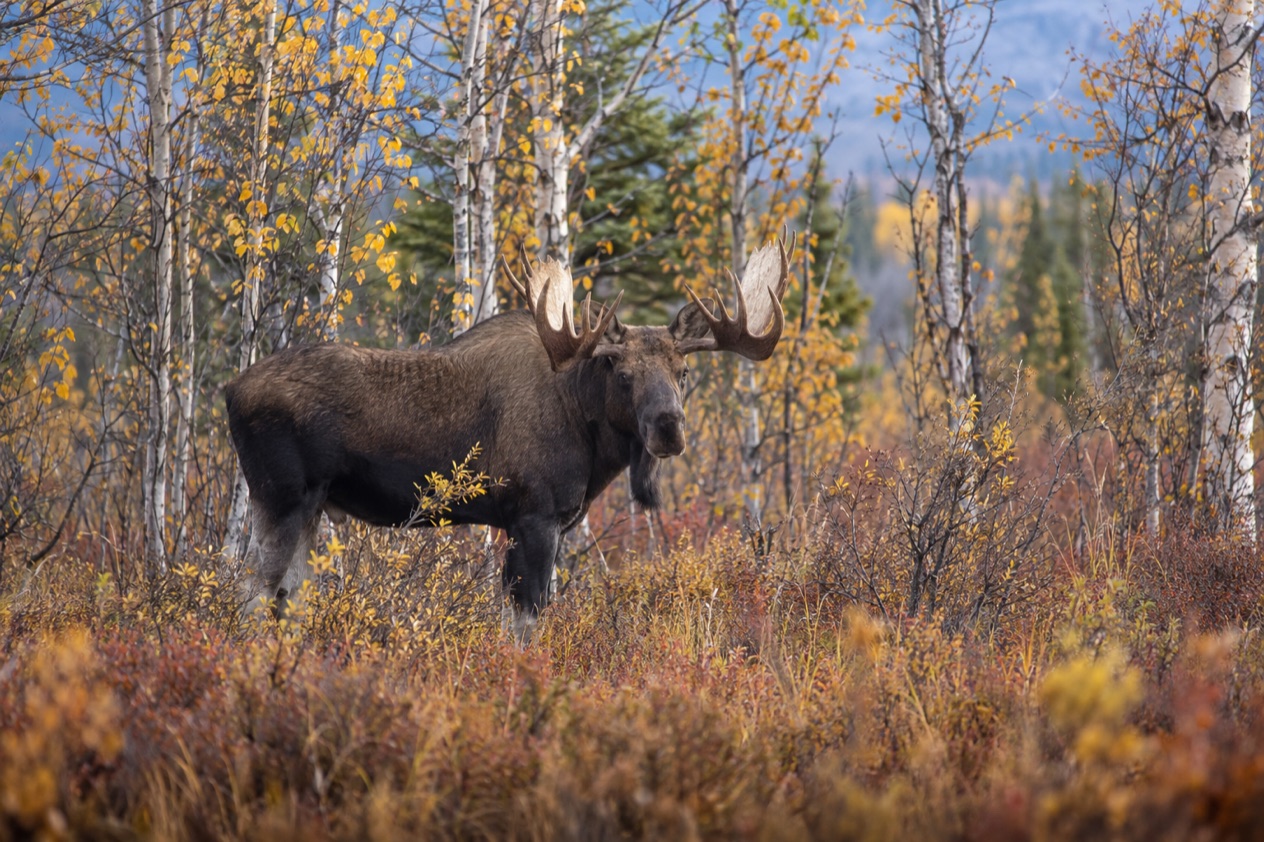
Adult males engage in the rut in late September and early October, and moose mating season runs through September and October, with energetic fights between males competing for a female. During the fall mating season, bull moose may be aggressive toward humans. A bull in rut is focused on rivals and cows, and a person walking up can look like one more competitor.
Bulls are the ones carrying antlers, and a big one can grow an 80-pound rack in a single summer, adding a pound of bone and an inch a day. By autumn that rack is fully grown, which is one more reason to keep your distance from any bull in the weeks after the rut begins.
Where do you see moose in Alaska?
You can see moose across most of the state, from the Stikine River in Southeast Alaska all the way to the Colville River on the Arctic Slope. Roughly 175,000 to 200,000 moose are widely distributed throughout Alaska, so the question is less whether they are around than which kind of country you are standing in.
They are animals of willow, birch and aspen. In fall and winter they eat large quantities of twigs from those trees and shrubs, which is why a thicket of willow beside a trail, a pond or a road is a place to scan before you walk through it.
Moose are also excellent swimmers and wade into water to eat aquatic plants, and they have been known to dive more than 18 feet to reach plants on lake bottoms. A pond edge with a moose standing in it is a classic Alaska scene.
Interior and Fairbanks country
Around Fairbanks, in three subunits of Game Management Unit 20 (20A, 20B and 20D), about 30 percent of the entire Alaska moose harvest takes place. That tells you the area holds a lot of moose, and it is the kind of broad river and forest country where a sighting from a roadside or a trail is a real possibility, though never a promise.
Denali National Park sits in moose range as well, since the moose range includes most of Alaska.
Nelchina, the Upper Susitna and the western bulls
The Nelchina and Upper Susitna River area (Game Management Unit 13) has been one of the most important moose hunting areas in the state, another sign of how many animals live in that country. Trophy-class bulls are found throughout Alaska, but the largest come from the western portion of the state. Alaskan bulls average about 1,400 pounds and cows about 1,050 pounds, so the animals you may see in these regions are big even by moose standards.
Where moose are scarce
In Southeast Alaska, moose are found only in limited areas and are essentially absent from the major islands. If your trip is a cruise or an Inside Passage ferry journey, do not count on seeing one from a town or a deck. Moose can apparently swim the six miles across Clarence Strait to Prince of Wales Island, but there is no open season for moose in that unit.
At the other end of the state, the North Slope of the Brooks Range and the Arctic Coastal Plain east of the Itkillik River (Game Management Units 26B and 26C) mark the northern limit of the moose range in North America. Past that line, other animals take over the landscape.
How do you watch moose safely?
You watch moose safely by staying far enough back that the animal never changes what it is doing because of you. In Denali, the rule is explicit: visitors must stay 25 yards from animals other than bears, and 300 yards from bears, at all times. Visitors must also keep wildlife wild and never feed or harass wildlife. Those distances are Denali’s rules, and they are a sound habit to carry to other places.
Reading the animal
Watch the ears, the head and the hair along the neck. A moose that keeps eating and ignores you is relaxed. One that stops, stares and raises its hackles is warning you, and the Anchorage Visitor Centers specifically flag raised hackles as something to take seriously. Move away calmly and put something solid between you and the animal if you can.
In the fall, treat every bull as a possible problem, since bulls may be aggressive toward people during the mating season. And treat every cow as if a calf were nearby, because a cow will attack humans who come close, especially if they come between mother and calf.
Dogs, trails and companions
Moose may charge in the presence of a dog, so a dog off the leash near a moose is a risk to the dog and to you. Keep dogs close and out of willow thickets where a moose may be feeding unseen.
Denali’s advice for hikers is to always go with at least one other person and to make sure someone else knows where you are going. Bear spray is strongly encouraged for all hikers there. Moose are not bears, but the same careful, quiet habits on a trail apply, and the advice fits any backcountry outing.
If something goes wrong in Denali
In Denali National Park, dial 9-1-1 in an emergency and be prepared to give your location as Denali National Park. Cell phone coverage exists only within three miles of the park entrance, so the phone in your pocket may be of no use farther in. Even the entrance of Denali is several hours from the nearest hospital.
For questions, a ranger is available by phone at 907 683-9532 from 9 am to 4 pm daily, except on major holidays. More people die from falls in the park than from any other cause, a reminder that the ground itself, not only the wildlife, deserves attention when you step off the road to get a better look.
Good to know before you go
Dress for the weather as well as the wildlife. In Denali, hypothermia is always a factor in the subarctic, so layers of wool or synthetic material and rain gear or an umbrella are the advice, and snow can fall nearly any month of the year.
A person watching a moose from a distance may stand still for a long time, and cold arrives fast. Some plants can also cause allergic reactions, such as cow parsnip, which is worth knowing if you are pushing through brush for a better view.
Sources
- Alaska Department of Fish and Game, Moose species profile (https://www.adfg.alaska.gov/index.cfm?adfg=moose.main), checked October 11, 2026
- Wikipedia, Moose (https://en.wikipedia.org/wiki/Moose), checked October 11, 2026
- National Park Service, Denali National Park & Preserve, plan your visit: safety (https://www.nps.gov/dena/planyourvisit/safety.htm), checked October 11, 2026