
A cow moose steps out of the willows at the edge of a pond, water streaming from her legs, and for a long minute everything else in the landscape seems to hold still. It is a scene that plays out across much of Alaska, from boggy lowlands to the river bottoms near its largest towns. Moose are the animal visitors have a real chance of meeting, and autumn gives them a particular edge.
Where can you see moose in Alaska?
You can see moose across most of the state, since their range runs from the Stikine River in Southeast Alaska all the way to the Colville River on the Arctic Slope. It depends on knowing what kind of ground they like and being patient there.
Think of moose as animals of willow thickets, birch and aspen stands, and shallow ponds. They wade into water to feed on aquatic plants, and they have been known to dive to lake bottoms for them. A pond edge with a ring of willows is a better bet than an open hillside, and wet ground with brush is the first thing to scan.
Around Fairbanks and the Interior
The country around Fairbanks is one of the heartlands of Alaska moose. About 30 percent of the state’s entire moose harvest comes from three subunits around the city, which tells you how many animals live in the surrounding river valleys and forest. For a traveler, that means moose are part of the everyday scenery here, and the edges of town and the quiet back roads are worth watching with your eyes as much as your camera.
Creamer’s Field Wildlife Refuge, right in Fairbanks, has trails and open fields that suit a slow morning walk, and it is the kind of mixed field and woodland edge where wildlife often shows itself. Go with no fixed plan, walk quietly, and stop often to look at the tree line and the wet patches.
Denali National Park and Preserve
Denali was the first national park created to protect wildlife, and it shelters 39 species of mammals. Moose share that landscape with a long list of neighbors, so a day in the park is rarely only about one animal. You scan river bars, willow flats and the margins of kettle ponds, with the great bulk of Mount McKinley, at 20,310 feet, standing over the whole scene when the clouds allow.
If you have questions about wildlife in the park, a ranger is available by phone at 907 683-9532 from 9 am to 4 pm daily, except on major holidays. Denali suits people who like to spend hours looking across big country rather than expecting an animal at the roadside.
Nelchina, the Upper Susitna and the western reaches
The Nelchina and Upper Susitna River country has long been one of the most important moose areas in the state. It is wide, wet and brushy, which is exactly what moose want. The largest antlers, meanwhile, come from the western part of Alaska, where trophy-class bulls grow biggest, though that is remote country far from the usual visitor routes.
At the far end of the range, the North Slope of the Brooks Range and the Arctic Coastal Plain east of the Itkillik River mark the northern limit of moose in North America. Seeing one there would be a rare treat, a reminder of how far the species reaches.
Where moose are scarce
Southeast Alaska is the exception. Moose live only in limited areas there and are essentially absent from the major islands. If your trip is an Inside Passage cruise or a stay in a coastal Panhandle town, do not count on moose, and put your energy into other wildlife. Moose can apparently swim the six miles across Clarence Strait to Prince of Wales Island, a sign of how determined and capable they are in the water.
When are they most visible?
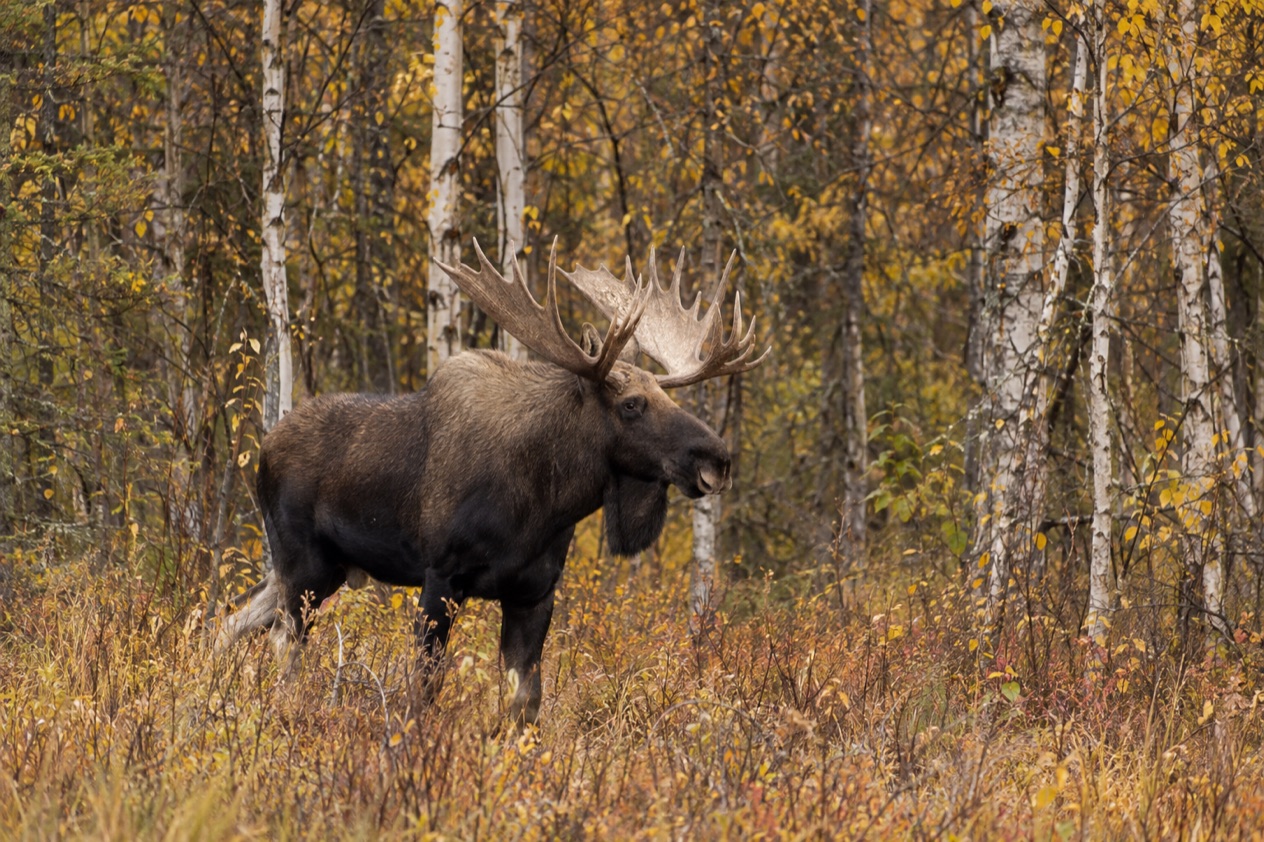
Moose are most visible in autumn, when the rut in late September and early October pulls the big bulls out of cover and into the open. By the time October arrives, the mating season is in full swing, and the whole animal changes its behavior: males that spent summer hidden in the brush now roam, call and fight.
The fall rut
Moose mating season runs through September and October and features energetic fights between males competing for a female. A big bull carries an impressive rack by then. In a single summer a large bull can grow an 80-pound rack, adding about a pound of bone and an inch a day, so by fall those antlers are at full size and the bulls have every reason to show them off.
This is also when the animals are least predictable. Bulls may be aggressive toward humans during the fall mating season, so the rut is a time to watch from a good distance with a long lens rather than to approach. The reward is seeing the animal at its most dramatic, with a rack that can leave a lasting impression.
Cows and calves
Moose are solitary animals and do not form herds, so a group you spot is usually a cow with her calf. Calves stay with their mother until she begins estrus again, typically 18 months after the birth. That long bond means a cow with a young one is a common sight, and also one that deserves respect, since cows are protective of young calves.
Fall and winter feeding
During fall and winter, moose eat large quantities of willow, birch and aspen twigs. That habit gives you a way to find them: look where those trees and shrubs grow thick, along river corridors and around the edges of clearings. You may notice browsed twigs and tracks before you see the animal itself.
An adult can weigh from 800 pounds for a small female to 1,600 pounds for a large male, and stand up to almost 6 feet tall. Even so, moose can slip into thick brush and vanish, so a quiet pause often tells you more than constant motion. Early and late in the day, with fewer people about, tends to feel best for watching, though the animals keep their own schedule.
How do you watch moose safely?
You watch moose safely by treating them as the large, powerful wild animals they are and keeping well back, because they may charge when startled or harassed. Their size is hard to appreciate until you see one up close, and the Alaskan subspecies is the largest moose race, with males averaging about 1,399 pounds and females about 1,054 pounds. The moose is also the world’s tallest, largest and heaviest species of deer, and the second-largest land animal in North America after the American bison.
Reading a moose’s mood
The Anchorage Visitor Centers warn tourists that a moose with its hackles raised is a thing to fear. Those raised hairs along the neck and shoulders are a sign the animal is unhappy with what it sees. If you notice it, the moment for photographs is over.
Moose may charge when harassed or startled by people. They are not herd animals, so there is no group to warn you, and a lone animal in thick brush can be surprised easily. Watch the whole scene, not just the animal in your viewfinder.
Dogs, calves and the rut
Three situations deserve special care. Moose may charge in the presence of a dog, so a pet on a walk changes the odds.
Cow moose will attack humans who come close, especially if they come between mother and calf, which is easy to do without realizing it when a calf is hidden in the willows. And during the fall mating season, bulls may be aggressive toward humans, which matters for anyone traveling in late September and early October.
Planning to find them
Alaska’s wildlands are vast, and finding wildlife often requires knowledge and preparation. The state’s wildlife viewing program can point out viewing opportunities across Alaska, help you learn about the animals and provide safety tips. The Alaska Department of Fish and Game also provides viewing sites, maps, and road and ferry routes for wildlife viewing, along with information by season, festivals and other events.
If you want to learn before you travel, the department offers virtual viewing through trailcams, webcams, video, audio and tracking maps. Watching Alaska’s wild creatures in their natural setting is a thrill for Alaskans and visitors alike, and a little homework makes it far more likely that the thrill happens.
Good to know before you go
Moose live lives that run to roughly 16 years in the wild at most, and every one you meet is a wild animal going about its business. Keep your distance, give cows with calves a wide berth, and treat the rut as a time for watching from afar.
Wildlife viewing permits exist for McNeil River, Round Island and Pack Creek, though those places are known for other animals. For a moose, the best equipment is patience and a good lens.
Sources
- Alaska Department of Fish and Game, Moose species profile (https://www.adfg.alaska.gov/index.cfm?adfg=moose.main), checked October 11, 2026
- Wikipedia, Moose (https://en.wikipedia.org/wiki/Moose), checked October 11, 2026
- National Park Service, Denali wildlife (https://www.nps.gov/dena/learn/nature/wildlife.htm), checked October 11, 2026
- Alaska Department of Fish and Game, Wildlife viewing (https://www.adfg.alaska.gov/index.cfm?adfg=viewing.main), checked October 11, 2026