
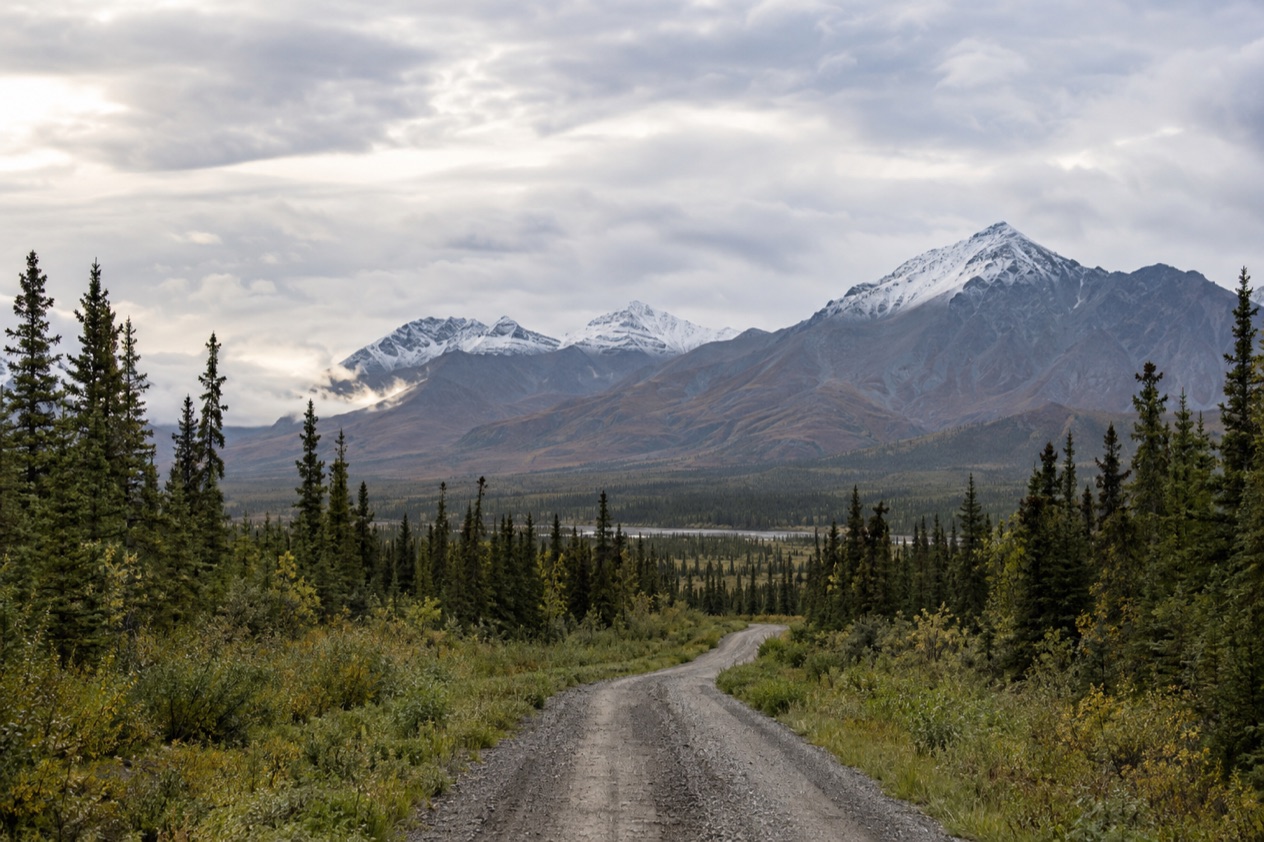
The pavement ends near Chitina, where the road crosses the Copper River and the gravel begins. From there you follow an old railroad bed toward the Wrangell Mountains, with spruce on both sides and the occasional glimpse of peaks ahead. The McCarthy Road is the way into Wrangell-St. Elias National Park for anyone who wants a ghost town, a glacier and a village without paved streets, and the drive is as much a part of the trip as the destination.
Is visiting the McCarthy Road worth it?
Yes, for travelers who like the journey to be part of the story and who are happy to leave the car behind at the end of it. You drive in the footsteps of that railroad, and at the end you find the mine buildings it served.
What sets it apart from other drives in Alaska is where it stops. There is no resort or parking lot waiting at the end, only a footbridge over the Kennicott River, and cars are not permitted in McCarthy.
You park, cross on foot and step into a village with a one-block dirt Main Street and about 100 year-round residents. The road is known for potholes, washouts, railroad spikes and flat tires, though it is usually suitable for passenger vehicles. If gravel is not your idea of a vacation, small planes make the same trip from the air.
It also suits people who want a quiet base. Park services here are limited and the backcountry is vast, so this is a place to slow down, walk, eat dinner in a saloon and look up at the mountains rather than tick off a long list of sights.
What to see at the McCarthy Road
The road itself
The McCarthy Road is a 60-mile gravel ribbon that begins at the Copper River near Chitina. Because it was laid over part of the railroad grade, it runs with a long, patient line, and the old rail history explains why railroad spikes still turn up as a hazard for tires. Drivers who like to stop and look will find the forest opening here and there onto river valleys and mountain views.
Treat the drive as an outing in its own right. Pull over where it is safe, watch for the remains of the railway era and let the road set the pace. The park describes it as scenic and rugged, and both words are fair.
The footbridge and McCarthy
The road ends at a footbridge across the Kennicott River. Visitors can walk to McCarthy in about 15 minutes from the end of the road, and it is half a mile to town. A second bridge for vehicles, built downstream, is open only to residents, businesses and the National Park Service, so everyone else crosses on foot.
McCarthy is a historic town in the middle of the park, with a one-block Main Street of dirt, wooden buildings and a small-town hush. The Golden Saloon serves breakfast and dinner, and the bar stays open later. Its population swells in summer, when many residents who winter elsewhere return and the tourist services open.
Kennicott, Alaska’s ghost town
Kennicott is described as Alaska’s most famous ghost town, an old mining village that keeps its Gold Rush relics. The Kennecott mines and mill town took shape in the early 1900s after copper was discovered nearby, and the old mine buildings and artifacts are what draw summer visitors up from McCarthy.
Look at the scale of the mill, the weathered red wood and the way the buildings climb the hillside. The place is best understood slowly, reading the structures as the leftovers of an industry that once ran copper ore down the rail line you drove in on. McCarthy and Kennicott are sister villages, and the contrast between the living one and the abandoned one is the heart of the visit.
Root Glacier
Root Glacier is one of Alaska’s most accessible glaciers. You can walk on the glacier after hiking two miles from Kennicott, which puts blue ice and moraine within reach of a day out from town.
The hike is a good way to pair the human history of the mill with the natural force that shaped the valley. Conditions on ice change, and the park says weather varies widely here, so treat the walk as one for a day when the sky looks settled.
Hours, tickets and rules
Nobody collects a ticket on the McCarthy Road, and the park is fee-free. There is no entry gate on this road or on Nabesna Road in the north. What does keep hours is the village, and the table gives the ones the park and the saloon publish.
| Site | Open |
|---|---|
| McCarthy Road | Open year-round, weather dependent |
| Wrangell-St. Elias National Park and Preserve | Open year-round, with operating hours and seasons varying by visitor center |
| Golden Saloon, McCarthy | Daily, breakfast 7:30 AM to 9:30 AM, dinner 5 PM to 10 PM, bar open later |
Permits are needed in the park for several activities, including subsistence use, sport hunting and fishing, and off-road vehicles, and all commercial operations require permits. Cars are not permitted in McCarthy, so visitors park at the footbridge and walk across into town. The private service bridge for vehicles is available only to residents, businesses and the National Park Service for an annual fee.
How to get to the McCarthy Road
By car, the route to McCarthy and Kennicott takes about 7 hours from Anchorage and about 8 hours from Fairbanks. The last stretch is the gravel McCarthy Road, a spur of the Edgerton Highway from Chitina, and you must pass through it to reach Kennicott. From Copper Center it is an hour to Chitina, where the road into the park begins.
Once you are on the gravel, the park gives the travel time from Chitina to Kennecott as 2 hours 45 minutes one way. Many Alaska car rental companies do not allow their vehicles on unpaved roads, but Alaska 4×4 Rentals and Alaska Overlander, both based in Anchorage, do. Before you set out, call Park Headquarters at (907) 822-5234 for current road conditions.
The drive ends at the footbridge. From there it is half a mile to McCarthy and five miles uphill to Kennicott, and shuttle vans and buses run from the bridge to both places during the tourist season.
By air
Copper Valley Air Service provides scheduled flights to McCarthy from both Anchorage and Glennallen. Ellis Air flies to McCarthy from Gulkana Airport near Glennallen on Wednesdays and Fridays.
A third option combines the road and the air. You can drive about 6 hours from Anchorage to Chitina and fly from there with Wrangell Mountain Air, which offers daily service to McCarthy three times a day from mid-May to mid-September with advance reservations.
When to visit the McCarthy Road
The tourist season is summer, and that is when the old mine buildings, the artifacts and the colorful history draw visitors to McCarthy. Shuttle vans and buses run from the footbridge then, the Wrangell Mountain Air flights operate from mid-May to mid-September, and many of the residents who winter elsewhere are back in town.
McCarthy has a subarctic climate, with cold winters and short, mild summers. In spring and summer the swing between the warmth of the day and the chill of the night can be large, so a day that starts cool in the valley may turn pleasant by afternoon.
The road is open year-round, weather dependent, so the question is less whether you can go than what you want to find when you arrive. The tourist services, the shuttle and the scheduled flights described above belong to the summer months, and the village is much quieter when they stop. Across the park, temperatures can differ by as much as 70 degrees F at any one time, which is a reminder that conditions near the mountains are not conditions on the road.
A good day is one that leaves time at both ends. Plan to arrive in daylight with room for the bridge crossing, and keep the Root Glacier hike for a day when you are not worried about the drive back.
Tips for your visit
Think of the McCarthy Road as a trip with its own rhythm. The road is notorious for flat tires, and the park warns that visitor services are limited, access can be challenging, weather varies widely and wildlife can be encountered. Facilities in the park are separated by as much as 260 miles, so arrive with what you need rather than counting on a stop along the way.
Plan on at least a full day in the village. The walk across the footbridge and into McCarthy is part of the experience, and a pause on Main Street, a meal at the Golden Saloon and a walk up toward Kennicott will fill an afternoon on their own. Staying overnight gives you the long evening light and the quiet of a place with about a hundred people.
Combine the road with the things that sit on the other end of it: the ghost town of Kennicott, the hike to the Root Glacier and, if you have a day, a scheduled flight over the mountains. Families and anyone who prefers not to walk far should note that cars stay at the footbridge and that Kennicott lies five miles uphill, so shuttle vans and buses in the tourist season are the link.
- Call Park Headquarters for road conditions before you leave Chitina.
- Park at the footbridge and cross on foot into McCarthy.
- Use the shuttle vans and buses from the bridge to Kennicott during the tourist season.
- Check your rental car company’s rules on unpaved roads before you book.
Good to know before you go
There is no entry gate and no park fee on the McCarthy Road, and most of the park beyond it is backcountry with its own regulations, which the park has gathered into a list of the most asked questions. Services are limited, so the smart approach is to treat McCarthy as a small village that happens to have a saloon and a ghost town, rather than a resort.
Wildlife can be encountered anywhere in the park, and weather changes, so the best plan is a flexible one. The park’s mailing address is PO Box 439, Mile 106.8 Richardson Highway, Copper Center, AK 99573.
Sources
- Wikipedia, McCarthy, Alaska (https://en.wikipedia.org/wiki/McCarthy,_Alaska), checked October 11, 2026
- Wikivoyage, McCarthy (https://en.wikivoyage.org/wiki/McCarthy), checked October 11, 2026
- Alaska.org, dest mccarthy (https://www.alaska.org/destination/mccarthy), checked October 11, 2026
- National Park Service, Wrangell – St. Elias National Park & Preserve, plan your visit: travel times between visitor services areas (https://www.nps.gov/wrst/planyourvisit/travel-times-between-visitor-services-areas.htm), checked October 11, 2026
- National Park Service, Wrangell – St. Elias National Park & Preserve, plan your visit: basicinfo (https://www.nps.gov/wrst/planyourvisit/basicinfo.htm), checked October 11, 2026
- National Park Service, Wrangell – St. Elias National Park & Preserve, plan your visit: copper center area (https://www.nps.gov/wrst/planyourvisit/copper-center-area.htm), checked October 11, 2026
- National Park Service, Wrangell – St. Elias National Park & Preserve, plan your visit: fees (https://www.nps.gov/wrst/planyourvisit/fees.htm), checked October 11, 2026