
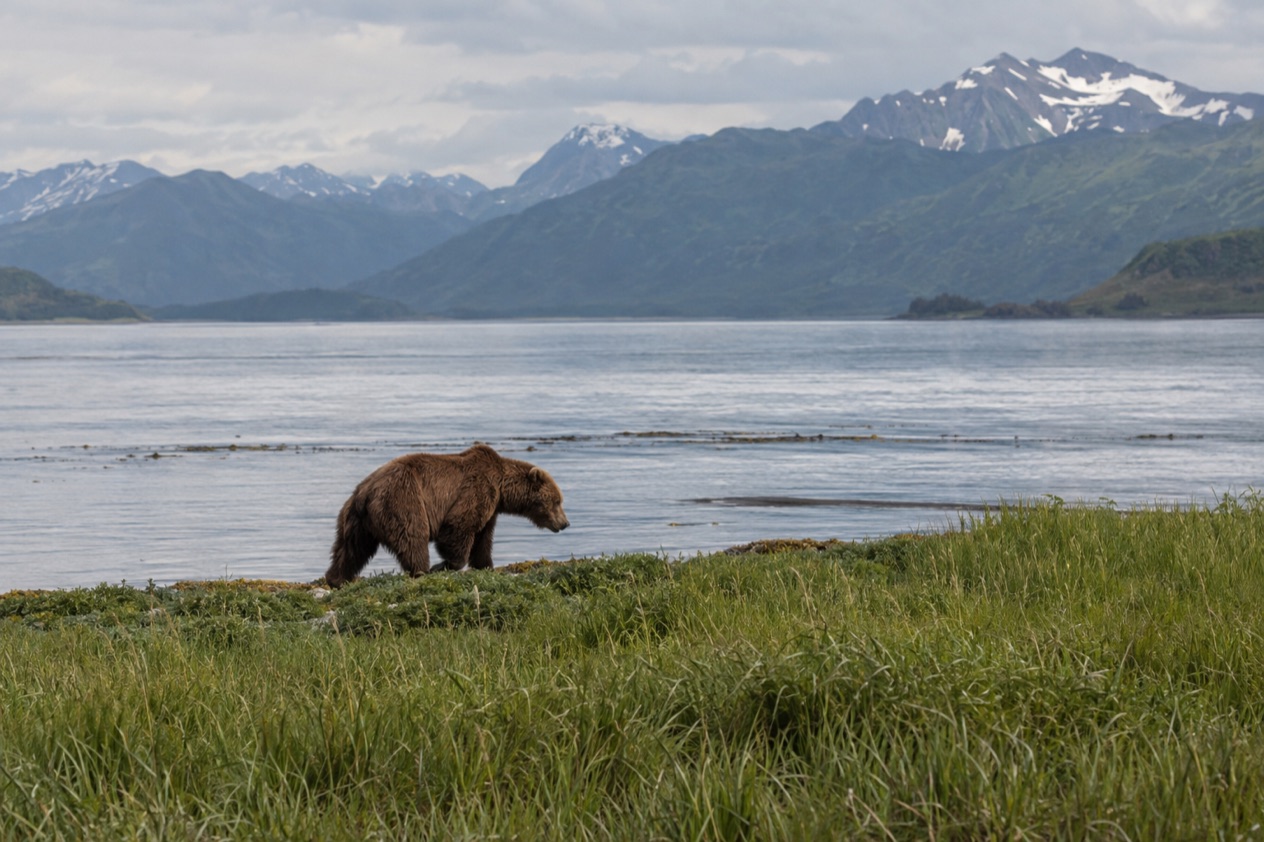
Along a Kodiak salmon stream in late summer, the water churns with fish, gulls wheel overhead, and a broad brown bear may wade into the current with the muscle hump of its shoulders rolling at each step. Kodiak bears live on the islands of the Kodiak Archipelago in southwest Alaska, and watching them feed is the reason travelers cross the Gulf of Alaska to this green island. The visit is a wildlife outing built around salmon, a working fishing town and a good deal of patience.
Is visiting the Kodiak bears worth it?
Yes, if what you want from Alaska is time near large, wild brown bears in their own landscape, and you are happy to build a trip around getting to an island. It suits travelers who like waiting and watching more than ticking off sights, and anyone who wants to understand how salmon, rivers and bears fit together. It is less suited to someone with a single free afternoon and no flexibility, because the bears set the schedule, not the visitor.
The island is promoted as the brown bear viewing capital of the world, with about 3,500 bears living across the archipelago. Kodiak bears are one of the largest bear subspecies, and adult males weigh between 600 and 1,400 pounds. Their size comes from the same source as the bears of the Kamchatka peninsula and parts of coastal Alaska: a diet made up mostly of spawning salmon.
What sets Kodiak apart from other bear destinations in Alaska is that it is an island with a real town on it. At Katmai, the draw is Brooks Camp, where visitors view brown bears, fish and learn about the area’s human history.
At Chinitna Bay in Lake Clark National Park, visitors are sometimes able to see twenty or more brown bears in the salt marsh and on the tidal flats. On Kodiak you also get the harbor, the museums, the Alutiiq history and the fishing culture, so a day without a bear sighting is still a day spent somewhere worth being.
The island has a second quality that bear fans appreciate: its bears are a distinct island population, and about half of the archipelago is protected in the Kodiak National Wildlife Refuge. Much of the bears’ country has no road at all, which is exactly why the animals still behave like wild bears and not like roadside attractions.
What to see at the Kodiak bears
What you see on Kodiak depends on where the salmon are. Bears gather at rivers with spawning fish, and the habits that make them easy to recognize are the ones to look for: the hump of muscle above the shoulders, the heavy head, the unhurried walk along a bank, and the sudden lunge into the current. Brown bears are mostly solitary, but at a good salmon river several can end up fishing within sight of one another.
Frazer River
Frazer River is the most accessible bear-viewing location on Kodiak, and it drew over 1,100 visitors in 2007. It is a salmon river, which explains everything: bears come to the water because fish come to the water, and watching a bear work a riffle for a meal is the core of the experience here.
What to look for is behavior more than posing. Some bears stand in the current and pin fish, others patrol the edges, and sows with cubs keep the young ones close. The best months for seeing Kodiak bears are July, August and September, ideally with a knowledgeable guide, so that is the season to build around if Frazer River is your goal.
Karluk River and the salmon streams
The Karluk River is famous for its salmon run, and it stands for what drives the whole island: salmon runs extend from May through September on most of the archipelago, and they feed the bears through the stretch when they need to put on weight for winter. Rivers like the Karluk are the reason the island’s bears grow so large.
You do not need to see a bear to appreciate a salmon stream. Watch the water for dark backs of fish pushing upstream, the gulls and eagles waiting for scraps, and the trampled paths along the bank that bears have used for generations. Much of the Kodiak refuge is reached only by floatplane or boat, which shapes how visits to the more distant rivers are made.
Kodiak National Wildlife Refuge Visitor Center
It offers an educational film, exhibits, maps and learning opportunities, and it puts the archipelago in context: the refuge covers about half of it, and the bears live across a landscape that is mostly without roads.
Go here on a rainy morning or on an arrival day, when you want to learn what bears eat, how they use their territory and where the protected land lies. Refuge headquarters sit on the Chiniak Highway right at the access road to Buskin River State Recreation Site, so the two stops pair naturally.
Buskin River and Pasagshak River recreation sites
Buskin River State Recreation Site offers camping, picnic areas and fishing for salmon and trout in the Buskin River. It is a good place to see how Kodiak lives with its rivers: anglers on the bank, the fish in the water, and the same salmon that draw the bears elsewhere on the island.
Pasagshak River State Recreation Site is a 25-acre park with a small campground and access to some of the island’s best salmon and trout fishing. Both sites are about the river and the fish, and they give you a feel for the habitat even when you are not watching a bear.
Hours, tickets and rules
The bears keep their own hours, so the schedules that matter on Kodiak belong to the town’s visitor center, museums and cathedral, which are good for the hours around a bear outing. From early May through late September, the Kodiak visitor center is also open on Saturday, and its hours are extended to fit ferry and cruise ship schedules.
| Site | Open |
|---|---|
| Kodiak National Wildlife Refuge Visitor Center | Daily 9AM-5PM in summer, Tuesday-Saturday noon-5PM in winter |
| Alutiiq Museum | Tuesday-Friday 10AM-4PM, Saturday noon-4PM, closed Sunday and Monday |
| Kodiak History Museum | Monday-Saturday 10AM-4PM in summer, Tuesday-Saturday 10AM-3PM in winter |
| Holy Resurrection Cathedral | Sunday 8AM-noon, Thursday 5-7PM, Saturday 5-8PM |
The rules that matter most concern food and bears. People in Alaska must keep all human sources of food secure from bears, and dangerous bear situations should be reported to the Alaska Department of Fish and Game with its wildlife encounter form. Hunting is a separate matter: Kodiak bear hunting seasons run April 1 to May 15 in spring and October 25 to November 30 in fall, and every hunter must check in at the department’s office in Kodiak before hunting.
How to get to the Kodiak bears
Everything starts in the city of Kodiak. All commercial transportation between Kodiak Island and the outside world goes through the city, by ferryboat or airline, and it is the largest community on the island, with a population of 5,581. Kodiak Island sits in the Gulf of Alaska, 250 miles south of Anchorage.
By air from Anchorage
Alaska Airlines offers daily scheduled flights from Anchorage to Kodiak. Kodiak Benny Benson State Airport is five miles southwest of downtown Kodiak, so you arrive close to the harbor, the museums and the visitor center, which makes the town a convenient base for planning the bear part of the trip.
By ferry from Whittier
The Alaska Marine Highway System ferry from Whittier to Kodiak takes about 23 hours. That is a voyage across open water, and it arrives in the same city that every other commercial route does, so the ferry and the plane lead to the same starting point.
From Kodiak to the bears
Once in town, the question is which part of the archipelago you want. Most of the Kodiak National Wildlife Refuge is only accessible by floatplane or boat, and nearly two-thirds of the island lies within the refuge with no road access. That is the reason a knowledgeable guide is recommended for seeing the bears, especially in the best months of July, August and September.
For travelers who also want the Katmai Coast, Kodiak Island is promoted as offering access to it. The Chiniak Highway reaches the refuge headquarters and the Buskin River recreation site from the city, so those stops do not need a boat or a plane.
When to visit the Kodiak bears
The best time to see a Kodiak bear is July, August and September. Salmon runs extend from May through September on most of the archipelago, and the fish are what pull the bears to the rivers, so the later months of the run are when the viewing is described as best. Summer on the island is the stretch from June to August, while December to March is the cold season.
May and June belong to a different part of the bears’ year. The mating season runs from mid-May to early July, and sows with new cubs stay in their dens until late June, while males emerge in early April. A spring visit finds a landscape still waking up, with bears coming out of winter and the first salmon arriving.
Autumn is the season of the den. Kodiak bears begin entering their dens in late October, and brown bears are not full hibernators and can be woken easily, but both sexes prefer a protected spot through the winter months. Fall is also when the hunting season opens, on October 25, and that matters if you are planning a late-season outing around the island.
Town hours change with the seasons too. The refuge visitor center is open daily in summer but only Tuesday through Saturday in winter, and the history museum shortens its week in the cold months. If your dates fall in winter, the museums and the Alutiiq Museum are the better use of a day than a search for bears that are denning.
Tips for your visit
Build the trip around the fish, not the clock. Salmon are what bring bears to the water, so a plan that follows the run, July through September for the best viewing, gives you the best chance of a sighting. Bears are wild animals and a sighting is a chance, never a promise, so leave room in the schedule for a second try.
A knowledgeable guide is the approach the Kodiak visitors bureau recommends for seeing a bear, and it matters most for the roadless parts of the refuge. Keep food secure at every stop, because that is a rule for everyone in Alaska, and report any dangerous bear situation to the Alaska Department of Fish and Game.
Combine the bears with Kodiak town
The Alutiiq Museum tells the story of the island’s Native people, and the Kodiak History Museum covers the town’s fishing and Russian-era past. Holy Resurrection Cathedral, with its limited opening hours, is part of that story, and Fort Abercrombie State Historical Park is on the island too. These are the stops for a day when the weather or the schedule keeps you in town.
Fishing is the most important economic activity on Kodiak Island, with fisheries including Pacific salmon, Pacific halibut and crab. Walking the harbor shows the other side of the salmon story: the same fish that feed the bears feed the town.
Combine the bears with the rivers
Buskin River State Recreation Site and Pasagshak River State Recreation Site give you the habitat without a flight. Camping, picnic areas and fishing for salmon and trout are the activities named at Buskin River, and Pasagshak has a small campground. The refuge visitor center, nearby on the Chiniak Highway, adds the film, the exhibits and the maps.
Good to know before you go
Kodiak is a place of green hills and gray weather, nicknamed the Emerald Isle for its lush landscapes, and the town is built around its harbor. Plan around the seasons: bears den from late October, and the refuge visitor center and the history museum shorten their hours in winter.
Keep every source of food secure from bears, report dangerous encounters to the Alaska Department of Fish and Game, and treat each sighting as a chance, never a certainty. Travelers can also download a visitors guide from the Discover Kodiak Visitors Bureau and subscribe to its newsletter for news of local events.
Sources
- Wikipedia, Kodiak bear (https://en.wikipedia.org/wiki/Kodiak_bear), checked October 11, 2026
- Wikipedia, Kodiak Island (https://en.wikipedia.org/wiki/Kodiak_Island), checked October 11, 2026
- Wikivoyage, Kodiak (https://en.wikivoyage.org/wiki/Kodiak), checked October 11, 2026
- Discover Kodiak Visitors Bureau (https://www.kodiak.org/), checked October 11, 2026
- Alaska Department of Fish and Game, Living with bears (https://www.adfg.alaska.gov/index.cfm?adfg=livingwithbears.main), checked October 11, 2026
- Wikipedia, Brown bear (https://en.wikipedia.org/wiki/Brown_bear), checked October 11, 2026
- National Park Service, Katmai National Park & Preserve, plan your visit: basicinfo (https://www.nps.gov/katm/planyourvisit/basicinfo.htm), checked October 11, 2026
- National Park Service, Katmai National Park & Preserve, plan your visit: brooks camp (https://www.nps.gov/katm/planyourvisit/brooks-camp.htm), checked October 11, 2026
- National Park Service, Sitka National Historical Park, plan your visit: basicinfo (https://www.nps.gov/sitk/planyourvisit/basicinfo.htm), checked October 11, 2026
- National Park Service, Lake Clark National Park & Preserve, plan your visit: conditions (https://www.nps.gov/lacl/planyourvisit/conditions.htm), checked October 11, 2026