
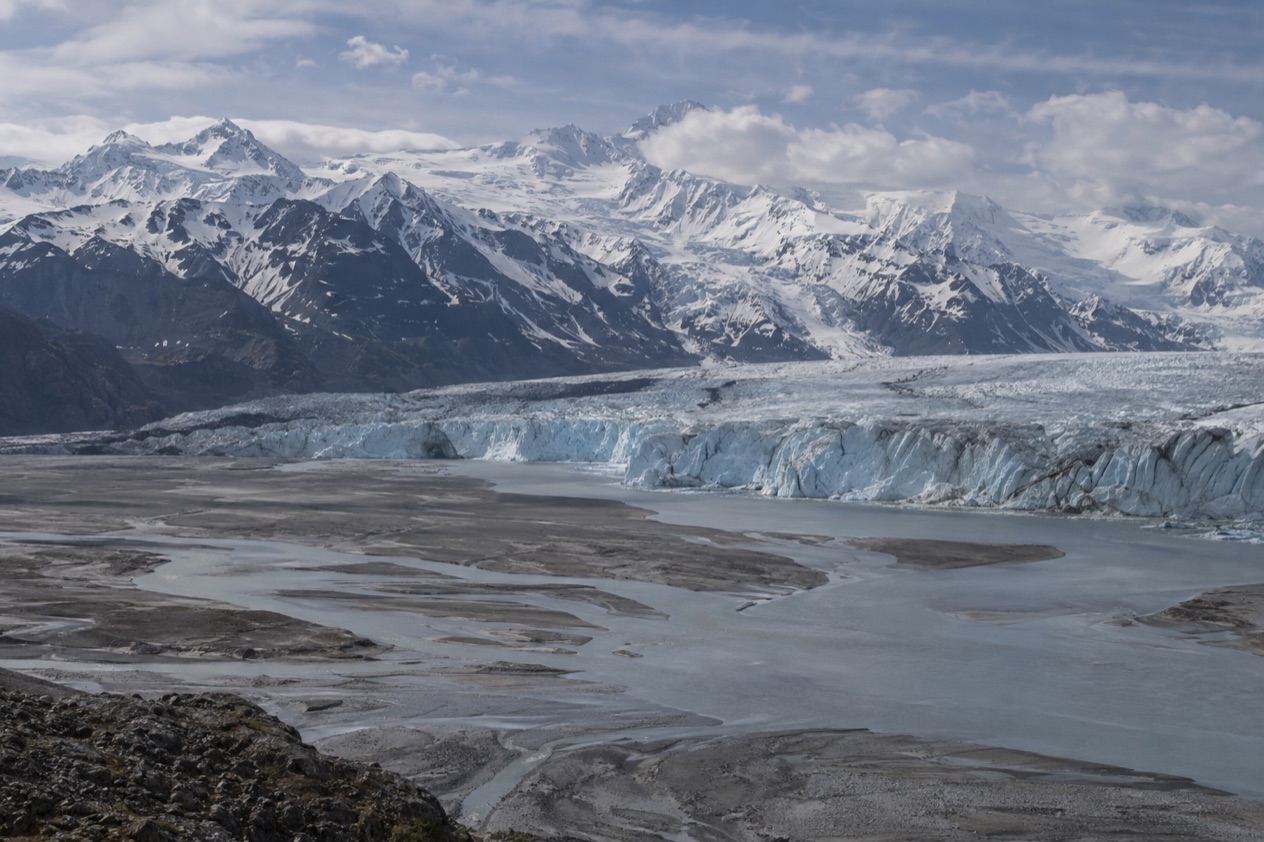
The first thing that gives Knik Glacier away is its color: a band of blue-white ice spilling out of the Chugach Mountains, streaked with gray moraine and framed by rock walls that seem to go straight up. Below it, braided channels of milky meltwater wander across gravel bars toward the river. This is a glacier you meet on its own terms, by air, by wheel or by water, and it makes for a day that feels far from Anchorage even though the city is not far away.
Is visiting Knik Glacier worth it?
Yes, for anyone who wants to see a big Alaska glacier up close without a long expedition, and especially for travelers who like the idea of arriving by something more adventurous than a tour bus. Knik Glacier sits 50 miles east of Anchorage, on the northern end of the Chugach Mountains, and it averages over 25 miles in length. It is one of the largest glaciers in southcentral Alaska, and standing near it, that scale is the point.
What sets it apart from other glaciers near the city is how you reach it. The ways to see Knik Glacier are a flightseeing company, an all-terrain vehicle, a jetboat, an airboat charter, or a guided packrafting tour.
Each puts you in a different relationship with the ice: from above, on a gravel track, skimming a braided river, or floating on it. That variety is the draw, and it gives a trip here more texture than a viewpoint pullout would.
It also has a story that few glaciers can match. Matanuska Glacier, an hour beyond Palmer, is the other big name in the valley, but Knik feels less like a roadside stop and more like a destination you travel into.
What to see at Knik Glacier
The glacier and its ice
The glacier averages over 5 miles across, so what you see is less a single wall of ice than a broad, rumpled river of it, ridged and cracked and shading from white to deep blue where the ice is dense. Dark bands running along its length are rock and debris carried down from the peaks. Seen from the air, those stripes show how the whole mass slowly flows.
Look for the texture at the edges, where meltwater has carved channels and the ice meets bare rock. Sound is part of it too: glaciers creak, drip and sometimes crack. Whether you see it from a plane window or from a gravel bar, give yourself time to just look, because the details appear slowly.
Lake George and its floods
Lake George is a glacial lake that formed near the face of the glacier, and the National Park Service recognized it as a National Natural Landmark. For years it did something dramatic: the lake experienced a jökulhlaup, a glacial lake outburst flood, annually, until the floods stopped in 1967 as the glacier receded. The water would drain suddenly and pour down the valley.
Today you picture that history rather than see it. Look at how wide the river corridor is and how bare the gravel flats are, and the scale of those old floods makes sense. It is a good reminder that glaciers are not static scenery but shapers of the land that keep changing.
The Knik River and its gravel flats
The glacier feeds the 25-mile Knik River, which empties into the Knik Arm of Cook Inlet. Near its start, the river splits into braided channels that shift with the season, leaving pale gravel bars, pools and quick, cloudy water the color of weak milk. This is the landscape you cross on an ATV, a jetboat or an airboat.
The Mat-Su rivers and lakes are spawning grounds for chinook, coho, sockeye, pink and chum salmon, so this is a valley where fish shape the whole ecosystem. Wildlife is always a chance rather than a promise, but it adds a reason to watch the banks and the sky as you travel.
Bodenburg Butte and the view from the valley
Bodenburg Butte is a family hike with views of Knik Glacier and Pioneer Peak. It suits travelers who want a look at the glacier from the valley floor, set against the jagged mountains behind it. It is the kind of stop that puts the glacier in context, showing how it sits at the head of a wide, open landscape.
If you have seen the ice from above or from a gravel bar, the butte gives you a third angle, and it is a natural pairing with a day around Palmer and Wasilla. Bring your camera for Pioneer Peak, which rises steeply and gives the scene its backbone.
A glacier on screen
In 1991, Paramount Pictures used Knik Glacier to film a portion of Star Trek VI: The Undiscovered Country. It is easy to see why a film crew wanted it: the ice is so large and so strange that it can pass for another world. Fans of the film may enjoy looking at it with that in mind.
Hours, tickets and rules
It is a stretch of wild country, and the way you see it decides how your day is organized. Flightseeing, ATV trips, jetboats, airboat charters and guided packrafting tours are the ways named for visiting, so your plan starts with choosing one of them.
The glacier and the beginning of the Knik River are managed under the Knik River Public Use Area Management Plan. The manager is the State of Alaska’s Department of Natural Resources, Division of Mining, Land, and Water, Southcentral Regional Office. That makes this state-managed public land, a different thing from a national park with a visitor center.
The management plan is the document that governs how the public use area is run, and it is the reference point for anything that concerns the land itself. Knowing who manages it helps you understand what kind of place this is: a working landscape of river, ice and gravel, set aside for public use rather than arranged for sightseers.
How to get to Knik Glacier
Anchorage is the natural base. The glacier lies 50 miles away, but the last stretch is not an ordinary road trip. It is reached on an ATV or a flightseeing tour, and jetboat, airboat and packrafting options are among the ways to see it as well. The route into the valley is part of the experience.
Palmer and Wasilla are the closer towns for the trip, and both are 45 minutes from downtown Anchorage. To drive from Anchorage to Palmer, take the Glenn Highway north and then the off-ramp toward Palmer. The Parks Highway passes through Wasilla.
You can also reach Wasilla by train. The Alaska Railroad’s Denali Star offers transportation to Wasilla from Anchorage, Talkeetna, Denali and Fairbanks. That makes Wasilla a workable base if you are already traveling along the railroad corridor.
Eklutna is another useful marker on the way. It lies near Mile 26 of the Glenn Highway and near Milepost 142 of the Alaska Railroad, and it makes a natural stop in the same day. The Mat-Su Valley beyond it includes Palmer, Wasilla, Big Lake, Houston, Willow, Sutton and Talkeetna, so there is plenty of country to move through.
When to visit Knik Glacier
The glacier itself does not keep a calendar, but the valley around it does. Late August is a lively moment in the area, because the Alaska State Fair takes place then in Palmer, and the fair is where world-record-sized cabbages and other vegetables are displayed. A glacier day followed by a fairground evening makes for a very Alaskan contrast.
August and early September are also when the you-pick farms around Palmer and Wasilla are available, which pairs well with a day on the ice. The Matanuska-Susitna Valley is farm country as well as glacier country, and that late-summer harvest is a flavor of the place.
For travelers who come later, the Palmer and Wasilla area has a chance of northern lights from late August through mid-April. The aurora is never a promise, but it gives the shoulder seasons something to look for after dark. A day around the glacier and a night watching the sky is a combination worth hoping for.
Because the ways of seeing Knik Glacier depend on operators, dates and conditions, the details of when a particular tour runs come from that tour. What the valley offers on any given day is a mood: big mountains, braided water and a glacier that dominates the head of the valley.
Tips for your visit
Pick your way of seeing the glacier first, because it shapes everything else. Flightseeing gives the sweep of the ice from above, while the ATV, jetboat and airboat options keep you on the ground and in the river valley. A guided packrafting tour is the quietest choice, taking you onto the water itself.
Build the rest of the day around the towns on the way. Eklutna is the oldest inhabited location in the Anchorage area, first settled more than 800 years ago. Its cemetery, in use since 1650, is now a historical park with brightly colored spirit houses that blend Orthodox Christianity and native practices, and it is probably the most photographed graveyard in Alaska.
Hatcher Pass offers hiking in alpine tundra with wildflowers and ptarmigan, and Independence Mine Historical State Park sits there between Willow and Palmer. History fans will also like Knik, the first boom-town in the valley, settled by trappers and gold miners.
For families, Bodenburg Butte is the hike named as a family outing, and it gives children and adults alike a view of the glacier and Pioneer Peak. Beyond that, how a tour handles children or limited mobility is a question for the tour itself, so choose the way of seeing the glacier that suits your group.
Good to know before you go
Knik Glacier is wild country on state-managed land, and a day here is shaped by weather and by the operator you choose. The Mat-Su Valley has 31 state parks and campgrounds, so if you want to stay longer, there is room to build a trip around the valley. Treat the ice and the river with respect, and let the landscape set the pace of the day.
Sources
- Wikipedia, Knik Glacier (https://en.wikipedia.org/wiki/Knik_Glacier), checked October 11, 2026
- Wikipedia, Eklutna, Alaska (https://en.wikipedia.org/wiki/Eklutna,_Alaska), checked October 11, 2026
- Wikipedia, Mat-Su Valley (https://en.wikipedia.org/wiki/Mat-Su_Valley), checked October 11, 2026
- Alaska.org, dest palmer wasilla (https://www.alaska.org/destination/palmer-wasilla), checked October 11, 2026