
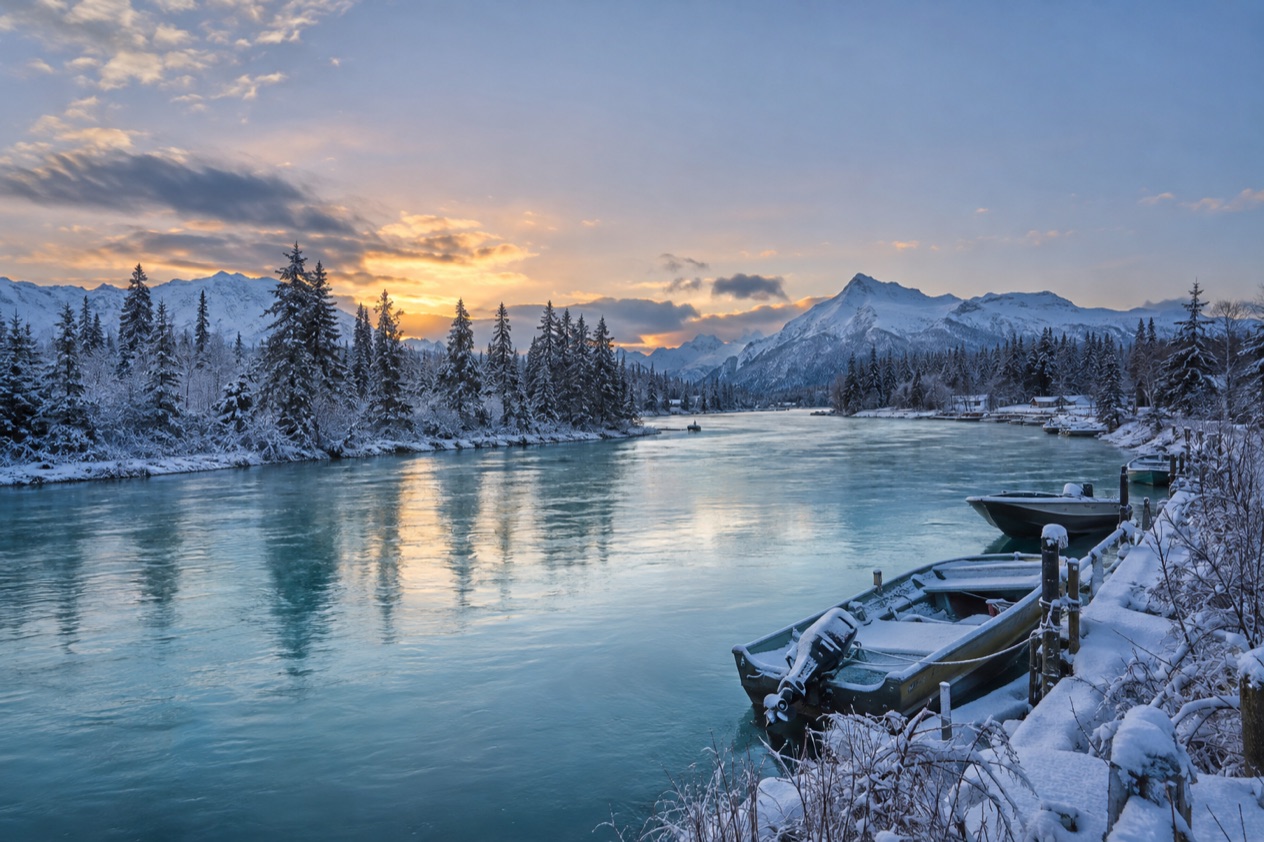
On a February morning in Soldotna, exhaust hangs in the cold air outside the coffee stands, and the spruce along the Kenai River carry a crust of frost that glitters when the low sun finally clears the trees. The long dark of midwinter is loosening, and the days stretch a little further every week. This is Kenai and Soldotna in the quiet, snowy part of the year, a month for people who like their Alaska cold, spare and uncrowded by summer standards.
What is the weather like in Kenai and Soldotna in February?
February here is properly cold but not the deepest cold of the winter, with highs that stay below freezing, nights that fall well into the teens or lower, and very little precipitation, most of it falling as snow.
| Month | Average high (°F) | Average low (°F) | Precipitation (in) | Days with precipitation | Daylight on the 15th |
|---|---|---|---|---|---|
| January | 22.4 | 7.4 | 0.89 | 2.6 | 6 h 30 min |
| February | 28.1 | 11.6 | 0.83 | 2.6 | 9 h 03 min |
| March | 32.7 | 14.4 | 0.64 | 1.4 | 11 h 39 min |
Mornings are the coldest part of the day, and you feel it in your fingers and face before you reach the car. By afternoon the thermometer climbs to just under the freezing point, which in still, bright weather feels almost mild once you are moving.
Evenings cool off quickly again, so the layers you shed at lunch go back on at dusk.
When it does arrive it is snow, not rain, so a waterproof shell matters less than a warm, windproof one and boots with real insulation and grip. Dry days can still leave slick patches where packed snow turns to ice, and that is the thing you notice first on sidewalks and parking lots.
The light is the real story of the month. Daylight has grown by about two and a half hours since mid-January, and you can feel it: a morning start no longer means working by headlamp, and the afternoons hold a soft, low glow that lingers over the river and the bare birches. It is still far from a summer day, so plan your outdoor hours around the middle of the day.
What to do in Kenai and Soldotna in February
February is a month for winter outdoors and for slow, small-town Alaska. Soldotna sits on the banks of the Kenai River in the center of the Kenai Peninsula, and Kenai lies where the river empties into Cook Inlet. The two towns share the same cold, bright winter, and what you do here is mostly about getting out into it, then warming up indoors afterward.
Do not expect the summer calendar. The Wednesday Market and the Levitt AMP concert evenings at Soldotna Creek Park belong to summer, so in February the park is a winter place, and the town’s energy moves to cafés, restaurants, local shops and community gatherings. Sports, school events and the winter pursuits of the peninsula fill the calendar instead.
The Kenai River in its winter dress
The Kenai River runs for 82 miles from Kenai Lake to Cook Inlet, and the stretch through Soldotna is where visitors meet it. In summer it is a busy fishing river.
In February it looks entirely different: steam may rise off open water on the coldest mornings, snow banks the shoreline, and the bare cottonwoods stand sharp against a pale sky. The stillness is the draw, and you hear the river more than you see people.
Go when the sun is highest, wear boots with a good sole, and let yourself stop often, because the cold light changes by the minute. Eagles and other birds sometimes work the open stretches of water, though that is a chance, not a promise.
Edge of the Kenai National Wildlife Refuge
Soldotna lies on the western edge of the Kenai National Wildlife Refuge, a protected area of nearly 2 million acres that shelters bears, moose, caribou, sheep and many species of fish and birds. In February the bears are not what you think about. What you look for instead are tracks pressed into fresh snow, the browsed willows that moose leave behind and the quiet of the boreal forest under a heavy white load.
A winter landscape here is one of spruce, birch and open muskeg, with the shapes of the mountains showing on a clear day. Wildlife sightings are chances, never guarantees, and the pleasure of the refuge edge in February is mostly its silence. Take a camera for the light on the snow and keep your expectations on the scenery.
Warming up in town
Soldotna is home to 5,000 people, with about 30,000 in the surrounding area, and it works as the service and retail hub of the Central Peninsula, which is why it sits where the Sterling Highway meets the Kenai Spur Highway. That makes it the place for a late breakfast, a hot bowl of soup, a stack of pancakes or a seafood dinner in the evening. Alaska’s coffee-stand habit is at home here, and a hot drink in a parked car with the heater running is a very local pleasure.
Kenai, at the river’s mouth, is the other half of the visit. A drive between the two towns is a chance to watch the light change over the flat country beside Cook Inlet. Winter dinners lean toward the comfort of the North: salmon and halibut when they are on the menu, chowders, burgers, and the kind of baked goods that make cold hands feel better.
Sterling, a community of nearly six thousand people on the western side of the peninsula, lies along the same Sterling Highway that links Soldotna with Cooper Landing and Homer. It is part of the same winter landscape of woods, small lakes and quiet roads, and it is a reminder that much of life here happens in scattered houses among the trees.
A two-day itinerary for Kenai and Soldotna in February
Day 1 belongs to Soldotna and the river. Begin with a slow breakfast at a café in town, since mornings are the coldest part of the day and there is no reason to hurry out. By late morning, when the temperature starts to rise, walk the Kenai River bank near Soldotna and take your time with the frozen edges and the open water.
After lunch, drive to the junction where the Sterling and Kenai Spur Highways meet and look into the local shops that make Soldotna a hub for the peninsula. As the light fades, which happens around the end of a daylight stretch of just over nine hours, head for dinner at a restaurant with a warm dining room and a menu built around Alaska seafood.
Day 2 moves to Kenai and the coast. Spend the morning on the road to Kenai, where the river meets Cook Inlet, and take in the winter shoreline in the brightest hours of the day.
On a clear evening, step outside after dinner and look up, because the aurora is a chance on any dark, clear night, never a promise.
Is Kenai and Soldotna busy in February?
No, February is the quiet season in both towns, and the pace is that of a working Alaska community, not of a destination. The summer attractions, such as the Wednesday Market and the Levitt AMP concerts in Soldotna Creek Park, belong to summer and are not part of the month.
Neither Kenai nor Soldotna has a deepwater port, and no ferries or cruise lines serve them, so there are no ship days in town. Visitors arrive by road, and the people you meet in cafés and shops are mostly residents going about their winter. That gives the month its character: you share the riverbank with a few walkers, and the restaurants feel like neighborhood places.
What to pack for Kenai and Soldotna in February
With highs below freezing and nights in the teens or colder, pack for dry cold and for standing around outside in it.
- An insulated, windproof parka, because mornings are the coldest hours and the wind makes them feel colder.
- Warm base layers, so you can add or remove a layer as the afternoon warms.
- Insulated boots with good traction, for packed snow and icy patches in parking lots.
- A warm hat, gloves and a neck gaiter for the river walks.
- Sunglasses, since low sun on snow is bright.
- A camera, with a spare battery kept warm in an inside pocket.
Good to know before you go
Daylight is the main thing that shapes a February day here, with a bit over nine hours in the middle of the month, so make the outdoor plans early and keep the evenings for indoor meals. Soldotna is reached by the Sterling Highway, which runs from the Tern Lake junction with the Seward Highway through Cooper Landing and Sterling, and then on down to Homer. Neither town has ferry or cruise service, so a road trip is how you arrive.
Kenai and Soldotna in February vs January and March
Going four weeks earlier means January, with the shortest days of the winter, about six and a half hours of daylight in the middle of the month, and the coldest highs and lows of the three months. It suits people who want dark, deep winter and long evenings. February already feels brighter and a little less severe.
Going four weeks later brings March, with highs reaching the low 30s, the least precipitation of the three months and nearly twelve hours of daylight mid-month. Days are long enough for a full outdoor day, and the cold begins to ease. The quiet remains, but the feel is closer to a spring thaw than a deep freeze.
Choose January for the darkest winter mood, February for the balance of cold and returning light, and March if you want longer days and a gentler chill. Anyone who wants summer fishing, markets and concerts should look to the summer months instead.
Is February a good time to visit Kenai and Soldotna?
Yes, for travelers who like cold, quiet places and are happy with a small-town winter, February is a good time to visit Kenai and Soldotna. It suits people who enjoy walking beside a river in the snow, drinking coffee in a warm café and watching the light return.
It is a poor fit for anyone who wants summer’s markets, concerts and long evenings, or who dislikes cold and early dark.
On arrival, start with a walk along the Kenai River in the brightest part of the day, then settle into a warm meal in Soldotna. What is special about February here is the stretch of light coming back to the river, the spruce and the snow, in towns that are simply living their winter.
Sources
- NOAA NCEI, U.S. Climate Normals 1991-2020, monthly (https://www.ncei.noaa.gov/access/services/data/v1?dataset=normals-monthly-1991-2020&stations=USW00026523), station Kenai Muni Ap, elevation 91 feet, checked October 11, 2026
- Computed from the date and the latitude of the place (sunrise equation, solar elevation -0.833 degrees), October 11, 2026
- Wikipedia, Kenai River (https://en.wikipedia.org/wiki/Kenai_River), checked October 11, 2026
- Alaska.org, dest soldotna (https://www.alaska.org/destination/soldotna), checked October 11, 2026
- Wikivoyage, Soldotna (https://en.wikivoyage.org/wiki/Soldotna), checked October 11, 2026
- Wikipedia, Soldotna, Alaska (https://en.wikipedia.org/wiki/Soldotna,_Alaska), checked October 11, 2026
- Wikipedia, Sterling, Alaska (https://en.wikipedia.org/wiki/Sterling,_Alaska), checked October 11, 2026
- Wikipedia, Climate of Alaska (https://en.wikipedia.org/wiki/Climate_of_Alaska), checked October 11, 2026
To plan your stay
- Things to Do in Kenai and Soldotna: Kenai River Fishing, the Old Town Walking Tour and Day Trips
- Where to Stay in Kenai and Soldotna: Kenai River Access, Refuge Gateways and Area Comparison
- Kenai Fjords Cruise from Seward: Wildlife, Coastline and Getting There
- Kenai Fjords National Park: Exit Glacier, Harding Icefield, Boat Tours and Wildlife