
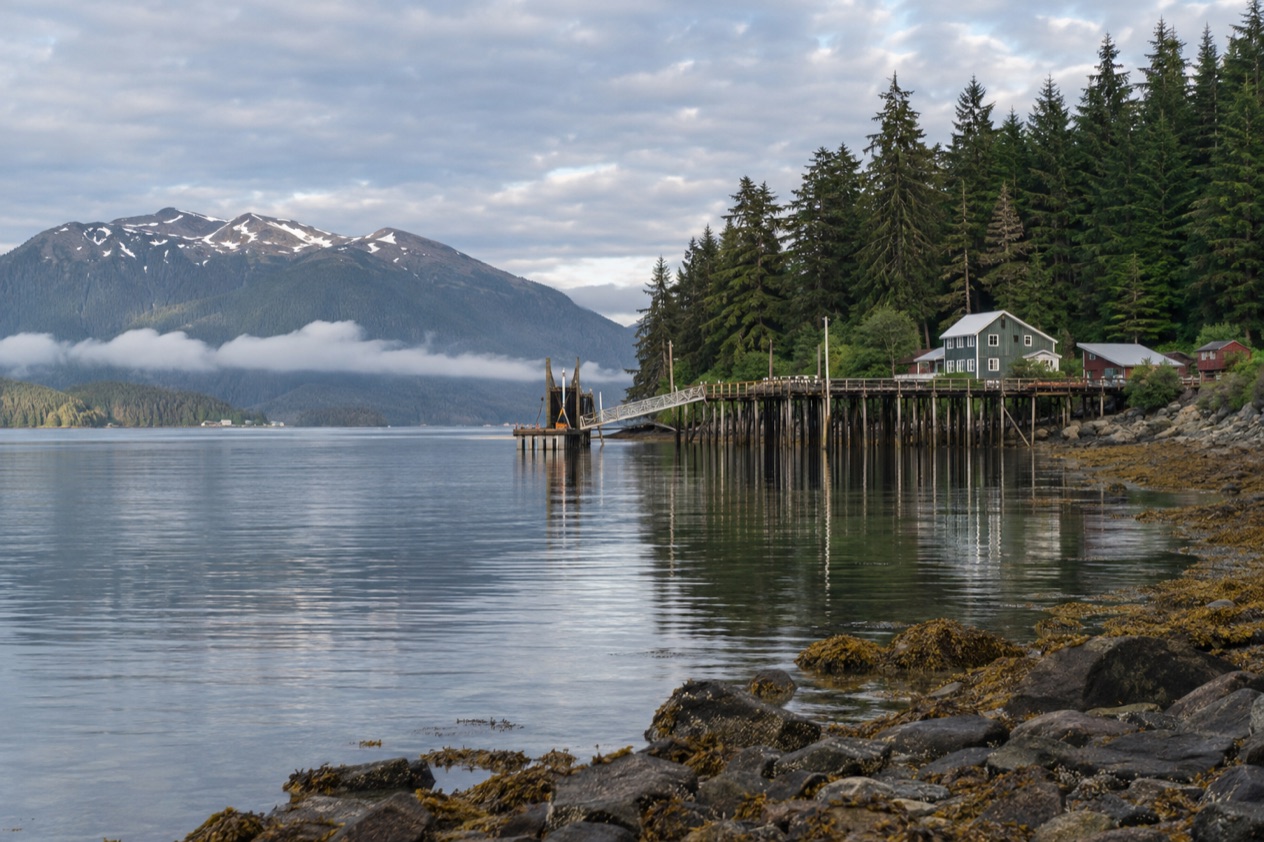
On the waterfront at Hoonah, old cannery roofs sit low against dark spruce, and the talk on the dock turns between Tlingit place names, fishing boats and the next seaplane. Behind the buildings, forest climbs straight up Chichagof Island. This is a working Tlingit village with a cannery turned museum at its edge, a place where history is still lived rather than staged, and it suits travelers who like their Alaska rooted in people and water.
Where is Hoonah and Icy Strait Point and what is it like?
Hoonah sits on Chichagof Island in Southeast Alaska, beside Icy Strait and near Glacier Bay, and Icy Strait Point is the old cannery district on the village’s edge. It is a small island community first and a travel stop second, and that order shapes everything about the visit.
Southeast Alaska is a long, island-strewn region of channels and forest, and its biggest cities are Juneau, Sitka and Ketchikan. Hoonah is none of those. It has no road network leading out to a larger world, and the only ways in are by boat or by plane. That single fact sets the pace. Things arrive on the ferry or on a small aircraft, and the village feels like a place you reach on purpose.
The people matter more than any building. Hoonah is a traditional Tlingit village, home of the Xúnaa Ḵáawu, and the Tlingit (Lingít) are an Indigenous people of the Pacific Northwest Coast whose historic territory covered almost all of the Alexander Archipelago.
Icy Strait Point itself is owned by Huna Totem Corporation, a company of about 1,350 Alaska Natives with ties to Hoonah and Glacier Bay. When you walk the site, you are walking land managed by the community whose home it is.
The place rewards people who like to look closely: weathered timber, a net loft, a boat unloading, a story told by someone who grew up here. It may disappoint anyone hoping for a resort strip, nightlife or a long list of big-name attractions. Hoonah is quiet in the way of small waterfront towns, and its appeal is in detail, history and the surrounding water and forest.
What is there to do in Hoonah and Icy Strait Point?
The big reasons to come are the cannery museum, Tlingit culture, a chance at brown bears and the village itself. What sets Hoonah apart from its neighbors is that it is a Tlingit-owned destination in a real village, not a town built around a single industry that left.
The cannery and its museum
The core of Icy Strait Point is the 1930s Hoonah Packing Company facility, now converted into a museum, a restaurant and shops. The long wooden buildings still read as a cannery, with their pitched roofs, pilings over the water and the plain practical shapes of a place built to process salmon. Walking through gives you a feel for the industry that shaped the coast, and the museum puts names and faces to the work.
It is a good place to slow down. You can look at the exhibits, browse the shops for Alaska-made goods, and sit down to a meal in the restaurant with the same working waterfront outside the window.
Anyone who likes industrial history, old photographs and the stories of the people who worked here will find the cannery the most rewarding stop. Take your time in the museum before you wander the shops, because the context makes the buildings around you much more readable.
Tlingit culture in a Tlingit village
Hoonah is a traditional Tlingit village, and the culture is part of daily life instead of a display. The Tlingit built their world around the coast, the salmon and the forest, and their territory ran from the Portland Canal at the present Alaska and British Columbia border up the coast and across the islands. Clan identity, carved art and storytelling remain central to who they are, and the community’s ownership of Icy Strait Point means that visitors meet that heritage on the community’s own terms.
Approach it as a guest. Listen more than you photograph, ask before you take pictures of people, and treat any carved work or regalia you see as belonging to living families, not as scenery. Tlingit people in Alaska live without reservations, because the Alaska Native Claims Settlement Act set up regional corporations instead, and Huna Totem is part of that story.
Looking for brown bears on the Spasski River
Visitors can search for coastal brown bears on the Spasski River near Icy Strait Point, but sightings are not guaranteed. That wording is worth taking seriously. A bear outing here is a chance, a patient scan of a river valley and forest edge, and it may end with a bear or with nothing but good scenery and the sound of moving water.
The experience suits people who enjoy watching and waiting more than ticking boxes. Bring binoculars and keep expectations open, and if a bear does appear, follow the guidance of the people leading the outing and of the National Park Service and Alaska Department of Fish and Game. The river and the forest around it are worth the time on their own.
The village waterfront
Hoonah’s own streets reward a slow wander. Fishing boats sit in the harbor, houses face the water, and the forested hills rise close behind. You see how the town lives, from workboats to small shops and neighbors talking outside, and that gives context to everything at the cannery.
How many days do you need in Hoonah and Icy Strait Point?
A day gets you the highlights, and a night or two lets you feel the village at an unhurried pace.
A short stay can cover the cannery museum, a meal in the restaurant, the shops and a walk through the village. Add a bear-watching outing on the Spasski River if you want a chance at wildlife, remembering that sightings are never guaranteed. That is a full, satisfying visit for anyone interested in Tlingit heritage and Southeast Alaska history.
With more time, the day opens up. You can go back to the museum with questions you did not have the first time, spend an unhurried morning in the village, and let the schedule follow the tides and the weather instead of a plan. A longer stay also means you see Hoonah when the dock is quiet, which is when the community feels most itself.
Juneau is the natural companion. Alaska Seaplanes runs multiple flights a day between Hoonah and Juneau, so pairing the two gives you a capital city and a Tlingit village in one trip. Glacier Bay lies near Hoonah and is part of the village’s story and the Huna Totem ownership, so it belongs in your planning if you want to widen the trip across Icy Strait.
Where to stay in Hoonah and Icy Strait Point
Your base is Hoonah itself, the village on Chichagof Island, with Icy Strait Point as the cannery district at its edge. There is no spread of resort zones or neighborhoods to choose between, and that simplicity is part of the appeal.
Staying in the village puts you inside the community. You are near the harbor, the ferry facility and the streets where people actually live, which suits travelers who want to feel the rhythm of a Tlingit village from morning to evening. It is the right choice if you came for culture, history and the quiet of a small place.
Icy Strait Point, with its restored cannery buildings, museum, restaurant and shops, is the part of the area shaped most around visitors. It suits anyone who wants to be close to the museum and the waterfront buildings and to pair a stay with time in the village. The two areas sit together, so choosing one does not cut you off from the other.
Because the options are few, think about what you want from the stay before you pick. If you want to see the village in its off-hours, when the main activity has slowed and the harbor is quiet, a night in town gives you that.
How do you get to Hoonah and Icy Strait Point and get around?
You reach Hoonah by boat or by plane, because it is accessible no other way. There is no road connection to the rest of Alaska, which is true of much of Southeast Alaska and a big reason the region feels the way it does.
By air from Juneau
Air carrier Alaska Seaplanes offers multiple flights a day between Hoonah and Juneau. Hoonah Airport has a 3,000-foot runway, which fits the small aircraft that serve the route. For travelers who want a quick link to Alaska’s capital, this is the practical connection, and it makes pairing the two places straightforward.
A small aircraft over the channels and forested islands is an experience in itself, and the view across Icy Strait is part of arriving. It is a good option when you want to link Hoonah with a longer Southeast Alaska itinerary built around Juneau.
By ferry
The Alaska Marine Highway serves Hoonah with the M/V LeConte. The Alaska Department of Transportation built a new ferry facility in Hoonah that opened in early 2001, and it is where the ferry connects the village to the state’s marine highway system. Traveling by ferry gives you the slower, more scenic approach, with the coastline unfolding at the speed of the water.
By cruise ship
Icy Strait Point opened for cruise ships in 2004, and the cannery district was shaped around that arrival. If you come on a cruise that calls here, the cannery buildings, museum, restaurant and shops are the heart of the site you step into.
Getting around once you are here
Hoonah is a small village on Chichagof Island, and the place is best understood on foot, with the harbor, the village streets and the cannery district all part of one compact area. Bear viewing on the Spasski River near Icy Strait Point is a separate outing rather than part of a casual walk. Beyond that, the forest and water around Hoonah are what you came to see, so let the setting set the pace.
When is the best time to visit Hoonah and Icy Strait Point?
The cannery museum, the village streets and the harbor are the constants, and the bear search on the Spasski River is a chance whenever you try it, never a promise.
Hoonah is a coastal island community, so the character of a visit follows the sky and the water. A gray, misty day suits the old cannery buildings and the museum, with the forest low in cloud above the roofs. A clearer day opens the view across Icy Strait and shows how close the mountains and water sit to the village. Both versions are Southeast Alaska, and neither is a mistake.
Since Icy Strait Point opened for cruise ships in 2004, the waterfront has been shaped by ship calls, and the village feels different when one is in and when it is not. If you like lively activity at the cannery, time your visit with that in mind. If you prefer the quiet of a small Tlingit village, give yourself time in town when the dock is calm.
Good to know before you go
Hoonah is a community first, so treat it that way. Icy Strait Point is owned by Huna Totem Corporation, and the village around it is home to Tlingit families, which makes courtesy and curiosity the right habits. Ask before photographing people, listen to the stories you are offered, and take a slow walk through the village as well as the cannery.
Because Hoonah can be reached only by boat or plane, plan your arrival and departure around the ferry or the Alaska Seaplanes flights to Juneau. For bears, follow the guidance of the National Park Service and the Alaska Department of Fish and Game, and remember that a sighting on the Spasski River is never guaranteed.
Sources
- Wikipedia, Hoonah, Alaska (https://en.wikipedia.org/wiki/Hoonah,_Alaska), checked October 11, 2026
- Wikipedia, Icy Strait Point (https://en.wikipedia.org/wiki/Icy_Strait_Point), checked October 11, 2026
- Wikipedia, Tlingit (https://en.wikipedia.org/wiki/Tlingit), checked October 11, 2026
- Wikipedia, Southeast Alaska (https://en.wikipedia.org/wiki/Southeast_Alaska), checked October 11, 2026
- Wikipedia, Climate of Alaska (https://en.wikipedia.org/wiki/Climate_of_Alaska), checked October 11, 2026