
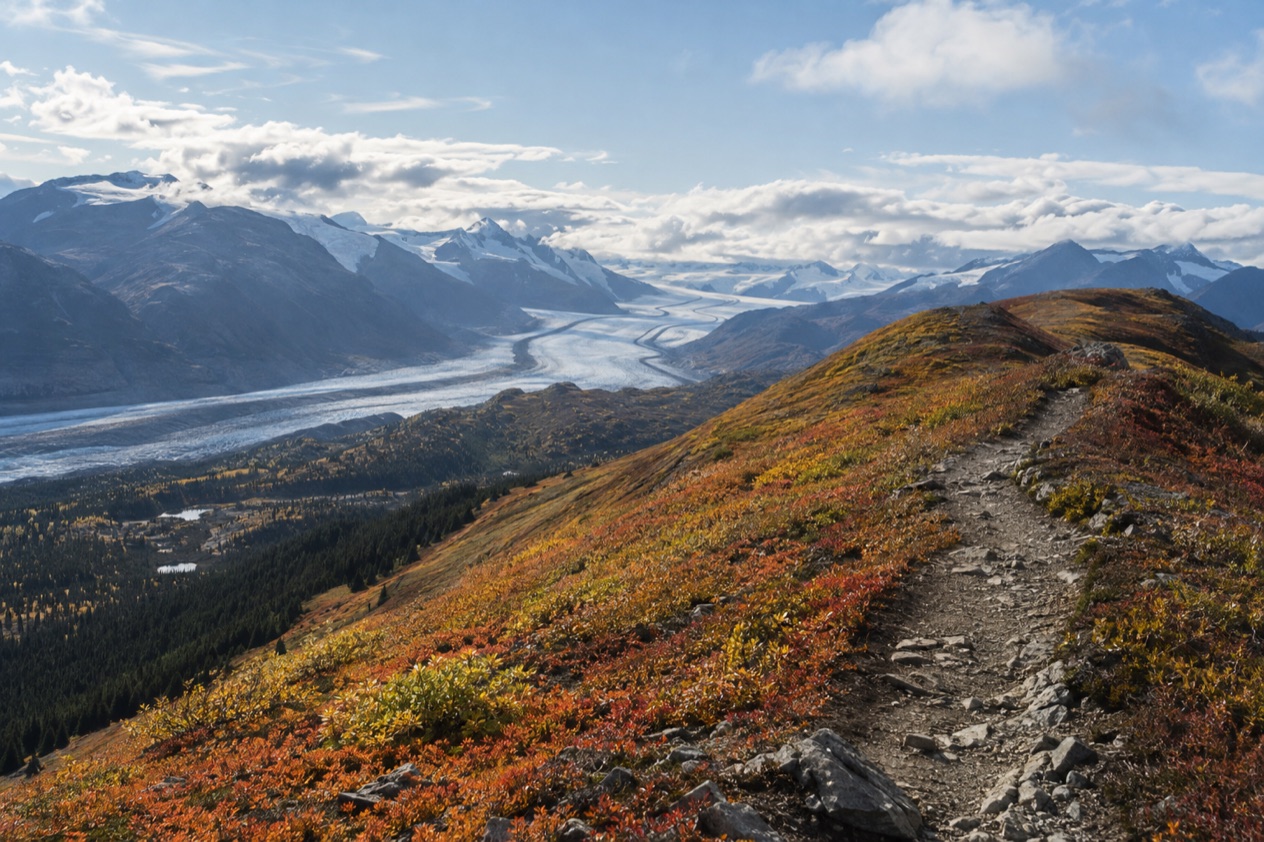
A head net hangs from a pack strap, a water bottle is full, and the trail ahead leads toward a glacier or a ridge with no fence in sight. That is hiking in Alaska, where a marked path can end at a lake of ice and the land beyond the path is often open to you. Denali, the Chugach Mountains above Anchorage, Kachemak Bay near Homer, Skagway’s Chilkoot Trail and Hatcher Pass all offer a different version of it.
Where can you hike in Alaska?
You can hike in nearly every corner of the state, but a handful of places gather most of the walking: Denali National Park, Chugach State Park near Anchorage, Kachemak Bay State Park across the water from Homer, Kenai Fjords near Seward, the Chilkoot Trail from Skagway, and the mountain road at Hatcher Pass.
Denali: marked trails or no trail at all
Denali offers two ways to hike. You can follow a marked trail, or you can head off-trail in nearly any direction you choose. Most parks ask visitors to stay on the path, and Denali is unusual in also giving you trail-less wilderness to explore. The marked trails are mostly short and gather around the Denali Visitor Center, near the park entrance, so a first walk can begin right from the buildings.
Off-trail walking feels different from anything on a groomed path. You pick your own line across open ground, stop when a view asks you to, and turn around when you decide. It suits people who are comfortable reading terrain and carrying what they need. If you would rather have a guide in the form of a ranger, the Discovery Hikes described later are the park’s organized way into the backcountry.
Chugach State Park and Eklutna Lake
Chugach State Park is huge, about 495,000 acres, and its western edge sits seven miles east of downtown Anchorage. Communities such as Eagle River, Girdwood, Palmer and the village of Eklutna lie within minutes of it, so a hike can start the same morning you wake up in the city. It is counted among the four largest state parks in the country.
At Eklutna Lake, the Lakeside Trail runs 12.7 miles along the shore to the mile-long Eklutna Glacier Trail, which leads to the moraines at the foot of the glacier. The Lakeside Trail is largely flat, and in summer people use it on foot, by mountain bike, ATV or horseback.
Boats on the lake must be non-motorized or electric. Near Eagle River, a nature center run by a non-profit explains the wildlife and geology of the park, a good first stop before you head onto the trails.
Kachemak Bay State Park, across from Homer
Homer sits on the shore of Kachemak Bay on the Kenai Peninsula, and the state park across the bay covers over 400,000 acres with more than 80 miles of trails. The landscape mixes glacier, lake and coastline, and it is a place where hikers often connect one trail to the next rather than walking out and back.
A popular pattern is to walk the Glacier Lake Trail, then continue on the Saddle Trail to Halibut Cove, where a water taxi can pick you up. That way the day ends on the water instead of retracing your steps. It is a hike for people who like a loop with a boat ride built in.
Kenai Fjords, Skagway and Hatcher Pass
Near Seward, Kenai Fjords National Park centers on the coast, Exit Glacier and the Harding Icefield. The park describes itself as remote, rugged and unpredictable, with changing weather and possible wildlife encounters, which is worth keeping in mind when you plan a day on its trails. Exit Glacier Road status can be checked through the park’s current conditions page.
From Skagway, the Chilkoot Trail begins at Dyea, and at Hatcher Pass, about 12 miles from Palmer and Wasilla, the road climbs to 3,886 feet through the Talkeetna Mountains. Most of that country lies inside the Hatcher Pass East Special Management Area, 75,000 acres of wilderness. The Hatcher Pass Lodge in Independence Valley offers food and lodging, and the central part of the road is usually closed by snow from late September to July.
Which trails are best known?
The Chilkoot Trail, Denali’s Triple Lakes Trail, the Eklutna Lakeside Trail and Kachemak Bay’s Glacier Lake Trail are among the trails hikers talk about most, and each suits a different kind of day, from an afternoon to several nights.
Chilkoot Trail
This is the long one: 33 miles from Dyea, Alaska, to Bennett, British Columbia, following the route of gold rush stampeders. Along the way the trail gains about 3,500 feet, and Chilkoot Pass roughly marks the halfway point and the international border.
The official hiking season usually begins in late May and ends in early September, the period when rangers are on duty and a trail crew is on site. Demand peaks from June through August.
Overnight hikers need a validated permit between June 1 and September 12, and no more than 50 backpackers may start each day. Camping is allowed only in the nine designated campgrounds. Crossing the border at the pass is illegal in either direction, and firearms are not permitted on the Canadian side.
Triple Lakes Trail in Denali
At 9.5 miles, Triple Lakes is the longest trail in Denali. It links the Tsenesdghaas Na’ Trailhead near mile 231 of the George Parks Highway with the Denali Visitor Center Campus, so it is a way to walk from the highway into the heart of the park’s trail network. Because most other marked trails are short and stay near the entrance, this one gives a fuller day.
Two other Denali trails come with notes. The Savage River Loop and Savage Alpine Trail have a group size limit of 12 people. The McKinley River Bar Trail, which leads from Wonder Lake Campground to the McKinley River, is plagued by mosquitoes most of the summer, so bring a head net.
Glacier Lake and Eklutna
Near Homer, the Glacier Lake Trail runs 3.2 miles to Grewingk Glacier Lake with very little elevation gain, and the guidebook calls it easy. It is the first leg of the Saddle Trail route to Halibut Cove described above. Humpy Creek Trail has a tram spur whose tram may need two people to operate and has a maximum weight of 500 pounds.
At Eklutna, the Lakeside Trail and the glacier trail at its end make one long, mostly flat outing along the lake. In winter the same trail is used by snowmobile, snowshoe or cross-country ski, as regulation and weather allow. Two other trails come with cautions: past the Lower Summit on Poot Peak Trail, only climbers with rock climbing training should continue, and the Albert Loop Trail near Eagle River is closed in the fall when bears are fishing in the area.
What should you know before you go?
Know your water, your bears and your seasons. Alaska’s trails are wild, and the details of each park decide what a good day looks like.
Denali Discovery Hikes
Discovery Hikes begin in mid-June each year, with one hike each day through late summer, though the exact ending date varies. You sign up one or two days in advance, in person only, at the Denali Visitor Center, and everyone in your party must be present.
You cannot sign up the morning of a hike. Children age 8 to 17 may join only with an adult guardian 18 or older, and children under 8 may not sign up.
Signing up gets you a voucher for a reserved seat on the 8:00 am transit bus. Most hikes require buying a bus ticket, but there are always enough seats for Discovery Hikers. Expect a bus ride of thirty minutes to two hours, three to five hours of hiking, and a similar ride back, so the day can last up to 10 hours. Bring at least two liters of water per person.
Bears, water and food
Black bears, brown bears and polar bears all live in Alaska, and the state requires that people keep all human sources of food secure from bears. The Alaska Department of Fish and Game has a page on bear resistant containers, and dangerous bear situations should be reported through its wildlife encounter form. Surface water from streams and lakes in Denali should be both filtered and disinfected before you drink it.
Seasons and access
Seasons shape every plan. The Chilkoot Trail has its ranger season from late May to early September, and the Hatcher Pass road is usually closed by snow from late September to July, with skiers and snowmachines using it in winter and spring.
The road itself is unpaved and minimally maintained for about 20 miles. At Homer’s Calvin & Coyle Trail, parking at the end of Mariner Drive is limited, and RVs and other large vehicles are prohibited.
If you arrive by cruise ship, ports such as Skagway, Juneau and Ketchikan put you near trails and, in Ketchikan, a state historical park with totem poles. Juneau’s airport dike trail is also open for a walk.
Good to know before you go
Camping is where fees show up most clearly. At Chugach State Park’s Eagle River Campground, the group camping area, the tent platforms and the picnic pavilion are reservable, and Eklutna Lake has two group camping areas that can be booked separately or together. Carry food in bear-secure ways, and remember that many trails here have their own season or closure.
| Fee | Amount | Who pays |
|---|---|---|
| Eagle River Campground group camping area | $150 per night | Groups camping there |
| Eagle River Campground tent platform | $35 per night | Tent-only groups |
| Eagle River Campground picnic pavilion | $35 per night | Groups reserving the pavilion |
Sources
- National Park Service, Denali National Park & Preserve, plan your visit: dayhiking (https://www.nps.gov/dena/planyourvisit/dayhiking.htm), checked October 11, 2026
- National Park Service, Denali National Park & Preserve, plan your visit: discovery hikes (https://www.nps.gov/dena/planyourvisit/discovery-hikes.htm), checked October 11, 2026
- Wikipedia, Chugach State Park (https://en.wikipedia.org/wiki/Chugach_State_Park), checked October 11, 2026
- Alaska State Parks, Chugach region (https://dnr.alaska.gov/parks/aspunits/chugach/chugachindex.htm), checked October 11, 2026
- Wikipedia, Hatcher Pass (https://en.wikipedia.org/wiki/Hatcher_Pass), checked October 11, 2026
- Homer, hiking and trails (https://www.homeralaska.org/things-to-do/outdoors-and-recreation/hiking-and-trails/), checked October 11, 2026
- National Park Service, Kenai Fjords National Park, plan your visit (https://www.nps.gov/kefj/planyourvisit/index.htm), checked October 11, 2026
- Wikipedia, Chilkoot Trail (https://en.wikipedia.org/wiki/Chilkoot_Trail), checked October 11, 2026
- National Park Service, Klondike Gold Rush National Historical Park (Skagway), plan your visit: planning your hike (https://www.nps.gov/klgo/planyourvisit/planning-your-hike.htm), checked October 11, 2026
- Alaska Department of Fish and Game, Living with bears (https://www.adfg.alaska.gov/index.cfm?adfg=livingwithbears.main), checked October 11, 2026
- Alaska Department of Fish and Game, Wildlife viewing (https://www.adfg.alaska.gov/index.cfm?adfg=viewing.main), checked October 11, 2026
- Juneau International Airport (https://juneau.org/airport), checked October 11, 2026
- Princess Cruises, Alaska cruise tips (https://www.princess.com/en-us/cruise-destinations/alaska-cruises/alaska-cruise-tips), checked October 11, 2026
- Princess Cruises, Alaska cruises (https://www.princess.com/en-us/cruise-destinations/alaska-cruises), checked October 11, 2026