
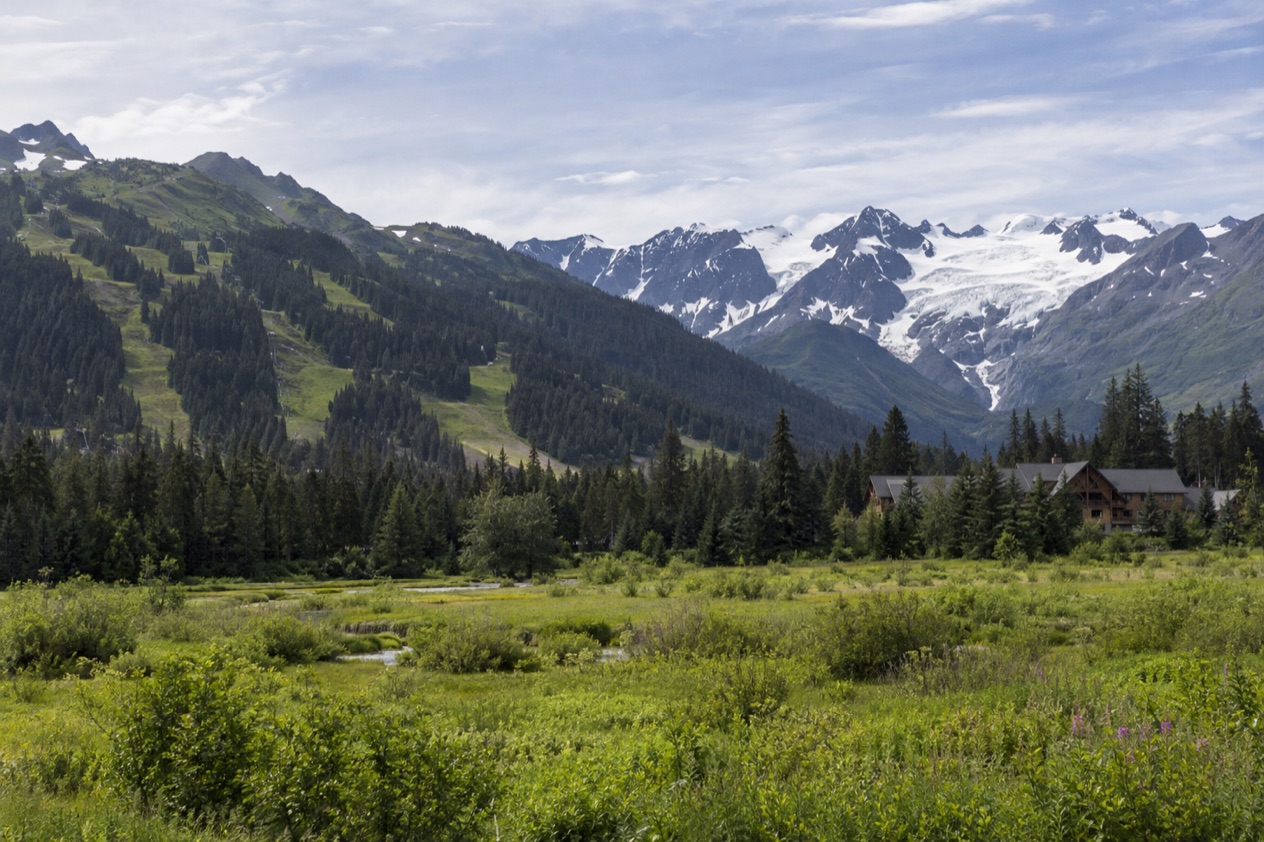
Down in the Girdwood valley, the moss hangs thick on the spruce, a creek talks beside the trail, and above the treeline the aerial tram slides up the face of Mount Alyeska toward the snowfields. Glaciers hang from the peaks that wall the valley in, and the tide empties out of Turnagain Arm below the highway.
Girdwood is a small mountain resort town on the edge of Anchorage, built around a ski area and a rain forest. It suits travelers who want trails, ridgelines and a warm lodge at the end of the day.
Where is Girdwood and what is it like?
Girdwood is a resort town in the southern part of the Municipality of Anchorage, tucked into a mountain valley near the end of Turnagain Arm, 37 miles south of the city. It sits among the Chugach Mountains, and a ring of seven glaciers surrounds the valley. The Seward Highway, which carries most traffic toward the Kenai Peninsula, passes the turnoff at Milepost 90.
The place feels like a mountain village that happens to belong to a big city. Alyeska Resort anchors everything, and it is the largest ski area in Alaska.
Around it, the valley holds trailheads, forest and a small community rather than a long main street of shops. The pace is that of a ski town: you plan your day around a lift, a trail or a view, then retreat to a restaurant or a hotel bar when the light goes.
The setting changes your idea of what Alaska looks like. Instead of open tundra or a harbor full of boats, Girdwood gives you dense forest, steep rock walls and ice. The Winner Creek Trail runs through the northernmost rainforest in the United States, so moss, ferns and wet bark are as much a part of the scene as snow.
Girdwood rewards people who like to be outdoors and are happy to be near a lodge at night. It may disappoint anyone hoping for a busy harbor, a line of gift shops or a large nightlife scene. The town is built around the mountain, and the mountain sets the schedule.
Turnagain Arm shapes the approach. It is a long, narrow inlet, and its tides rise as much as 40 feet, the largest in the United States. At low tide the water drains away and leaves a broad mud flat cut by stream channels. The flood tide often arrives as a tidal bore, a wall of water that moves at about the pace of a jogger.
What is there to do in Girdwood?
Girdwood offers mountain days, forest walks and a handful of short excursions to glaciers and wildlife. It stands apart from its neighbors in having a full ski resort, a rain-forest trail and a historic gold-mining site inside one small valley.
Alyeska Resort and the aerial tram
Alyeska Resort is the center of the valley. Skiing and snowboarding are what bring most winter visitors, with a vertical drop of 2,500 feet for lift-served skiing and a total of 3,200 feet. The runs are mostly for confident skiers: more than half are rated more difficult, and over a third most difficult.
You do not have to ski to go up. Visitors can ride an aerial tram to the top of the mountain, where there is a restaurant, a bar and a gift shop. Near the summit stands the Mt. Alyeska Roundhouse, an octagonal building on the National Register of Historic Places that now houses a museum of local ski history. A ride up gives you a look at the glaciers and the arm of water below.
In winter the resort also lists heli-skiing and cat-skiing tours, and Northern Lights viewing is on its winter list too. The aurora is a chance, not something to count on. Summer brings a different program of sightseeing, biking and activities for children.
Winner Creek Trail and the rain forest
The Winner Creek Trail winds through the northernmost rainforest in the US and ends at a thundering waterfall. The walk is mostly about the forest itself: tall evergreens, wet moss and the sound of the creek growing louder as you go. It gives you the green side of Alaska, far from the open tundra of the postcards.
A trail like this is best for slow walking with a camera and no deadline. Pair it with a meal at the resort, so the day has a clear shape: forest in the morning or afternoon, mountain views from the tram, then dinner in the valley.
Crow Creek Gold Mine
Crow Creek Gold Mine is a historic gold mine area that is open to the public as a tourist attraction. It carries a bit of Alaska’s prospecting past into a valley otherwise known for skiing. Expect old mining structures and a setting among the creeks and mountains that made the place worth digging.
It suits travelers who like history with their scenery, and anyone traveling with people who might not want a full mountain day. Treat it as a stop that sits alongside the trails and the tram, not as a replacement for them.
Wildlife and glacier outings from Girdwood
The Alaska Wildlife Conservation Center is highlighted by Alyeska Resort as an activity in both summer and winter, which makes it one of the few outings that does not depend on the season. The resort also points guests to the Begich, Boggs Visitor Center at Portage Glacier and to Whittier and Prince William Sound.
At Portage Glacier, the glacier ends in a lake and is retreating. In summer a boat ride across Portage Lake is required to see it, and commercial boat tours are available. In winter, if the lake freezes, the glacier sees foot, bike and ski traffic. Nearby Portage itself is a ghost town: the ground sank about six feet in the 1964 earthquake, and a ghost forest of salt-killed trees marks the spot.
How many days do you need in Girdwood?
A long weekend is enough to enjoy Girdwood, and a few extra days let you add the glacier country around it. The town does not need a long list of sights. It needs time to move at the speed of the valley.
In a short stay, build the days around the mountain. If the weather turns wet, the rain forest looks even greener, and the resort restaurants and the Roundhouse museum give you indoor options. A visit to Crow Creek Gold Mine fits in as a lighter outing.
In winter, a short stay naturally revolves around skiing or snowboarding, with the aurora as a possible bonus on a clear night. In summer, the resort’s biking, sightseeing and children’s activities fill the same space. Either way, two or three nights lets you do one big thing a day without rushing.
With more time, Girdwood works as a base for the surrounding country. The Alaska Wildlife Conservation Center is one outing. Portage Glacier is another, with the Begich, Boggs Visitor Center and the boat ride on Portage Lake in summer. People also go on to Whittier and Prince William Sound, reached through the Anton Anderson Memorial Tunnel from the Portage junction.
The Portage area has more to offer for longer stays: floating the Portage, Twentymile and Placer rivers, fishing for hooligan in the Twentymile River, and skating on marshy areas, creeks and Portage Lake in winter. The Alaska Railroad also stops here, so trains like the Glacier Discovery can carry you to Whittier, Portage and Spencer Glacier. Spread across a week, this makes a comfortable mix of valley days and day trips.
Chugach State Park, which borders the area, is another reason to linger. It covers about 495,000 acres and is one of the four largest state parks in the country. Its trails and lakes, such as Eklutna Lake, give you more to explore if you have a full week and want to see more of the mountains behind Anchorage.
Where to stay in Girdwood
The main place to stay in Girdwood is Alyeska Resort, a hotel and ski resort at the base of Mount Alyeska in the heart of the Chugach Mountains. Staying here puts you beside the aerial tram, the restaurants and the winter lifts, which matters most to skiers and to anyone who wants the mountain at the door.
The resort is about 45 minutes outside Anchorage. For travelers who want to be near the trails without a long transfer each morning, that distance is easy to bridge. The hotel also runs a green stay initiative: guests who stay two nights or more can decline housekeeping and receive a $5 per day dining voucher.
The other way to do it is to stay in Anchorage and visit Girdwood for the day. That works for travelers who prefer a city base with more restaurants and shops, and who want to see the mountain on a single outing. It makes less sense if your priority is early skiing, an evening tram ride, or a clear night for the aurora, since the valley is where you want to be.
Think of the choice this way. The resort suits skiers, couples and families who want the mountain and the dining in one place. A day trip from Anchorage suits travelers with limited time who want a sample of the valley. Anyone planning to use the Alaska Railroad can also treat Girdwood as one stop on a longer rail trip, getting off for a night or two before moving on.
How do you get to Girdwood and get around?
The usual way to reach Girdwood is by road from Anchorage along the Seward Highway, a drive of about an hour. The town is reached by the turnoff at Milepost 90, and the highway runs along Turnagain Arm at the edge of Chugach State Park. It is a scenic road but can be slow during peak summer travel times.
There is also a train from Anchorage to Girdwood, which takes about an hour and a half. Two Alaska Railroad trains stop here. The Coastal Classic runs between Anchorage and Seward, and the Glacier Discovery stops in Whittier, Portage and Spencer Glacier. That makes the town a useful stop for anyone linking several places by rail.
The route in is part of the experience. The road and the railroad both follow the edge of Turnagain Arm, where the tide pulls out to leave wide mud flats, and the mountains of Chugach State Park rise beside the water. On a flood tide the bore may be visible as a pulse of water moving up the arm.
Once in Girdwood, the valley is organized around the resort and its trailheads. Many of the best things to do are at the resort itself, including the aerial tram, or on trails like Winner Creek. For the outings farther afield, such as Portage Glacier, the Alaska Wildlife Conservation Center and Whittier, the road and the railroad are the connections the area relies on.
When is the best time to visit Girdwood?
Girdwood has two clear seasons for visitors, winter for skiing and summer for hiking, biking and glacier outings. Alyeska Resort publishes a separate activities guide for each, which shows how different the two versions of the valley are.
Winter is when skiing and snowboarding draw people to the valley, and it is the season for heli-skiing and cat-skiing tours. Northern Lights viewing is also on the resort’s winter list, though the aurora is only ever a possibility on a clear night.
The Alaska Wildlife Conservation Center is listed as a winter activity as well, so there are options for days away from the slopes. At Portage Glacier, a frozen lake brings foot, bike and ski traffic.
Summer opens up the trails and the boat tours. The Winner Creek Trail goes through the rain forest to its waterfall, the aerial tram carries visitors up the mountain, and the resort lists sightseeing, biking and children’s activities.
At Portage Glacier, the boat ride across Portage Lake is required to see the ice, and commercial tours run in summer. The Seward Highway can be slow during peak summer travel times, so allow extra time on the road.
If you love to ski, come for winter. If you want rain-forest trails, glacier boat rides and long walks, come for summer. Either way, the mountain, the forest and the arm of the sea are the constants, and each season simply changes how you meet them.
Good to know before you go
Girdwood is small, and most of what you will want sits in and around the resort, so plan your meals and your days around it. Skiing, the aerial tram and winter tours belong to the cold season, while the Portage Lake boat ride belongs to summer, so pick your outings to match the time of year you visit.
At low tide the mud flats along Turnagain Arm are not a place to wander, and the Seward Highway is where you will see them. Resort staff and the Visit Girdwood website carry winter information for anyone planning a cold-season stay.
Sources
- Alaska.org, dest girdwood (https://www.alaska.org/destination/girdwood), checked October 11, 2026
- Wikivoyage, Girdwood (https://en.wikivoyage.org/wiki/Girdwood), checked October 11, 2026
- Wikipedia, Girdwood, Alaska (https://en.wikipedia.org/wiki/Girdwood,_Alaska), checked October 11, 2026
- Alyeska Resort, Girdwood (https://www.alyeskaresort.com/), checked October 11, 2026
- Alyeska Resort, summer (https://www.alyeskaresort.com/summer/), checked October 11, 2026
- Alyeska Resort, winter (https://www.alyeskaresort.com/winter/), checked October 11, 2026
- Wikipedia, Alyeska Resort (https://en.wikipedia.org/wiki/Alyeska_Resort), checked October 11, 2026
- Wikipedia, Turnagain Arm (https://en.wikipedia.org/wiki/Turnagain_Arm), checked October 11, 2026
- Wikipedia, Portage, Alaska (https://en.wikipedia.org/wiki/Portage,_Alaska), checked October 11, 2026
- Wikipedia, Portage Glacier (https://en.wikipedia.org/wiki/Portage_Glacier), checked October 11, 2026
- Wikipedia, Chugach State Park (https://en.wikipedia.org/wiki/Chugach_State_Park), checked October 11, 2026
- Alaska State Parks, Chugach region (https://dnr.alaska.gov/parks/aspunits/chugach/chugachindex.htm), checked October 11, 2026
- Wikipedia, Climate of Alaska (https://en.wikipedia.org/wiki/Climate_of_Alaska), checked October 11, 2026