
A halibut comes up from the bottom of the water like a heavy, flat door, and the whole boat leans over the rail to watch it appear. On the dock afterward there is the slap of fish on cleaning tables, the smell of herring bait and a lot of grinning.
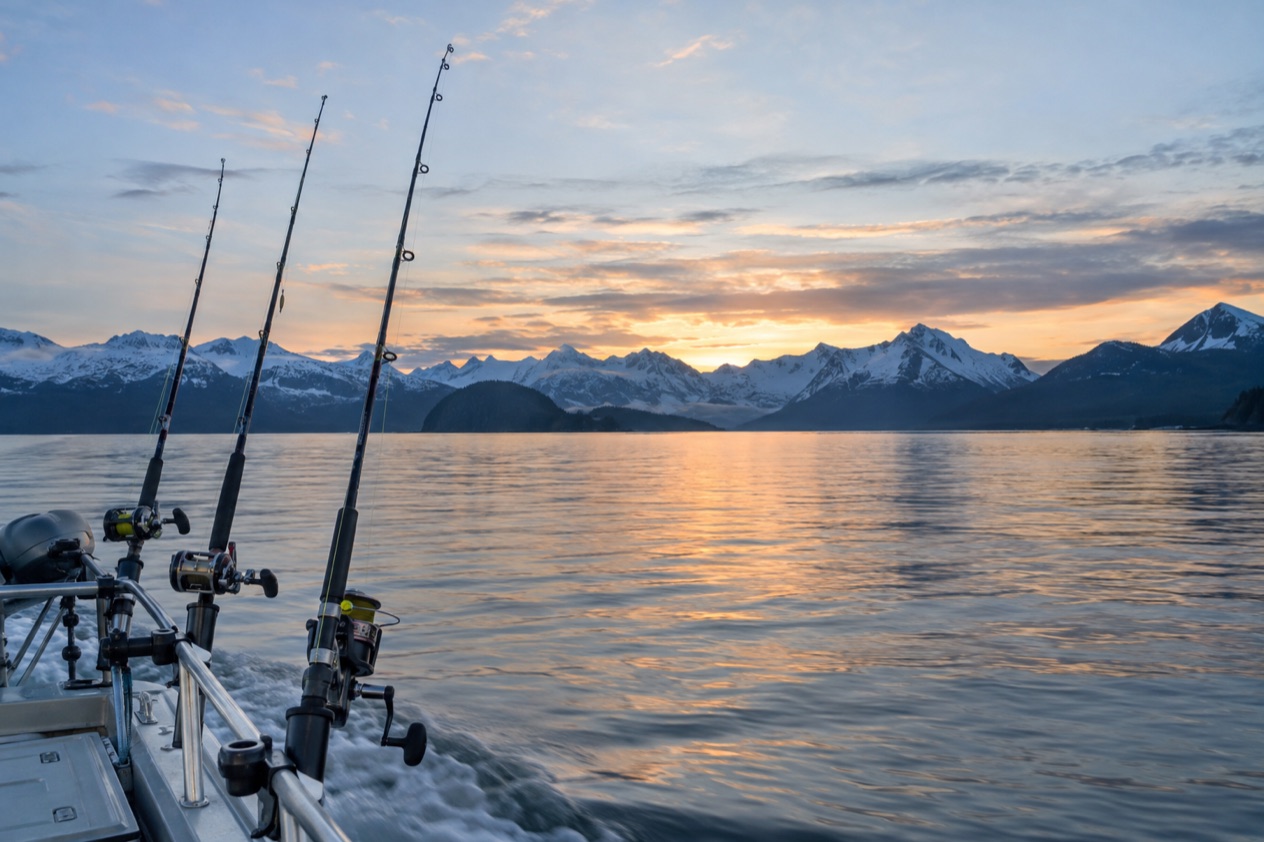
What kinds of fishing are there in Alaska?
Alaska fishing comes in two broad kinds: saltwater trips after halibut, salmon, lingcod and rockfish, and freshwater fishing for salmon and trout in rivers and lakes. Both are managed by the state, and Alaska’s Division of Sport Fish works year-round to protect, manage and improve sport fisheries across the state. For a visitor, the choice usually comes down to a boat with a captain, a spot on a riverbank, or a small lagoon where you can fish from shore.
The Rod Loaner Program rents fishing gear for free, so you can get out on the water without packing a rod from home. Hatchery tours are also available if you would like to see the fish up close and learn how they are managed. Both are good ideas for a rainy afternoon or for travelers who are curious about the fish before they try to catch one.
Halibut: the big flatfish of the bottom
The Pacific halibut is a very large flatfish that lives on or near the bottom, where the water is cold. Anglers go after it with bait, and most prefer herring, though squid, octopus, cod pieces and other small bottom fish also work. You drop the line, wait on the deck, and then the fight begins, a long, heavy pull that is more about stamina than speed.
Most halibut taken by anglers weigh in the range of 15 to 20 pounds, but much bigger fish turn up regularly. Fish over 150 pounds are caught, which explains the tall tales told at the dock. Halibut fishing suits anyone who likes a steady day on a boat with a real chance at a heavy fish and a freezer full of fillets.
Halibut fishing is regulated by the International Pacific Halibut Commission, which meets yearly to set the rules for the next season. In Homer, anglers start targeting halibut in earnest in May and keep at it through September.
Salmon: kings, silvers and the rest
Pacific salmon are anadromous, meaning they migrate between the ocean and fresh water, and they die after spawning. That life cycle is why rivers fill with fish at certain moments and why the sport is tied so closely to the calendar. King salmon, also called Chinook, are the prize for many anglers. Silver salmon, or coho, are a favorite for their hard runs and bright flesh.
Chum, sockeye and pink salmon also swim Alaska’s waters. Pink salmon in the Kenai River run only in even-numbered years, so the river can feel quite different from one year to the next. Alaska is the northern edge of the range for several of these species, which is part of the reason fishermen travel here from the Lower 48.
Lingcod, rockfish and trout
Bottomfish trips add lingcod and rockfish to the day. Lingcod retention season opens July 1, and many anglers plan their bottomfish trips with that date in mind. Lingcod are long, toothy fish with a good reputation at the table, and the state record is a hefty 85 pounds.
Rainbow trout, meanwhile, live in streams and lakes throughout southwestern and southeast Alaska. They are the fish for people who prefer a quiet bank, a light rod and a day with fewer people around, and they offer a different rhythm from the heavy-tackle world of the halibut boats.
Where do people go?
Visitors head to Homer for saltwater fishing and to the Kenai River near Kenai and Soldotna for salmon, while halibut anglers also fish around southeast Alaska, Kodiak and Cook Inlet. More than 65 percent of the halibut effort and harvest happens in Cook Inlet, southeast Alaska, the Kodiak area and near the mouth of Deep Creek in the Lower Cook Inlet. The GoFishAK interactive maps help anglers discover sport fishing opportunities across the state, which is handy when you are trying to pick a place.
Homer and the Homer Spit
Homer is dubbed The Halibut Fishing Capital of the World, and its reputation comes from the large volume of both sport and commercial halibut fishing in the area. The town is a jumping-off point for the waters of Kachemak Bay, Cook Inlet and the Gulf of Alaska. Across the season, anglers who choose saltwater fishing out of the port can access king salmon, halibut, lingcod, rockfish and silver salmon.
King salmon are present year-round in the waters around Homer. Silver salmon are a popular target from mid-July through September. The current world record halibut caught on rod and reel weighed 459 pounds, a number that keeps hopeful anglers looking hard at every rod bend.
On the Homer Spit, the Nick Dudiak Fishing Lagoon (also called The Fishing Hole) is stocked with both kings and silvers. Anglers can target kings there from May through early July, and starting in mid-July the stocked silvers return.
| Fish | Where | Season |
|---|---|---|
| King salmon | Nick Dudiak Fishing Lagoon, Homer Spit | May through early July |
| Halibut | Homer waters | May through September |
| Lingcod | Homer bottomfish trips | Retention opens July 1 |
| Silver salmon | Homer waters and the lagoon | Mid-July through September |
The Kenai River
The Kenai River is in southcentral Alaska, on the Kenai Peninsula, and runs 82 miles westward from Kenai Lake to Cook Inlet near Kenai and Soldotna. It is described as the most popular sport fishing destination in Alaska, particularly for king salmon, and a king caught here in 1985 still holds the world record at about 97 pounds.
The river changes character as it goes. The Upper River runs from Kenai Lake to Skilak Lake and includes a stretch of whitewater rapids in Kenai Canyon. The Middle River continues from Skilak Lake to the Sterling Highway bridge near Soldotna. The final stretch near the mouth is greatly influenced by changing tides, so the fishing there follows the water as it rises and falls.
In recent years the king salmon fishery on the Kenai has been closed or heavily restricted due to low returns of fish. That matters for your plans, because the river’s old reputation and its present rules are not always the same thing. Silvers, sockeye and pinks give anglers other reasons to come.
Other waters: Kodiak, Dutch Harbor and the Tanana River
The Kodiak area and southeast Alaska are among the main halibut grounds, and the largest sport-caught halibut on record was landed in Dutch Harbor near Unalaska in 1996. Alaska’s state trophy fish program starts at 250 pounds for halibut, a weight that few anglers ever see on their own line.
For a different kind of trip, there are six remote recreational public use cabins in the Tanana River drainage. They are the sort of base you pick when you want river fishing far from the busy harbors, and they come with the quiet that goes with it.
What rules apply to visitors?
The rules that visitors meet most often concern the species they fish, the equipment on the boat and the operators they book. Fishing for Pacific halibut is regulated by the International Pacific Halibut Commission, whose members from the United States and Canada meet yearly to make regulations for the next fishing season. Because those regulations are reset each year, a rule you read in an old guidebook may no longer be the one in force.
Species rules: kings, lingcod and rockfish
Lingcod retention season opens July 1, so a bottomfish trip before that date is planned around other fish. Anglers who target deepwater rockfish are required to have equipment on board that allows them to descend the fish back to depth, to help reverse the effects of barotrauma. If you fish with a charter, the crew will normally handle this, but it is good to know why the weighted device is sitting on the rail.
On the Kenai River, the king salmon fishery has been closed or heavily restricted in recent years because of low returns. Over 105 miles of the river and its lakes are managed by the Alaska Department of Natural Resources as the Kenai River Special Management Area, so the river sits under its own layer of oversight.
Guides, charters and fish handling
Guided sport fishing operators must register and report their activity through eLogbooks. This is a rule for the businesses rather than for you, but it means the guides who take you out are part of a state reporting system. It is one more reason to book with an operator rather than improvise with a stranger’s boat.
Fish are cleaned at tables like those at the Nick Dudiak Fishing Lagoon, where the setup is part of the scene. Anglers line up the day’s catch, and the gulls gather overhead. Watching a neighbor fillet a big silver teaches you more about handling fish than any manual does.
Using the state’s own resources
The Division of Sport Fish publishes information for anglers, and its GoFishAK maps help show where the opportunities are. The Rod Loaner Program rents gear for free, and hatchery tours let visitors see how fish are managed. These are good first stops for travelers who are new to the sport and want to understand it before they commit to a charter.
Because the regulations are updated and the Kenai restrictions have changed in recent years, it makes sense to look at the state’s current guidance for the water you choose. The state’s own pages are where the rules for each species and each river are kept.
Good to know before you go
Fishing here follows the fish more than the calendar, so the month you choose shapes what you catch: kings in the Homer lagoon from May to early July, halibut from May through September, silvers from mid-July. Pack for cold, wet days on the water, and expect to spend a good part of the day waiting, then a few minutes of real excitement. Fish cleaning tables, restrooms and picnic areas at the Homer lagoon make it easy to finish the day on the spot.
Sources
- Alaska Department of Fish and Game, Sport fisheries (https://www.adfg.alaska.gov/index.cfm?adfg=fishingsport.main), checked October 11, 2026
- Homer, fishing (https://www.homeralaska.org/fishing/), checked October 11, 2026
- Wikipedia, Kenai River (https://en.wikipedia.org/wiki/Kenai_River), checked October 11, 2026
- Wikipedia, Pacific halibut (https://en.wikipedia.org/wiki/Pacific_halibut), checked October 11, 2026
- Wikipedia, Pacific salmon (https://en.wikipedia.org/wiki/Pacific_salmon), checked October 11, 2026
- Seward, Silver Salmon Derby and events (https://www.seward.com/events/), checked October 11, 2026