
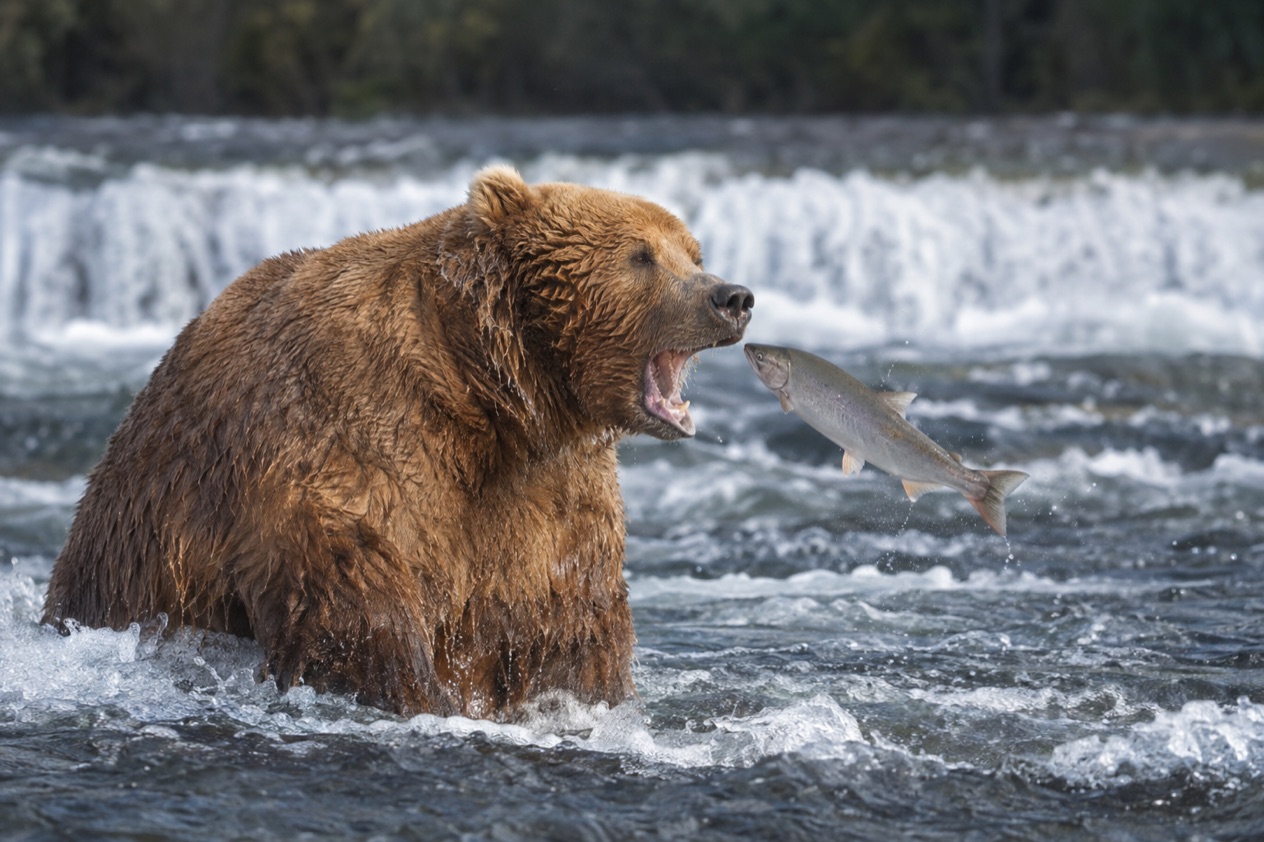
On a screen somewhere, a big brown bear stands at the lip of a waterfall with its mouth open, and a sockeye salmon drops straight into it. Thousands of people watching the livestream cheer at the same moment.
That is how most people arrive at Fat Bear Week, the autumn tournament run by Katmai National Park and Preserve, where the bears of the Brooks River are judged on how well they fattened up for winter. It is a visit you mostly make through a webcam, with Brooks Camp as the place behind it.
Is visiting Fat Bear Week worth it?
Fat Bear Week is worth your time if you like a little friendly competition mixed with real wildlife, and it suits anyone, anywhere, because the main way to take part is to vote online. There is no gate to walk through and no ticket to buy. You pick your favorite bear, watch the match-ups and follow the bracket as it narrows toward a champion.
The event is held in late September or early October, and the exact dates change from year to year. It is organized by the National Park Service and Explore.org, and the bears that qualify are those spotted catching sockeye salmon at the Brooks River.
Each day, two bears face off in a single-elimination match-up, and the one with more votes moves on. Before voting, you can look at before and after photos, read each bear’s biography and watch the livestream feeds to judge the bulk for yourself.
What sets it apart from other wildlife viewing in Alaska is that the audience is the whole country. A bear that never leaves the Brooks River becomes a character with fans, rivals and a following.
The park is home to roughly 2,200 brown bears, and the contest turns a few of them into personalities. If you want to stand on a platform above the river, that is a separate trip to Brooks Camp, and it follows a different calendar from the tournament.
What to see at Fat Bear Week
Everything in the tournament happens along one short stretch of river inside Katmai, and each part of it has its own character.
Brooks Falls
The falls are only about 6 feet high, which is why they work so well as a fishing spot. Sockeye salmon leap up them on the way to their spawning grounds in Brooks Lake, and bears position themselves at the top to catch fish in midair or pin them in the current. The viewing platforms here let people watch the river and the bears.
The bears gather mostly from July through early September, and the heaviest crowds of bears are in July. By September fewer bears are at the falls at a time, though a good number can still be seen. Watching in person or on camera, notice how each bear fishes: some stand patiently, others plunge in, and a few simply wait for a fish to come to them.
The Brooks River webcams
Live webcams sit at Brooks Falls and along the river, and they are the heart of Fat Bear Week. A 1.5-mile stretch of the Brooks River with cameras is used to identify the eligible bears. If a bear is seen catching salmon there, it can qualify for the tournament.
Watching the feeds is a slow pleasure. You may see a bear walk the bank, shake off water, nap in the grass or snatch a fish, and sometimes nothing happens for a while. Many viewers keep a feed running while they work, then check back for the next catch.
Brooks Camp
Brooks Camp sits at the mouth of the Brooks River on the shore of Naknek Lake. It is where visitors see bears, fish and learn about the human history of the area. It is also the starting point for backcountry trips in Katmai.
Every visitor begins with a brief bear safety talk that explains the park regulations. The campground, visitor center and ranger programs belong to the summer season, so the camp as a whole is quieter by the time the tournament is on.
The Valley of Ten Thousand Smokes
Daily bus tours run from Brooks Camp to the Valley of Ten Thousand Smokes, shaped by the 1912 eruption, the largest volcanic eruption of the 20th century. Katmai preserves that landscape, and most of the geothermal features there have cooled in the years since.
It is a very different Katmai from the salmon river: a valley formed by volcanic force, set among towering volcanoes. For a visitor to the camp, it is the natural companion to the bears.
Hours, tickets and rules
Voting in Fat Bear Week is open to anyone online, so there are no hours for the tournament itself. The hours that matter belong to Brooks Camp, and they end before the tournament usually begins. National Park Service services at the camp run through the summer, lodge meals and rooms stop in mid-September, and only very limited services may continue a little longer.
| Service at Brooks Camp | Open |
|---|---|
| Visitor center, ranger station, campground and auditorium with daily ranger-led programs | June 1 to September 17 |
| Brooks Lodge meals and lodging | Through September 17 |
| Very limited visitor services | May continue through September 30 |
Every visitor to Brooks Camp must start their stay with a brief bear safety talk covering park regulations. A permit is needed for any activity within the Brooks River Corridor, except redfish fishery subsistence activities.
The corridor includes the river and 50 yards from the water’s edge along the banks, from the Lake Brooks inlet downstream to the elevated bridge and boardwalk. No permit is needed for travel to or from villages or homesites within the corridor.
How to get to Fat Bear Week
To join Fat Bear Week, you only need an internet connection. Vote on the tournament site, open the livestream and read the bear biographies. No travel is involved, and that is part of why the event reaches so many people.
Getting to the bears themselves takes more planning. Brooks Camp lies in southwestern Alaska, within Katmai National Park and Preserve, and most people arrive there in small aircraft fitted with floats. The camp sits at the mouth of the Brooks River on the shore of Naknek Lake, which is where those planes come down.
From the camp, the falls and the river are part of the same landscape, with the viewing platforms reached from the camp itself. The park’s mailing address is in King Salmon, a name you will see on park material, but that address is for correspondence rather than a travel route. Once at Brooks Camp, the bus tours to the Valley of Ten Thousand Smokes also start there.
Because float-equipped aircraft are the way most visitors arrive, the trip is shaped by the sky as much as by the ground. The park describes windy, rainy and cold conditions as normal, which is worth keeping in mind when you picture a visit to the river.
When to visit Fat Bear Week
The tournament itself takes place in late September or early October, and the dates shift each year. It runs as a bracket, with one match-up a day, so the excitement builds as the field narrows toward a champion. If you want to watch live, check the schedule for the year you are in and plan to open the stream around the match-ups.
For a trip to see the bears in person, the calendar is different. Bears usually gather at Brooks Falls from July through early September. July brings the largest numbers, with up to 25 bears seen at one time, and as many as 43 have been sighted in a single day. September brings smaller numbers, with a maximum around 18 at a time.
That means the tournament comes after the peak of the in-person season. By then, the bears are heavy from a summer of salmon, which is exactly what voters are judging. The camp’s services wind down in mid-September, and only very limited services may continue to the end of that month.
Time of day matters for the livestream, too. Bears fish whenever the salmon are running, so the cameras can show action at any hour, and a morning check can bring a different scene than an evening one. Sightings are chances, never promises, so give the feed a little patience.
Tips for your visit
If you are taking part from home, make it a daily habit. Open the match-up, compare the before and after photos and read the biographies before you vote. Watching a few minutes of the livestream gives you a feel for how each bear fishes, which makes the choice more fun.
Many people follow the whole bracket with friends or family, each picking a favorite. It works well for children, who tend to enjoy the nicknames and the idea of a contest between bears. Because the viewing is online, there are no mobility concerns at all.
If you plan to go to Brooks Camp, dress and pack for changing weather, because the park says to expect wind, rain and cold. Plan on the bear safety talk as your first stop, and remember that a permit is required for activities in the Brooks River Corridor. Visitors can also fish and learn about the human history of the area.
Pair the bears with a second side of Katmai. The bus tour to the Valley of Ten Thousand Smokes shows the volcanic landscape, while the camp offers ranger-led programs during its summer season. Katmai also holds moose, foxes and sticklebacks, and more than 700 plant species have been documented in the park, so the landscape has more to it than the salmon run.
Good to know before you go
Voting costs nothing and needs no account at the park, so the only practical limits are time and a connection. Katmai protects its brown bears as a core charge, and the park contends with environmental issues despite its isolation.
If you visit Brooks Camp, remember that services end in the second half of September and that the weather is changeable, so layers matter. Whatever way you follow the bears, treat each sighting as a chance, not a promise.
Sources
- Wikipedia, Fat Bear Week (https://en.wikipedia.org/wiki/Fat_Bear_Week), checked October 11, 2026
- National Park Service, Katmai National Park & Preserve, plan your visit: brooks camp (https://www.nps.gov/katm/planyourvisit/brooks-camp.htm), checked October 11, 2026
- Wikipedia, Brooks Falls (https://en.wikipedia.org/wiki/Brooks_Falls), checked October 11, 2026
- National Park Service, Katmai nature (https://www.nps.gov/katm/learn/nature/index.htm), checked October 11, 2026