
Late in June, the evening in Fairbanks never quite ends. Ballplayers, street-fair crowds and paddlers on the Chena River carry on in a light that does not fade to dark.
When winter comes, the same town hands the sky to the aurora, and ice sculptures, dog teams and steaming hot springs take the place of the long days. Fairbanks, the gateway to Alaska’s Interior and Arctic, rewards two very different trips, one built on summer light and one on winter dark.
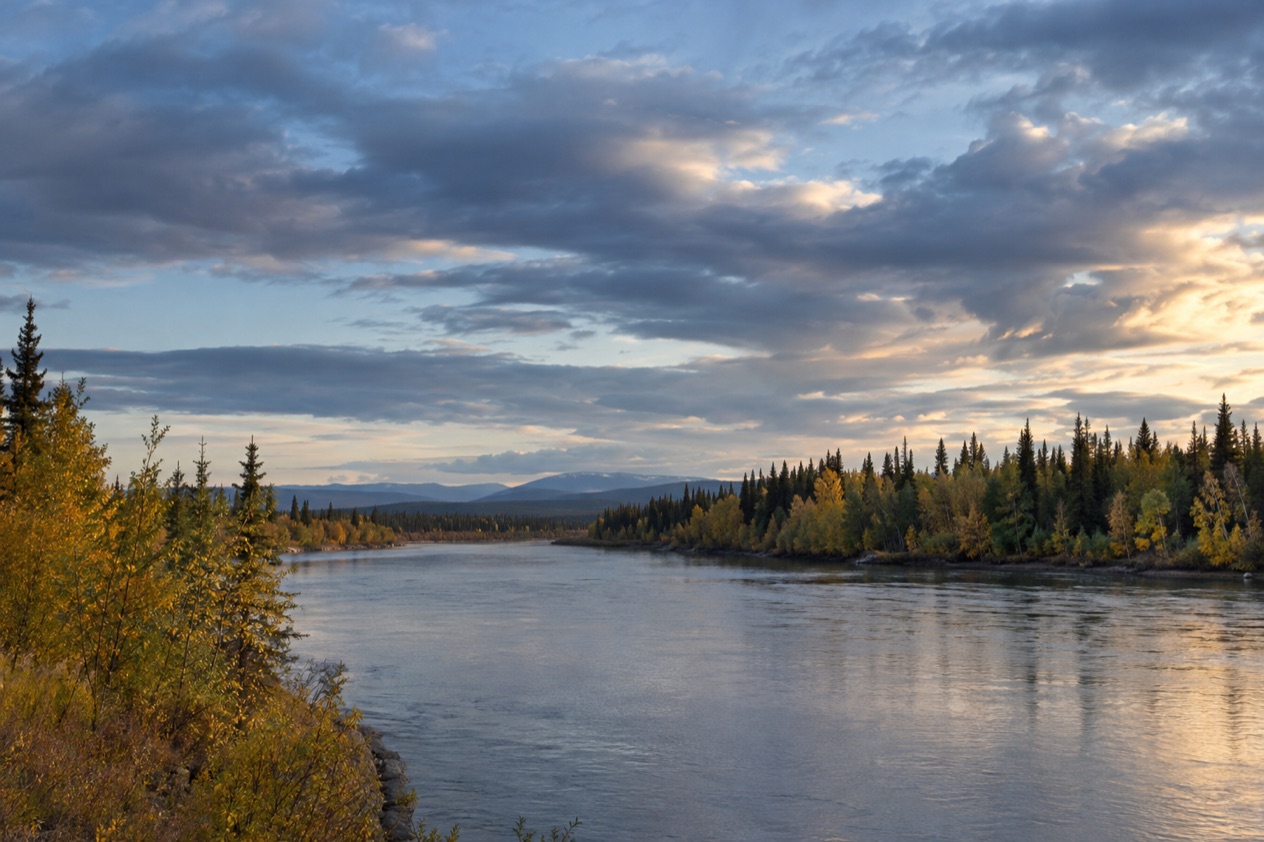
When is the best time to visit Fairbanks?
The two seasons barely overlap, so it helps to decide first what you want to see, then fit the dates to it.
For sightseeing, summer is the easy choice. The sun stays up around the clock from May 17 through July 27, which turns a day into whatever length you like: a late dinner on the river, a stroll through downtown after supper, a drive out to the Interior in what feels like mid-afternoon light at ten at night. Days are comfortably warm, and the daylight gives you room to fit in a museum, a riverboat outing and a walk without hurrying.
For wildlife and the big parks, Fairbanks works as a base. Lodges near Fairbanks sit in Denali National Park and Preserve and are scattered across the Interior and the Arctic, and local businesses can help with remote access, guiding and gear. Wildlife viewing, flightseeing and fishing are all part of what the town’s outfitters offer. Sightings are always a chance and never a promise, so build in time rather than a fixed checklist.
For the quiet seasons, the appeal is atmosphere. In the dark half of the year the town leans into dog mushing, hot springs, ice art and aurora watching, and the pace feels slower and more local.
Families tend to find summer simplest, with North Pole nearby, its Santa Claus House and the reindeer kept just outside. Winter families can still enjoy the hot springs and the Winter Solstice Celebration, as long as everyone is dressed for real cold.
Fairbanks weather by month
Fairbanks has one of the widest seasonal swings of any city in the United States, from deep winter cold to genuinely warm summer afternoons.
| Month | Average high (°F) | Average low (°F) | Precipitation (in) | Days with precipitation | Daylight on the 15th |
|---|---|---|---|---|---|
| January | 0.6 | -17.2 | 0.61 | 2.1 | 5 h 02 min |
| February | 11.6 | -11.2 | 0.52 | 1.6 | 8 h 24 min |
| March | 24.9 | -3.4 | 0.40 | 0.8 | 11 h 34 min |
| April | 45.6 | 21.7 | 0.34 | 1.2 | 15 h 03 min |
| May | 62.1 | 38.6 | 0.54 | 1.5 | 18 h 32 min |
| June | 71.8 | 50.2 | 1.48 | 4.5 | 21 h 37 min |
| July | 72.7 | 53.1 | 2.26 | 5.5 | 20 h 14 min |
| August | 66.4 | 47.6 | 2.10 | 6.1 | 16 h 42 min |
| September | 55.3 | 36.2 | 1.35 | 3.9 | 13 h 13 min |
| October | 34.1 | 18.4 | 0.76 | 2.7 | 9 h 54 min |
| November | 12.3 | -4.1 | 0.74 | 2.4 | 6 h 25 min |
| December | 4.3 | -13.0 | 0.57 | 1.6 | 3 h 52 min |
The shape of the year is simple. Summer is the warm and slightly wetter stretch, and its rain arrives as showers on a handful of days a month, with July and August the dampest.
Winter precipitation falls as snow rather than rain, and snow totals climb through the autumn and stay heavy until early spring. Layers matter most from fall through March, when mornings are far below zero in the coldest weeks, while a rain jacket earns its place in the summer bag.
Light changes the feel of every month more than temperature does. In June the sun is up from the small hours until nearly one in the morning and it never gets fully dark. By the middle of winter the sun clears the horizon only for a short, low arc around midday, so plan outdoor time around those hours and leave evenings for the aurora and the hot springs.
What is there to do in Fairbanks in each season?
Summer: long days on the river and in town
Summer in Fairbanks is built around the midnight sun, when the sun shines nearly 24 hours a day and the town stays awake with it. Activities on offer include fishing, flightseeing, wildlife viewing, gold rush history and adventure ecotours, and the Chena River is the natural center of it all.
A day can start slowly and still be full, because the light does not run out. Because the dark never really arrives, this is not the season for the aurora, which needs a night sky to show itself.
Fall and winter: aurora, snow and hot springs
As the nights lengthen the sky becomes the main attraction. Fairbanks has an aurora season, and the University of Alaska Fairbanks Geophysical Institute posts an aurora forecast on its website for planning your evenings.
Chena Hot Springs Resort adds an Aurora Viewing Tour by tracked vehicle to Charlie Dome, with heated yurts and hot drinks, and its natural hot springs are open for soaking all year, including under the aurora. The resort’s own viewing season runs from late August to mid-April.
Winter also means dog mushing, ice art, museums and other winter activities listed by local operators. Days are short, so use the middle hours for being outside and the rest for indoor stops. Fairbanks also keeps a major daytime attraction under a roof.
| Site | Open |
|---|---|
| University of Alaska Museum of the North, UAF Campus, 1962 Yukon Drive | Daily, 9 AM to 5:30 PM (admission sales close at 5 PM) |
Spring thaw
Spring comes fast. Snow still falls in April, though less each week, and the days stretch out so quickly that the light feels like a gift after winter. The aurora season is still running in the early part of this stretch, and ice sculptures stay on display around town until the end of March.
By May the town has thawed and summer services are beginning to stir. It is a time of mud, melting snow and changeable weather, but the long evenings are already back. Travelers who like the idea of seeing the end of winter and the start of the light in one trip will find the thaw rewarding.
When is Fairbanks cheapest and least crowded?
The busiest stretch of the Fairbanks year is the one built around its two big draws, the midnight sun in summer and the aurora from late summer through early spring. Those are the weeks when tours, lodges and the hot springs see the most interest, because they are what the city is known for. Midsummer, around the Midnight Sun Festival, is the clearest peak.
The quieter weeks are the in-between ones, when the town has no headline event and no spectacle on the calendar. Early spring after the ice sculptures come down, the first thaw weeks and the stretch of fall between the end of the summer fairs and the first deep snow are the times when Fairbanks feels least programmed. Locals go about their day, restaurants are calmer and you move through town at your own pace.
What that means for rooms and tours is best checked directly with a lodge or operator for the dates you want. Fairbanks offers bed and breakfasts among the birch trees, cabins, hostels, hotels and motels, lodges, campgrounds and RV parks, and vacation rentals, so there is a choice of styles in any season. Explore Fairbanks answers questions by phone at (907) 456-5774.
Which months should you avoid in Fairbanks?
No month is bad for everyone, but the wrong month can cost you the thing you came for: a summer trip will not give you an aurora, and a winter trip will not give you endless daylight.
The midnight sun season runs from April 22 to August 20, and in that window the sky does not get dark enough to see the aurora, even when it is a spectacular display. If the northern lights are the goal, skip those months.
Aurora season runs from August 21 to April 21, and a stay of at least three nights in clear weather makes a sighting highly likely. The activity is statistically about twice as strong around the equinoxes as at the solstices, so the shoulder weeks of fall and spring give you good odds.
If you want long days, sightseeing and a gentler climate, avoid November through February. Those months are for travelers who come specifically for the cold, the lights, the hot springs and the winter traditions.
The seasons of nature also set what runs. Summer-only services and winter-only activities do not overlap, so confirm that the specific tour, lodge or experience you want operates on your dates before locking in a month.
Festivals and events in Fairbanks through the year
Summer: solstice baseball, a street fair and a state fair
The Midnight Sun Festival is held in downtown Fairbanks on the Saturday closest to June 21, a free 12-hour street fair set 140 miles south of the Arctic Circle. Streets fill with food, music and booths, and everyone seems to forget about bedtime. It is a good way to see the town at its most social, and the light keeps the crowd out long after a normal evening would have ended.
The Midnight Sun Baseball Game is a national tradition played since 1906 under the endless daylight of the summer solstice, with a first pitch long past a normal evening. At the end of summer, the Tanana Valley State Fair brings a Ferris wheel under the midnight sun, carnival games and local delicacies, a classic fair with a northern twist. The World Eskimo-Indian Olympics, with Indigenous athletes competing in games such as the high kick, blanket toss and four-man carry, is another gathering that draws the community together.
Winter: solstice fireworks and ice art
The Winter Solstice Celebration takes place in downtown Fairbanks during the week of December 21, when the town marks the shortest day of the year. Fireworks light up the sky, something you cannot see in the summertime because the sky never gets dark enough. It is a good reason to come when the dark is at its deepest.
Ice art sculptures are displayed around Fairbanks from mid-February to the end of March. The cold keeps them crisp, and the lengthening days make it easier to wander outdoors and see them. That window pairs naturally with aurora watching, since the season for the northern lights is still running.
The nature seasons that frame the year
Two natural seasons frame the Fairbanks calendar more than any event. In summer, long days let you do things at hours that would be impossible elsewhere. From late summer into spring, the aurora season turns the night sky into the attraction, and the hot springs and viewing tours around Chena are built for it.
Between them sit the shoulder weeks of fall and spring, when the light is balanced and the temperatures are mild by Fairbanks standards. They are good for travelers who want to catch a little of both worlds and are comfortable with changeable weather.
Sources
- NOAA NCEI, U.S. Climate Normals 1991-2020, monthly (https://www.ncei.noaa.gov/access/services/data/v1?dataset=normals-monthly-1991-2020&stations=USW00026411), station Fairbanks Intl Ap, elevation 432 feet, checked October 11, 2026
- Computed from the date and the latitude of the place (sunrise equation, solar elevation -0.833 degrees), October 11, 2026
- Explore Fairbanks (https://www.explorefairbanks.com/), checked October 11, 2026
- Alaska.org, dest fairbanks (https://www.alaska.org/destination/fairbanks), checked October 11, 2026
- Wikivoyage, Fairbanks (https://en.wikivoyage.org/wiki/Fairbanks), checked October 11, 2026
- Wikipedia, Fairbanks, Alaska (https://en.wikipedia.org/wiki/Fairbanks,_Alaska), checked October 11, 2026
- Wikipedia, Fairbanks International Airport (https://en.wikipedia.org/wiki/Fairbanks_International_Airport), checked October 11, 2026
- Wikipedia, Fairbanks North Star Borough, Alaska (https://en.wikipedia.org/wiki/Fairbanks_North_Star_Borough,_Alaska), checked October 11, 2026
- University of Alaska Museum of the North (https://www.uaf.edu/museum/), checked October 11, 2026
- Chena Hot Springs Resort (https://www.chenahotsprings.com/), checked October 11, 2026
- Wikipedia, Chena Hot Springs (https://en.wikipedia.org/wiki/Chena_Hot_Springs), checked October 11, 2026
- Wikipedia, North Pole, Alaska (https://en.wikipedia.org/wiki/North_Pole,_Alaska), checked October 11, 2026
- Wikipedia, Ester, Alaska (https://en.wikipedia.org/wiki/Ester,_Alaska), checked October 11, 2026
- Wikipedia, Fort Wainwright (https://en.wikipedia.org/wiki/Fort_Wainwright), checked October 11, 2026
- Wikipedia, Riverboat Discovery (https://en.wikipedia.org/wiki/Riverboat_Discovery), checked October 11, 2026
- University of Alaska Fairbanks Geophysical Institute (https://www.gi.alaska.edu/), checked October 11, 2026
- Wikivoyage, North Pole (https://en.wikivoyage.org/wiki/North_Pole), checked October 11, 2026
- Wikipedia, Interior Alaska (https://en.wikipedia.org/wiki/Interior_Alaska), checked October 11, 2026
- Wikipedia, Climate of Alaska (https://en.wikipedia.org/wiki/Climate_of_Alaska), checked October 11, 2026
To plan your stay
- Things to Do in Fairbanks: Riverboat, Aurora, Chena Hot Springs and Day Trips
- Where to Stay in Fairbanks: Downtown, Birch-Wood Cabins, Chena Hot Springs and Denali Lodges
- Fairbanks from Anchorage: Denali Star Train, Road Conditions, Flights and Stops Along the Way
- Know Before You Go to Fairbanks: Midnight Sun, Aurora Season, Layers and Local Habits