
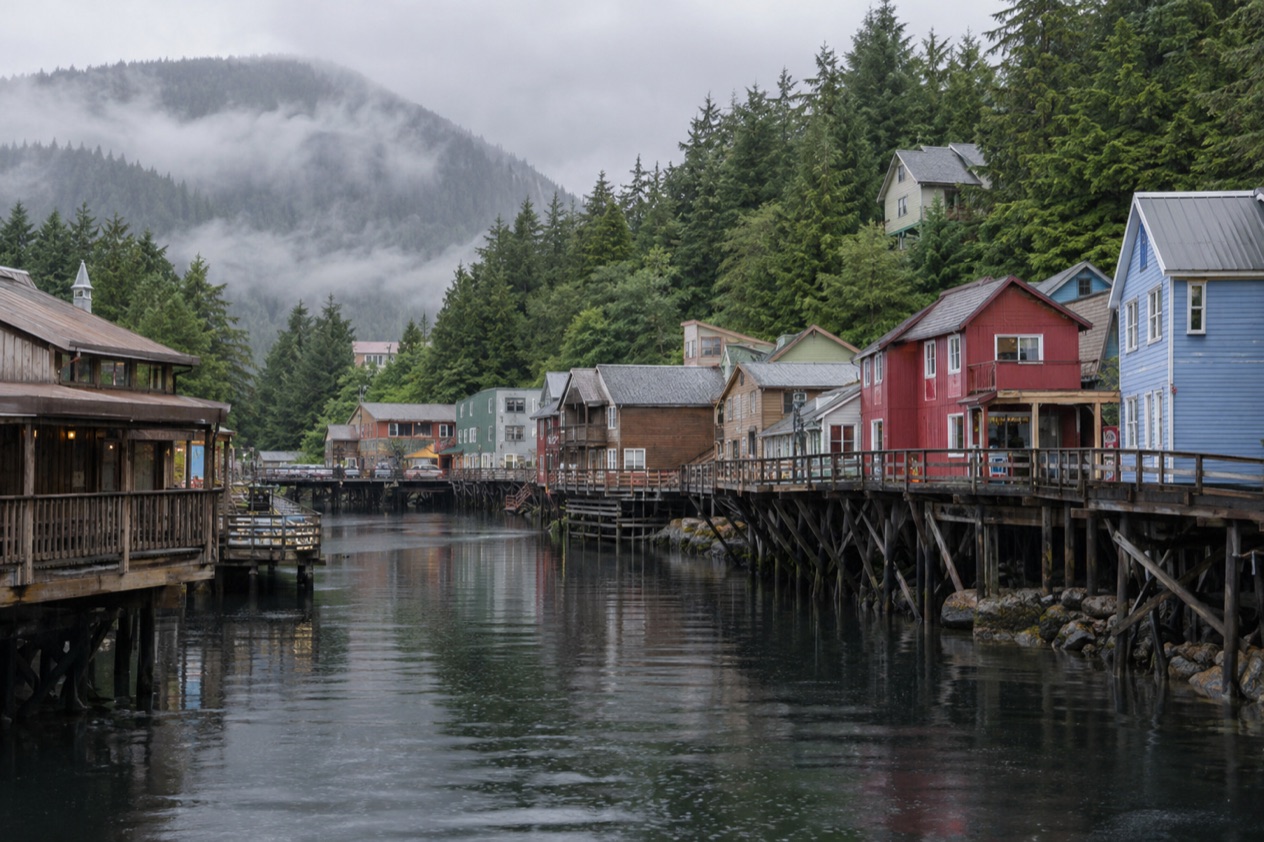
Rain taps on the boardwalk of Creek Street while salmon hold in the dark water of Ketchikan Creek, and the clapboard houses on their pilings lean over it as they have for generations. Downtown Ketchikan is the compact waterfront heart of this Southeast Alaska town, a place for walking, looking at carved cedar and old storefronts, and ducking into a gallery when the weather turns.
What is Downtown Ketchikan like?
The town sits on Revillagigedo Island in the Inside Passage, and the rainforest seems to press right up against the last row of buildings. Ketchikan has the nickname of the Rain Capital of Alaska, and the downtown streets are built for it, with covered walkways, shop doorways and museum lobbies close at hand.
The story here is salmon, timber and the people who came for both. Ketchikan became known as the Canned Salmon Capital of the World, and canneries, logging and maritime trades shaped the town’s economy and its identity.
Long before that, this was the country of the Tlingit, Haida and Tsimshian people, and their carving tradition is still the most visible thread downtown. Creek Street adds a rowdier chapter, once a red-light district for miners, fishermen and loggers, and during Prohibition a row of speakeasies.
The district suits travelers who like to explore on foot, who enjoy museums and craft shops, and who want to feel a working fishing town rather than a resort. When cruise ships are in port, the waterfront fills with visitors. Once they leave, the streets settle back into the pace of a town of about 14,000 people.
Things to do in Downtown Ketchikan
Creek Street
Creek Street is a row of historic buildings along Ketchikan Creek, and it is the picture people carry home. The houses recall the days when it served miners, fishermen and loggers as a red-light district, while today it holds quieter establishments and keeps its historic charm. You walk the wooden boardwalk, peer into small shops and galleries, and look down at the creek.
Go early or late in the day if you want the boardwalk to yourself, since the cruise-ship crowds gather in between.
Tongass Historical Museum
The Tongass Historical Museum tells the town’s story through exhibits on Ketchikan’s people, businesses and events from the late 19th and early 20th centuries. It is the place to understand how canneries, logging and the fishing fleet built the waterfront you have just walked along.
It pairs naturally with a stroll along the creek, and it is a good rainy-hour stop. Look for the details of everyday working life, which make the old photographs of the waterfront easier to read.
Totem Heritage Center
The Totem Heritage Center helps preserve and interpret totem poles of the Tlingit, Haida and Tsimshian people. Ketchikan has one of the largest collections of standing totem poles in the world, and here you can see the carvings up close and learn what the figures and families they represent mean.
Take your time reading the interpretation, since a pole seen with context is a very different experience from one glimpsed from a street corner. After a visit, the poles scattered around town become easier to read.
Southeast Alaska Discovery Center
The Southeast Alaska Discovery Center offers interactive exhibits on the Tongass rainforest, regional wildlife and land use in Southeast Alaska. It is a useful first stop if you plan to explore the Tongass National Forest or fly out toward Misty Fjords, because it sets the scene for the country beyond the town. It also suits a wet afternoon, when the forest outside is better seen through a window than on a trail.
The Great Alaskan Lumberjack Show
Near Ketchikan Creek, the Great Alaskan Lumberjack Show is performed between May and September. It is a nod to the logging trade that built the town, played out as a lively show of the old woodsmen’s skills. Beyond downtown, Totem Bight State Historical Park and Saxman Totem Park hold more standing poles, and Misty Fiords National Monument, reached by floatplane, is one of the major attractions of the area.
Eating and drinking in Downtown Ketchikan
Eating in Downtown Ketchikan starts with the water. In a town whose fame came from canned salmon, the obvious order is salmon, whether grilled, smoked or in a chowder, and the fishing heritage runs through most menus along the waterfront. Halibut and crab are the other seafood stars of Southeast Alaska, and they appear as fish and chips, sandwiches and plates of steamed shellfish.
The district holds the kinds of places you would hope for in a small port town: casual seafood shacks and counters near the docks, cafés where you can warm up with coffee after a wet walk, and bars with a fishing-town crowd. Creek Street and the streets around the museums are good hunting grounds for a sit-down lunch, and the shops that sell locally made goods often sell smoked fish and jams to take home.
A good rhythm is a coffee and pastry in the morning before the crowds, a bowl of chowder in the middle of the day while the rain passes, and a slower seafood dinner once the ships have sailed. Evenings downtown are quieter, so a table at a local place feels like a visit to the town itself rather than to a tourist street.
If you have been out on a fishing charter, you may have a catch of your own to think about.
Staying in Downtown Ketchikan
Downtown is the base for travelers who want to walk to everything: the creek, the museums, the galleries and the waterfront. Staying here means you can step out for a morning coffee, spend the day on foot, and return to your room without needing transportation at all, which suits visitors without a car.
Lodging in a small historic town tends toward inns, bed-and-breakfast style rooms and hotels near the waterfront, and the atmosphere is that of a working port. Evenings are quiet compared with the daytime bustle, though the waterfront can be lively when ships are in. Ketchikan’s cruise season runs from early May through late September, and in those months the streets fill during the day.
Compared with places farther out of town, downtown puts you closest to the museums, the shops and the departure points for tours, including floatplane flights to Misty Fjords, wildlife and sightseeing tours and fishing charters. The Alaska Marine Highway ferry terminal lies about 2 miles north of downtown, so arriving by ferry means a short transfer before you are in the heart of town.
Rain is part of the deal in a place that sees just over 160 inches a year, so a base within walking distance of indoor stops makes the days easier. Pack for wet weather and let the town’s covered corners and cafés do the rest.
Getting to Downtown Ketchikan
Ketchikan lies on Revillagigedo Island in southernmost Southeast Alaska, 700 miles northwest of Seattle, Washington. Ketchikan International Airport has Alaska Airlines nonstop jet service to Seattle, Juneau, Sitka and Wrangell, and that is how visitors arrive from the Lower 48.
The other way in is by water. The Alaska Marine Highway ferry from Ketchikan to Bellingham, Washington takes thirty-six hours, and the ferry terminal sits approximately 2 miles north of downtown.
Once you are downtown, walking is the way to see it. The district is easy to walk, with historic buildings, galleries and shops all close together, and most of what is described here can be reached on foot. Tours to the Tongass National Forest, floatplane flights and wildlife outings all start from Ketchikan.
Good to know before you go
Pack a rain jacket whatever the month, since Ketchikan is one of the rainiest cities in North America. Cruise-ship days bring the biggest crowds from early May through late September, and the Great Alaskan Lumberjack Show runs between May and September. Outside those months, the town is quieter and some seasonal attractions are not operating.
Sources
- Visit Ketchikan (https://www.visit-ketchikan.com/), checked October 11, 2026
- Wikivoyage, Ketchikan (https://en.wikivoyage.org/wiki/Ketchikan), checked October 11, 2026
- Wikipedia, Ketchikan, Alaska (https://en.wikipedia.org/wiki/Ketchikan,_Alaska), checked October 11, 2026