
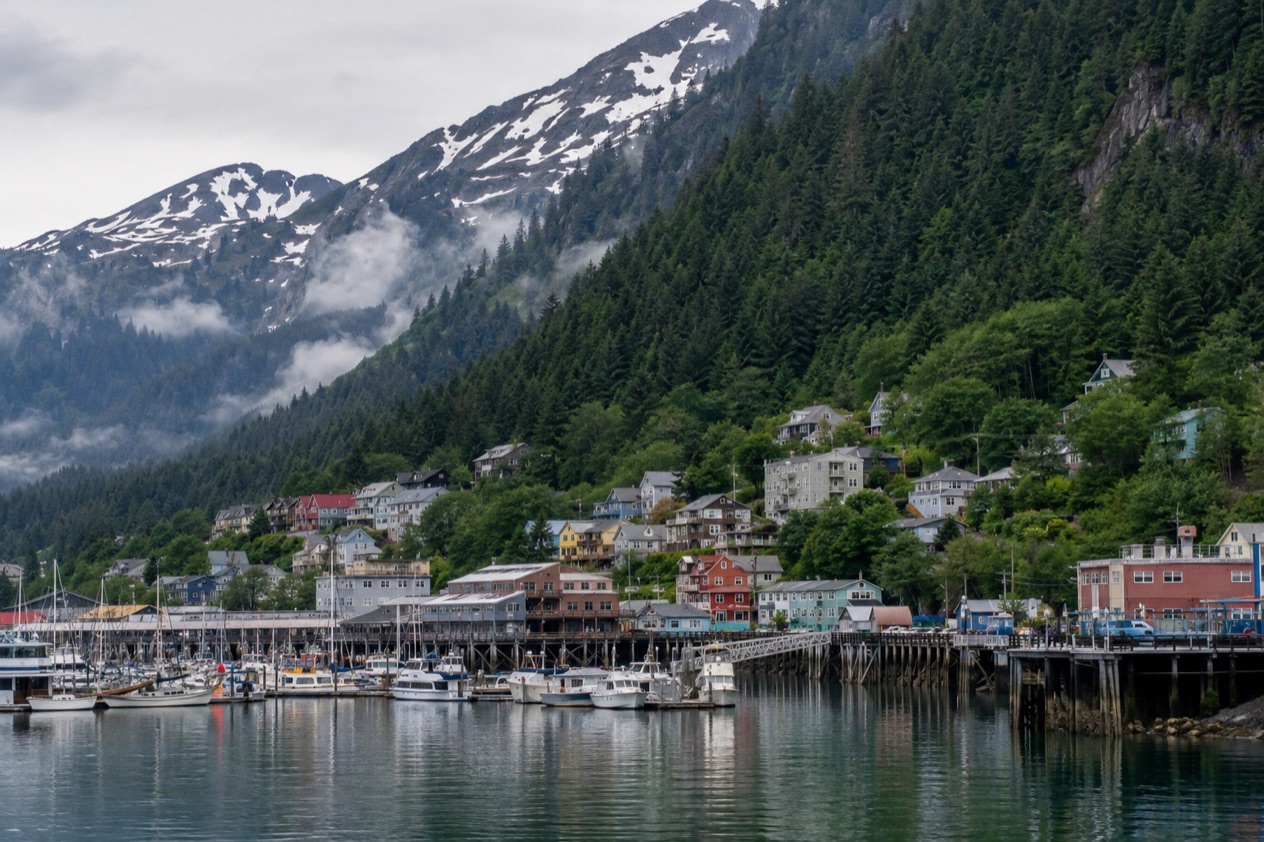
On a cruise-season morning, the downtown waterfront in Juneau fills with the sound of footsteps on the boardwalk, gulls over the docks and tram cars sliding up into the clouds on Mount Roberts. Behind the shop fronts, the steep green slope of the Tongass rises almost to the end of the street. Downtown is the part of Alaska’s capital where government, history, harbor and rain forest sit within a few blocks of each other.
What is Downtown Juneau like?
Downtown Juneau is a compact waterfront district squeezed between the Gastineau Channel and a mountainside, part working capital and part port of call. The historic district is small and walkable, and its sights sit close together, so you can drift from a government building to a gallery to a harbor view without a plan.
The setting shapes everything. Juneau lies in the Tongass National Forest, the largest temperate rain forest in the world, and the trees come down nearly to the sidewalks. The city has no road connecting it to the rest of Alaska or to the Lower 48. Everything arrives by plane or boat, which gives downtown the feel of an island town even though it sits on the mainland.
The story here is about politics as much as gold-rush days. Juneau became the capital in 1906, when the government moved from Sitka, and it is the only state capital that borders a foreign country. Lawmakers fill the streets during the legislative session, which runs from January into spring. In summer the crowd changes, because cruise ships bring a tide of visitors every day from May through September.
The district suits people who like to explore on foot, who enjoy museums and galleries, and who want a glacier, a mountain and a good meal within reach of a single base. It is also a place with a quieter, more reflective side, including a memorial park that recalls a painful chapter of the war years.
Things to do in Downtown Juneau
The Alaska State Capitol
The Capitol began life as the Federal and Territorial Building, and its stately, columned look still says more government office than statehouse. It was built in 1931, and inside you can walk the halls where the state’s business is done. Part of the interest is how modest and approachable it feels, with the mountain pressing in just behind.
Another good reason to stop is the state flag. A 13-year-old Alaska Native student named Benny Benson won the 1927 contest to design it, with the Big Dipper and the North Star. The constitution’s drafters made it the official state flag in 1959. It is a story worth knowing before you look at the flags flying along the street.
| Site | Open |
|---|---|
| Alaska State Capitol (self-guided tours) | Monday through Friday, throughout the year |
The Goldbelt Tram and Mount Roberts
The tram starts at the downtown waterfront at 490 S. Franklin Street, at the cruise ship dock. The cars climb 1,800 feet through the rain forest to the Mountain House, and the view opens wider with every minute, taking in the town, the Gastineau Channel and the mountains beyond.
At the top, trails lead out across Mount Roberts, including one to a sub-alpine meadow with a 360° view. A full-service restaurant and bar, Timberline Bar & Grill, overlooks Juneau and the Inside Passage if you want to sit with the scenery. Tram hours change from day to day and can shift with weather on the mountain, so the weather decides whether the ride happens as planned.
The historic district on foot
Walking is the point of the historic district. The streets hold shops, restaurants and art galleries, and the city has many rotating museum galleries, so the exhibits you find may differ from one visit to the next. Between stops you pass working docks, stairways climbing the hillside and views over the water.
If you want a reason to time your visit, the city’s annual events bring the historic district to life, and the Events Calendar lists spontaneous happenings as well. A slow loop with no fixed destination often turns up more than a checklist.
Capital School Park and the Empty Chair Memorial
Capital School Park holds the Empty Chair Memorial, dedicated in July 2014. It remembers the removal of Juneau’s Japanese community during World War II, and the empty chair itself is the symbol. It is a quiet stop in a district otherwise busy with sightseeing, and it adds a human note to the capital’s history.
Also tied to the city’s story is the Alaska Governor’s Mansion, which held its first open house for citizens on January 1, 1913. The Shrine of St. Therese also holds Sunday Mass at 1:30PM from Memorial Day through Labor Day, if a service fits your plans.
Within reach of downtown, the Mendenhall Glacier lies 13 miles away and can be reached by driving directly to it. Wildlife tours, fishing trips and small-plane or helicopter landings on a glacier for hiking or dog-sledding all start from Juneau as well.
Eating and drinking in Downtown Juneau
Downtown is where Juneau’s restaurants cluster, and eating well here usually means sitting down to something from Alaska’s waters. Juneau is a fishing town, with fishing trips among the things visitors do, so seafood is a natural thing to look for on a menu. Salmon and halibut are the fish most associated with Southeast Alaska, and crab is another common sight.
The restaurants and galleries share the same walkable streets, which makes a meal part of the stroll. A late lunch after the Capitol, then a walk along the waterfront, fits the rhythm of the district. Cafés suit the cool, damp days that the rain forest setting brings, when a hot drink and a window seat are the right plan.
Dining with a view at the top of the tram
The one place by name is Timberline Bar & Grill, a full-service restaurant and bar at the top of the Goldbelt Tram. It overlooks Juneau and the Inside Passage, so the setting matters as much as the plate. Pairing a hike on the Mount Roberts trails with a meal here makes a natural outing.
Because the tram runs by weather and its hours vary by day, plan the meal around the ride rather than the reverse. On a clear day the view from the table stretches across the channel, and on a cloudy one the clouds themselves become the scenery.
Bars and evenings downtown
Downtown has bars and restaurants where the capital’s residents gather. During the legislative session, lawmakers and staff are part of the crowd, and in cruise season the streets are lively through the day. After the ships leave, the mood settles and the waterfront feels more like a small town. Evenings are for a slow dinner and a walk past lit shop windows.
Staying in Downtown Juneau
Downtown suits travelers who want to walk to the Capitol, the galleries, the restaurants and the tram without arranging transport. With a small and walkable historic district, a base here keeps the main sights close at hand, and the waterfront is the natural starting point for most plans.
The trade-off is crowds. Between May and September, Juneau receives a daily influx of 16,000 people or more from cruise ships, and the downtown streets and the tram base are where that tide arrives. Mornings and late afternoons around the docks feel busiest, and the district settles once the ships depart.
The legislative session, from January to April or May, brings its own visitors, so downtown has a working, political energy in those months. Outside both seasons the district has a calmer, local feel.
Compared with other parts of Juneau, downtown is the place for walking and sightseeing. The Mendenhall Glacier lies 13 miles away, and the ferry terminal sits in Auke Bay, so staying in either area makes sense if the glacier or the ferry is the main plan. For a first visit centered on the capital, the museums and the mountain, downtown is the straightforward choice.
Getting to Downtown Juneau
Juneau cannot be reached by road, so you arrive by air or by sea. The city sits on the North American mainland, yet no highway links it to the rest of Alaska or the contiguous United States. Juneau is also the Alaska city closest to the Lower 48, which the visitor bureau describes as making it reachable any time of year.
By air and by ship
The airport is near the Mendenhall Glacier, which gives a sense of how the city is laid out, with the airport and the glacier on the road system and downtown on the waterfront. Cruise passengers step off at the dock in downtown, right where the tram begins.
Ships bring thousands of people each day from May to September. The waterfront at the base of the tram cables is the center of that arrival, so downtown is the place where the cruise season is most visible.
By ferry
The Alaska Marine Highway System ferry terminal is in Auke Bay, 13.8 miles from Juneau on Glacier Highway. Ferries run regularly throughout Southeast Alaska, so the terminal links the city to the other towns of the Inside Passage.
The closest port with a road connection is Haines, about a five-hour ride on a regular ferry or a two-hour ride on a catamaran ferry. That crossing is how travelers link Juneau to the road network.
Once you are downtown
Downtown itself is for walking. The historic district is small, the Capitol and the tram base are within the same stretch of waterfront, and the sights sit close together. A visitor review on the tram’s page mentions cars about every five minutes, though that is not an official schedule.
Good to know before you go
Many sights depend on weather and season. The tram runs on hours that vary by day and can change when conditions on the mountain turn bad, and the wildlife months run from April through November, when bears, bald eagles and humpback whales are most likely to be seen.
The Capitol tours run Monday through Friday, so plan a weekend around the waterfront and galleries instead. In cruise season downtown is at its liveliest, and outside it the district is quieter.
Sources
- Travel Juneau (https://www.traveljuneau.com/), checked October 11, 2026
- Wikivoyage, Juneau (https://en.wikivoyage.org/wiki/Juneau), checked October 11, 2026
- Goldbelt Tram, Juneau (https://mountrobertstramway.com/), checked October 11, 2026
- Wikipedia, Juneau, Alaska (https://en.wikipedia.org/wiki/Juneau,_Alaska), checked October 11, 2026